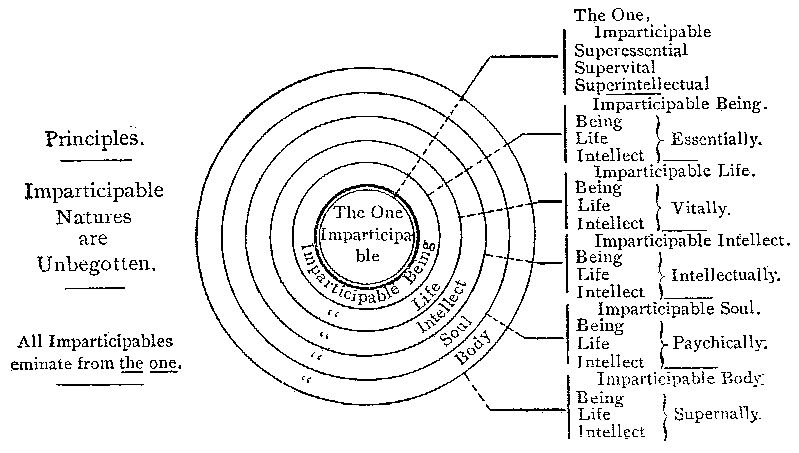
Every thing which is united is different from The One itself.
 
For if it is united it will participate in a certain re­spect of The One, so far as it is rightly said to be united. That, however, which is a participant of The One is both one and not one. But The One itself is not both one and not one: for if this was so, again the one which is in it would have both of these, and this would take place ad infinitum, if there was no One itself at which it is possible to stop; but every thing being one and not one, there will be something united, which is different from The One. For if The One is the same as the united, it will be infinite multitude. And in a similar manner each of the things of which the united consists will be infinite multitude. Every thing, there­fore, which is united is different from The One itself.

COMMENTARY

To "be united" is to be a unity, or a one, which consists of parts joined together in a whole. Anything which has parts-- no matter how totally united those parts might be-- is not the same as the One. 

This proposition continues to deal with a topic with which we're already familiar. Everything which is not The One itself is different from the One. This has important implications, though, both for Proclus's theology and for any sort of tradition which wishes to make use of Proclus.

In the Platonic Theology, Proclus tells us that the First God-- which is to say, the One-- is not the leader of a Triad. This is important, because every other God who puts in an appearance is triadic. The first God is the One, and is entirely one, alone, and simplex; but immediately after the One we have the appearance of the Intelligible Triad:

Being-Life-Intellect.

This is also the first God with whom we can have any kind of relationship as we understand it. Every deity subsequent to the first can be approached by the rites of theurgy; the First God is worshiped "by silence alone." 

If one is willing to take seriously both the claims of pagan Platonists like Proclus and those of Christian theologians, it becomes apparant that the Holy Trinity as it is normally understood either is not God Himself, or else needs to be seen as the outward face of a God who is inwardly totally simple and undivided. 
 Every thing which becomes one, becomes so by the partici­pation of The One, and is one so far as it experi­ences the participation of The One.
 
 
For if the things which are not one become one, they doubtless become so by a harmonious alliance and association with each other, and experience the presence of The One, though they are not that which The One is. Hence they participate of The One, so far as they allow themselves to become one. But if they are already one, they will not become one: for that which is, does not become that which it already is. But if they become one from that which was previously not one, they will possess The One, since a certain one was ingenerated in their nature. [And this ingenerated one must be de­rived from The One itself. Everything, therefore, which becomes one, becomes so by the participation of The One, etc.]


Or: 

For if things which are not one become one, they doubtless become so by a conjunction and communication with each other, and they sustain the presence of The One, not being that which The One itself is. Hence, they participate of The One so far as they suffer to become one. For, if they are already one they will not become one; since that which is does not become that which it is already. But if they become one from nothing, i.e., from the privation of The One, since a certain one is ingenerated in them, The One Itself is prior to them. [And this ingenerated one must be derived from The One Itself. Every thing, therefore, which becomes one, becomes so through the participation of the One, etc.]

COMMENTARY

The subject of today's proposition is "becoming one." It has two basic components. First, things which become one do so by participation in the One itself. Second, oneness is a matter of degree, with the degree of oneness indicating the degree of participation in the One.

So things become one by participating in The One itself. How is this done? 

By disparate things uniting with one another. 

Now we have our first indication of an important concept in Neoplatonic thought-- nothing. In the Taylor translation, which is the second one I posted, "if they become one from nothing, i.e., the privation of The One..." 

From this, again, we learn two things. First, "nothing" has a kind of existence; its existence is the privation of the One. But what is this nothing? It is that concept of fragments of fragments of fragments, endlessly divided and united by nothing at all. This is the primordial chaos. What is interesting about this concept is that it has a claim to a kind of eternity, just as the one is eternal. That is because, on the one hand, it is the source-substance of all things other than the One Itself, but, being nothing, it is also necessary uncreated. We could see it as just as eternal as the One. Proclus circumvents this, by teaching us that the One, which is the ordering principle, is necessarily prior in an ontological sense to the chaotic multitude. 

Notice that in modern thought, order and oneness are secondary and deriviative principles, and Chaos is the first principle. The primordial chaos is also linked to the Dyad in Pythagorean thought, and is also the unformed Prime Matter. "Materialism" as a philosophy is well named, and can be seen as nothing less than the worship of Chaos. 

SPECULATION

It is this chaos that is certainly meant by the opening lines of the Book of Genesis:

The Earth was without form, and void; and darkness was upon the face of the deep. And the Spirit of God moved upon the face of the waters.

In ancient near-Eastern thought, the primordial chaos is often represented as the Sea, and personified in the form of a great sea-monster. The oldest creation-myths of this region have the creator-God bringing order through force, literally killing the great Sea Monster. This notion is also preserved in the Bible, i.e., 

Thou didst divide the sea by thy might;
    thou didst break the heads of the dragons on the waters.
Thou didst crush the heads of Leviathan,
    thou didst give him as food for the creatures of the wilderness.
 

Plato's Timaeus is a kind of philosophical myth, a re-writing of the ancient creation stories in a more rational form. In the Timaeus, the act of creation is a straightforward act of applying order to chaos, which is to say, of bringing unity to multitude. Genesis appears to be the same type of thing, probably written under the influence of the Platonists. This is more comprehensible, closer to the reality of the situation-- but far less dramatic. Sometimes it's more fun to think of Chaos as the many-headed dragon dwelling in the primordial waters, and to think of one's inward journey of growth and development as a battle against titanic forces.  
Everything which participates in The One is alike one and not one. 

For though it is not The One itself — since it partic­ipates of The One and is therefore other than it is — it experiences The One through participation, and is thus able to become one. If therefore it is nothing besides The One, it is one alone, and will not participate of The One but will be The One itself. But if it is something other than The One, which is not The One but a par­ticipant of it, it is alike one and non-one, — one being, indeed, since it partakes of oneness, but not oneness it­self. This therefore is neither The One itself, nor that which The One is. But, since it is one and at the same time a participant of The One, and on this account not one per se, it is alike one and not one, because it is something other than The One. And so far as it is multiplied it is not one; and so far as it experiences a privation of number or multitude it is one. Every thing, therefore, which participates of The One is alike one and not one.
 
 
COMMENTARY

This is straightforward enough. Every thing which participates in the One-- which is to say, every thing that we can experience-- is both one and not one. That's all of us. But-- and I think this critical-- no particular being is the One Itself.

The easiest way to understand the Platonic ideas-- easiset for me, at any rate-- is to think of color. Imagine a red cup on a red table next to a red couch. All of these are red objects; none of them is the color red itself. Indeed, if the color red were to somehow appear, it wouldn't actually be Red Itself, but would be yet another red object. Redness as such is outside of the series of red objects. In the same way, the One Itself is outside of the series of particular ones-- no matter how unified they may be.

SPECULATION

Replace "One" with "God" and we can draw two very important points regarding theology. By the way, this substitution doesn't place us outside of the tradition of Proclus himself. In his Platonic Theology, he also calls the one "God" and "the First God."

1. Every particular being is able to become One, which is to say, to unite its being to God. But at any given moment, all beings will be ordered from most-united-to-God to least-united-to-God. On the other hand, this is a progression which can never end, because even the most exalted of particular beings is not the source of being, anymore than the most vividly red object is the color red itself. Therefore our journey upward toward unity with God will continue forever.

2. Even the most exalted of Gods is not God Godself, who is entirely transcendant. This is why worship is directed at the highest of the gods, but the First God, as Proclus tells us, is honored only by "silence." This silence is the silence of deep meditation, which is a higher thing than theurgic ritual, as Porphyry knew. In Christian terms, the ways of Centering Prayer and Hesychasm are, therefore, necessary higher than the Eucharistic rites-- but it is through the Eucharistic rites that one must come to know God as He is encountered in the silent modes of prayer. But the First God being absolutely transcendant, the way to him is unending and cannot be contained by any one particular tradition.
 
Every multitude participates in some respect of The One.

For if it in no way or degree participates of The One, neither will the whole be one, nor each of the many things from which multitude arises, but each mul­titude will originate from certain or particular things, and this will continue ad infinitum. And of these in­finites each will be again infinite multitude. For, if multitude partakes in no respect of any one, neither as a whole nor through any of its parts, it will be in every re­spect indeterminate. Each of the many, whichever you may assume, will be one or not one; and if not one will be either many or nothing. But if each of the many is nothing, that likewise which arises from these will be nothing. If each is many, each will consist of infinites without limit. But this is impossible. For there is no being constituted of infinites without limit, since there is nothing greater than the infinite itself; and that which consists of all is greater than each particular thing. Neither is any thing composed of nothing. Every mul­titude therefore partakes in some respect of The One.


Commentary: 

As Thomas Taylor promised us, we begin in absolute Unity. The first proposition concerns the One and its relationship to the Many. This very topic is the subject of Plato's Parmenides, which is both his most difficult dialogue, and the dialogue that was read last in the Platonic schools of antiquity, as it is concerned with the most exalted subjects. (It's also the dialogue that modern thinkers have the most trouble with, with some seeing it as an attack by Plato on his own ideas, which it is not, and others throwing up their hands in frustration or declaring it one big joke!) 

In the Platonic understanding of the universe, the One is the first principle of existence, that by virtue of which anything else exists at all. Although it might seem backward to begin with such a lofty topic and one so far removed from our daily affairs, Proclus is actually doing us a favor here and giving away the answer to a difficult problem. The relationship of the one to the many is one of the great puzzles of philosophy. If the One exists, how can anything exist outside of it? If the many exist, how can there be any kind of unity?

Proclus gives us the answer here, and at time same time introduces us to the Platonic way of thinking about these things. "Every multitude participates in a certain respect of the One." That is: If you have any multitude, or group of things, you must have some form of unity as well. Otherwise, each component part of the multitude will itself be consist of nothing but an infinite number of component parts, with nothing to unite them. Indeed, you won't even be able to call them "parts," because parts are parts of a whole, and without the One, there is no whole-- no one thing. There are only fragments of fragments of fragments, unto infinity. Instead, each individual part of any multitude of things participates in the One-- it has some measure of unity, oneness, wholeness. But not the One itself, or the One in its entirety-- because then it would be unable to be a separate thing, different from others. 

Speculation:

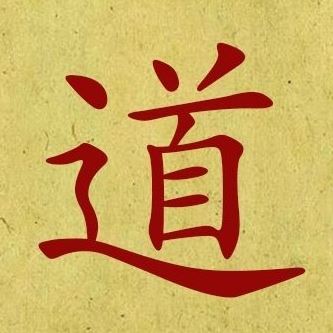
The One is the name for the first principle in the Platonic tradition-- the One, and also, the Good. But there are other philosophical traditions which also know the First, but by a different name. The Christian tradition-- in its Catholic and Orthodox forms, at least-- borrows many of these ideas, but applies them to God. The Chinese tradition uses the word "Tao" in the same way as the Christians use "God" and the Platonists use "One." One of the ideas which I have drawn from John Michael Greer is that in the Druid tradition, the Welsh word "Awen," which refers to poetic inspiration, can also be a name for the First Principle of thing. 

What happens when we exchange some of these other names for the word "One"? 


Let's try it and see. 

"All creatures participates in a certain degree of God."

Suppose this to be the case, and suppose that, by "God," we mean precisely what the Church means when it prays "I believe in one God, the Father Almighty, creator of Heaven and Earth." 

If this is the case, then several other things immediately follow: 

1. God is always present to all of his creatures, because their very existence is sustained by their participation in Him.

2. If that's the case, then nothing in the universe is wholly deprived of God. Not even devils, and not even Hell. 

3. If it is also the case that-- as the tradition suggests-- by deliberate activity one may increase one's participation in God, this suggests both that universal salvation is probably true, since God is present to everything. Moreover, since God himself cannot be divided, God in His entirety is present to everything, even the Damned, even the devils, and that, therefore, anyone or anything in the cosmos my ultimately be united to Him. This also gives us a more useful way to understand the old formula, "Christ became man that men might become gods." 

"All beings participate in a certain degree of the Awen." 

Awen is a kind of poetic inspiration. Its presence to all things makes all things a kind of song or poem. This is a very fine way to look at a human life: Each of us is capable of becoming a true divine song. Our trouble, often, is that we are out of tune, in the wrong key, inharmonious. Our work, then, is to restore harmony within ourselves, and also our harmony to the larger creation of which are are a part. 

"All ways participate in a certain degree of the Way."

The Taoist way of looking at things is processual. If the first principle is a path or Way, everything can be seen as a kind of activity or journey. This allows for a more dynamic and relational way of approaching the cosmos. One of the great virtues of the Taoist tradition is its approach to politics, which is very hands-off, relaxed, and libertarian. It makes a strong contract to the control-freakery that one often sees in even the best Western thinkers, even in Plato himself. I'm going to do a post at some point called "Platonic Ends, Taoist Means" making the case that the Taoist method provides a very useful way of approaching Platonic ideas about both society and, more importantly, the soul. 

In the meantime, it's worth noting that the first chapter of the Tao Te Ching reads a lot like Proclus's first proposition translated into Taoist


The Elements of Theology is one of the great works of Proclus, the last great pagan philosopher of antiquity. Like most of Proclus's works, it's dense, difficult, and very hard to read unless one has a grounding (as did Proclus himself) in the work of Plato and Aristotle both, as well as the later philosophers in the tradition, such as Plotinus and Porphyry. Unlike Proclus's other works, however, the Elements is divided into brief, manageable chunks. The work consists of 211 propositions, which, taken together, are intended to constitute the whole of Platonic philosophy. As Thomas Taylor tells us in the introduction to his 1792 English translation of the work,

They begin from super-essential Unity, and proceed gradually through all the beautiful and wonderful progressions of divine causes, ending in the self-motive energies of the soul. They possess all the accuracy of Euclid, all the subtlety and sublimity necessary to a knowledge of the most profound theology, and may be considered as bearing the same relation to the Pythagoric and Platonic wisdom, as Euclid's Elements to the most abstruse geometry.
As Taylor's introduction suggests, Proclus's way of reasoning can seem backward to the modern mind, as it is always his method to begin with the highest and most abstract concepts and only from there descend, one degree at a time, to the world of our experience. Starting today and concluding, let us hope, 211 days or more from now, I'm going to work through Proclus's propositions one at a time, beginning, as Taylor says, in the super-essential Unity, and proceeding to the self-motive energies of the soul.

Proclus wrote in Greek, which is a language that I can read only with great difficulty. Rather than trying to bang my head through the original text, I'm going to make use of multiple English translations. Thomas Taylor's 1792 translation is online here; Thomas Johnson's 1909 translation is here; and a more recent translation by the Noetic Society is here.


Born Before Heaven and Earth


Laozi said,

There is something, an undifferentiated whole, that was born before Heaven and Earth. It has only abstract images, no concrete form. It is deep, dark, silent, undefined; we do not hear its voice. Assigning a name to it, I call it the Way.

The foregoing is from an ancient Chinese scripture called the Wenzi, or Understanding the Mysteries. Wenzi, "Master Wen," was reputed to have been a student of the more famous Laozi, the author of the Tao Te Ching. These days, Modern Scholars have discovered that neither of these men existed, and could not have authored the texts attributed to them. Those of us who are not cursed with the intelligence of Modern Scholars are dumb enough to know that existence isn't limited to physical incarnation, nor authorship to an individual committing his thoughts to writing. That's beside the point, however. 

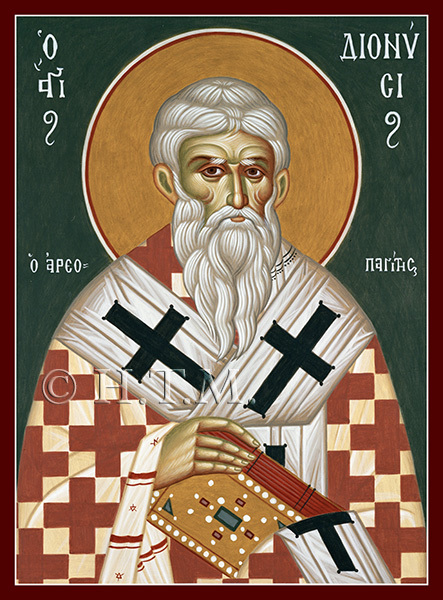
Dionysius the Areopagite is another great sage whose existence has been rejected by Modern Scholars; indeed, one could say that Modernity itself begins in the rejection of Dionysius. Here is what he says about God, in his Mystical Theology:

 
We maintain that it is neither soul nor intellect; nor has it imagination, opinion reason or understanding; nor can it be expressed or conceived, since it is neither number nor order; nor greatness nor smallness; nor equality nor inequality; nor similarity nor dissimilarity; neither is it standing, nor moving, nor at rest; neither has it power nor is power, nor is light; neither does it live nor is it life; neither is it essence, nor eternity nor time; nor is it subject to intelligible contact; nor is it science nor truth, nor kingship nor wisdom; neither one nor oneness, nor godhead nor goodness; nor is it spirit according to our understanding, nor filiation, nor paternity; nor anything else known to us or to any other beings of the things that are or the things that are not; neither does anything that is know it as it is; nor does it know existing things according to existing knowledge; neither can the reason attain to it, nor name it, nor know it; neither is it darkness nor light, nor the false nor the true; nor can any affirmation or negation be applied to it, for although we may affirm or deny the things below it, we can neither affirm nor deny it, inasmuch as the all-perfect and unique Cause of all things transcends all affirmation, and the simple pre-eminence of Its absolute nature is outside of every negation- free from every limitation and beyond them all.

Dionysius elsewhere calls it the Divine Darkness, and he tells us:
 
By the unceasing and absolute renunciation of yourself and of all things you may be borne on high, through pure and entire self-abnegation, into the superessential Radiance of the Divine Darkness.

And Wenzi says,
 
It is so ungraspable and undefinable that it cannot be imagined; yet while it is undefinable and ungraspable, its function is unlimited. Profound and mysterious, it responds to evolution without form; successful and effective, it does not act in vain. It rolls up and rolls out with firmness and flexibility; it contracts and expands wityh darkness and light.
 
Wenzi and his master Laozi call it the Way; Dionysius and his predecessors call it God. Proclus and Plotinus will call it the One. Did Plato call it the One or God? Argue amongst yourselves. 

It's clear to me that these two great and nonexistent masters were discussing the same thing in very nearly the same words, but the name they give it differs. The name matters: Approaching it as One, approaching it as the Way, approaching it as God, and you will follow a different path to it. But I believe that when you arrive at it, or as close as you can get to It, all names will have long since fallen away. 


Creation

In Barddas, we read the following account of the Creation of the Universe, which is also an account of the creation of letters, and of music:

God, when there was in life and existence only Himself, proclaimed His Name, and co-instantaneously with the word all living and existing things burst wholly into a shout of joy; and that voice was the most melodious that ever was heard in music.
 
Parmenides

In the school of Iamblichus, one's education in the philosophy of Plato was crowned with two dialogues, the Timaeus and Parmenides. Timaeus, it was said, is concerned with physics, Parmenides with metaphysics. The bulk of Timaeus is occupied with a mythical account of the creation of the Universe by God-- what the eponymous character, a Pythagorean named Timaeus, calls "the likely story." The bulk of Parmenides, meanwhile, is occupied with a discussion of the nature of the One, or the First Principle of existence, by its own eponymous character, the Eleatic philosopher Parmenides.

The discourse of Parmenides on the One consists of eight hypotheses, each of which considers the implications either for the One or the Many (that is, the others, everything besides the First Principle) if the one either exists or does not exist. Here are the first three:

Hypothesis 1: If One. Yes, that sentence lacks a verb. The first hypothesis considers the One on its own. If anything at all can be said of the One, including its existence or nonexistence, then the One is no longer the One. This is because anything we might say about it adds something to it. Even if we say "The One exists," then we already have two terms: "The One" and "exists." Or, "Oneness and "Existence," or "One" and "Being." The One of the First Hypothesis is simply One. Thus we see that the First Principle is above even existence. That is why it is simply called "The One," and even to say this is to say immeasurably too much.

Hypothesis 2: If the One is. The moment the One exists, we have two terms, which we can call The One and Existence or Being. But we will see that if we look at each of these, they also contain two terms: The One which is has both oneness and being; the being of the One which is has both being and oneness; the oneness of the being of the One that is has both being and oneness; and so on, unto infinity. Thus the very moment the One comes into being, infinity also comes into being, and every possibility down to the last of things. To say it another way:

Hypothesis 3: Consequences for the Many if the One is. If the One is, then the Many will become One, both entirely and individually. That is: lacking oneness, the many have in no way any identity, because to be anything is to be one thing, and, in the absence of the One, there is no One Thing. If the One exists, however, each of the many is itself one, and also the Many as a whole are One, or One Whole.

Return to Barddas

The account of Creation in Barddas is given as a sentence, "God, when there was life and existence only in Himself, proclaimed His Name, and co-instantaneously with the word all living and existing things burst wholly into a shout of joy; and that voice was the most melodious that ever was heard in music." But this is actually an ordered series, in which the whole of theology is contained.

God : The One

When there was life and existence only in Himself : The One Being

Proclaimed his Name: For something to be named, it must be differentiated in some way from other things.

And co-instantaneously with the word all living and existing things burst wholly into a shout of joy : The moment the One Being exists, the Many exist as well, and each, containing all that is God within themselves, burst entirely into a shout of joy

And that voice was the most melodious that ever was heard in music : Music is harmony, and the "most melodious" is the "most harmonious." This is the ordered Whole which is brought forth into being by the creative power of the One.


Today's post is necessarily going to be an overly short and, frankly, unfair treatment of a topic which needs larger consideration. At some point I may return to it, so consider this post a placeholder.

When you mention the word "reincarnation" to Americans, you'll very often find that the religion or philosophy that they associate it with is not Platonism, Gnosticism or even Hinduism, but Buddhism. Now, whether or not they are correct in this association is another matter, which we'll turn to presently. But for now it is enough to say that no discussion of the metaphysics of reincarnation would be complete without at least a cursory overview of the Buddhist tradition, which presents alternatives both to the Platonist-Gnostic and Aristotelean notions we've looked at so far.

Every word of the preceding paragraph is true, but to step forward from this point is to immediatley court controversy. There are at least three reasons for this. The first is simply that Buddhism itself is older than Christianity by some five centuries, and as such has had that much more time to spread and diversify. It has, moreover, from a far earlier date lacked an organizaton which could enforce an orthodox set of opinions. Rather than "Buddhism," there are many "Buddhisms," which at times differ greatly from one another. The second is that within the individual Buddhist traditions, there are differences of opinion on precisely this topic. One can find Japanese, Chinese, and Indian Buddhists arguing for or against various interpretations of reincarnation.

The third reason is simply that, here in the West, Buddhism has for a long time been marketed as a kind of up-market "rational religion" for atheists. This has resulted in a particular view of Buddhist teaching becoming widespread here.

Reincarnation or Rebirth?

The upshot of all of this is that there are many contemporary Buddhists-- especially in the West and especially online-- who object to the term reincarnation, and in fact insist that the Buddha never taught reincarnation, and that reincarnation doesn't exist. Now, so far, this is nothing terribly unfamiliar. Mainstream Christians, Muslims, and scientific-atheists insist on the same things. But there are two really odd things about this claim. The first is simply that the historical Buddha clearly taught reincarnation, and many, perhaps most, Buddhist scriptures accept reincarnation as a matter of fact. The second and even odder oddity is that the same teachers who claim that reincarnation does not happen are also willing to admit the existence of past life memories.

So what's going on here?

Six Realms of Rebirth

Reincarnation is central to the teachings of the historical Buddha, as the idea of reincarnation was widely known and taught in his time. It's well worth noting that, while the exact dates of the Buddha's lifetime are not known for certain, he was a contemporary either of Pythagoras of or Empedocles, both of whom, as we have seen, taught reincarnation. Now, the claim here is not that Buddha learned about reincarnation from Pythagoras or vice versa. In fact, both teachers claimed to have learned about reincarnation directly: that is to say, through their own memories. ( There is a discussion of reincarnation beliefs in early Buddhism here.)

Like many other teachers on this subject, the Buddha's view of reincarnation was not exactly a positive one. The Buddhist term samsara refers to the condition of constantly returning to incarnation, and this is seen as a condition of suffering from which we must escape. In this sense, the Buddhist take on reincarnation may be seen as another spin on the idea found both in Plato's teachings and in Gnosticism.

As in the case of Platonism, Buddhism traditionally teaches that there are many possible forms in which one may be reborn. Many Buddhist schools organize these into the Six Realms of Rebirth, representing six possible levels of existence. These are, in order from the most to the least pleasant:
 
1. Gods
2. Asuras (angelic beings below Gods but above mortals)
3. Human beings
4. Animals
5. Hungry Ghosts
6. Demons

After death, the mind enters into a liminal space, called Bardo in the Tibetan tradition, after which it takes rebirth in one of these six realms. Attentive readers will already note the similarities to Plato's Phaedo. The difference seems to be that Plato conflates the time spent in between incarnations with rebirth in one of the more pleasant parts of the spiritual world.
 
Now, in the Platonic tradition, as we have seen, the souls of the just abide in a pleasant or heavenly part of the spiritual world-- but this is not the ultimate goal. The goal, rather, is, through the practice of Philosophy, to ascend beyond the cycle of death and rebirth. In the Buddhist tradition too this is the goal. There are two critical differences, however. First, Buddhism has a far more skeptical view of the realms of the Gods and Asuras than does Platonism. Some Buddhist traditions teach that one ascends to these realms through pride, not through virtue. Even those with a more positive view of the Divine realm see it as just another part of the cycle of Samsara, and thus a fate to be avoided. Second, the ultimate goal for the Platonists is ascent to the realm of the Ideas, or perhaps to the One Itself, depending upon who one is talking to. For the Buddhist, by contrast, the goal is Nirvana, which...
 
...Well, here again we run into difficulties. Sometimes, Nirvana is seen as a positive state of transcendent consciousness, in which one is no longer bound to fixed realities or conditioned states of existence. At other times, it is seen as a total cessation of all consciousness. And very often, it is both of these at once.

The result is that some forms of Buddhism are very similar to Platonism-- or, rather, can be seen as part of a family of traditions which includes Platonism and Gnosticism. The relationship between these traditions can be views in the following way:

Platonism, Gnosticism, Buddhism

 
1. Platonism. The material world is a kind of prison, but its creator is a good Demiurge. After death, the human being abides in Tartarus, Hades, or Heaven for a time, experiencing either joy or suffering depending upon merit. Rebirth may be in human or animal form. The goal of the spiritual life is to transcend the cycle of reincarnation through the practice of Philosophy. The cycle of reincarnation may or may not begin anew for human souls during the next cycle of Creation.

2. Gnosticism. The material world is a prison, and its creator is an evil Demiurge. After death, the human being is recycled back into the prison house of matter, which is as good as being tossed into Hell. The goal of the spiritual life is to transcend the cycle of reincarnation through the achievement of Gnosis. The way of Gnosis was brought to mankind especially by Jesus, who was sent from the Divine Realm of the True God, who is above the Demiurge.

3. Buddhism. The material world is an illusion, and has no creator. The spiritual worlds are also illusions with no creators. Gods, angelic beings, humans, animals, spirits and devils are all trapped in the cycle of rebirth. The goal of the spiritual life is to transcend the cycle of reincarnation through Awakening. Awakening is achieved by following the Eight-Fold Path taught by Gautama Buddha.

American Buddhism

The foregoing should suffice for a very general comparison of Buddhism with other reincarnationist traditions. It remains to discuss the outlier, non-reincarnationist forms of Buddhism. And the reason to discuss this is simply that you're very likely to encounter it if you talk to modern Buddhists, especially in America and especially on the Internet. 

The approach this type of Buddhism, which we might as well just call American Buddhism, takes to reincarnation can be seen in a video on the topic from a British Zen organization called Zenways. Note the claims that the teacher makes: 

1. Past life memories occur to some people who meditate regularly (he estimates between 1 in 10 and 1 in 20 meditators will encounter this). 

2. But the person in the past life isn't you.

3. On the other hand, the person in your own childhood memories isn't you either. 

4. (Left unstated: But the childhood memories are somehow more you than the pastlife memories.)

The crux of this approach is point number 3, which is an expression of the idea of anatta. Anatta is a Buddhist doctrine meaning "no self." Its meaning in practice is that hte fixed self that you experience does not exist. Anatta is paired with another idea, "anitta," which means "impermanence." This refers to the way that all things move and change. In other words: There is no fixed self, and there is also no fixed world out there for the self to experience! Buddhist traditions which emphasize anitta and anatta tend to teach their followers to spend a great deal of time meditating on impermanence. Vipassana practitioners, for example, will spend hours, or even days, scanning their own bodies from crown to feet and back again, in order to notice how the body sensations exist in a state of continual flux. Enlighteningment, in this case, means the realization of the nonexistence of, basically, everything. In such a state, past-life memories happen, and present life memories happen, because there is some sort of connection between past and present-- but it's nothing to make a very great fuss about, because there is nothing really there at all. 

If I'm being honest, I find it very hard to be polite about this tradition. At best I believe it's a great illustration of the classical Occult teaching: What you contemplate, you imitate. The flux that these Buddhists describe is what Platonism refers to as Chaos or the Indefinite Dyad, and it's identical with what I've identified as Cythraul or the Devil in the posts on Druidry. Contemplate Chaos, and you become Chaos. Contemplate nothing, you become nothing. This seems to have an enormous appeal especially to the upper class of America and Western Europe, for reasons that seem obvious enough.


Janus's Gate

With the coming of January, we enter into a new year. It's easy to see this as simply a secular affair, a way to mark time on the calendar and make it easier for government officials to record how much of our money we owe them, but the symbolism of January is deeper than that.

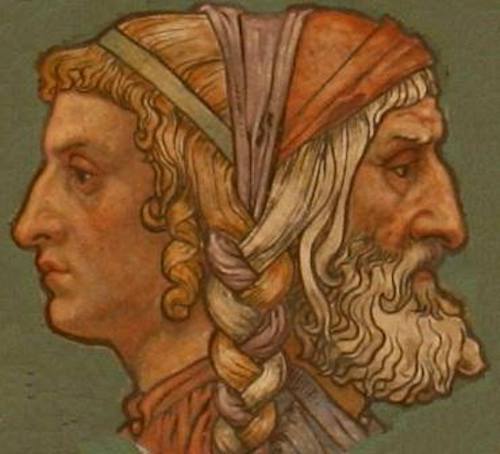
January is the month of Janus, the two-faced god of doorways. In fact, in Latin the word janus or ianus can simply refer to a door, in the same way that Vesta is the goddess of the sacred fire, but the vesta can also simply be the name for the altar. (Considering that, and considering that Sallust assigns Vesta to the element of Earth, leads to some interesting thoughts, if you're willing to follow them.)

Now, as in ancient times, we pass through Janus's Gate into the New Year just after the entrance of the Sun into Capricorn. Capricorn is a sign of special significance. An Earth sign, symbolized by the goat slowly and patiently making its way to the top of the mountain, Capricorn also represents the descent of souls into material incarnation. The Sun's entrance into Capricorn was anciently marked by the great festival of Saturnalia. During this time, the feast of great Saturn, all social bonds were relaxed. Above all, it was a time of freedom for slaves, who ate at their masters' tables, often served by the masters themselves, and everyone wore the distinctive cap of a freedman.

The symbolism of Saturnalia functions on several different levels:

First, the freeing of the slaves during the time of Capricorn reminds us that it is through its seeming enslavement to the body that the soul will eventually become freed.

Second, the leveling of the social order signifies the return of the Golden Age, when slavery had not yet been instituted among men. During this time Saturn was the high god, not having yet been deposed by his son, Jupiter. In Politicus Plato tells us that the day will come when Sun will reverse his course and begin to rise in the West and set in the East. On that day Jupiter will relinquish his throne to his father, the Dead will rise from their graves, and the Golden Age will come again. At Saturnalia the Golden Age comes again, for a moment, and then a new cycle of creation begins.

At still another level, Saturn is the Divine Intellect, as Jupiter is the Universal Soul. As Time, brought into being by Jupiter, is a moving image of Eternity, the Golden Age of Saturn already exists for those who have transcended material incarnation and abide in the Intellectual Cosmos, which is also called the light of Gwynvydd.

And Janus?

To be a god of doorways might seem a rather lowly thing, after considering such exalted topics. It is nothing of the kind.

Consider an actual doorway. It is a boundary, making a division between two separate spaces-- inside and outside a home, between two rooms in a home. But the boundary itself does not exist as a physical space. If you try to locate it, you will find that you are always on one side or the other, in one room or the other, in the home or out of the home. It has no material existence-- in a sense, no existence at all. And yet, it is by virtue of this nonexistent reality that the separate places, inside and outside, this room or that room, have existence at all.

This is why, Porphyry tells us:

The Pythagoreans, and the wise men among the Egyptians, forbade speaking while passing through doors or gates; for then they venerated in silence that God who is the principle of wholes (and, therefore, of all things).

Notice, too, that it is at Saturnalia that Christ, the Logos, who both is and transcends the Divine Intellect, descends into material incarnation, and that it is at January First that we celebrate the Solemnity of Mary, the Mother of God, who is the living gate through which the Logos is incarnated.

Housekeeping and Announcements

I've discovered that making announcements about my plans for this blog is the quickest way to sabotage them, so I'm just going to say that I think you'll like what I have planned for the new year. 

That said, there are also a few items leftover from 2023 to discuss. 

First, if you're waiting on an astrological chart from me, please be patient. I had set aside a great deal of time to work on these during the holidays, and then I promptly contracted Covid and was unable to do much of anything for a week. Today is the first day I'm functioning more-or-less normally. 

Second, and in keeping with the first, I'm no longer going to be taking orders or appointments any time Mercury is in retrograde. Yes, I know, "Mercury Retrograde" is the great cliche of contemporary astrology, but I've been whacked by it so many times that it's clearly time (long past time) to take it seriously. This is probably due to the position of Mercury in my natal chart, which is strong enough that if my parents had consecrated me I could have been a living astrological talisman. There are three remaining retrogrades in 2024, which I record here for the future: 
  • April 1 to April 25, 2024
  • August 5 to August 28, 2024
  • November 25 to December 15, 2024
What I'll probably do is go dark during these times, and then offer some kind of sale once Mercury stations direct again. 

Finally, I want to wish you all a Happy New Year from all of us here at Read Old Things! 

(All of us presumably consists of me, whatever spirits guide my writing here, and the cats who can't stop laying on my keyboard while I'm trying to type.)


The Winter Solstice has arrived. On this night of Alban Arthan, the longest night of the year, I want to thank everyone who has read and supported my work here over the years. The readership of this blog has, from the beginning and consistently been a group of very smart people. I always get a lot out of the comments here, even or especially when it's readers who come from a different perspective from my own.

Over the coming season the series on reincarnation is going to continue to its natural conclusion, and then I'm probably going to go in a completely different direction again. I've never thrown this blog open to suggestions before, but if there's anything that anyone wants to hear about, feel free to let me know in the comments section. More astrology? A return to the Gospel of Matthew? Another readthrough of an ancient and arcane text? Whatever it is, feel free to share. (If not, I'll probably just pull another random book off the shelf and start writing about it).

In any case, I want to wish everyone reading this a blessed Winter Solstice, health and prosperity in the season to come.


Click here to support this blog.


Hi Everybody,

Posting will probably continue to be a little light around here for the next few weeks. But in the meantime, I'm running a sale on various divination products over at my Etsy store. Could you use a bit of Geomantic advice? Or would you like a tarot reading? Perhaps there's someone on your Christmas list who would love a detailed reading of their astrological chart? If so, head on over!


We have seen that Aristotle opposed Plato and the Pythagoreans on the question of reincarnation, while the Gnostics agreed but reversed the meaning. Today I want to look at another anti-reincarnationist viewpoint-- that of the orthodox Church Fathers.


The Reward of the Body

Dionysius the Areopagite, in his treatise on the Ecclesiastical Hierarchy, tells us the following, in the passage concerning the rites said over those who have died:

The holy souls, which may possibly fall during this present life to a change for the worse, in the regeneration, will have the most Godlike transition to an unchangeable condition. Now, the pure bodies which are enrolled together as yoke-fellows and companions of the holy souls, and have fought together within their Divine struggles in the unchanged steadfastness of their souls throughout the divine life, will jointly receive their own resurrection; for, having been united with the holy souls to which they were united in this present life, by having become members of Christ, they will receive in return the Godlike and imperishable immortality, and blessed repose.
 
Of the idea of reincarnation he has this to say:

But others assign to souls union with other bodies, committing, as I think, this injustice to them, that, after (bodies) have laboured together with the godly souls, and have reached the goal of their most Divine course, they relentlessly deprive them of their righteous retributions.

Dionysius was a thoroughgoing Platonist, hardly ignorant of the tradition of reincarnation. The passage cited here is derived in large part from Plato's Phaedo. Another treatise, the Divine Names, is concerned (as one might expect) with the Names of God given in the scriptures and elsewhere in the Christian tradition. The first name that he cites is Goodness, and his discussion of it is derived directly from Plato's Republic:

Even as our Sun-- not as calculating or choosing, but by its very being, enlightens all things able to partake of its light in their own degree-- so too the Good-- as superior to a Sun, as the archetype par excellence, is above an obscure image-- by Its very existence sends to all things that be, the rays of Its whole goodness, according to their capacity.

And again:

The Good then above every light is called spiritual Light, as fontal ray, and stream of light welling over, shining upon every mind, above, around , and in the world, from its fulness, and renewing their whole mental powers, and embracing them all by its over-shadowing; and being above all by its exaltation; and in one word, by embracing and having previously and pre-eminently the whole sovereignty of the light-dispensing faculty, as being source of light and above all light, and by comprehending in itself all things intellectual, and all things rational, and making them one altogether.

And so we see that Dionysius is informed from his very first principles by the Platonic tradition. And yet, in this passage alone, he appears to directly attack Plato himself. Why?

Why Bother with the Other Philosophers?
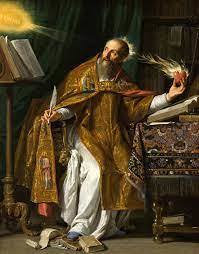


Dionysius was one of the most important of the early theologians. He retains his status in the Christian East, wherein he is often still venerated as Saint Dionysius, the companion of Saint Paul. In the West Dionysius's influence is today felt more indirectly, via his influence on Thomas Aquinas. Aquinas draws heavily on Dionysius, citing him 1700 times. But Aquinas is above all an Aristotelean-- he loves Aristotle enough that he refers to him as "The Philosopher." Of Plato he has a much lower opinion. In this Aquinas represents a deviation from the earlier, dominant, Christian tradition, and that deviation has affected Western Christianity down to the present. But let us leave that discussion for another time.

Writing many centuries before Aquinas, Augustine of Hippo is far more in line with what I'm calling the Christian mainstream. Several books of his City of God are addressed directly to the Platonists of his day, specifically because, as he says, of all the pagan philosophers, "It is evident that none come nearer to us than the Platonists." Indeed, he has a great deal of praise for Plato himself and for the philosophical system which bore his name:

If, then, Plato defined the wise man as one who imitates, knows, loves this God, and who is rendered blessed through fellowship with Him in His own blessedness, why discuss the other philosophers?
 
Through several books Augustine elaborates the doctrines of the Platonsits of his day, and their differences with the Christians. In Book X, he comes to the subject of reincarnation, as part of a long discussion of Porphyry:

 
It is very certain that Plato wrote that the souls of men return after death to the bodies of beasts. Plotinus also, Porphyry's teacher, held this opinion; yet Porphyry justly rejected it. He was of opinion that human souls return indeed into human bodies, but not into the bodies they had left, but other new bodies. He shrank from the other opinion, lest a woman who had returned into a mule might possibly carry her own son on her back. He did not shrink, however, from a theory which admitted the possibility of a mother coming back into a girl and marrying her own son. How much more honorable a creed is that which was taught by the holy and truthful angels, uttered by the prophets who were moved by God's Spirit, preached by Him who was foretold as the coming Saviour by His forerunning heralds, and by the apostles whom He sent forth, and who filled the whole world with the gospel, — how much more honorable, I say, is the belief that souls return once for all to their own bodies, than that they return again and again to various bodies? Nevertheless Porphyry, as I have said, did considerably improve upon this opinion, in so far, at least, as he maintained that human souls could transmigrate only into human bodies, and made no scruple about demolishing the bestial prisons into which Plato had wished to cast them. He says, too, that God put the soul into the world that it might recognize the evils of matter, and return to the Father, and be for ever emancipated from the polluting contact of matter. And although here is some inappropriate thinking (for the soul is rather given to the body that it may do good; for it would not learn evil unless it did it), yet he corrects the opinion of other Platonists, and that on a point of no small importance, inasmuch as he avows that the soul, which is purged from all evil and received to the Father's presence, shall never again suffer the ills of this life. By this opinion he quite subverted the favorite Platonic dogma, that as dead men are made out of living ones, so living men are made out of dead ones; and he exploded the idea which Virgil seems to have adopted from Plato, that the purified souls which have been sent into the Elysian fields (the poetic name for the joys of the blessed) are summoned to the river Lethe, that is, to the oblivion of the past,
 
 
That earthward they may pass once more,
Remembering not the things before,
And with a blind propension yearn
To fleshly bodies to return.


Reincarnation, Incarnation, Resurrection

Augustine and Dionysius have their differences. Above all, from my own perspective, I find Dionysius's writings inspiring, and his vision compelling; I don't think that Dionysian Christianity is, ultimately, correct-- but for spiritual sustenance, from my own perspective, it would be sufficient. Augustine is harsher, more given to disputation; I frequently find him unpleasant, sometimes downright appalling. Here he is describing the fate of unbaptized babies: 

Let no one promise infants who have not been baptized a sort of middle place of happiness between damnation and Heaven, for this is what the Pelagian heresy promised them.
 
Yes, he's saying what you think he's saying. For Augustine, an infant who dies before baptism is consigned to Hell. And yes, that includes babies who die in the womb. I will return to this subject in due time.

For now, what I want to note is the specific vision of human life and the human soul that unites both Augustine and Dionysius, and separates them from Plato, or from his later successors like Plotinus and Porphyry.

For Plato, just as Augustine says, "The living come from the dead, and the dead from the living." Now, Augustine makes it "a favorite doctrine of the Platonists" that this is the case for all human souls-- that is, that we are all subject to reincarnation, for all of time. Porphry and Plotinus did not believe this; for them, the souls of those who are purified return to the Intelligible Realm, and abide there eternally. It was, however, the teaching of Proclus, and of his school-- which some have identified as an "Eastern" school of Platonism, as opposed to the Western school of Plotinus et al-- more generally. Where Plato stood on the subject depends on which dialogue you are reading, as do many such details. Unlike his later followers, Plato appears to have been happy to keep certain questions open. 

Whether or not they believed that human souls would eventually return to material incarnation, the Platonists were united in believing three things: First, that our souls are eternal; second, that they begin their existence in the presence of God, and strive to return to him; third, that the journey of the soul's return to God takes place across many lifetimes.

The differences between Augustine and Dionysius are certainly as great as those between Plotinus and Proclus, but they, too, are united by their underlying beliefs about the soul and its relation to body, which can also be described as consisting in three principles: First, our souls are created by God and come into existence with our bodies; second, upon death, our soul departs the body either into the presence of God, or not; third, at the end of time our soul and its body will be reunited. 

It is true that, as Augustine says, the Platonists are the closest to the Christians of all of the ancient philosophical schools. Both traditions believe in a single Creator; both believe that moral action in this life determines our fate fater death; both believe that the purpose of the soul in this life is to return to God. Describing the nature of the life of God (City of God, Book VIII), Augustine speaks for both the Christians and the PLatonists when he says: 

And therefore, whether we consider the whole body of the world, its figure, qualities, and orderly movement, and also all the bodies which are in it; or whether we consider all life, either that which nourishes and maintains, as the life of trees, or that which, besides this, has also sensation, as the life of beasts; or that which adds to all these intelligence, as the life of man; or that which does not need the support of nutriment, but only maintains, feels, understands, as the life of angels — all can only be through Him who absolutely is.

Where they differ, and differe greatly, is in what they see as the nature of the human person and its relationship to the physical world. 

For the Platonists, the soul has a body, just as a body has clothes. In the same way that our body changes clothes, our soul changes bodies. Just as our body is sometimes naked, so, too, our soul is sometimes naked. And when the soul is naked-- that is, not in a body-- this isn't a loss, or a condition of deprivation. The soul between lives abides in the spiritual world, in a pleasant or a painful part depending on its merits. After its long sojourn through the realms of earthly existence-- including those parts of the spiritual world which are the abodes of the human Dead-- it returns to the Father and rests in the Intelligible Realm, either forever or until time begins again. 

For the Christians-- at least, the mainstream Christians-- the soul and the body are, essentially, one. In this, the Christian doctrine far more closely resembles that of Aristotle, who we looked at last time, and you will often hear Christians both Western and Eastern citing Aristotle on this topic. The soul no more "has" a body than Architecture "has" schools or drawing boards or architects. To imagine Architecture deprived of its instruments, or in possession of different instruments, would simply be to imagine a different art entirely. Similarly, on this account of soul and body, to possess a different body would be simply to be someone else. Death, on this account, is a disaster; and, indeed, Christianity sees Death as the result of the Fall. Prior to Adam and Eve's expulsion from Paradise, they were ensouled bodies who did not die; after the Fall, the monstrous absurdity that is the separation of soul from body became possible. But, on this account, all will be corrected in due time. 

I know that I find one of these accounts far more plausible than the other, and readers of this blog will already have guessed which one. Before we get to that, though, I want to discuss one more alternative take on the subject. We'll get to that tomorrow. Or next time. 


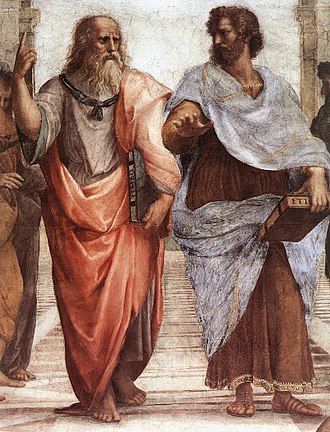
Everyone knows the famous depiction of Plato and Aristotle that occupies the center of Raphael's School of Athens. It's worth taking a moment to study the image, as it says a very great deal without a single word, except for the inscriptions on the books each man carries. 

Plato stands in the background. Aged, barefooted, with his right hand he points upward, along a vertical line, toward the Heavens, with his left, he holds a copy of his Timaeus. Plato seems to be standing still, but this sense of stillness is belied by his feet, which are in motion. To his left, his pupil Aristotle, a much younger man, appears to move away and ahead of his teacher. The image is of a departure-- but notice, Aristotle's feet are still. In his left hand, he holds a copy of the Nichomachaean Ethics. With his right, he gestures outward and downward. His palm points toward the Earth, but his open hand suggests a horizontal line. The two figures look towards one another, while around them gather all the luminaries of ancient philosophy, science, and art. 

This single image captures much about the relationship between the two men-- or, rather, between the philosophical systems that each developed. Of their personal relationship we can only make guesses. Aristotle was the student of Plato for twenty years, during which time he lectured at Plato's Academy. Plato referred to Aristotle as the intellect of the academy; Aristotle eulogized Plato at his funeral. Their relationship during Plato's life appears to have been one of friendship between master and pupil. 

After Plato's death, the story changes. Plato was succeeded as head of the Academy by his nephew Speussipus. Following Speussipus, there seems to have been a dispute, with different factions within the academy favoring either Aristotle or Xenocrates. According to at least some accounts, while Aristotle was out of town Xenocrates was made head of the Academy, and following this Aristotle founded his own school. The works of Aristotle's that modern academics believe date from after this time reflect a very different perspective. Many of his works from this period open with an attack on Plato and the Academy, and then go on to contain continuous, tendentious and often tedious attacks throughout the remainder. 

The Whole or the Part? 

Of course, it's Aristotle's views on reincarnation that concern us here. Fortunately, he left us no doubt at all as to either his position or the reasoning behind it. Put simply, he thought the whole idea was ludicrous. In his commentary On the Soul he tells us why: 

It is as absurd as to say that the art of Carpentry could embody itself in flutes; each art must use its tools, each soul its body.

Notice what's being said here. As with Raphael's painting, there is quite a bit contained in a very small space.

If you reason from Aristotle's premises, his point is a good one and it makes perfect sense. No, we cannot imagine Carpentry, as an art, somehow becoming Flutes; just to say so is to utter an absurdity.

Now, consider what is meant by "Carpentry." We use a single word here, and in doing so denominate a single "thing." But that thing consists of a great many, separate processes, including a suite of knowledge, trade schools or apprenticeships in which the knowledge is learned, tools and materials in which the knowledge is applied, and finished products, all transmitted across time. That time is limited, at least in theory; there must have been a time when the art of working with wood to make things like houses and furniture was discovered, and there may be a time in which it is forgotten. But that finite time is different from the lifespans of particular objects, or the length of time it took to produce this house or that chair, or the time that this or that carpenter spent in trade school. John could become a carpenter or not; Sally could make a chair or a house today; Billy could cut his hand with a jigsaw. Carpentry as such is not affected by these particulars. The particulars, then, are akin to the body of the art. In just the same way, you could cut your hair today, or not, or go running and lose five pounds, or eat donuts and gain five pounds. You can go through puberty and double in size, have a baby and double in size again, then go through menopause. Your body will be modified, as the "body" of Carpentry is modified by Sally's chair or Billy's workplace compensation suit. But the "You" of you will remain. It is not reducible to these particulars-- and, yet, it expresses itself through the particulars. It would be as absurd, on this account-- indeed, as grammatically meaningless-- for you to suddenly exist as Billy or Sally as it would for Carpentry to suddenly become Flutes. 

This "You" is precisely what Aristotle means by "Soul." It is, as he puts it, the "actuality" of a particular body, or that which is expressing itself through that body. On this account, it is meaningless to even talk about a soul without a body, and doubly meaningless to talk about a soul with a different body. A soul with a different body is a different soul. 

The Locus of Being

The difference between Plato and Aristotle is a subject for a very long blog post, and maybe we'll get to that one day. For now, I want to focus on one thing-- but this one thing is a microcosm of the entire divide. That is the approach of each of the two philosophers to ousia

Ousia is a Greek word which we can translate as "essence," "substance," or-- stretching the point a bit-- as "being." The Platonic account, which we are all familiar with by now, has Ousia as the primary Form out of which all other things emerge. If we can simplify things a bit and simply call it "being," for the Platonists, Being comes first, and all particular beings participate in Being Itself. 

Aristotle reverses the situation entirely. For Aristotle, ousia primarily is not being, but this being. Socrates is ousia primarily. "Man," a species of which Socrates is a part, is ousia only secondarily. "Animal," of which "Man" is a part, has a tertiary existence. 

On this account, Soul cannot be an eternal principle in which ensouled beings participate. Indeed, Aristotle attacks the very notion of participation, central to Platonic metaphysics, early on in his own Metaphysics. Starting with particulars and rooted in particulars, Aristotle can only interpret the soul as particularity. Indeed, his word for the soul is entelechia, "entelechy," meaning precisely the actuality of this or that particular body. 

To Be Continued

There are two different ways to look at Aristotle. He can be seen, on the one hand, as an anti-Platonist-- and, indeed, as the anti-Platonist. Certainly a cursory reading of him bears this out, as, like I said, attacks on Plato are basically constant throughout the entire corpus of his written work. 

Given that, it would seem to be somewhat odd that the most important introduction to Aristotle's work, one which endured throughout the Christian Middle Ages, was written by Plotinus's student Porphyry. It would seem even odder that Proclus of Lysias's introduction to philosophy began, not with the reading of Plato, but with a systematic reading of all of the works of Aristotle. Plato is more than human for Proclus, he is divine, and Proclus's masterwork is the Theology of Plato, not the Theology of Aristotle

So what's going on here? 

I'm afraid that's all the time we have for today. Join me tomorrow, when we'll pick up the thread from this point. 


I thought we would get to Aristotle today, but I'm afraid there's one more stop we need to make. Because the truth is, this isn't a two way fight, between the reincarnationists and the anti-reincarnationists. Within the reincarnationist camp, there is a major dissenting opinion, and it's time we discussed it.

The Demiurge

Plato's Timaeus is an accoiunt of the creation of the universe by a good God called the Demiurge or "craftsman." Plato is somewhat coy about the Demiurge's identity, saying in the dialogue that it's unclear what his true name is. Proclus later interpreted the Demiurge as Zeus-- or, rather, the first of gods named Zeus and sharing in the attributes of the Zeus of earlier mythology. Christian Platonists, of course, interpreted the Demiurge as Christ. What both the Christian and the pagan Platonists had in common is that they agreed with Plato's statement that, above all else, the Demiurge, the Creator of the cosmos is good.

But there were some who disagreed.

The word "Gnostic" refers to a wide variety of Christian and semi-Christian religious dissidents who flourished in the first few centuries after Christ. The Gnostics were never anything like a unified tradition; indeed, modern academics debate over whether the term "Gnostic" is really useful at all, given the wide variety of different traditions that can be gathered under that one label. What we're going to discuss here is one strain of Gnosticism, which we can call the Radical Dualist tradition. Of these, the most extreme were a sect known as the Sethians, and their later descendants, the Manichaeans and the medieval Cathars.

The central point of Dualist Gnosticism is quite simply that the Demiurge is evil. The Secret Book of John, a Sethian text, gives an elaborate account of the spiritual beings that existed prior to the creation of the material universe, concluding with a feminine power named Wisdom or Sophia. Except for the first Power, each of these primordial spirits is part of a mated pair, and it is in union with their appropriate partner that they give rise to the next pair. Sophia, unfortunately, decides to try to give birth without her partner, and brings forth a monstrous being:


Because she had unconquerable Power
Her thought was not unproductive.
Something imperfect came out of her
Different in appearance from her.
 

Because she had created it without her masculine counterpart
She gave rise to a misshapen being unlike herself.
 

Sophia saw what her desire produced.
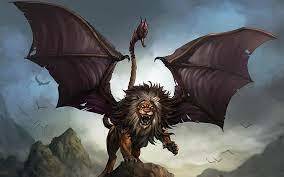
It changed into the form of a dragon with a lion’s head
And eyes flashing lightning bolts....
 
She named him Yaldabaoth.
 

Yaldabaoth is the chief ruler.
He took great Power from his mother,
Left her, and moved away from his birthplace.

He assumed command,
Created realms for himself
With a brilliant flame that continues to exist even now.

 
Yaldabaoth is then explicitly equated with the God of the Old Testament:


This dim ruler has three names:Yaldabaoth is the first.
Saklas is the second.
Samael is the third.

He is blasphemous through his thoughtlessness.
He said “I am God, and there is no God but me!”
Since he didn’t know where his own Power originated.

Yaldabaoth goes on to form the material world as a prison for human souls, which he rules over with the aid of his demonic Archons. The elaborate cosmology of the Sethian tradition is nearly a mirror-image of Proclus, with both the Hebrew God and the many gods of the pagan world gathered together into a single demonic system. In this system, reincarnation occurs as in the account of Plato-- but in keeping with the Gnostic inversion, reincarnation is a disaster pure and simple. In the thought of the Sethians, Christ's mission was precisely to liberate us from imprisonment in the material world. As the Secret Book of John goes on to explain:

I said, Master, where will the souls [of the saved] go when they leave their flesh?

He laughed and said to me, The soul in which there is more power than the Contemptible Spirit is strong. She escapes from evil, and through the intervention of hte Incorruptible One she is saved and taken up to eternal rest.

I said, Master, where will the souls go of people who have not known to whom they belong?

He said to me, The Contemptible Spirit has grown stronger in such people while they were going astray. This spirit lays a heavy burden on the soul, leads her into evil, and hurls her down into forgetfulness. After the soul leaves the body, she is handed over to the authorities who have come into being through the Ruler. They bind her with chains and throw her into prison. They go around and around with her until she awakens from forgetfulness and acquires knowledge. This is how she attains perfection and is saved.

Note well: The speakers in this dialogue are supposed to be Saint John the Evangelist and the resurrected Jesus.

Matter and Spirit

There is an ambivalence around matter, to be sure, in both the Christian and Platonist traditions. Christians believe in the Fall of Man, and see the world since that time as stained by sin. Plato famously compared the material world to an underground prison and the body to a tomb. Probably Plotinus took the Platonic pessimism as far as it could go when he declared matter to be the principle of evil. But even Plotinus did not achieve the radical dualism found especially in the Sethian tradition and its descendants, the Manichaeans and Cathars.

In many ways the Gnostic tradition resembles the Platonic. Indeed, one of Plotinus's chief complaints against the Gnostics was precisely that they'd taken the basic ideas of Platonic philosophy and bent them out of all proportion, multiplying the fundamental principles of spiritual reality to the point of absurdity. But the chief difference is precisely the answer to this question-- Why does reincarnation occur? For the Platonist, the answer is that we return to material incarnation until we learn to transcend it. We are here either through our own fault, in looking toward matter rather than spirit (Plotinus), or else because it is simply the nature of souls like ours to descend into embodiment for a time, until we work our way out (Proclus). For the Gnostics, we are here through precisely no fault of our own. We are prisoners, as Plato many times suggested, but not of good or just jailers. We are, in effect, in an earth-sized concentration camp, and it is our duty to escape. 

A Matter of Temperament


I suggested at the beginning of this series that certain distinctions in philosophy really do seem to come down to temperament. To quote Coleridge again, "Every man is born an Aristotelean or a Platonist." And so I'm willing to believe that it may be a matter of temperament-- but I personally can find absolutely nothing appealing in Gnosticism. To my mind, the entire tradition, from the Secret Book of John through the even more elaborate works of the Manichaeans and the medieval Cathars, looks like nothing so much as a UFO suicide cult.

I do sympathize with Plotinus's dim view of matter. Actually, if you want to know the truth, my sympathy for Plotinus seems to correlate exactly with the number of birthdays I've celebrated; at 40 it's far greater than when I first encountered his work at 30. So perhaps by 50 or 60 something in Secret John will start to resonate for me. For now, though, I share it here only in order to give an alternate account its due. 

The two possibilties we have seen are: 1. There is rencarnation. 2. There is no reincarnation.

But here is a third possiblity, or, rather, an alternate first possibility: There is reincarnation, and it sucks. 


In the future the American civil religion will be understood by all as a regular religion. Then all of our monuments and memorials will be called by their proper names temples and shrines to our Honored Dead. And Thanksgiving will simply be acknowledged as the great sacrament of the American people. In the meantime, I'm very grateful for everyone who reads this blog, and I wish you all a very Happy Thanksgiving.


Reincarnation and the Fae

I wanted to get to Aristotle today, but I realized that we need to talk a bit more about the doctrine of reincarnation among the Neoplatonists and others.


In Book 13 Homer's Odyssey, we read of the transportation of Odysseus to his homeland of Ithaca by the Phaecians:

Now when that brightest of stars rose which ever comes to herald the light of early Dawn, even then the seafaring ship drew near to the island. There is in the land of Ithaca a certain harbor of Phorcys, the old man of the sea, and at its mouth two projecting headlands sheer to seaward, but sloping down on the side toward the harbor. These keep back the great waves raised by heavy winds without, but within the benched ships lie unmoored when they have reached the point of anchorage. At the head of the harbor is a long-leafed olive tree, and near it a pleasant, shadowy cave sacred to the nymphs that are called Naiads. Therein are mixing bowls and jars of stone, and there too the bees store honey. And in the cave are long looms of stone, at which the nymphs weave webs of purple dye, a wonder to behold; and therein are also ever-flowing springs. Two doors there are to the cave, one toward the North Wind, by which men go down, but that toward the South Wind is sacred, nor do men enter thereby; it is the way of the immortals. Here they rowed in, knowing the place of old; and the ship ran full half her length on the shore in her swift course, at such pace was she driven by the arms of the rowers. Then they stepped forth from the benched ship upon the land, and first they lifted Odysseus out of the hollow ship, with the linen sheet and bright rug as they were, and laid him down on the sand, still overpowered by sleep.
 
In the time of Plotinus and Porphry, the tale of Odysseus's return to Ithaca was seen as an allegory of the soul's return to the Intelligible. Porphyry wrote a long treatise on this one small episode from Homer; it is worth reading in its entirety, but for our purposes here its main interest lies in his discussion of the nymphs or naiads, those spirits to whom the cave is sacred. Porphry tells us:

We peculiarly call the Naiades, and the powers that preside over waters, Nymphs; and this term also, is commonly applied to all souls descending into generation. For the ancients thought that these souls are incumbent on water which is inspired by divinity, as Numenius says, who adds, that |16 on this account, a prophet asserts, that the Spirit of God moved on the waters. The Egyptians likewise, on this account, represent all daemons and also the sun, and, in short, all the planets (note 6), not standing on anything solid, but on a sailing vessel; for souls descending into generation fly to moisture. Hence also, Heraclitus says, that moisture appears delightful and not deadly to souls; but the lapse into generation is delightful to them. And in another place (speaking of unembodied souls), he says, "We live their death, and we die their life."
 
That is all to say: The nymphs are a class of nature spirit, one particularly concerned with streams and pools. There are, for the ancient Greeks as well as all other animistic peoples, other sorts of nature spirits; some dwell in caves or valleys, others in trees, others in winds, others in fire. But the peculiar thing about these naiads is that at least some of them are in fact human souls out of incarnation.

This points to another part of the old doctrine of reincarnation, which is worth discussing before we go on. We have already seen, in Virgil as well as Plato, that the idea is not, as many think, that reincarnation is a quick process: First you die, then you wake up in another body. No, there is a long sojourn in the spirit world between one incarnation and the next. (There is one exception to this idea, which we will come to in time.) The question, of course, is precisely what we're doing during that long sojourn. Porphyry tells us-- and note well, he is quoting Hesiod, who stands with Homer at the beginning of Greek civilization: We live as nature spirits, which are literally those beings which animate the natural world. When it is time to return to incarnation, we die to the spirit world, and return to this material world:

We live their death, and we die their life.

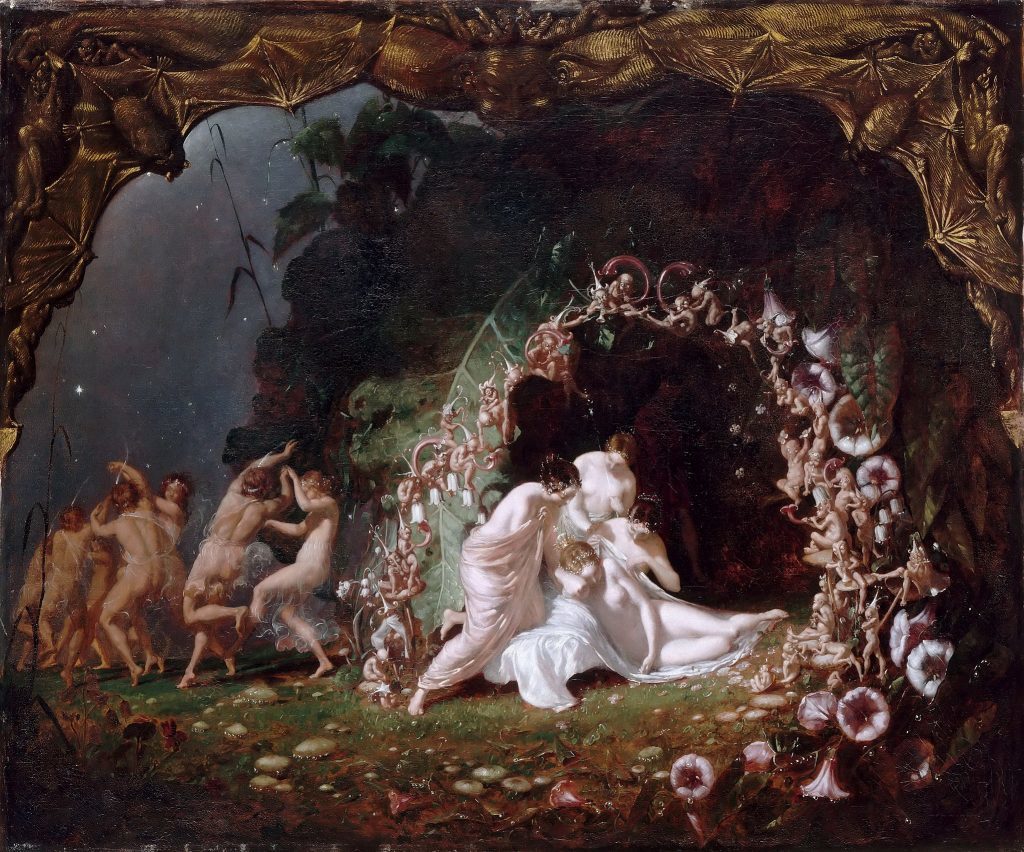
It is nearly certain that this exact doctrine prevailed among the ancient Celts.The way that we can know this is from the ambiguous nature of the Fae or fairies, those strange beings found in Celtic folklore from Ireland to Brittany and all areas in between. In some tales they appears as nature spirits, just like elementals or whathaveyou; but in others, they are very clearly identified with the Dead. In Brittany in particular, the emphasis is on the latter aspect of the fairies. The Bretons have some tales about mischevious nonhuman spirits called corrigans, but most of their fairy lore is concerned with the Dead, in whom are seen the exact same powers that the other Celtic people associate with the Fae. (The very best discussion of this, by the way, remains The Fairy Faith in Celtic Countries, by Evans-Wentz.)

Notice, too, that many of the sources have us involved in material incarnation only once in a thousand years. If that is the case, then it hardly seems correct to see our real nature as "human"-- human incarnation, it seems, is a test, or perhaps a punishment, meeted out to some but not all among the nature spirits who shape the material world. 

Now-- this isn't a necessary consequence of the doctrine of reincarnation as such. Recent research has indicated that people who remember past lives often only experienced a short time between death and re-incarnation; sometimes only a few years. Moreover the Druze people of Lebanon, who believe in reincarnation, report that they are reborn immediately after death. But it is a possible consequence-- one I personally find very interesting indeed. 


Today I want to continue the discussion of reincarnation by continuing to set the stage, as it were. For in ancient times, just as today, there were some who advocated the doctrine, others who rejected it, and both did so with a great deal of certainty and a fair bit of heat. Today we're going to set the board.


Apollonius and the Pythagoreans

Apollonius of Tyana was a wandering sage and miracle worker of the first century. The exact dates of his life are unknown; he may have lived contemporaneously with Jesus of Nazareth, or he may have been born somewhat after the latter's death. The most extensive account of his life from ancient times is The Life of Apollonius of Tyana, by Flavius Philostratus, which details Apollonius's various journeys to India, Ethiopia, and across the Roman Empire in search of wisdom. At the end, Apollonius is brought to trial in Rome and sentenced to death, at which point he miraculously disappears, reappearing regularly to his followers. For this reason, many contemporary atheists have brought out Apollonius as an argument against Christianity. The reasoning appears to be that if Jesus performed miracles and appeared to his followers after death, and if Apollonius performed miracles and appeared to his followers after death, then no one ever performed miracles or appeared to their followers after their death. On a similar note, I have, as usual, a cat laying next to my keyboard as I'm writing this. She is a small callico. However, out of the corner of my eye I've just spotted another cat, a large, male orange tabby. Should he also attempt to sit next to me while I write, I will naturally be forced to conclude that there is no such thing as a cat.

But I'm afraid the parallels between Apollonius and other First Century miracle workers aren't important here; the reason that I want to talk about him is that reincarnation was central to his life and teachings. In this, like Plato, he was a follower of Pythagoras. In fact, Apollonius was a central figure in the First Century revival of Pythagoreanism. Flavius opens his biography of Apollonius by teaching us about Pythagoras's doctrine of reincarnation:

The votaries of Pythagoras of Samos have this story to tell of him, that he was not an Ionian at all, but that, once on a time in Troy, he had been Euphorbus, and that he had come to life after death, but had died as the songs of Homer relate.
The capacity to remember one's previous lives, then, along with the willingness to abstain from wine or animal flesh, and the rejection of animal sacrifice as a whole, become the central themes of Apollonius's biography. Indeed, in the interpretation of Apollonius, the ancient command of Apollo to "Know Thyself" becomes " "Remember your previous incarnations!" The discussion of previous lives occurs over and over as Apollonius visits wise men around the ancient world, and is especially important during his sojourns with the Brahmans of India-- whom Apollonius regards as the wisest of men-- and the sages of Ethiopia (who are presented as runners-up to the Hindus.)

Nor was Pythagoras alone among the ancients in the teaching of reincarnation, though that would also be a point in favor of the doctrine. Flavius then immediatley quotes a line from Empedocles on the same subject:

For erewhile, I already became both girl and boy.

Empedocles lived about fifty years before Plato, and it was he who, appearently first conceived of the famous image of the material world as a kind of cave or underground prison.

Mysteries and Barbarians

Reincarnation, then, was a central doctrine for one of the major strains of Greek and later philosophers, the strain which includes Pythagoras, Empedocles and Plato, as well as later figures like Apollonius, Apuleius, Plutarch, Plotinus, Porphyry, Iamblichus and Proclus.

As we have seen, it was taught by the sages of other lands, outside the Graeco-Roman world, but it was also well-known outside the rarefied world of yogis and philosophers. Roman sources regularly mention that it was believed in by the Celts, where it is sometimes referred to as "the doctrine of Pythagoras." In his Decline and Fall, Gibbon relates the fact that certain of the Northern tribes were unusually fierce in battle, owing to their belief in reincarnation:

The first exploits of Trajan were against the Dacians... To the strength and fierceness of barbarians they added a contempt for life, which was derived from a warm persuasion of the immortality and transmigration of the soul.
Moreover, the doctrine of reincarnation appears to have been a central part of the initiation of the Mystery schools. The source for this is Virgil, the sixth book of whose Aeneid is believed to be as faithful as possible an account of the initiations of the Mysteries. Having descended into the Underworld, Aeneas has an encounter with the spirits of the Dead which is very similar to the account give in the Phaedo:

Why, when life leaves them at the final hour,
still all of the evil, all the plagues of the flesh, alas,
have not completely vanished, and many things, long hardened
deep within, must of necessity be ingrained, in strange ways.
So they are scourged by torments, and pay the price
for former sins: some are hung, stretched out,
to the hollow winds, the taint of wickedness is cleansed
for others in vast gulfs, or burned away with fire:
each spirit suffers its own: then we are sent
through wide Elysium, and we few stay in the joyous fields,
for a length of days, till the cycle of time,
complete, removes the hardened stain, and leaves
pure ethereal thought, and the brightness of natural air.
All these others the god calls in a great crowd to the river Lethe,
after they have turned the wheel for a thousand years,
so that, truly forgetting, they can revisit the vault above,
and begin with a desire to return to the flesh.’

Half the Board Set

And so we have established that the doctrine of reincarnation, or the transmigration of souls, was well known in the ancient pagan world, both among philosophers and initiates in the mysteries, and among ordinary warriors in places like Gallia and Germania. It's very important to make this point clearly before we go on, for the following reason: There are some writers who attempt to deny that this doctrine was ever taught or believed in in ancient times. These include some otherwise reputable commentators, like Marsilio Ficino, and they also include some far more dubious characters, like Renee Guenon.

(By the way, as I'm typing these words, another cat has jumped onto my desk. It isn't the orange tabby but a small, gray female without a tail. Be it then established, there is no such thing as a cat!)

Now, Ficino had his reasons for downplaying reincarnation. He was trying to get Plato's works and his ideas back into circulation at a time when charges of heresy still very much included the possibility of execution in a variety of very painful ways. In his lifetime he saw his friend Pico della Mirandolla's work condemned by the pope as "in part heretical, in part the flower of heresy" and banned. Guenon, on the other hand, had a rather worse excuse. He was annoyed that reincarnation was being taught by the Theosophical Society, and he appears to have been even more annoyed that the Theosophical Society had put together a syncretic system of spiritual wisdom before he had gotten around to it. And so he claimed that reincarnation had, in fact, never been taught or believed in by anyone before Madame Blavatsky showed up and started preaching it in the 19th century. This was nonsense and it remains nonsense, but you ought to be aware of it, because you will still to this day find people insisting upon it in various corners of the occult internet.

And that's all for today.

So far we have one side established, the board set with half the pieces. Tomorrow (or in our next post) we're going to establish who, besides the hapless Renee Guenon, has objected to the doctrine of reincarnation, and on what grounds they have done so. We will start with Aristotle.


Reincarnation

There are some questions in human life that admit of two nonconensurable answers of which every person seems disposed by temperament to pick one and only one. Speaking on one of these questions, Coleridge once famously remarked that

Every man is born an Aristotelian or a Platonist. I do not think it possible that anyone born an Aristotelian can become a Platonist; and I am sure that no born Platonist can ever change into an Aristotelian.

On the everyday level, it also seems to be the case that every man (and woman) is born a cat person or a dog person. Cat people like all, or nearly all cats, and if they like any dogs they do so on an individual basis; dog people like dogs in general, and may or may not like this or that cat. That is to say, cat people like the species "cat," with which, on a certain level, they identify; dog people like the species "dog" in the same way. If a dog person likes a cat, he likes it for its individual qualities (which often include being somewhat doglike). Tangentially, this is also the way that a dog person likes human beings-- not as a species, but individually.

Given the theory of transmigration of souls, which claims that each of us passes through successive animal incarnations before arriving at the level of the human being; and given the large populations of both dogs and cats and their proximity to human beings; it's tempting to wonder whether cat people are in fact human beings who lived many previous lives as cats, while dog people rose to humanity through the ranks of dogs. Whether or not this is the case, it brings us neatly to the thing I actually want to talk about today, which is the nature of reincarnation. For reincarnation is another one of these questions on which people tend to fall on one side or the other. Those who don't believe in it generally can't believe in it, while those who do believe in it often find that they can't believe otherwise.

What I'd like to do in this post-- which is likely to turn into several-- is to go into more detail on the doctrine of reincarnation or the transmigration of souls in the Western tradition, including the question of precisely what reincarnates and how it does so; objections to the doctrine; and whether there is a secret tradition of reincarnation within Christianity and other traditions which explicitly reject it.

Reincarnation in Plato

Plato taught the theory of reincarnation in many of his dialogues, including Meno, Phaedo, Phaedrus, Republic, Timaeus, Statesman and Laws. Of these, the Phaedo and Republic give the most extensive treatments of the topic. Let's look at what he has to say in these.

In the Phaedo, Plato has Socrates, facing execution, give an account of the fate of souls after death.

When the dead arrive at the place to which the genius of each severally guides them, first of all, they have sentence passed upon them, as they have lived well and piously or not. And those who appear to have lived neither well nor ill, go to the river Acheron, and embarking in any vessels which they may find, are carried in them to the lake, and there they dwell and are purified of their evil deeds, and having suffered the penalty of the wrongs which they have done to others, they are absolved, and receive the rewards of their good deeds, each of them according to his deserts. But those who appear to be incurable by reason of the greatness of their crimes—who have committed many and terrible deeds of sacrilege, murders foul and violent, or the like—such are hurled into Tartarus which is their suitable destiny, and they never come out. Those again who have committed crimes, which, although great, are not irremediable—who in a moment of anger, for example, have done violence to a father or a mother, and have repented for the remainder of their lives, or, who have taken the life of another under the like extenuating circumstances—these are plunged into Tartarus, the pains of which they are compelled to undergo for a year, but at the end of the year the wave casts them forth—mere homicides by way of Cocytus, parricides and matricides by Pyriphlegethon—and they are borne to the Acherusian lake, and there they lift up their voices and call upon the victims whom they have slain or wronged, to have pity on them, and to be kind to them, and let them come out into the lake. And if they prevail, then they come forth and cease from their troubles; but if not, they are carried back again into Tartarus and from thence into the rivers unceasingly, until they obtain mercy from those whom they have wronged: for that is the sentence inflicted upon them by their judges. Those too who have been pre-eminent for holiness of life are released from this earthly prison, and go to their pure home which is above, and dwell in the purer earth; and of these, such as have duly purified themselves with philosophy live henceforth altogether without the body, in mansions fairer still which may not be described, and of which the time would fail me to tell.
Some of these ideas are familiar from the Christian tradition. We have a pure home in the World Above, in which the good find release from earthly existence; we also have a dark world far, far below, into which the wicked are hurled, never to return. But we also have a middle realm, which is the Underworld as we usually think of it-- that is, Hades or the World of the Dead. This is not the same as Tartarus, the place into which those who commit massacres and sacrileges are cast. We are told in Homer's Iliad, in fact, that Tartarus is as far below Hades as our Earth is below Heaven. It thus forms a kind of middle term in the possible afterlives, for all of us who are not quite good enough for Heaven nor bad enough for Hell. Here the wicked are purified of their misdeeds, but after this receive their just reward. The presence of the middle term is important, as we shall see; it is one of the important differences between the thought of Plato and that of his wayward pupil Aristotle. And as we shall also see, Christianity for its first millennium followed Plato in most things, but Aristotle in this.

Notice, too, that there are two more middle terms, between the middle term itself and the extremes. Some among the worst are indeed cast into Tartarus, but after a year of torment they are given a chance to repent of their crimes. If their victims forgive them, they are allowed into the pleasant part of the Underworld, with everyone else; if not they must continue to undergo suffering and purification until they are forgiven. And note well-- it is not by God that they beg forgiveness, but those whom they have wronged. This idea is something that, from what I can tell, was totally lost in later traditions. Finally, we are told that those who have followed the disciplines of philosophy will be conducted to Heaven and never have to return to the Earth, but that they are are others will sojourn in Heaven for a time, and again descend.

So far, then, we have five possible conditions for a spirit after death: 1. Tartarus; 2. Tartarus temporarily; 3. Hades; 4. Heaven temporarily; 5. Heaven. To this list we might possibly add a sixth, potentially the same as the third, which is a kind of ghost, so attached to the physical form that it wanders about graveyards until the time comes for it to return to incarnation. Of all of these, groups 2, 3, 4 and 6 can all expect to return to incarnation in a body:

After death, as they say, the genius of each individual, to whom he belonged in life, leads him to a certain place in which the dead are gathered together, whence after judgment has been given they pass into the world below, following the guide, who is appointed to conduct them from this world to the other: and when they have there received their due and remained their time, another guide brings them back again after many revolutions of ages.
Those who return to earthly incarnation return to a form suited to the life that they previously lived:

 
Socrates: Men who have followed after gluttony, and wantonness, and drunkenness, and have had no thought of avoiding them, would pass into asses and animals of that sort. What do you think?
 
Cebes: I think such an opinion to be exceedingly probable.
 
Socrates: And those who have chosen the portion of injustice, and tyranny, and violence, will pass into wolves, or into hawks and kites;—whither else can we suppose them to go?
 
Cebes: Yes....
Socrates: Some are happier than others; and the happiest both in themselves and in the place to which they go are those who have practised the civil and social virtues which are called temperance and justice, and are acquired by habit and attention without philosophy and mind.
...they may be expected to pass into some gentle and social kind which is like their own, such as bees or wasps or ants, or back again into the form of man, and just and moderate men may be supposed to spring from them.

This treatment of the subject in the Phaedo is the most extensive in all of Plato's works, and fittingly, since the Phaedo is entirely concerned with death. In the Republic we are given a brief summary of the same, but with the added detail that the Dead are given the opportunity to choose what life they will live upon return to Earth. This is very much a mixed blessing, as many, without thinking, choose lives which appear good but which lead them to disaster:

...he who had the first choice came forward and in a moment chose the greatest tyranny; his mind having been darkened by folly and sensuality, he had not thought out the whole matter before he chose, and did not at first sight perceive that he was fated, among other evils, to devour his own children. But when he had time to reflect, and saw what was in the lot, he began to beat his breast and lament over his choice, forgetting the proclamation of the prophet; for, instead of throwing the blame of his misfortune on himself, he accused chance and the gods, and everything rather than himself. Now he was one of those who came from heaven, and in a former life had dwelt in a well-ordered State, but his virtue was a matter of habit only, and he had no philosophy.

And so we see that the system of reincarnation given by Plato is somewhat similar to that in Tibetan Buddhism. The ultimate goal of the spiritual life is to attain release from incarnation. This is done through the practice of philosophy, a word which we should understand similarly to the Sanskrit word yoga. Failing that, a temporary sojourn in the Heavenly realms or in the more pleasant part of the Underworld is possible for those who are relatively virtuous. Following a time spent in the spiritual worlds, most of us return to incarnation, and the specific form we take is determined in more ways than one by the life we lived previously. 

Tomorrow we will talk about reincarnation elsewhere in the Graeco-Roman traditions, including in Pythagoras and Virgil, and hopefully come to Aristotle's objections to the doctrine. 

Steve's Note

I've been neglecting this blog lately because my time has been limited. Last week I started several posts but ran out of time. This week and from henceforward I hope, I'm simply going to post whatever I have completed, even if it means cutting off in the middle of a sentence. See you tomorrow!


Descent and Return

The Gorsedd Prayer concludes:

And in the Love of Justice, the Love of All Existences
And in the Love of All Existence, the love of God

A final line or clause admits of variation. The version in the Barddas has "God and all goodness." Some Druid orders have "God [variant: Goddess, Great Spirit, the Gods], the Earth our Mother, and all goodness." As is often the case, the choice is left to the individual Druid. 

Love

True Knowledge of Justice is contact with the Form of Justice, Iustitia herself. This contact cannot help but change us: We are purified and become just, and then act with justice in all our doings. 

What is that which binds us to Justice? 

This is Love, the Power which binds all things together, and especially which unites humankind to the Divine. 

Notice, again, that our prayer is leading us through a process of descent from Ceugant (God) to Abred. That journey is now complete, as we turn toward "All Existences." This is the opposite from how things usually work from our perspective as dwellers in Abred. Here, we begin by seeking God, and that which animates and binds us to God is Love. Animated by Divine Love, we endeavor to practice the virtues, and in their practice come to know them, and thereby to become them. Having by degrees become just, courageous and temperate, we finally become wise, which is to say, our third eye opens and we are given a glimpse of the Higher Reality of Gwynvydd. Even this brief contact is enough to change us, and we begin to understand what we have seen. Our third eye, which is the eye of our heart, remains open for ever longer durations, and we are animated by the fire of God, which becomes our strength. Finally, resting in the Divine Presence, we are protected, preserved from declining again toward matter and vice by the living presence of God. 

In the Gorsedd Prayer, we ask all of these things in what appears to us to be the reverse order. But this only true from our perspective: This is the true order of creation, as all things arise from God and descend by slow degrees into matter. 

At the end we come to All Existences. This reminds us that God is not one being, or one existence, among others; not one thing among many things. God is that in whom and through whom there is any existence whatsoever. Each existence has its origin and its fulfillment in God. And now, we pray that, having become Just, we may act Justly toward all other beings, which is to say, to act toward them with Love. And it is this very justice which leads us back to God, because it is, ultimately the divine nature within others which we love. 

Variations

To each Druid the Name of the final terms, which occur at the beginning and end of the prayer, are left as a matter of their own decision. The reason is this: As God is beyond all existences, no name can truly be given to him without limiting him to that name. And yet, in order to act and to think, the human being during its sojourn in the world of names and images, which is Abred, must have a name. By allowing each other to choose a name of God appropriate to our own practice, we acknowledge the complete transcendence of the Divine Absolute. It is as though we say to the Deity, "I know that no Name that I give can truly contain Thee, who art beyond all Names, but I offer unto thee this Name as a holy sacrifice: Let it be a bond between us, and deny not the sacrifice of my sister, though it differ from mine." In allowing our Fellow Druid that Name suited to her or to him, we humble ourselves, and do not allow the conceit of our intellect to rise greater than the love of our heart. And all are led back by degrees to that Eternal Presence who abides unchanging within all existences. 


Our prayer continues:

And in Understanding, Knowledge,
And in Knowledge, Knowledge of Justice
And in the Knowledge of Justice, the Love of It
 
From Understanding immediately proceeds Knowledge. This is somewhat different from our usual way of using these words. Ordinarily they are either synonyms, or else understanding is a more complete form of knowledge. What's going on here?

The answer is that in our ordinary way of living, we ascend from knowledge to understanding. But in the Gorsedd prayer, we follow the emanations of divinity from the highest to the lowest. In the order of creation, Understanding gives rise to Knowledge.

By "Understanding" we particularly mean intellection or noesis-- the immediate knowledge of the noetic level of being, at which knower and object of knowledge are united. By Knowledge, we mean discursive reasoning or dianoia, which knows by applying the faculties of mind in sequence toward an object of knowledge. As separation has been introduced, we see that we have, again, made a descent in terms of the planes of being. Understanding is the activity of the highest part of the mind, called Intellect or Nous. Knowledge is its first-born, its image in the soul. 

Now, we ask that we may direct our knowledge in a specific direction, toward Justice. Now, the very fact that we are directed toward "Justice" in particular rather than "Virtue" in general also indicates that we are moving further from the Divine Untiy, toward the realms of separation and generation. 

Like Knowledge and Understanding, the term "Justice" is often misused (and mis-understood) in modern discourse. This is especially the case as it has become more common. And so it's worth taking a moment to remember that the ancient meaning of "Justice" is not "Governments take revenge against large segments of their own population for crimes they never committed." Justice means, very specifically, the right relationships between things. Aristotle defines it as rendering to each what is due to him. Plato tells us that it consists, internally, in the state in which each part of the soul performs its correct task, not seeking to usurp the role of others, and, externally, the same relation between the parts of the state. 

It naturally follows that for Justice to be possible, there must be separation; only when there are parts is it possible for a relationship between parts to exist. Notice, too, that Justice is the only virtue given a name, but all of the virtues are present:

The Protection of God produces an abiding stability in the soul, which is the virtue of Temperance.

The Strength, given by God and unfolding from the Protection of God is the virtue of Courage. 

The Understanding which arises from the Protection and Power of God, and the Knowledge which unfolds from Understanding, is the virtue of Wisdom. 

From these Justice is unfolded, as a right application of power and knowledge toward the multitude which arise from the overflowing creative fire of the divine unity. 

Finally, from the Knowledge of Justice is born Love. This is another simple statement which hides many layers of meaning. 

We must always remember that, for the ancients, powers that move the human soul like "Love" are not simply choices or acts or events. They are gods or spirits. For Plato, Love (Eros) is divine: A daimon who causes us to desire unity with that which is beautiful, and, if we properly follow his teachings, will lead us to union with God. But Love is also an act of will, and the nature of that act for Plato as well as for Christ is "to will the good of another."

Justice, Courage, Wisdom, Temperance: We know all these things to the extent we know them only as we know their Paradigms, and these are living Ideas in the mind of the Father. All abide as great Powers in Gwynvydd, and when we act justly or temperately in Abred we unite ourselves to them. Here we invoke their son, Divine Love, and ask his aid in uniting ourselves to Them. 

How exactly do we do this? We'll see tomorrow.  


Profile

readoldthings

December 2024

S M T W T F S
1234567
891011121314
1516 17 18192021
22232425262728
293031    

Syndicate

RSS Atom

Most Popular Tags

Style Credit

Expand Cut Tags

No cut tags
Page generated Jan. 1st, 2026 09:11 am
Powered by Dreamwidth Studios