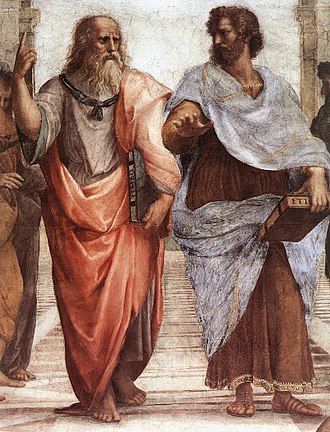
Everyone knows the famous depiction of Plato and Aristotle that occupies the center of Raphael's School of Athens. It's worth taking a moment to study the image, as it says a very great deal without a single word, except for the inscriptions on the books each man carries. 

Plato stands in the background. Aged, barefooted, with his right hand he points upward, along a vertical line, toward the Heavens, with his left, he holds a copy of his Timaeus. Plato seems to be standing still, but this sense of stillness is belied by his feet, which are in motion. To his left, his pupil Aristotle, a much younger man, appears to move away and ahead of his teacher. The image is of a departure-- but notice, Aristotle's feet are still. In his left hand, he holds a copy of the Nichomachaean Ethics. With his right, he gestures outward and downward. His palm points toward the Earth, but his open hand suggests a horizontal line. The two figures look towards one another, while around them gather all the luminaries of ancient philosophy, science, and art. 

This single image captures much about the relationship between the two men-- or, rather, between the philosophical systems that each developed. Of their personal relationship we can only make guesses. Aristotle was the student of Plato for twenty years, during which time he lectured at Plato's Academy. Plato referred to Aristotle as the intellect of the academy; Aristotle eulogized Plato at his funeral. Their relationship during Plato's life appears to have been one of friendship between master and pupil. 

After Plato's death, the story changes. Plato was succeeded as head of the Academy by his nephew Speussipus. Following Speussipus, there seems to have been a dispute, with different factions within the academy favoring either Aristotle or Xenocrates. According to at least some accounts, while Aristotle was out of town Xenocrates was made head of the Academy, and following this Aristotle founded his own school. The works of Aristotle's that modern academics believe date from after this time reflect a very different perspective. Many of his works from this period open with an attack on Plato and the Academy, and then go on to contain continuous, tendentious and often tedious attacks throughout the remainder. 

The Whole or the Part? 

Of course, it's Aristotle's views on reincarnation that concern us here. Fortunately, he left us no doubt at all as to either his position or the reasoning behind it. Put simply, he thought the whole idea was ludicrous. In his commentary On the Soul he tells us why: 

It is as absurd as to say that the art of Carpentry could embody itself in flutes; each art must use its tools, each soul its body.

Notice what's being said here. As with Raphael's painting, there is quite a bit contained in a very small space.

If you reason from Aristotle's premises, his point is a good one and it makes perfect sense. No, we cannot imagine Carpentry, as an art, somehow becoming Flutes; just to say so is to utter an absurdity.

Now, consider what is meant by "Carpentry." We use a single word here, and in doing so denominate a single "thing." But that thing consists of a great many, separate processes, including a suite of knowledge, trade schools or apprenticeships in which the knowledge is learned, tools and materials in which the knowledge is applied, and finished products, all transmitted across time. That time is limited, at least in theory; there must have been a time when the art of working with wood to make things like houses and furniture was discovered, and there may be a time in which it is forgotten. But that finite time is different from the lifespans of particular objects, or the length of time it took to produce this house or that chair, or the time that this or that carpenter spent in trade school. John could become a carpenter or not; Sally could make a chair or a house today; Billy could cut his hand with a jigsaw. Carpentry as such is not affected by these particulars. The particulars, then, are akin to the body of the art. In just the same way, you could cut your hair today, or not, or go running and lose five pounds, or eat donuts and gain five pounds. You can go through puberty and double in size, have a baby and double in size again, then go through menopause. Your body will be modified, as the "body" of Carpentry is modified by Sally's chair or Billy's workplace compensation suit. But the "You" of you will remain. It is not reducible to these particulars-- and, yet, it expresses itself through the particulars. It would be as absurd, on this account-- indeed, as grammatically meaningless-- for you to suddenly exist as Billy or Sally as it would for Carpentry to suddenly become Flutes. 

This "You" is precisely what Aristotle means by "Soul." It is, as he puts it, the "actuality" of a particular body, or that which is expressing itself through that body. On this account, it is meaningless to even talk about a soul without a body, and doubly meaningless to talk about a soul with a different body. A soul with a different body is a different soul. 

The Locus of Being

The difference between Plato and Aristotle is a subject for a very long blog post, and maybe we'll get to that one day. For now, I want to focus on one thing-- but this one thing is a microcosm of the entire divide. That is the approach of each of the two philosophers to ousia

Ousia is a Greek word which we can translate as "essence," "substance," or-- stretching the point a bit-- as "being." The Platonic account, which we are all familiar with by now, has Ousia as the primary Form out of which all other things emerge. If we can simplify things a bit and simply call it "being," for the Platonists, Being comes first, and all particular beings participate in Being Itself. 

Aristotle reverses the situation entirely. For Aristotle, ousia primarily is not being, but this being. Socrates is ousia primarily. "Man," a species of which Socrates is a part, is ousia only secondarily. "Animal," of which "Man" is a part, has a tertiary existence. 

On this account, Soul cannot be an eternal principle in which ensouled beings participate. Indeed, Aristotle attacks the very notion of participation, central to Platonic metaphysics, early on in his own Metaphysics. Starting with particulars and rooted in particulars, Aristotle can only interpret the soul as particularity. Indeed, his word for the soul is entelechia, "entelechy," meaning precisely the actuality of this or that particular body. 

To Be Continued

There are two different ways to look at Aristotle. He can be seen, on the one hand, as an anti-Platonist-- and, indeed, as the anti-Platonist. Certainly a cursory reading of him bears this out, as, like I said, attacks on Plato are basically constant throughout the entire corpus of his written work. 

Given that, it would seem to be somewhat odd that the most important introduction to Aristotle's work, one which endured throughout the Christian Middle Ages, was written by Plotinus's student Porphyry. It would seem even odder that Proclus of Lysias's introduction to philosophy began, not with the reading of Plato, but with a systematic reading of all of the works of Aristotle. Plato is more than human for Proclus, he is divine, and Proclus's masterwork is the Theology of Plato, not the Theology of Aristotle

So what's going on here? 

I'm afraid that's all the time we have for today. Join me tomorrow, when we'll pick up the thread from this point. 


Reincarnation

There are some questions in human life that admit of two nonconensurable answers of which every person seems disposed by temperament to pick one and only one. Speaking on one of these questions, Coleridge once famously remarked that

Every man is born an Aristotelian or a Platonist. I do not think it possible that anyone born an Aristotelian can become a Platonist; and I am sure that no born Platonist can ever change into an Aristotelian.

On the everyday level, it also seems to be the case that every man (and woman) is born a cat person or a dog person. Cat people like all, or nearly all cats, and if they like any dogs they do so on an individual basis; dog people like dogs in general, and may or may not like this or that cat. That is to say, cat people like the species "cat," with which, on a certain level, they identify; dog people like the species "dog" in the same way. If a dog person likes a cat, he likes it for its individual qualities (which often include being somewhat doglike). Tangentially, this is also the way that a dog person likes human beings-- not as a species, but individually.

Given the theory of transmigration of souls, which claims that each of us passes through successive animal incarnations before arriving at the level of the human being; and given the large populations of both dogs and cats and their proximity to human beings; it's tempting to wonder whether cat people are in fact human beings who lived many previous lives as cats, while dog people rose to humanity through the ranks of dogs. Whether or not this is the case, it brings us neatly to the thing I actually want to talk about today, which is the nature of reincarnation. For reincarnation is another one of these questions on which people tend to fall on one side or the other. Those who don't believe in it generally can't believe in it, while those who do believe in it often find that they can't believe otherwise.

What I'd like to do in this post-- which is likely to turn into several-- is to go into more detail on the doctrine of reincarnation or the transmigration of souls in the Western tradition, including the question of precisely what reincarnates and how it does so; objections to the doctrine; and whether there is a secret tradition of reincarnation within Christianity and other traditions which explicitly reject it.

Reincarnation in Plato

Plato taught the theory of reincarnation in many of his dialogues, including Meno, Phaedo, Phaedrus, Republic, Timaeus, Statesman and Laws. Of these, the Phaedo and Republic give the most extensive treatments of the topic. Let's look at what he has to say in these.

In the Phaedo, Plato has Socrates, facing execution, give an account of the fate of souls after death.

When the dead arrive at the place to which the genius of each severally guides them, first of all, they have sentence passed upon them, as they have lived well and piously or not. And those who appear to have lived neither well nor ill, go to the river Acheron, and embarking in any vessels which they may find, are carried in them to the lake, and there they dwell and are purified of their evil deeds, and having suffered the penalty of the wrongs which they have done to others, they are absolved, and receive the rewards of their good deeds, each of them according to his deserts. But those who appear to be incurable by reason of the greatness of their crimes—who have committed many and terrible deeds of sacrilege, murders foul and violent, or the like—such are hurled into Tartarus which is their suitable destiny, and they never come out. Those again who have committed crimes, which, although great, are not irremediable—who in a moment of anger, for example, have done violence to a father or a mother, and have repented for the remainder of their lives, or, who have taken the life of another under the like extenuating circumstances—these are plunged into Tartarus, the pains of which they are compelled to undergo for a year, but at the end of the year the wave casts them forth—mere homicides by way of Cocytus, parricides and matricides by Pyriphlegethon—and they are borne to the Acherusian lake, and there they lift up their voices and call upon the victims whom they have slain or wronged, to have pity on them, and to be kind to them, and let them come out into the lake. And if they prevail, then they come forth and cease from their troubles; but if not, they are carried back again into Tartarus and from thence into the rivers unceasingly, until they obtain mercy from those whom they have wronged: for that is the sentence inflicted upon them by their judges. Those too who have been pre-eminent for holiness of life are released from this earthly prison, and go to their pure home which is above, and dwell in the purer earth; and of these, such as have duly purified themselves with philosophy live henceforth altogether without the body, in mansions fairer still which may not be described, and of which the time would fail me to tell.
Some of these ideas are familiar from the Christian tradition. We have a pure home in the World Above, in which the good find release from earthly existence; we also have a dark world far, far below, into which the wicked are hurled, never to return. But we also have a middle realm, which is the Underworld as we usually think of it-- that is, Hades or the World of the Dead. This is not the same as Tartarus, the place into which those who commit massacres and sacrileges are cast. We are told in Homer's Iliad, in fact, that Tartarus is as far below Hades as our Earth is below Heaven. It thus forms a kind of middle term in the possible afterlives, for all of us who are not quite good enough for Heaven nor bad enough for Hell. Here the wicked are purified of their misdeeds, but after this receive their just reward. The presence of the middle term is important, as we shall see; it is one of the important differences between the thought of Plato and that of his wayward pupil Aristotle. And as we shall also see, Christianity for its first millennium followed Plato in most things, but Aristotle in this.

Notice, too, that there are two more middle terms, between the middle term itself and the extremes. Some among the worst are indeed cast into Tartarus, but after a year of torment they are given a chance to repent of their crimes. If their victims forgive them, they are allowed into the pleasant part of the Underworld, with everyone else; if not they must continue to undergo suffering and purification until they are forgiven. And note well-- it is not by God that they beg forgiveness, but those whom they have wronged. This idea is something that, from what I can tell, was totally lost in later traditions. Finally, we are told that those who have followed the disciplines of philosophy will be conducted to Heaven and never have to return to the Earth, but that they are are others will sojourn in Heaven for a time, and again descend.

So far, then, we have five possible conditions for a spirit after death: 1. Tartarus; 2. Tartarus temporarily; 3. Hades; 4. Heaven temporarily; 5. Heaven. To this list we might possibly add a sixth, potentially the same as the third, which is a kind of ghost, so attached to the physical form that it wanders about graveyards until the time comes for it to return to incarnation. Of all of these, groups 2, 3, 4 and 6 can all expect to return to incarnation in a body:

After death, as they say, the genius of each individual, to whom he belonged in life, leads him to a certain place in which the dead are gathered together, whence after judgment has been given they pass into the world below, following the guide, who is appointed to conduct them from this world to the other: and when they have there received their due and remained their time, another guide brings them back again after many revolutions of ages.
Those who return to earthly incarnation return to a form suited to the life that they previously lived:

 
Socrates: Men who have followed after gluttony, and wantonness, and drunkenness, and have had no thought of avoiding them, would pass into asses and animals of that sort. What do you think?
 
Cebes: I think such an opinion to be exceedingly probable.
 
Socrates: And those who have chosen the portion of injustice, and tyranny, and violence, will pass into wolves, or into hawks and kites;—whither else can we suppose them to go?
 
Cebes: Yes....
Socrates: Some are happier than others; and the happiest both in themselves and in the place to which they go are those who have practised the civil and social virtues which are called temperance and justice, and are acquired by habit and attention without philosophy and mind.
...they may be expected to pass into some gentle and social kind which is like their own, such as bees or wasps or ants, or back again into the form of man, and just and moderate men may be supposed to spring from them.

This treatment of the subject in the Phaedo is the most extensive in all of Plato's works, and fittingly, since the Phaedo is entirely concerned with death. In the Republic we are given a brief summary of the same, but with the added detail that the Dead are given the opportunity to choose what life they will live upon return to Earth. This is very much a mixed blessing, as many, without thinking, choose lives which appear good but which lead them to disaster:

...he who had the first choice came forward and in a moment chose the greatest tyranny; his mind having been darkened by folly and sensuality, he had not thought out the whole matter before he chose, and did not at first sight perceive that he was fated, among other evils, to devour his own children. But when he had time to reflect, and saw what was in the lot, he began to beat his breast and lament over his choice, forgetting the proclamation of the prophet; for, instead of throwing the blame of his misfortune on himself, he accused chance and the gods, and everything rather than himself. Now he was one of those who came from heaven, and in a former life had dwelt in a well-ordered State, but his virtue was a matter of habit only, and he had no philosophy.

And so we see that the system of reincarnation given by Plato is somewhat similar to that in Tibetan Buddhism. The ultimate goal of the spiritual life is to attain release from incarnation. This is done through the practice of philosophy, a word which we should understand similarly to the Sanskrit word yoga. Failing that, a temporary sojourn in the Heavenly realms or in the more pleasant part of the Underworld is possible for those who are relatively virtuous. Following a time spent in the spiritual worlds, most of us return to incarnation, and the specific form we take is determined in more ways than one by the life we lived previously. 

Tomorrow we will talk about reincarnation elsewhere in the Graeco-Roman traditions, including in Pythagoras and Virgil, and hopefully come to Aristotle's objections to the doctrine. 

Steve's Note

I've been neglecting this blog lately because my time has been limited. Last week I started several posts but ran out of time. This week and from henceforward I hope, I'm simply going to post whatever I have completed, even if it means cutting off in the middle of a sentence. See you tomorrow!
Everyone knows the Twelve Olympian Gods. If you need a reminder, these are Jupiter, Neptune, Mars, Apollo, Mercury, and Vulcan; and Vesta, Ceres, Venus, Diana, Athena, and Juno. Yes, those are the Roman names; Thomas Taylor uses them exclusively in his translations, and I have those in mind just now.

The Twelve appear in Plato's Phaedrus, in a very specific role. In this dialogue we learn that each of us is ultimately gathered under one of the Twelve. We are, originally, immortal spirits, each of us one of the vast multitude of spirits that follows on each of the gods. It is in this dialogue that Plato gives us his famous image of the soul as a winged chariot drawn by two horses, which you may be familiar with from another source:


In any case, these Twelve play a specific and interesting role in the thought of Proclus, who discusses them in Book 6 of his Platonic Theology. For Proclus, the Twelve are divided in two ways. First, Jupiter and Vesta-- the king of the gods and the goddess of the hearthfire-- are the two most important; they are monads, the other ten gathered into a decad. Second, the Twelve may be gathered into four triads. These triads are shaped exactly the way we have seen Platonic triads structured before. One begins the series, one proceeds from it, and the third closes out the series, at once reflecting the first, returning to it, and beginning a new order.

This may also look familiar:


The four triads are named the demiurgic, the guardian, the vivific, and the anagogic.


"Demiurge" means "craftsman," and it is the term for the creator of the universe in Platonic thought. Plato's Timaeus is concerned with the original creation of the universe by the Demiurge. This Demiurge is unnamed in the Timaeus, and Plato leaves his identity open to question. For Proclus the question is closed; the Demiurge is Jupiter, or Zeus. This Jupiter is, in fact, the third in a triad of his own, a triad which begins with his father Saturn, procedes into his mother Rhea, and concludes with himself.

This Jupiter, however, isn't the Jupiter that we know and love. From him procedes another triad of demiurgic gods, consisting of a second Jupiter, Neptune, and Pluto, the three sons of Saturn. Jupiter governs all things, Neptune guides them into material existence, and Pluto closes the series, ruling matter-- and the release from matter, as god of the dead.

But-- and this will confuse you-- we still haven't reached the Jupiter of the Demiurgic Triad.

After the Three Sons of Saturn follows another order of gods, who are divided into a Tetrad-- that is, a group of four. There may or may not be a third Jupiter as part of this series; I'm not clear on this.

Finally we come to our Twelve, who are called the Liberated Gods. These are, again, divided into the Demiurgic, Guardian, Vivific, and Anagogic triads.

Let's look at them one at a time.

The Demiurgic Triad consists of Jupiter, Neptune, and Vulcan. Like the preceding demiurges, these gods are concerned with the creation of things. Jupiter (either the third or four Jupiter) begins the series, in Proclus's words "supernally from Intellect governing souls and bodies." The meaning of this will be apparent in a moment. Neptune governs the middle of the series, as he is especially concerned with motion and generation; he governs the soul, as the soul is "essentially motion." Finally, Vulcan closes out the demiurgic series, as he produces bodies, including what Proclus calls the "mundane seats of the gods"-- that is to say, the planets and stars. And so in the demiurgic series we have three gods ruling or producing the three levels of being below the divine, that is, the Intellectual (or Noetic), the Astral (or Psychic), and the Physical (Hylic).

After this we have the "Guardian and Immutable Triad." This series consists-- in order-- of Vesta, Minerva, and Mars. Vesta-- who was the goddess, above all, of the altar; I believe that altars at Rome were sometimes called "vestae"-- "contains the summits of wholes," another one of these difficult phrases. Minerva preserves "middle lives," and Mars sustains corporeal things. As is often the case with Proclus, it's easier to understand any of this if you work backward. If we start from Mars, we realize that these three gods perform the role of preserving and sustaining the existence of things. Mars sustains the corporeal and gives it power; Minerva rules the intellectual life; and Vesta preserves things as a whole.

The Vivific Triad gives life to all things; it consists of Ceres, the Earth Goddess; Juno, the queen of the gods; and Diana, the moon goddess. Ceres generates all life in the world, whether intellectual, psychic, or corporeal. Juno governs the generation of hte soul. Diana, finally, as moon goddess, governs the life of matter, "perfecting its imperfections," and "moving all natural reasons into energy." The latter sentence is qutie a difficult one, because we have to do some detective work to understand what Greek words are being translated here and what they mean. "Reasons" usually translate "logoi." Logoi, at least for Plotinus, are the emanations of the Ideas at another level down. The Ideas, remember, are those unchanging principles which unfold the whole of things. Reasons or logoi, then, are more specific ideas which conduct eternal powers further downward into matter. "Natural" reasons are reasons having to do with Nature, that is, with living things below the sphere of the Moon, and "energy" has the specific meaning of activity. To put it in very modern and incorrect terms, Diana rules the "laws of nature."

Finally, we have the Anagogic Triad. "Anagoge" means "to lead upward." As the Demiurgic Triad creates things, the Guardian Triad sustains created things, and the Vivific Triad gives life to things, the Anagogic Triad conducts things-- that is, souls-- back out of material existence, to return to union with the Divine. This series begins with Hermes, procedes with Venus, and concludes with Apollo. These three represent the three paths of ascent given in the Phaedrus, which are the ways of Philosophy, Love, and Music.
Yesterday I shared a particular assignment of the classical virtues to the Four Elements, viz:

Earth: Courage

Water: Justice

Air: Wisdom

Fire: Temperance

 
In the comments section, JPRussel mentioned that this differs from the assignment given to the elements in the Dolmen Arch system. 

I wanted to share, first, why I assign the elements in this fashion, and, second, some alternatives.

Systems of Correspondence

Structures like this one are called "systems of correspondence." They are universal in magical systems, and, in fact, in traditional systems of learning in general. The Cabala itelf is little more than one vast system of correspondences-- I believe it was Israel Regardie that referred to the whole system as a "filing cabinet." The point of such systems is to allow one to immediately contact particular states of consciousness, and thereby to produce particular modes of change. 

Again, these systems are not limited to magic, but occur in pre- and non-modern modes of thinking in general. For example, as Western culture has its seven traditional virtues, and Helleniuc culture its four, traditional Chinese culture has five. It's actually not very easy to translate these into English, but, roughly speaking, they amount to: Benevolence, Righteousness, Propriety, Wisdom, and Faithfulness. (Notice, as an aside, that these are different from the four virtues of Plato, and that cultivating these five, rather than our four or seven, produces a different sort of virtuous person. This is a clue to the deeper meaning of cultural difference.) 

In Taoist philosophy and Traditional Chinese Medicine, these five virtues have the following correspondences:
 
Benevolence-- Wood Element-- Liver-- Sour-- Springtime-- Green-- Vice:Anger Jupiter

Propriety-- Fire Element-- Heart-- Summer-- Bitter-- Red-- Vice:Excitement Mars

Faithfulness-- Earth Element-- Spleen-- Present or Late Summer-- Yellow-- Vice:Anxiety Sweet-- Saturn

Righteousness-- Metal Element-- Lungs-- Autumn-- Pungent-- White-- Vice:Grief Venus

Wisdom-- Water Element-- Winter-- Kidneys-- Salty-- Blue-- Vice:Fear Mercury
 
This system of correspondences allows a Taoist adept, or a TCM practitioner, both to cultivate particular states of consciousness in themselves and even to treat disease in their patients. For example, a client suffering from a lung condition might be found to have been attacked by an excess of grief. This can be treated by a qigong exercise which at once opens the chest and activates the muscles along the lung meridian, while the patient visualizes inhaling healing white light into the lungs and exhaling smoky gray light containing grief and sorrow. This can be combined with acupuncture and massage focusing on the lung points, and regularly taking pungent herbs in soup and tea. 

Such systems of correspondences are not arbitrary, but they also aren't universal. It's neither one right way, nor anything goes. To give an example, the season of Winter may be plausibly assigned to the element of Water or Earth, as both are slow, heavy, and cold. It makes rather less sense to assign Winter to Air-- unless, perhaps, you live in a part of the world in which Winter is marked by wind storms. It makes very little sense at all to assign the element of Fire to the Winter season-- unless you're using the elements in a different way, which I'll discuss in a moment.

 Personal Elements

The arrangement of the elements that I provided yesterday is personal to me, as I said, but I want to talk a little about why this is so. 

The virtue of Courage is defined by Plato in the Laws as a knowledge of divine goodness that sustains us through every danger, and also through every pleasure. He is also at pains in the Laws to point out that Courage is the first and lowest of the virtues-- although it holds together cities like Sparta and Crete, it is insufficient to elevate the soul to the higher worlds. Aristotle, meanwhile, points out in Nichomachaean Ethics that Courage is not the opposite of cowardice, but a mean between cowardice and rashness. For Aristotle as for Plato, all of the virtues are means, with vices of excess and deficiency on either side. 

Now, when I consider the virtue of Courage, I find that I am not lacking in the ability to face danger. Not that I throw myself into dangerous situations on purpose-- not these days, anyway-- but I have on a number of occasions had the opportunity to face physical danger and death, and acted in a way that I felt was appropriate. 

On the other hand, one of my greatest vices is my inability to see projects all the way through. My harddrive is full of half-written novels, but no finished ones. I can read Spanish and Latin at a child's level (Iulia puella parva est); I can identify 1 or 200 words in Chinese and write the corresponding characters. I know the guitar well enough to play in a punk band, provided none of my bandmates is older than 16. I have a similar degree of proficiency in the dao or Chinese broadsword, and less in the jian, the Chinese straight sword. I recently acquired a bata, or Irish fighting stick, and if my pattern holds, in a year I'll know it well enough to fight an unarmed civilian.  

What's the point of all this self-effacement?

Only the following: When it comes to assigning an element to Courage, I ask myself: "What is it that I need in order to cultivate the virtue?" For me, the answer is stability and endurance. Of all the elements, Earth represents this most strongly-- to my mind at any rate. And so I assign the virtue of Courage to the element of  Earth, which is to say, I ask the powers of Earth for help in developing Courage. 

But that doesn't mean this is a universal assignment. If I had no problem with stick-to-it-iveness, but I was terrified of physical danger, I might invoke Fire for Courage, as I might find its burning strength a great help in facing my fears. If, on the other hand, my issue was one of rashness-- that is, an excessive love of danger for its own sake-- I might invoke the calming power of Water. Finally, if I simply needed help getting started on my projects or adventures, I might invoke Air.

And I repeat the process with the remaining virtues.

Justice is defined as a right relationship between things. Plato describes it in the Republic as every part of the soul performing its own correct task; Aristotle defines it in the Ethics as giving everything what is due to it. I personally, usually, invoke Water to cultivate Justice. The reason for this is that Water is binding, unifying, and giving. I have a tendency toward selfishness and an equal tendency to be temperamental; these things stand in the way of giving to others what is due to them, whether a tip at a restaurant or a kind word on the street, and in the way of proper relationships with the people in my life, who often need my love rather than irritation or sarcasm.

Wisdom is described by Plato in the Phaedo as a separation of the soul from the body, and contact with the higher reality of the spiritual world. To my mind Air perfectly symbolizes this idea, as Air is the element of the sky (which is the symbol of the Noetic world), the mind, and Form. 

Temperance, finally, means self-control, and for me this is symbolized by Fire, which is above all the element of power. Real power is power over the self, especially the lower self and its cravings. 

In order to cultivate these virtues, I often say the following prayer, especially in the morning:

May I take up my hammer to work,
May I take up my cup to give,
May I take up my book to learn,
May I take up my sword and live.

The hammer symbolizes the gnomes who labor in the north; the cup is the cauldron of life; the book is the wisdom of philosophy and nature; the sword is my personal symbol of success and self-mastery.

External Elements, and Other Arrangements

In a sense, this way of working with the elements is a form of medicine, taylored to the individual. When designing a system of magic or initiation, it seems that it is often more important to choose a more universal arrangement. 

It seems to me that a more universal Druidic arrangement might look like this:

Earth: Courage
Water: Wisdom
Air: Justice
Fire: Temperance

This again draws on Plato's Laws, which describes Courage as the first and lowest of the virtues, and Justice as a mean between Wisdom and Temperance. Water has straightforward associations with wisdom in Celtic lore, in the form of the Salmon of Wisdom who dwells in the sacred well. The animal associated with Justice is the Hawk of May, whose name, "Gwalchmai," is the Welsh form of Gawain, who was in the oldest tales one of the most important of Arthur's knights; his encounter with the Green Knight is itself a lesson in Justice. Temperance, finally, is assigned to Fire. In ordinary American English the word "temperance," if it's used at all, means something like "Not getting drunk," and maybe also "...and keep it in your pants, too." Its original meaning in Greek, dikaiosune, means "self-mastery." This is the final virtue, as Fire is the highest of the elements. 

The following arrangement works equally well:

Earth: Justice
Water: Temperance
Fire: Courage
Air: Wisdom

This arrangement follows the assignment of the virtues to the parts of the human soul, and the parts of the soul to energy centers in the body, in Plato's Republic. To the abdomen, which is called the "lower dantien" in Chinese internal alchemy and the lower cauldron in the Dolmen Arch system, corresponds the  Epithymia, which is the lowest part of the soul, the appetites for food and reproduction that we share in common with every animal. To this center corresponds the element of Water. The proper virtue here is Temperance, as Temperance is control over the appetites and the re-direction of the generative power of the lower cauldron toward productive ends. To the heart, which is called the middle dantien or middle cauldron, corresponds the Thymos, and the element of Fire. The Thymos is the seat of the social emotions, and here the proper virtue is Courage, which compels a warrior to stand with his comrades on the battle-field. The head, which is the upper dantien or cauldron, is the seat of the Nous, and the element of Air. The Nous is the reasoning mind, and also the part of the mind that extends beyond ordinary reason and is capable of direct contact with the higher worlds. Only the Nous can attain the virtue of Wisdom. 

Finally, Justice is the unity of all three parts of the soul, and their performance of their proper function, under the command of the Nous. United, the soul functions as a microcosm of the whole world, and thus the element of Earth is associated with the body as a united whole, and also has special reference to the lower body as it conveys the upper body through the material world. 

Ladders of Virtue

The later Neoplatonists assigned multiple definitions to each of the four virtues. These definitions then corresponded to the highest form of that virtue a person could achieve, depending upon their particular station in life. The virtues were arranged into hierarchies. In the writings of Plotinus, the virtues exist at two levels, the political and the purificatory. The political virtues are given the definitions of Plato's Republic and Laws; their cultivation allows us to exist together in society. But having established himself in the political virtues, the philosopher then cultivates the purificatory virtues, based on Plato's Phaedo, which aim at the union of the soul with God. This simple twofold hierarchy of virtue was then elaborated into four by Porphyry and seven by Iamblichus. 

It seems to me that a Druidical take on this system would work by assigning the elements to the virtues in different ways at different degrees of initiation. Perhaps one assignment exists at the first degree, another at the second, but at the third, the initiate must discover his own set of correspondences. There is much to think about here. 
Way back in February, we looked at the idea of the daimon as a launching-off point for a discussion of American political philosophy. Or, to say it more correctly, American political theology.


The daimon, as we saw, is a power intermediate between gods and ordinary human beings. Actually, this is an oversimplification— there is another Order of beings intermediate between ordinary humans and daimones, as we will see shortly. For now it suffices to recall our descrption of the daimones as those powers which meet the following conditions:

  1. To worship them is to court disaster;

  2. Equally, to ignore or, even worse, to attempt to suppress them is to court disaster.

We gave the example of Eros. Eros, erotic love, is a force in human life whose role cannot be eliminated. Every attempt to do so simply ensures that he manifests in a way that is beyond the control, and far beyond the predictive capacity, of those who attempt the suppressing. The classic examples are the way that Victorian prudery led to the backlash of the Sexual Revolution, and the misguided attempts to impose celibacy on those unsuited for it have resulted in an epidemic of sexual abuse among Catholic clergy. 

Eros and his opposite number, Anteros, are examples are daimones, as we saw, but so too are the spirits of the natural world, who can respond to respectful overtures from human beings with friendship, or at least cooperation, but who make for bad gods and worse enemies. 

Having said all this by way of review, I want to turn now to a discussion of the Gods. 

The Limit and the Unlimited

Let's start with a few quotations.

Socrates: Of all that now exists in the universe, let us make a twofold division, or rather, if you don't mind, a threefold.

Protarchus: On what principle, may I ask?

Socrates: We might apply part of what we were saying a while ago.

Protarchus: What part?

Socrates: We said, I fancy, that God had revealed two constituents of things, the Unlimited and the Limit.

Protarchus: Certainly. 

Socrates: Then let us take these as two of our class, and, as the third, something arising out of the mixture of them both.
 
Plato, Philebus, 23.c
 
 
For law is order, and good law is good order; but a very great multitude cannot be orderly: to introduce order into the unlimited is the work of a divine power-- of such a power as holds together the universe.

Aristotle, Politics VII.4.1326.a.30
 
According to Plato, then, God has established three powers or forces, which can be found in all things. The first is the Limit, the second, the Unlimited, and the third, the Mixture of the two. Everything in the universe is brought into being by these three forces.

This is difficult to understand, because it is very different from modern ways of thinking. Let's try to illustrate it by way of an example.
 
In Geometry, Limit is equivalent to the geometric point. The Unlimited, then, is the line, which extends to infinity in either direction. The point is fixed; it has no dimensions, it goes nowhere. It is all boundary. The line is unlimited. It extends to Infinity.

On their own, neither the single point nor the infinite line is of very much use, and if that were the end of geometry, we wouldn't have much of a universe. 
 
Now, imagine a power prior to both the point and the line producing both, and then deliberately combining them. How? By taking the line and bending it back upon itself, to produce the first shape, the circle. The circle, like the point, has a fixed location and is circumscribed. The point is nearly infinitely small; in a sense, there is nowhere that it actually is. Bringing in the line's power of extension allows the circle to have a location-- somewhere that it is. But bringing in the point's power of limitation allows the circle to function in the universe, because it now has somewhere-- or, rather, an infinite somewhere-- that it is not. The latter is just as important as the former-- a line extending to infinity is incapable of accomplishing anything. The only way to be anything in particular is to also not be anything else. 
 
This is the beginning of geometry. Starting with the circle, the process then begins again. From the circle, a series of succeeding shapes can be derived, by the addition of still more circles. The triangle, the square, the pentagon, and so on. These then generate their own successions of shapes-- the equilateral triangle, the right triangle, the rectangle, the parallelogram, and so on.
 
The same process works again with human speech. For the point, there is the sound uttered for the briefest moment. For the line, the unending noise. The combination of the two produces the word, or, rather the letter or syllable- A, B, C and so on-- which then combined to produce the word, and then the sentence, and so on for the whole sequence of human communication.

Culture and the Unlimited
 
The same process is at work in human culture.
 
Like the line of infinite extension, the number of possible arrangements of human society is basically infinite. We know this from the anthropological record. Is farming best done by men or by women? Should hunting territories be owned by individuals, by fathers and sons, by clans, by secret societies, by tribes, by hereditary nobility, or by the Bureau of Land Management? Should marriage take place between one man, and one woman, for life? One man and one woman at a time, with the possibility of additional marriages for either once the first is dissolved? Between one man and a number of women? Between one woman and a number of men? Between any number of persons? Between two men, or two women?

All these questions and countless others have been given different answers by different societies across the world and throughout time. A set of answers to the full range of questions about how human life is to be lived which is shared among a discrete community and transmitted to its children is called a culture. 

God and the Powers
 
Plato writes, as I said, that God has established the first two powers and caused their mixture. God, the cause of the mixture, is the fourth power to which Socrates alludes-- really the First, which is prior to the three.

Now God, in this context, was understood by the Neoplatonists to refer to the One. This, says Proclus, is why Plato simply says "God," rather than "Zeus" or some other particular God-- the One is beyond all description, and can simply be referred to as "God" or "the First God." In a Christian context, God would refer to the Holy Trinity, all three Persons of which are understood to be, somehow, prior to existence as the One is for Proclus or Plotinus. For our purposes here it doesn't matter-- use the framework that works best for you. 
 
The triad of the Limit, the Unlimited, and the Mixed, is also the Intelligible Triad of Being, Life, and Intellect, which we've discussed at length elsewhere. As we've seen, the cycle of creation is recursive. The third term of the triad, the mixed, also called Intellect, begins a new cycle of creation and acts as the First for the beings that follow it. Thus the circle in my example, which is the third term in the tirad of Point, Line, Shape, produces additional shapes, and the word produces additional words.

Now, notice that  the circle, the first shape, produces additional shapes, rather than colors, or notes, or catfish. In just the same way, in the First Creation of Things, the beings produced by God immediately are themselves Gods, immense Divine powers which shape life on Earth. The First God is universal; the second Gods, very nearly universal, but with elements of particularity. The more remote you get from the First God, the more particular the Gods become. The second term in the Intelligible Triad is life, the Unlimited, and she-- even numbers are feminine-- is all life, everywhere. Much closer to the world that we know, Ceres governs the outpouring of Life onto the Earth by the creator. Interestingly, the 3 sons of Cronus, Zeus, Poseidon, and Hades, also form the same type of triad. Here Poseidon is the second term, and his job is to conduct life into the world of generation.

Back to Culture


Let's return to the subject of culture, and let's introduce two more concepts from Proclus that will help us.
 
Every unity participates of the One. This means that everything which is united, whether the circle, or the musical note, or the human culture, is united by virtue of the One. As the One can be denominated as simply God, the unifying power which governs, say, a human culture, can be understood as a God.
 
Now the Divine is always good, and never evil. The Divine is always perfect and never incomplete. But the perfect and the good do not exist as such in the material world. The perfect circle exists in the mind; it cannot be found in nature. It is the ideal form which determines the geometries of the material world, which are always slightly off from absolutely perfect. In a similar manner, then, it must be the case, that every human culture is to a perfect version of itself as a circle in the material world is to a perfect circle. It is possible for a circle drawn by a human hand to come closer and closer to the absolute ideal, but it won't reach it in the material world. On the other hand, it is possible for material circles to be extremely sloppy. In the same way, the perfect culture does not exist. But the perfect version of every particular culture can be approximated, or we can be very far away from it.
 
Now, among shapes, which is different in each has its use. The unity of a triangle is the oneness of the triangle, or, even, the Divinity of the triangle. the triangle does not become a better triangle by trying to become more like a square. This is impossible it becomes a better triangle by becoming a more perfect reflection of the ideal form of the triangle.
 
Applying the same principle to human culture, there is not a single ideal human culture, because culture is a concept like shape. It is a genus, not a species. A given culture comes closer to the divine, the One, God, by expressing in the best form possible the ideal which itself is striving, not an abstract ideal toward which all of human culture is striving. If you were to try to create a perfect shape which consisted of it at once a triangle, a rhombus, and a pentagram, you would just draw a mess on a paper. It is its separation, paradoxically, it's unique identity as a triangle, which allows a triangle to express the unity of the one.
 
That being the case, the same must be true of human culture. To simply mash cultures together or to try to force them to become one another, does not actually produce unity between them. It destroys the possibility that they individually have for reaching unity by expressing in a clear and united way the Divine ideal which is their own origin and unattainable endpoint.
 
Now the isolated individual is not a culture, and neither is the isolated family. Moreover, the collection of isolated families, each with radically different modes of life is not a culture-- it is a return to the principle of the Unlimited. At this point, it feels very apropos to point out that the Unlimited is the principle of Evil. The Unlimited is the primordial chaos, the great void out of which being arises.

American Nations, American Gods


I've said before that there are four books that are necessary to understanding American culture. The first three are Albion's Seed, the Nine Nations of North America, and American Nations. The first is the most detailed. Each is a study of the ways in which the apparent unity of American, or North American, culture is illusory. There are between seven and eleven-- depending on the author-- major cultures, and dozens of minor ones, hidden under that unity. The fourth book is a good atlas of American Indian culture regions, which will demonstrate that the American cultural regions we have today aligns very closely with cultural regions that existed long before Columbus. 

I submit that each one of these regional cultures is a unity properly understood. Just like a triangle or a pentagon. Each expresses in its own way one of the unlimited possible ways of being human. The major problems in our history down to the present day have been caused by our failure to recognize our actual differences and by our attempt to destroy these differences, thereby metaphorically speaking returning us to the primordial chaos.
 

It is my view that the persistent issues facing the United States arise from this fact. Left to its own devices, each culture has its own particular virtues, and also its own particular vices. United under a too-strong federal government, the pathologies of each manifest on a continent-wide scale, while the virtues are lost in the chaos. Next time I want to talk about the particular American regional cultures, the gods that govern them, and the demons that come with them. 


Socrates and the Rhapsode

Plato's Ion is a dialogue between Socrates and Ion, a rhapsode. Rhapsodes, in ancient Greece, were traveling musicians who performed the work of poets such as Homer or Hesiod.

Ion tells Socrates that he speaks better of Homer and has more to say about him than about any other man. Why is this, he wonders? Socrates explains:
The gift which you possess of speaking excellently about Homer is not an art, but, as I was just saying, an inspiration; there is a divinity moving you, like that contained in the stone which Euripides calls a magnet... This stone not only attracts iron rings, but also imparts to them a similar power of attracting other rings; and sometimes you may see a number of pieces of iron and rings suspended from one another so as to form quite a long chain: and all of them derive their power of suspension from the original stone. In like manner the Muse first of all inspires men herself; and from these inspired persons a chain of other persons is suspended, who take the inspiration. For all good poets, epic as well as lyric, compose their beautiful poems not by art, but because they are inspired and possessed. And as the Corybantian revelers when they dance are not in their right mind, so the lyric poets are not in their right mind when they are composing their beautiful strains: but when falling under the power of music and meter they are inspired and possessed; like Bacchic maidens who draw milk and honey from the rivers when they are under the influence of Dionysus but not when they are in their right mind. And the soul of the lyric poet does the same, as they themselves say; for they tell us that they bring songs from honeyed fountains, culling them out of the gardens and dells of the Muses; they, like the bees, winging their way from flower to flower. And this is true. For the poet is a light and winged and holy thing, and there is no invention in him until he has been inspired and out of his senses, and the mind is no longer in him: when he has not attained to this state, he is powerless and is unable to utter his oracles.


Notice, again: A true poet is not an inventor, but the subject of a divine possession. And in a case of a truly great poet like Homer, he forms a first link in a great chain of possession which extends to everyone who hears his words and finds themselves enraptured by them. Ion is a link in the chain.

The Unbroken Chain

The Ion is a great example of why you should always ignore whatever introduction appears before the dialogue in your copy of Plato, unless the introduction was written by Thomas Taylor. The introduction to my copy of the Ion helpfully explains that the whole thing is a joke; Plato is just screwing around. Don't believe it. You only need to watch the way that psychic forces move through musicians and music to understand what he is talking about.

Here is a contemporary example:


He was mesmerizing. I watched his face, his hands, the way he tapped his foot, his big black glasses, the eyes behind the glasses, the way he held his guitar, the way he stood, his neat suit. Everything about him. He looked older than twenty-two. Something about him seemed permanent, and he filled me with conviction. Then, out of the blue, the most uncanny thing happened. He looked me right straight dead in the eye, and he transmitted something. Something I didn’t know what. And it gave me the chills.

The writer of these words is Bob Dylan, and he is describing his first experience seeing Buddy Holly in concert. Soon afterward, note well, Buddy Holly died in a freak plane crash. And Bob Dylan went on to become, as they say, the voice of his generation, as the force which had possessed Buddy Holly went on to speak through him bring about great changes in our cultural landscape which, for better or for worse, endure to this day.


Heresies

This is a speculation which I sometimes indulge in. I call it my most heretical thought, because I imagine both Christians and pagans finding it annoying.

I posted a link yesterday to an interview with an occult author who believes he has found "Neoplatonic survivals" in the Hagia Sophia which demonstrate that this most famous church of Christendom is truly a temple of Saturn. I think that he overstates his case and misunderstands certain aspects of Neoplatonism, but the interview is very interesting for all that, and he reveals some details which seem astonishing to the 21st century listener, such as the fact that one of the designers of Hagia Sophia was a student of none other than Proclus of Lysias.

There are other elements of Neoplatonism to be seen in Catholic and Orthodox worship. Now, many of these are known; St. Augustine was profoundly influenced by Plotinus; St. Dionysius the Areopagite was probably a student of Proclus who pretended to have been a student of St. Paul; and so on. No one denies these things, and, only recently, it was common to acknowledge and to celebrate them. (The discussion between Bishop Maximos and John Vervaeke, which continues here, suggests that this acknowledgement is making a come back in our time, and we will all be the better for it.)

But if you look closely, it's possible to see other, hidden, survivals of Neoplatonic philosophy and practice in traditional Christian worship. Let me give two examples:

1. Easter is always celebrated on the Day of the Sun, while the Sun is in the sign of his Exaltation (Aries) and separating from an opposition to the Moon. Oh, and in addition to being the Exaltation of the Sun, Aries is also the sign specifically dedicated to the gods, and the gate through which they enter the world, according to Porphyry.

Proclus writes that the Demiurge-- that is to say, the God who created the visible universe-- especially constitutes the Sun among the planets, so that the visible Sun, itself a god in its own right, is also an image of the Demiurge. He tells us the identity of hte Demiurge: it is none other than Jupiter, the king of the Gods and son of Saturn.

2. According to an interview I listened to many years ago by an American priest, the clergy in an Orthodox church always move counter-clockwise. The meaning of black-clad clergy moving counterclockwise around a temple would have been immediately apparent in the ancient world. Black is the color of Saturn, the Father of Jupiter. And the counterclockwise movement? That has a very particular meaning.

According to the fable narrated in Plato's Statesman, the day will come when the Sun will stand still and then begin to move backwards, rising in the West, setting in the East-- in other words, moving counterclockwise. On that day, Jupiter will step down from his thrown, and Saturn will return to his seat of power and rule the universe directly. On Earth, the Dead will rise up from their graves, and the gods will descend and live among us. And the Golden Age will come again. We will grow young, instead of growing old with time, and there will be no war or killing, and the Earth will give up her fruits without struggle. To move counterclockwise, against the Sun, clad in black and invoking the Father of the Creator-God, is quite simply to invoke the Golden Age and bring it down to Earth, at least for a time.

Saturn the Terrible
 

But wait-- I hear you say-- Wasn't Saturn that creepy cannibal who ate his children? And didn't Jupiter overthrow Saturn and bind him with chains? Doesn't that suggest that they don't really like one another?


Well, yes, and no.

Many people are aware of the famous-- or infamous-- passage in Plato's Republic, in which poets, especially Homer, are to be either censored or banned outright. Plato is often condemned for this sort of thing, but his reasons are clear. In the Republic specifically-- leave aside his discussions of the poets in other dialogues-- he is at pains to remove any poetic description of the Gods, or Heroes (sons of Gods) in which they are shown to act in ways that are evil or which might inspire evil or vicious behavior in a listener.

Then, although we are admirers of Homer, we do not admire the lying dream which Zeus sends to Agamemnon; neither will we praise the verses of Aeschylus in which Thetis says that Apollo at her nuptials
 
‘Was celebrating in song her fair progeny whose days were to be long, and to know no sickness. And when he had spoken of my lot as in all things blessed of heaven he raised a note of triumph and cheered my soul. And I thought that the word of Phoebus, being divine and full of prophecy, would not fail. And now he himself who uttered the strain, he who was present at the banquet, and who said this—he it is who has slain my son.’
 
These are the kind of sentiments about the gods which will arouse our anger; and he who utters them shall be refused a chorus; neither shall we allow teachers to make use of them in the instruction of the young, meaning, as we do, that our guardians, as far as men can be, should be true worshippers of the gods and like them.

And

 
Then we will once more entreat Homer and the other poets not to depict Achilles, who is the son of a goddess, first lying on his side, then on his back, and then on his face; then starting up and sailing in a frenzy along the shores of the barren sea; now taking the sooty ashes in both his hands and pouring them over his head, or weeping and wailing in the various modes which Homer has delineated. Nor should he describe Priam the kinsman of the gods as praying and beseeching,
 
‘Rolling in the dirt, calling each man loudly by his name.’
 
Still more earnestly will we beg of him at all events not to introduce the gods lamenting and saying,
 
‘Alas! my misery! Alas! that I bore the bravest to my sorrow.’
 
But if he must introduce the gods, at any rate let him not dare so completely to misrepresent the greatest of the gods, as to make him say—
 
‘O heavens! with my eyes verily I behold a dear friend of mine chased round and round the city, and my heart is sorrowful.’
 
The meaning of all this and its solution will become clear as we consider Plato's discussion of the myths associated with Saturn in particular:

 
First of all, I said, there was that greatest of all lies in high places, which the poet told about Uranus, and which was a bad lie too,—I mean what Hesiod says that Uranus did, and how Cronus retaliated on him. The doings of Cronus, and the sufferings which in turn his son inflicted upon him, even if they were true, ought certainly not to be lightly told to young and thoughtless persons; if possible, they had better be buried in silence. But if there is an absolute necessity for their mention, a chosen few might hear them in a mystery, and they should sacrifice not a common (Eleusinian) pig, but some huge and unprocurable victim; and then the number of the hearers will be very few indeed.
 
Why, yes, said he, those stories are extremely objectionable.
 
Yes, Adeimantus, they are stories not to be repeated in our State; the young man should not be told that in committing the worst of crimes he is far from doing anything outrageous; and that even if he chastises his father when he does wrong, in whatever manner, he will only be following the example of the first and greatest among the gods.

And so we see that, for Plato, the trouble with these sorts of stories is precisely that they make the gods look evil, and that young or uneducated people, who see myths are literal descriptions of historical events, may then see themselves as justified in committing evils. Notice, though, that he doesn't actually ban the myths outright: "A chosen ew might hear them in a mystery, and they should sacrifice... some huge and unprocurable victim; and then the number of hearers will be few indeed."

In other words: Such myths are to be used only in ritual, by initiates of a mystery school. The uninitiated are to know nothing of them, but are to see God as good.

The Father of the Gods


Let us suppose the following to be true:
  • There is a creator God, through whom all things were made.
  • The creator-God can be understood as the Son of a Father-God, who abides beyond the created world.
  • There is a Golden Age which will come again either in historical time or (more likely) in a time beyond time as we understand it, in which the spirits of the Dead will dwell with the Father and the lesser divine beings.

And let us also assume the following to be true:

  • The nature and activity of the Gods is expressed allegorically through myth, but
  • Many myths seem to depict obscene or evil behavior on the part of the Gods, and
  • Most people take the myths about the Gods literally.

Suppose that all of this were the case, and suppose that you came across a different set of myths, one which didn't depict the Gods as occasionally evil, or fearful, or quarrelsome, but rather as good-- All Good, superlatively good? A set of myths that would be suitable for anyone to read, regardless of their station in life?

Now it does not matter for this speculation whether the myths in question happened to also relate true historical events as they happened or nearly as they happened. That's not the point; they aren't being considered as works of journalism, but as myths.

Would it not make sense, in such a situation, to adopt the better myths, and hide the old ones away? Might it not then be that traditional Christianity seems, under the surface, to invoke Saturn (the Father) and Jupiter (the Son) because that's exactly what it's doing? Perhaps the Father is the Father, regardless of the name; and the Son is the Son. And it's also just possible that those who designed the sacraments of the Christian Church knew exactly what they were doing, and had in mind just the passages from Plato that I quoted above when they were doing it.

But again, all of this is speculative. You might take it seriously, but please don't take it literally; it could be wrong down to the details.
This post was inspired by a comment at John Michael Greer's blog. The commentator pointed to a new book entitled Music to Raise the Dead,  and shared the following quote:
 
It seems like an unfair battle. How can music ever be more powerful than logic? But Plato—and the other leading ancients who laid the groundwork for our rational and algorithmic society—feared music for a good reason. They saw the hypnotic effect of the epic and lyric singers on the masses. For centuries, people learned life skills from songs. They preserved history, culture, and the entire mythos with songs. They tapped into their own deepest emotions with songs. They celebrated every life milestone and ritual with songs. They reached out to the gods themselves with songs. Above all, they used this music to secure personal autonomy and what today we would call human rights. So we should not be surprised that Plato, Aristotle and the other originators of Western rationalism had to displace this dominant worldview of their ancestors—mythic, magical, musical—in order for them to create a more rigorous, disciplined, and analytical society.
 
This is not the first time I've encountered this idea lately. In an interview here, an Eastern Orthodox bishop criticizes the Western phlosophical tradition for being "rationalist," and claims that that rationalism is rooted in Ancient Greek philosophy. A new book by the author Peter Mark Adams discusses the survival of Proclean Neoplatonism in Christianity, but the author insists of separating Proclus from Plato, who he also seems to consider a kind of rationalist, or a philosopher in the modern sense of "university employee who writes about stuff." (Yes, that's me arguing with him in the comments.)

So we see that this idea is pervasive. And it's also completely wrong. 

To say it as simply as I can: 

The only way to read Plato as a rationalist is never to have read him at all. 

Plato, Music, and Madness

And that goes double for the idea that he was "fearful of the power of music." The importance and power of music features prominently in many of Plato's dialogues. The Philosopher-King in the Republic, who is intended as the model for every complete human being, is to be trained successively in arithmetic, geometry, music and astronomy. And this in turn is because "music" isn't simply something we enjoy, it's built into the structure of the Cosmos itself. That's very far from "fearing the power of music"! 
 
Now, one could still make the case that this is a kind of rationalist sequence, since the same structures underlying arithmetic and geometry also give rise to musical harmony and then to the locations of the planets in the Solar System. But this is also incorrect, for three reasons: First, in Platonic thought the highest part of the soul, the nous, is *above* the reasoning mind, not identical to it. Second, many of Plato's shorter dialogues specifically point to the failure of rationalism. This is what is happening when, in dialogues like Euthyphro, Laches, Lyses or Charmides, Socrates's debating partners/victims find that they are unable to explain what they mean with common words like piety, courage, temperance or friendship. 
 
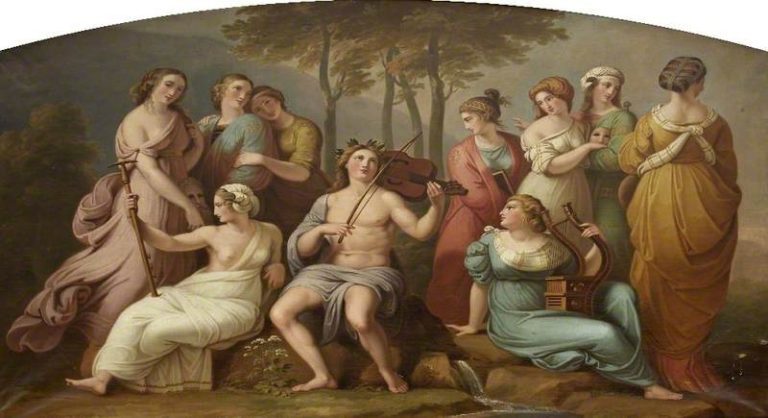
Third and very importantly, several of Plato's most important works specifically celebrate the mystical and non-rational. In Phaedrus in particular, the question arises as to whether madness, which is the most non-rational state imaginable, is always a bad thing. Socrates answers that it is not, because there are at least four forms of madness that come to us directly from the gods. These are prophetic madness, during which the gods speak directly through oracles; "telistic" madness, which is a form of divine purification and can include such altogether anti-rational activities as the Bacchic ecstasies; and the madness of erotic love, which, properly directed, can lead the lover upward toward union with the Divine. Finally, the fourth form of madness is poetic madness. In this form of madness, the poet is possessed by the Muses, and it is only through this Musical possession that one can write poetry, or at least, GOOD poetry! It's hard to imagine anything less rationalist than that. 
 
...Unless maybe it's this statement from Socrates, later in the dialogue: 
 
...the priests of the temple of Zeus at Dodona say that the first prophecies were the words of an oak. Everyone who lived at that time, not being as wise as you young ones are today, found it rewarding enough in their simplicity to listen to an oak or even a stone, so long as it was telling the truth...
 
 
These days, those are the sorts of words that one expects to find in a New Age bookshop, or perhaps in an anthology on Native American or Ancient Celtic spirituality-- the sort that opens with a long chapter explaining the difference between this worldview and our own rational, disenchanted way of looking a things. It's certainly not something you expect to see in one of the most important works of one of the supposedly-rationalist philosophers who gave rise to our supposedly-rationalist civilization. But there it is.

Disenchantment and the Western Mind

All of this is important for another reason, and it directly relates to something else that our preceptor Mr. Greer has been discussing, which is the idea of the disenchantment of the world.

"The disenchantment of the world" is a concept which originates a century ago in a sociologist named Max Weber. Weber claimed that, whereas primitive people had seen the world as alive, filled with spiritual beings and the possibility of magic, we moderns know better. It's very sad in a way, because the old worldview was nice, but it was also wrong, and now that we've outgrown it we're finally able to make things like medicine and trains and widgets.

In the intervening century, many authors have built on Weber. And one of the very common ways that ideas evolve in human history is that they are taken up in their entirety, but the terms are reversed. The classic example of this is the "Objectivist" philosophy of Ayn Rand. Rand swallowed hook, line, and sinker every Communist claim about the greed and selfishness inherent in Western capitalism, and then turned around and said "...But that's a good thing!"

In a similar way, many authors over the last century have believed Weber's claims about the disenchantment of the world, and then gone on to read them back into the entire history of Western civilization, as far as the Ancient Greeks. And then they've turned around and said, "And that's the problem with Western civilization, all this rationalism and disenchantment!" We are then, invariably, treated to a discussion of an another, non-Western worldview, which is fully enchanted, spiritual, mystical, and natural. Sometimes this view is imputed to Native Americans; sometimes to ancient and conveniently extinct peoples, especially Celts; sometimes to mystical traditions from India, China or Japan; sometimes all of the above. 

The trouble with this idea is that it is wrong. And it is wrong in both senses of the word, factual and moral. As a factual truth-claim it fails immediately. If you want to understand how wrong it is as a truth claim, consider how many of those great speeches about the sacredness of nature and oneness of all life that were supposedly written by Native Americans, ancient Celts, ancient Egyptians or whathaveyou were actually written by modern urban Americans. 

 
This we know: the Earth does not belong to man, man belongs to the Earth. All things are connected like the blood that unites us all. Man did not weave the web of life, he is merely a strand in it. Whatever he does to the web, he does to himself.
 

This was supposedly written by Chief Seattle in a letter to President Franklin Pierce in the 1850s. In reality, it was written by an unknown American environmentalist in the 1970s, based on several earlier versions-- all of them written by white people. Don't get me wrong, it's a very fine sentiment, and very true. And also very much a product of the true heritage of Western culture and Western philosophy. The very fact that we find it so moving demonstrates this. We value these words, because they express our values. 
 
And that leads to the second problem with the idea of disenchantment: It leads us to reject our own heritage. This is the sense in which it is not merely factually but morally wrong. Rationalism, insofar as it exists, is not at the heart of our civilization. The Greek philosophers employed reason, but they were not rationalists. The Scholastics of the Middle Ages were not rationalists. Even the founders of the scientific revolution were not rationalists. We have rationalists today, but to be completely honest with you, I'm not sure where they came from; they seem to have turned up all but spontaneously during the Victorian era and back-read their own existence through the whole of Western history. 
 
The problem with the West is not its rationalism, but its belief in its rationalism. We are not really rationalists, and we never have been. For a few centuries we've suffered through the existence of a few rationalists, whose volume was dialed up to 11 in recent decades. But at its core, our heritage is as mystical and as enchanted and as spiritual as any other. While we can look to Native American or Far Eastern teachers for spiritual direction if we choose to, we don't have to; we have all the resources we need within our own heritage and our own history. Plato employs reason, but he also rises above it, and he calls all of us to do so as well. This is the real heart of our common Western heritage. Don't reject it, embrace it.
Rushing to work today to make an 11:30 appointment, I looked down at my phone to make sure I had the time correct and discovered that the appointment had been canceled sometime between the time I left the house and that moment. And, looking at my phone, I managed to miss my exit, and drove some 20 more minutes into the mountains of Western Virginia before realizing what I had done. I now find myself sitting at a coffeeshop in a place called Purcellville, with several hours to kill, or to use.

And so I'd like to take the opportunity to discuss something that's frequently on my mind, which is the question of how we ought to read Plato's political writings, and what relevance they have to our modern politics. 

Plato and Politics

Modern treatments of Plato very often take him as some sort of weird old politician. In College I was forced to read the Crito in a Political Philosophy class, and told nothing of its author except that he was very old and very dead, but that we ought to know something about what he had thought on political topics merely as a way of saying "People have been talking about these matters for some time now."

Plato does indeed discuss politics-- or, rather, law-- in the Crito, but he treats of political matters much more fully in the Republic, the Statesman, and the Laws, three dialogues which come out to nearly 700 pages between them. As my own copy of the Complete Works of Plato comes out to around 1700 pages, these 3 dialogues between them make up some 40% of the entire body of Plato's work. Since Platonism has become so central to my thinking and to what I'm trying to do with this blog and my work in general, I thought it was worth spending some time on this issue. 

In this post, I'd like to give an overview of Plato's political views, discuss how we ought to approach Plato's politics and what relevance they have to our approach to Platonism as a spiritual discipline, and, finally, to see whether Platonic politics has any relevance to our modern world. 

Before we do that, though, it is critical that we understand what "politics" means in Plato's world.

The Polis

The word "politics," as you probably know, is derived from "polis," which is the ancient Greek word for a city. And, as you probably also know, the Greek world was composed of city-states, which were countries so small they were limited to a single city. This is what I was taught, at any rate, and if you know any better than this you're further along than I was just a short while ago. 

It is true that the political unit Plato was discussing was the polis and it is true that the polis is a city and that the reach of a particular government in ancient Greece did not extend beyond the reach of a particular polis. But matters are not as simple as that. The polis, you see, is not simply a smaller version of one of our modern states, nor is the government of a polis the equivalent to the US Congress on a smaller scale, or to the government of the town in which you live. The polis is not merely a smaller thing than the things that we have, it is a different kind of thing altogether.

The best book on this subject is The Ancient City, by a Frenchman named Fustel Coulanges; you ought to read the whole thing when you have a moment. In The Ancient City, Coulanges shows that, in the "cities" of the ancient world, the categories of human life that we currently separate under the headings "family" "religion" and "government" were not separate, but were a single category of experience called "the city" or "politics." 

To illustrate how such a thing is possible, let's think about it in reverse. In our society, the life-categories "marriage" "child-rearing" and "residence" are combined under the single heading, "family." A "family" consists, ideally, of a married couple, sharing a home, and raising their children. To us, nothing in the world could be more natural; even where this system breaks down, it is still there in the background as something which is missed. 

Imagine if we separated these things. Imagine a society in which husbands and wives don't live together-- the men live together with their friends and brothers in a dormitory or fraternity house, while the women have their own sorority, along with the youngest children. It's not that they don't get married-- they do. Husbands and wives go on dates and spend time together and sneak off into out of the way corners of town when they need some adult time. But they don't share a bed, and they don't share a house. And they don't raise children together-- the babies and young girls live with their mothers, yes, but men don't even raise their own sons. Instead, they raise their sisters' sons. When boys come of age, they are sent to live in their uncle's fraternity house, which is invariably in another city, since women move to a sorority house attached to their husband's fraternity, and it's considered somewhat incestuous to marry a girl from your home town. If a boy lacks an uncle, a suitable male relative is found for him, back in the mother's hometown-- but never his father.

Does that sound odd, or impossible? In fact, it's a very common social arrangement among certain tribes of the New Guinea highlands. So yes, it's very possible. 

Now let us suppose that a similar living arrangement is found among our own descendants living right here in America sometime around the year 4500. Categories of life that seem to us to be obviously connected seem to them to be completely separate. Moreover, just as we pride ourselves on having separated the categories of "religion" and "government"-- and both from "family"-- much of their identity as a people and a culture revolves around their having had the wisdom to separate residence from marriage and marriage from child-rearing.

Given such a set of circumstances, what would our descendants make of a modern philosopher who wrote at length about spiritual issues, but regularly connected them with the family-- an institution which they either no longer had, or no longer had in the same form? If a modern philosopher-- I give no examples as I don't know that there is one-- wrote several books of detailed advice on household-management, describing the proper roles of father, mother, and children, but also filled them with detailed discussions and hints and allegories of a grand and universal spiritual system, what could these descendants of ours do with it? Dismiss it out of hand? If so they would lose an enormous contribution to human wisdom and human excellence, as well as (let us imagine) the root of many of their own ideas. But if they attempted to adopt our philosopher's recommendations as far as household management whole-cloth, they would need to burn their own civilization to the ground and start again from scratch. And even if they managed it-- as they probably wouldn't-- it would be at the cost of an enormous amount of suffering and death. And they probably wouldn't manage it; they'd probably just get a lot of people killed. 

This, I argue, is precisely the position that we are in with regard to Plato's political writings. The polis that he wrote of does not exist, and the concepts that applied to it cannot be applied to our modern governments, as modern government-- this is critical-- is not the heir to the polis

The Fire, the House, and the King

Let's go back and discuss ancient society, drawing, again, on Coulanges.

The basic unit of that society is the fireplace

The fireplace? How is that possible?

In the ancient world the fire was-- as it still is today in India-- the living body of a god, or-- in the West-- a goddess, named Vesta at Rome and Hestia in Greece. Fire is a living being, and the fireplace-- the sacred hearth-- is a sacred altar. Every home has its fire, and lacking its fire, it is no home at all. The father, as head of the family, is also the high-priest of the religion of the hearth-fire. At the fire-- tended by his wife, the priestess-- the sacrifices are made every day to the spirits of the ancestors, the land on which the family lives, and the home in which they dwell. Sacrifices are made, too, to be sure, to the high gods and heroic ancestors that the family shares with its neighbors and its community as a whole, but at the microscopic level, each household is essentially a church and each family has its own, independent religion. 

And each family is also a kind of political unit, with the father as its king. 

In The Statesman, Plato discusses the nature of what he calls the True King, which is a leader who possesses the Science of Rulership. It's worth noting that, in the school of Iamblichus, The Statesman was read after The Sophist but before Philebus. In The Sophist, Plato discusses the nature of charlatan-philosophers called sophists, but the later Platonists understood him to also be discussing a being called the "Sublunar Demiurge," who is the trickster-god that creates the world that we experience with our senses, the exact equivalent of the Hindu Maya. The Philebus, meanwhile, is a discussion of the nature of the Good, which is the First God and Highest Principle. The Statesman must, therefore, also be understood as a dialogue about the nature of God Himself-- that is, the God that creates and governs the cosmos as a whole. 

In the Statesman, Plato is explicit about the relationship between rulership of a city and rule of a household:


Stranger: Are we, then, to regard the statesman, the king, the slavemaster, and the master of a household as essentially one though we use all these names for them, or shall we say that four distinct sciences exist, each of them corresponding to one of the four titles?

....

Stranger: The science possessed by the True King is the Science of Kingship?

Socrates: Yes.

Stranger: The possessor of this science, then, whether he is in fact in power or has only the status of a private citizen, will properly be called a "statesman" since his knowledge of the art qualifies him for the title whatever his circumstances. 

Socrates: Yes, he is undoubtedly entitled to that name.

Stranger: Then consider a further point. The slavemaster and the master of a household are identical.

Socrates: YEs.

Stranger: Furthermore is there much difference between a large household organization and a small-sized city, so far as the exercise of authority over it is concerned?

Socrates: None. 

Stranger: Well, then, our point is clearly made. Once science covers all these several spheres and we will not quarrel with a man who prefers any one of the particular names for it; he can call it royal science, political science, or science of household management. 

Layers of Meaning

All of Plato's dialogues were understood to have multiple layers of meaning. The Statesman is about the Science of political leadership, but it is also about how God rules the universe. The Republic, meanwhile, is supposedly a discussion of the ideal city, but Plato is explicit at the beginning of the dialogue that the city in quetsion is intended as an allegory of the soul:

 
Suppose [Here Socrates is speaking] that a short-sighted person had been asked by some one to read small letters from a distance; and it occurred to some one else that they might be found in another place which was larger and in which the letters were larger --if they were the same and he could read the larger letters first, and then proceed to the lesser --this would have been thought a rare piece of good fortune.
 
Very true, said Adeimantus; but how does the illustration apply to our enquiry?
 
I will tell you, I replied; justice, which is the subject of our enquiry, is, as you know, sometimes spoken of as the virtue of an individual, and sometimes as the virtue of a State.
 
True, he replied.
 
And is not a State larger than an individual?

It is.

Then in the larger the quantity of justice is likely to be larger and more easily discernible. I propose therefore that we enquire into the nature of justice and injustice, first as they appear in the State, and secondly in the individual, proceeding from the greater to the lesser and comparing them.

Summarizing

Let's summarize our argument before we proceed. Two major issues have emerged:

1. The polis of Plato is not a smaller form of a modern state. It is, rather, a different form of social organization, in which the categories of life that we currently separate under the headings "family," "religion," and "government" are combined. Plato's political arguments, therefore, cannot be applied to our current forms of government on a one to one basis.

2. Plato's political writings, like all of his writings, admit of more than one reading. What appears to be a discussion of an ideal ruler of a city can also be understood either as a description of God in his government of the universe, or as advice to the individual concerning the care of his own soul, which is regularly likened to a state with workers, soldiers, and leaders.

The Heir to the Polis

Let's consider the first issue. 

Given the foregoing, the questions become: Do Plato's political theories have any applicability to our modern world as political theories? And, if so, can they be understood as applying to government, or are there other structures or organizations which might better be understood as heirs to the ancient polis?

Now, to a real extent, this is where we leave the domain of Truth and enter into the realm of Opinion. There are no fixed answers to these questions, and certainly Plato himself could not have anticipated them and gives no explicit guidance concerning them. So the following can only be my own view of hte topic. 

That said, it's my view that Plato's writings on politics-- especially the three dialogues mentioned-- are very important, and very worth reading. But in a modern context, and perhaps especially in an American context, they have only minimal applicability to government as such. They work far better when applied to the lives of other heirs to the polis, including individuals and families, but also what are often called "civil society" organizations-- which can include anything from a church to a charity to a bowling league.

To illustrate what I mean, let's take another example from the Statesman, since it's currently open in front of me.

Toward the end of the dialogue, Plato describes the ways in which different virtues can be opposed to one another. Courage and Moderation, in particular, frequently come into conflict. Moreover, particular individuals often exhibit one personality type or the other, and these individuals then come into conflict. This leads to the ruin of hte state if individuals of either one type or hte other predominate. A state overrun by individuals of hte courageous type will be forever looking for conflicts with its neighbors, until it eventually antagonizes a larger power or a coalition of smaller powers and is overrun. A state dominated by the moderate type, meanwhile, will not fight even when it is necessary, and will soon find itself enslaved by its enemies. The wise statesman weaves together both types of individuals, so that they strengthen one another, allowing the state to fight or to make peace as necessary.

So far, this actually does seem like rather good advice as far as modern statecraft goes, even up to the level of global powers like the US and Russia. 

But in the next part, Plato strays well beyond what is possible for any modern government. Having described the sort of education that unites the moderate and courageous types as the "divine link" between them, he now sets out to describe how to link them on the human level:

Socrates: But what are these links and how can they be forged?

Stranger: They are forged by establishing intermarriage between the two types so that the children of the mixed marriages are so to speak shared between them and by restricting private arrangements for marrying off daughters. Most men make unsuitable matches from the point of view of the betting of children of the best type of character.

...

Stranger: The moderate natures look for a partner like themselves, and so far as they can, they choose their wives from women of the quiet type. When they have daughters to bestow in marriage, once again they look for this type of character in the prospective husband. The courageous class does just the same thing and looks for others of the same type. All this goes on, though both types should be doing exactly the opposite. 

Yes, he's arguing for exactly what we in the modern world call "eugenics," and which we know is a disaster in the hands of a government. 

But does that mean that it's bad advice?

Consider that what Plato is saying here is "Marry someone whose strengths balance your weaknesses." The exact same idea is found in Carl Jung under the heading "Animus and Anima." And note that Plato very explicitly does not say something like "Men are aggressive and should therefore look for passive women to find balance," as one might expect from some of our modern "conservatives." No-- he says "Any person can be of the more active or more passive type, and both are necessary for a society. In a good marriage, an active woman is balanced by a passive man, or an active man by a passive woman." To my mind, that's exceedingly good advice-- to individuals. From a spiritual perspective, it can also be described as balancing fire and water or yin and yang energies. 

As far as the Science of Kingship itself, this can be applied to any situation, from a political ruler to a church to a corporate boardroom. Anyone who has authority over any group of people, whether a nation or simply their own children, is a king, and can and should acquire and use the Science of Kingship. 

Concluding: Who Is Above The Law?

After all this, I have to tell you that the best way to come to understand Plato's political writings is simply to read them. The Republic, Statesman and Laws are fun to read and, if you practice it, great sources of themes for discursive meditation. While you read them, ask yourself: How can I apply these ideas to my own life? Not to the ancient world which no longer exists, much less to (God help us) reforming society according to some ideal image, but to becoming a True King over yourself above all, and in all those situations which call for the exercise of leadership, wisdom, justice, courage and self-mastery. 

Let me give one example before we go. 

The Laws is-- you may have guessed this-- an entire book of laws for a hypothetical colony. Early on in the dialogue, Plato tells us that the very best society doesn't need laws-- its people hold all things in common-- including wives-- and live together as one. Is he arguing for Communism? No-- Such a society cannot be found on this earth, but is suitable only for gods or demigods (Compare Jesus: "In Heaven there is no marrying or giving in marriage.) On this Earth the best we can do is to imitate the ideal, the heavenly society; and so the laws he gives are only the second-best form of society. And then he tells us, "But you're probably only going to end up with the third best." He promises to tell us what the third best form of society might look like... and then never gets around to it. 

Meanwhile, in the Statesman, Plato also discusses the nature of law. Here, he says that the worst sorts of societies are lawless. Does that mean that societies governed by law are best? No, not at all. Law is only an imitation of the statesmanship of the True King. In real life-- as you know and as I know-- the actual situations we encounter and the people we encounter in them are far too variable to be covered under any code of laws, no matter how extensive. The True King does not rule by laws, but by Science: That is, a True Knowledge of what is good and evil. Rather than legal codes of the "Thou shalt not" variety, he governs by applying unchanging, eternal principles, to everchanging, particular situations

Now, is it possible for our nations to be governed in this way? 

Of course not. Plato is literally saying that the True King is above the law, and he means it. When our leaders set themselves above the law, they merely cast themselves below it. At the political level, we must have laws and be governed by laws, and no one must be above them. 

But what about the other levels? How do Plato's insights apply to those other inheritors of the fragments of the polis-- that is, the family, and the church?

Are we really to suppose, for example, that God Himself governs according to a mere petty legalist, checking our good and bad deeds and, above all, our opinions against a written set of rules that decide whether we get into Heaven or get tossed into the fire? Or do we suppose that he is a True King, applying eternal principles which He knows best of all to the everchanging situations of our material universe? 

And, if we suppose that God is a True King-- as I believe He is-- how can we imitate him in our daily affairs, especially those under our own authority? Can we become better parents by rising above our own laws? Better managers? Better priests, teachers, ministers, spouses, friends? 

I think so. What do you think? 
Sorry for the light posting this week-- it'll probably be this way on and off during the Summer, as I have far more spouses and children at home than I'm used to. But let's take a look at our next Beatitude, the Sixth, in The Gospel of Matthew, Chapter 5, Verse 8

Blessed are the pure in heart: for they shall see God. 

The Inner Vision

Every Beatitude follows a simple two-part formula: first we're given a prescription, then a promise. Let's begin with the promise, in this case. By following Jesus's path, we shall "see God."

What does this mean?

Remember our definitions of God. God is the One, the transcendent principle through which all reality is brought into being. God is the Most High God, the chief and leader of all the spiritual beings that dwell in the immaterial world of the spirit and care for the material world. God is YHVH, the particular God of the Jews, whose name means "He Brings Into Being All That Exists," and who has-- perhaps-- been revealed as the High God of all peoples. 

And Jesus tells us we will see Him. 

How? With our eyes?

Of course not; God is not visible.

Recall what we said about the Nous. It is the highest faculty of the human soul, transcending what we ordinarily mean by soul. And it is a kind of eye-- an eye which is open to spiritual realities, by which we perceive spiritual realities. 

Once again, Jesus is teaching us metanoia-- "repentance"-- that is, how to change our Nous. By doing so, we will attain the Kingdom of Heaven, which is already within us, and we will see God directly.

The Cave

Do you remember the Allegory of the Cave from Plato's Republic?

If not, let's have a quick recap.

Imagine, (says Plato), that you had spent your life imprisoned in a cave underground. You were chained in such a way that you could look neither left nor right, up nor down, but only at the cave wall in front of you. Next to you were many other prisoners, all in the same situation. Now behind you there is a fire, which casts its light on the wall ahead. All day long, men walk back and forth between you and the fire, carrying cardboard cutouts in the shape of trees and houses and dogs and people. The light of the fire throws the shadows of these images on the wall in front of you, and these shadows are the only things that you have ever seen, so that you think the shadows of images of trees and houses and dogs and people actually are trees and houses and dogs and people. 

One day, someone frees you from your chains and leads you up, out of the cave, into the real world.

At first you can't see very much, because it's too bright, and your eyes need time to adjust. You can only really come out at night, when the light is dim, and so you're still only seeing the shadows of things. Slowly, your vision improves, and you're able to go abroad in the day and really see the actual trees and houses and dogs and people. Eventually, after a long time perhaps, you'd be able to look up and see the Sun itself, and see that it casts the light by which you can see everything up here, in the real world.

Plato concludes his allegory thusly:

Dear Glaucon, the prison-house is the world of sight, the light of the fire is the Sun, the journey upwards, the ascent of the soul to the intellectual world. It seems to me that in the world of knowledge the Idea of Good appears last of all and is seen only with an effort, and when seen, is also inferred to be the universal author of all things beautiful and right, parent of light and of the lord of light in this visible world, and the immediate source of reason and truth in the intellectual; and that this is the power upon which he who would act rationally in public or private life must have his eyes fixed.

Eggheads

Reading Plato or his successors in translation is dangerous, in the same way that reading the Bible is dangerous. As we've discussed here before, the word "Intellectual" in a Platonic context doesn't mean the thinking mind, and Philosophy is not just a bunch of eggheads sitting around a college dorm talking about some real stuff, man. The word "Intellect" is a translation of Nous. Over the course of time and the degeneration of Western culture it has come to mean discursive reasoning, which is a lesser (though still important) faculty, called Dianoia in Greek. Plato's ascent to the "Intellectual" world is an ascent to the Noetic world, the realm of the eternal beings which create and shape and care for material reality. At the height of that world is the Idea of the Good, which is the source of the light of the Noetic Realm, and which is the image of the Good Itself, the closest we can get to attaining It. 

Remember that the Good is another name for the One, which is God, and the Idea of Good is also called the Son of the Good. 

Purity

In this Beatitude, then, Jesus is teaching us the manner by which we may open the eye of our Soul-- that is, our Nous-- to the Vision of God. 

And how shall we do this?

By "purity of heart."

What does this mean?

Let's answer this question by grasping it from the other direction. 

In Chapter 18 of the second book of the Doctrine and Ritual of High Magic, Eliphas Levi discusses the work of enchanters. As an aside, it's very interesting to read this chapter in full, as it discusses the means by which a person can put another under their power for the purpose of sexual exploitation. Read it, and you will understand exactly what men in the "Pick Up Artist" community-- and their female opposite numbers-- are doing. It's black magic, pure and simple. In any case, Levi writes that:

To reduce the action of intelligence is to augment in equal proportion the opposing forces of mad passion. Love of the type which evildoers wish to inspire, and of which we speak here, is a veritable stultification and the most shameful type of moral servitude.

Like the word "Intellect," Intelligence doesn't refer to discursive reasoning-- or, to be more accurate, it doesn't just mean that, it also means the power that extends above Reason, into what we would ordinarily call the Spiritual Realm. 

Now, the work of an evil sorcerer is of the same type as the work of the Devil, and is a subset of it. The heart-- in the context of this passage-- is the source of all of our passions and emotions. When these are disordered, overwhelmed with the chaotic impulses that come from our society; from deliberate evil intelligences, whether human or otherwise; and from our own animal nature-- that is to say, from the World, the Flesh, and the Devil-- then our Intelligence is reduced our Nous is clouded, and we are unable to see God.

Levi is talking specifically about sexual seduction, but evil magic of the same type is endemic in our society; we normally call it "advertising." Its purpose is to reduce activate the passions, reduce the intelligence, and, thereby, to render you a slave.

By purifying the heart of all that is foreign to it, we open the Nous to the Vision of God. 

What is the One that Precedes the Multiple?

Let's close with some lines from Plotinus. In the Fifth Ennead, he is discussing the three levels of existence above the physical. First there is the Soul; but above the Soul, or at its very height, there is the Nous, which is also called (in translation) Intellect and Divine Mind. And then there is that which is beyond Nous.

Our own soul is of the same nature with this by which the gods are divine, so that to consider it purified, freed from all that is adventitious, is to see how precious the essence of the soul is, far more honorable than anything bodily...

But over this Soul there is a diviner still, its prior and its source; for though so great a thing, Soul is but an image and an utterance of Divine Mind, the stream of life sent forth by It to the production of further being, the forthgoing heat of a fire in which also heat essentially inheres. Sprung from Divine Mind, Soul is intellective too; for its perfecting it must look to that Divine Mind which may be thought of as watching over its child.

Bring itself closer to Divine Mind, becoming one with It, Soul seeks still further: What Being, now, has engendered this God, what is the One preceding this multiple? Before duality, there must stand the Unity

How comes it, then, that possessed of such powers, we do not lay hold of them, but for the most part let them go idle, some of us indeed never bringing them to effect?

We remain unaware of them because the human being includes sense-perception too. If there is to be consciousness of what is thus present, we must turn the perceptive faculty inward and hold it to attention there. Hoping to hear a desired voice we let all others pass and are alert for the coming at last of that most welcome of sounds; so here, we must let the hearings of senses go by, save for sheer necessity, and keep the soul's perception bright and quick to the voices from above. 


Welcome back to our ongoing occult Bible study! I've selected just a few short lines for today, because we have a lot to talk about before we can go forward, and what we say here is going to shape everything we talk about from here on out.

The Gospel of Matthew, Chapter 3, Verses 1-2

1 In those days came John the Baptist, preaching in the wilderness of Judaea,
 
2 And saying, Repent ye: for the kingdom of heaven is at hand.
 
Saint John the Baptist

Let me begin by wishing you a blessed Feast of the Nativity of Saint John the Baptist! Yes, it's today, and no, I didn't plan it this way-- it "just so happens" that he enters our discussion here on his Feast Day. If you follow this path for just a little while, you'll find a lot of things "just so happen."

Notice that his Feast falls on the 24th of June. This puts it at the opposite point on the Wheel of the Year from Christmas, and shows us that the two feasts, and the two figures commemorated therein, are connected. On Saint John's Day, the Summer Solstice is just past. The Light of the Sun has triumphed over the darkness, and high summer is here-- but now begins the long, slow decline that will culminate in the darkness of Midwinter.

John is, we are told, Jesus's cousin, born six months prior to him; we can therefore set the date of his birth at around 3BC. It seems worth noting that this is the High Summer and the beginning of the end of the Classical pagan civilization that will be replaced by Christendom. Jesus will later say, rather mysteriously, that John is the greatest of all the prophets, and yet the least in the Kingdom of Heaven are greater than he.

Magic Rites

Certain places are places of power, where magical works for good or ill are strengthened or particular spirits may be contacted; similarly, certain points on the calendar are times of power, when particular rites may be accomplished. These two types of power-points, geographic and temporal, are related to the two great currents of magical power. The Telluric current arises from the heart of the Earth, and governs magical places; the Solar current descends from the heart of the Sun, and governs magical times. 

Saint John's Day is a potent day for certain types of magic.

Traditionally, the herb known as Saint John's wort was gathered on this day. The flowers can be dried, blessed, and hung above doorways to protect the home from malefic magic. It was also customary to build bonfires on Saint John's Day or Saint John's Eve. The fires were blessed and piled with Saint John's Wort, and livestock were then driven through the smoke, in order to protect them from witchcraft and evil spirits. Of course, most Christians today are far too smart to do such things, because Christians today are actually atheists, and what Christians think is "paganism" is actually Christianity.

A Bit of Speculation

In the thinking of Rudolph Steiner, there are two different types of Evil, represented by the demons Lucifer and Ahriman. The evil of Ahriman is the evil of wallowing in gross matter and sensory pleasure, rejecting the life of the Spirit. In a sense, it is the evil which fueled every side of the 20th century's Cold War, as that was mainly a contest over which economic system was better at producing and distributing material goods. The Communist side was officially atheist, but the capitalist side was tacitly so, justifying itself in religious terms only to mollify certain reactionary forces in the United States.

Luciferic evil, on the other hand, is the total rejection of matter and physical existence.

Discussing Classical Pagan civilization, the civilization whose peak and decline is marked by the Birth of Christ, Steiner writes:

If this ancient Paganism is rightly understood, it will be found to contain sublime, deeply penetrating wisdom, but no moral impulses for human action...

But why should this be the case?

Steiner tells us:


It was because through the millennia directly preceding Christianity, this Pagan wisdom was inspired from a place far away in Asia, inspired by a remarkable Being who had been incarnated in the distant East in the third millennium before Christ — namely, Lucifer.

To the many things we have learned about the evolution of humanity, this knowledge too must be added: that just as there was the incarnation which culminated in Golgotha, the incarnation of Christ in the man Jesus of Nazareth, there was an actual incarnation of Lucifer in far off Asia, in the third millennium B.C. And the source of inspiration for much ancient culture was what can only be described as an earthly incarnation of Lucifer in a man of flesh and blood.

The Wisdom of the Pagan World is rooted, ultimately, in an incarnation of Lucifer. This is why we see, in the High Philosophy of many pagan traditions, the total rejection of physical matter and incarnate existence.

According to Steiner, Lucifer was incarnated upon the Earth in Eastern Asia in the 3rd Millennium BC.

The Forerunner
 

John comes before Christ, and heralds his coming. The decline of the light immediately following the Summer Solstice heralds the approach of winter and the rebirth of the light following the Winter Solstice. John must decline, that Christ may increase.

The Goodness of Christ stands between the evil of Lucifer, the rejection of matter, and the evil of Ahriman, the rejection of Spirit. John is the last Great Prophet of the world before Christ. He is not a pagan prophet, of course, but a Jewish one, but he still dwells in the old world-- we'll see this more clearly when we discuss the work of Baptism. 

Say Your Prayers

John tells his followers, "Repent, for the Kingdom of Heaven" is at hand.

I don't know about you, but for most of my life and especially during my childhood, I thought those words meant something like this:

Say you're sorry, punk, because God's about to show up and kick the living shit out of you.

As amusing as that interpretation is, it isn't true. The word "repent" doesn't mean "Say you're sorry and be really sad." It's much more interesting that.

"Repent" in Greek is "metanoia." "Meta" means "change." "Noia" is derived from the word "nous," which means "mind."

To repent is to change one's mind. Often one will hear this described as a "change of heart," and there is a reason for this, which we'll get to momentarily.

And John says we must do this, because the Kingdom of Heaven is at hand, or "has drawn near," or "is among you." 

If the Kingdom of Heaven means anything, it is the sovereignty of God. But what sort of kingdom is it? The message we will see over and over in the Gospels is that it is not, and cannot be, a political kingdom. Heaven is not Earth, and Divine Power is, as we saw last time, not human political power. 

The Kingdom of Heaven is the reign of God within the human soul.

God, remember, is the Most High God, the Spirit who rules the Universe; and is identical to the One, which is also called goodness itself or The Good; and is that power by which we accomplish the Great Work, become that which we are meant to become, and gain mastery over our souls and our futures.

"Heaven" is the proper home of God, and since Heaven is, contra the '90s song, neither a place, nor on the Earth, it is not a location at all. Rather, it is a condition, and that condition must be the condition of the presence of God-- since Heaven is where God lives. Therefore, whenever we are in the presence of God, we are in Heaven. 

We attain the Kingdom of God by changing our minds-- or, rather, our nous. And so we'll have to talk about what that means.

More on the Kingdom of Heaven

On the magical worldview, the spiritual world is not separate from the material. Matter is only the last and most tenuous extension of spirit. Have you ever been to the sort of place-- perhaps a majestic cathedral, perhaps a natural setting like the ancient Redwood forests in the Pacific Northwest-- that filled you with a sense of awe, reverence and serenity all at once?

Those are places that border on Heaven, in which Heaven is made manifest.

On the other hand, have you ever driven through the kind of neighborhood that filled you with a sense of dread and foreboding, the kind of place that seemed marked by rage, violence and addiction?

That was a mouth of Hell. 

Lately, I've found that the sort of outwardly pleasant suburban neighborhoods where every person still goes about in a facemask, with a suspicious look in their eye, and the tension in the air is so thick you're afraid to breathe too heavilyand most of the lawns have signs that say 

IN THIS HOUSE, WE BELIEVE
BLACK LIVES MATTER
WOMEN'S RIGHTS ARE HUMAN RIGHTS
NO HUMAN IS ILLEGAL
SCIENCE IS REAL
LOVE IS LOVE
KINDNESS IS EVERYTHING

Those are hellmouths, too.

One doesn't have to travel as far as a cathedral or a redwood forest to find Heaven on Earth. In the old story, a samurai approaches a Zen master and says "Teach me about Heaven and Hell."

The Zen master replies, "It's a real shame that they're letting dumbasses like you become samurai these days."

Enraged, the samurai draws his sword and prepares to cut the Zen master's head off.

"This is Hell," says Zen master.

The Samurai understands. In an instant, his heart is changed: He sheaths his sword and bows in gratitude.

"And this is Heaven," Zen master says.

Heaven is never far away, and neither is Hell. 

An Anatomy of the Soul

In the Republic, Plato tells us that the soul consists of three parts:

Nous
Thymos
Epithymia

Now "nous" is often translated into English as "reason," but that is incorrect. Reason, which is dianoia in Greek, is part of nous, but nous isn't limited to reason. Proclus tells us that nous also has three parts: the lowest is opinion (in Greek, doxa). Above this is dianoia, and above dianoia, nous proper, which is sometimes translated as "Intellection."

Intellection is not a familiar concept to most modern people. In the modern, scientific worldview, the highest capacity of the mind is reason; intellection does not exist. That is the literal meaning of the word "rationalism." In that way, we can see that Rationalism itself is already a debasement. In Intellection, the nous is functioning on its own, proper level-- the level of pure being which is above manifested, material reality. On this level, it is able to grasp the objects of knowledge immediately and entirely, without any intermediary thought process. This is very hard to describe in English. 

In Christian literature, the nous is sometimes called "the eye of the soul," and Intellection is the process through which the soul interacts directly with God and spiritual beings. Bear this in mind as we continue.

Thymos is another word which doesn't have an exact translation in English. It's often rendered "spirit," but what's meant by "spirit" in this case isn't the eternal soul, but, rather, what we mean when we say that someone is "in good spirits," or that a horse is "high-spirited." Sometimes it is rendered "anger," but that isn't exactly it, either. The Thymos is the inner strength or energy.

The best English translation of thymos is probably "heart," as that word is used by high school athletics coaches. Traditionally, the Thymos was seen as located in the heart, while the Nous is in the head and Epithymia, which means "appetite" and refers to all of those desires that we share with the lower animals, is in the abdomen. It is worth noting that this arrangement of powers in the human body corresponds exactly to the three dan tiens of Chinese Taoist inner alchemy. 

It is the failure of the Thymos in modern man that C.S. Lewis discussed in his essay, "Men Without Chests," in The Abolition of Man. Drawing directly on Plato, Lewis describes the proper relationship between the three parts of the soul:

The head rules the belly through the chest — the seat, as Alanus tells us, of Magnanimity, of emotions organized by trained habit into stable sentiments. The Chest-Magnanimity-Sentiment — these are the indispensable liaison officers between cerebral man and visceral man. It may even be said that it is by this middle element that man is man: for by his intellect he is mere spirit and by his appetite mere animal.

The work of Ahriman is to render man headless; that of Lucifer, abdomen-less. (There is a less polite way of saying this; I'll let you work it out yourself).

The work of the two together in the modern world has produced Lewis's Men Without Chests. 

Each one of our three energy centers has its own proper virtues, and its own afflictions which must be overcome. The result of the spiritual life, the attainment of the kingdom of Heaven and the accomplishment of the Great Work, also means all parts of our psychic anatomy working harmoniously. The nature of this harmony is the virtue of Justice in Plato, and its consideration is the entire purpose of the Republic. Jesus's Kingdom of Heaven is the harmonious spiritual republic of Plato. Eventually, Jesus will teach us how to bring each part of the soul into harmony. 

We begin by changing our nous. We will discuss what this means as we go forward.
 
 Okay, I wanted to say one last thing about The Art of War.

Ove rhte last 5 months I talked about a lot of different things, from fighting demons to getting laid, using Sun Tzu as a springboard. But the thing I keep coming back to is the Great Work, defined by Eliphas Levi as:

The creation of man by himself, that is to say, the full and entire conquest of his faculties and his future; it is especially the perfect emancipation of his will.
 
I have described this as the conquest and command of our own souls. 

In some schools of Christianity, there is a great deal of confusion around the state of one's soul. The Catholic Church claims that extra ecclesiam nulla salus-- in English, "outside the Church, there is no salvation." It also claims that certain sins totally break one's relationship with God, and require the intervention of a priest to be forgiven.

Rather more appallingly, John Calvin claimed that some souls are damned eternally, and others saved eternally, by God for no particular reason other than because he can do it. 

I do not accept these claims, or any claims like them. In fact, they are sheer nonsense, and we can know that they are nonsense for this reason:

You always know the state of your own soul.

The soul, let us remember, is the animating principle (from Latin "anima," root of our words "animal" and "animated") of an organism. Your soul is you: The sum total of your actions and your mental states.

Do you spend all of your time locked in internal arguments against imagined enemies, lashing out at other people who remind you of those enemies, and occasionally soothing yourself with booze or videogames or masturbation or drugs?

You are damned. Not after death, and not eternally. You are a slave to your passions, and you are in Hell right now. 

Do you have self control, and is your resting mental state one of quiet poise and emotional balance? Are you able to enjoy the pleasures of life without being overcome by them and to respond to adversity without being shattered? 

You are saved. Not after death, and maybe not eternally. You have gained control of your faculties and your future, and the goodness which is divinity is manifest within you. You are in Heaven, right now.

Now, the purpose of spiritual practice is to lead us to salvation. If a spiritual practice is leading us in the direction of self-control, emotional balance, and an awareness of the presence and activity of the divine in our lives, then it is working. No matter what it is, and no matter who thinks it isn't working, doesn't work, can't work, or shouldn't work.

Conversely, if a spiritual practice is leading us in the direction of neuroticism, Manichaean thinking, subordination of the mind to contemporary fashions (either slavishly accepting or unthinkingly rejecting), and either enslavement to the passions or a constant internal struggle with them, it isn't working. No matter what it is, and no matter who thinks it does work, can work, must work, or should work. 

Are you winning the battle for your soul? Ask yourself the question, be honest about the answer, and persevere in the struggle!

I want to close with a fragment from the Alcibiades. This is one of Plato's dialogs, and was the first that a student would be given to study in the philosophical school founded by Iamblichus. (It's worth mentioning that the Alcibiades was believed to have been a forgery by 19th century scholars, but no one in antiquity believed that, and the 19th century had a mania for thinking that everyone who lived prior to the birth of Queen Victoria was dumb.) The setting is a conversation between Socrates and his former lover, Alcibiades.


SOCRATES: Then vice is only suited to a slave?
 
ALCIBIADES: Yes.
 
SOCRATES: And virtue to a freeman?
 
ALCIBIADES: Yes.
 
SOCRATES: And, O my friend, is not the condition of a slave to be avoided?
 
ALCIBIADES: Certainly, Socrates.
 
SOCRATES: And are you now conscious of your own state? And do you know whether you are a freeman or not?
 
ALCIBIADES: I think that I am very conscious indeed of my own state.
 
SOCRATES: And do you know how to escape out of a state which I do not even like to name to my beauty?
 
ALCIBIADES: Yes, I do.
 
SOCRATES: How?
 
ALCIBIADES: By your help, Socrates.
 
SOCRATES: That is not well said, Alcibiades.
 
ALCIBIADES: What ought I to have said?
 
SOCRATES: By the help of God.
 
Let's move on to Chapter 9 of The Art of War. I'm going to take the rest of the book somewhat quickly. 

We come now to the question of encamping the army, and observing signs of the enemy.

Pass quickly over mountains, and keep in the neighborhood of valleys.
 

The heading of this chapter is The Army on the March. Sun Tzu gives us details specific to actual military maneuvering, here. But are there general principles that we can tease out and apply to our own lives?

Let's see.

The point of telling us to "pass quickly over mountains," our translator notes, is that we need to not "linger among barren uplands, but keep close to supplies of water and grass."

Water and grass are fuel for men and horses. We can say for the soul generally, keeping in mind Plato's image of the soul as a winged chariot, pulled by two horses. "Barren uplands," then, are all those places in which the soul can find no nourishment, no water for the men nor grass for the horses.

What is it that nourishes the soul?

This varies from person to person, of course, depending on our individual needs and desires. There are some constants, though. Every soul is nourished by vital energy: Real food, fresh air, sunlight, the presence of other living beings. Every soul is nourished by beauty: In music, art, architecture, and stories. Every soul is nourished by purpose: By fulfilling that charge or set of charges which is its own to dispatch upon the Earth. 

And every soul without exception is nourished by Love. Love for God; for one's parents or mentors, one's children or students, one's friends, one's lover; for one's town and country, for a forest or mountain range, for one's own animals and plants-- relationship is another way to say this. 

Let us recall Plato's words in the Phaedrus:


Ten thousand years must elapse before the soul of each one can return to the place from whence she came, for she cannot grow her wings in less; only the soul of a philosopher, guileless and true, or the soul of a lover, who is not devoid of philosophy, may acquire wings in the third of the recurring periods of a thousand years; he is distinguished from the ordinary good man who gains wings in three thousand years:-and they who choose this life three times in succession have wings given them, and go away at the end of three thousand years. But the others receive judgment when they have completed their first life, and after the judgment they go, some of them to the houses of correction which are under the earth, and are punished; others to some place in heaven whither they are lightly borne by justice, and there they live in a manner worthy of the life which they led here when in the form of men. And at the end of the first thousand years the good souls and also the evil souls both come to draw lots and choose their second life, and they may take any which they please. The soul of a man may pass into the life of a beast, or from the beast return again into the man. But the soul which has never seen the truth will not pass into the human form. For a man must have intelligence of universals, and be able to proceed from the many particulars of sense to one conception of reason;-this is the recollection of those things which our soul once saw while following God-when regardless of that which we now call being she raised her head up towards the true being. And therefore the mind of the philosopher alone has wings; and this is just, for he is always, according to the measure of his abilities, clinging in recollection to those things in which God abides, and in beholding which He is what He is. And he who employs aright these memories is ever being initiated into perfect mysteries and alone becomes truly perfect. But, as he forgets earthly interests and is rapt in the divine, the vulgar deem him mad, and rebuke him; they do not see that he is inspired.
 
Stay close to the air and the sunlight; don't linger in catacombs, even if they're well stocked with groceries. Find time every day to do the things that you are meant to do on this Earth. And abide not long in a life devoid of love!
 Let's return to Sun Tzu, and to our discussion of the Spiritual Warfare.

Therefore the skillful leader subdues the enemy's troops without any fighting; he captures their cities without laying siege to them; he overthrows their kingdom without lengthy operations in the field. 

 
Now, our translator points out that the Chinese character 國, here being translated as "kingdom", refers especially to the government of a kingdom. In other words, the skillful leader overthrows the government without destroying the people. (The US strategy of regime change via "color revolution" is relevant here, though slightly off topic.)

As we have seen, the field of battle in the Spiritual Warfare is the soul, both the soul of the individual man and woman and the field of soul-stuff generally. And as we have also seen, at least a part of our souls-- all of our souls, I would guess-- is currently under the occupation of the Enemy. It is that part that we must reconquer-- if we are skillful, without strain or internal struggle; without lengthy operations in the field.

But how?

For assistance, let's turn to two other thinkers: the first is Plato; the second Bill Wilson, the founder of Alcoholics Anonymous.

At the beginning of The Republic, Plato tells us that the imaginary country he is describing is intended as an image of the soul. For, as Socrates says, the soul itself is too small to be seen; if we blow it up to the size of a kingdom, though, we can explore and understand it. And so Plato tells us that in the properly ordered kingdom, there will be three classes of people: the rulers, the soldiery, and the workers, all working together in harmony.

Now the rulers represent the reason and the divine part within us; the soldiers, the spirited part (call it the energy or the enthusiasm), and the workers the desires. In a properly ordered soul, the desires and passions will be subordinated to the rule of reason and divinity. The high-spirited part, the energy and enthusiasm, will support the goals of the reason and keep the passions in line. 

Now the rule of the demonic manifests in subordination to the passions

As we've discussed before, in the current world order, the primary vector for demonic attack is The Internet. And the Internet, especially social media, is deliberately designed to hijack to the brain and induce addictive behavior

And that's where Bill Wilson comes in.

In 1961, Wilson wrote to the psychologist Carl Jung what he called "a letter of great appreciation." 

The main subject of Wilson's letter was one of the early members of Alcoholics Anonymous, a one Roland H., who had previously been one of Jung's patients. Jung, however, had been unable to cure Mr. H of his addiction, and was forced to tell him that his case was probably hopeless. Wilson writes,

When he then asked you if there was any other hope, you told him that there might be, provided he could become the subject of a spiritual or religious experience—in short, a genuine conversion. You pointed out how such an experience, if brought about, might remotivate him when nothing else could. But you did caution, though, that while such experiences had sometimes brought recovery to alcoholics, they were, nevertheless, comparatively rare. You recommended that he place himself in a religious atmosphere and hope for the best.

Jung's response is extremely interesting:

 
His craving for alcohol was the equivalent, on a low level, of the spiritual thirst of our being for wholeness, expressed in medieval language: the union with God.

Jung continues-- and this is worth quoting at length--

The only right and legitimate way to such an experience is that it happens to you in reality, and it can only happen to you when you walk on a path which leads you to higher understanding. You might be led to that goal by an act of grace or through a personal and honest contact with friends, or through a higher education of the mind beyond the confines of mere rationalism. I see from your letter that Roland H. has chosen the second way, which was, under the circumstances, obviously the best one.

I am strongly convinced that the evil principle prevailing in this world leads the unrecognized spiritual need into perdition if it is not counteracted either by real religious insight or by the protective wall of human community. An ordinary man, not protected by an action from above and isolated in society, cannot resist the power of evil, which is called very aptly the Devil. But the use of such words arouses so many mistakes that one can only keep aloof from them as much as possible.
 
You see, “alcohol” in Latin is spiritus, and you use the same word for the highest religious experience as well as for the most depraving poison. The helpful formula therefore is: spiritus contra spiritum.*
 

To put it in Plato's language:

A part of our internal kingdom-- a large part, or a small part, as may be-- is under the rule of the enemy. When we strain and struggle internally, we are opposing our enemy's armies. What we should rather do is overthrow the government of his kingdom. 

How do we do this?

By Spiritus contra spiritum. 

Twelve-step people use the language of "turning our will and our lives over to the care of God as we understood him." We can use that language explicitly, or we can modify it a bit. In the language of Occultism, we might say "Turning our desires over to the rule of our Higher Self, custodian of our True Will, and our Holy Guardian Angel." And I'm sure you can think of other ways of saying the same thing. The point is that the forces of the higher planes must re-take the government of our souls, which are currently under the dominion of the demons of the Lower Astral Plane. 

But note the other major point that Jung makes: It's hard to do this alone. But we can have an honest religious experience through "a personal and honest contact with friends," and "the protective wall of human community." This is what recovery groups do for their members. Lacking a formal group, we can substitute for it by 1. rededicating our lives to our spiritual practices and 2. connecting with others on an informal basis. 

Is that enough? For many, it might be. If so, the next step might be to join or create something like "Screen Addicts Anonymous."

But I think we can do better than that. It seems to me that even the best recovery groups still have an aspect of struggle against the enemy's armies in the field, insofar as they continue to make addiction their focus

Last Summer, JMG fielded a discussion on his blog about the creation of a new Druid religious organization

From that conversation followed a flurry of development, which then stalled out for a time. Why did it stall? I'm uncertain, but I believe it was related to the badly afflicted condition of Jupiter, ruler of spirituality. Now the worst of that affliction has passed, and it's time to open the conversation back up. And that's what I plan on doing, starting today.


* "Spirit against spirit."


Today, a note from Plato on the nature of the soul:

Of the nature of the soul, though her true form be ever a theme of large and more than mortal discourse, let me speak briefly, and in a figure. And let the figure be composite-a pair of winged horses and a charioteer. Now the winged horses and the charioteers of the gods are all of them noble and of noble descent, but those of other races are mixed; the human charioteer drives his in a pair; and one of them is noble and of noble breed, and the other is ignoble and of ignoble breed; and the driving of them of necessity gives a great deal of trouble to him.
 
Later, in the same dialog, he elaborates:

 
As I said at the beginning of this tale, I divided each soul into three-two horses and a charioteer; and one of the horses was good and the other bad: the division may remain, but I have not yet explained in what the goodness or badness of either consists, and to that I will proceed. The right-hand horse is upright and cleanly made; he has a lofty neck and an aquiline nose; his colour is white, and his eyes dark; he is a lover of honour and modesty and temperance, and the follower of true glory; he needs no touch of the whip, but is guided by word and admonition only. The other is a crooked lumbering animal, put together anyhow; he has a short thick neck; he is flat-faced and of a dark colour, with grey eyes and blood-red complexion; the mate of insolence and pride, shag-eared and deaf, hardly yielding to whip and spur. Now when the charioteer beholds the vision of love, and has his whole soul warmed through sense, and is full of the prickings and ticklings of desire, the obedient steed, then as always under the government of shame, refrains from leaping on the beloved; but the other, heedless of the pricks and of the blows of the whip, plunges and runs away, giving all manner of trouble to his companion and the charioteer, whom he forces to approach the beloved and to remember the joys of love. They at first indignantly oppose him and will not be urged on to do terrible and unlawful deeds; but at last, when he persists in plaguing them, they yield and agree to do as he bids them.

Now, Plato is talking about sex here-- and not the kind of sex that would please Jerry Falwell, either. But his words apply to every circumstance in which the two steeds within us are aroused. A modern Plato might have written:
 
Now, when the charioteer sees a friend's Facebook post, the obedient steed thinks "Good for her!" or "I hope he's happy" or at least "After all, everyone tries to look as good as possible on social media. But the other, heedless of the whip, goes right to envy, or judgment, or regret, or lust. 

Or,
 
Now, when the charioteer beholds an advertisement, the obedient steed is unmoved, seeing in it only a cynical attempt to manipulate his desires; but the other, heedless of the whip, allows himself to be led by lust or fear or insecurity towards a product that he does not need.

Or,
 
Now, when the charioteer hears of some news item, the obedient steed, always under the government of patience and prudence, refrains from responding emotionally; but the other, heedless of the whip, plunges down into whatever rabbit-hole of fear or hatred the media have prepared for him. 
 

All of us who are not immortal beings come equipped with both of these horses, and learning, through meditation and spiritual practice, to guide the chariot of our soul is the work of a lifetime. And it is slow, difficult, work, requiring immense patience and a will to persist in the face of a thousand setbacks and obstacles. But the work is worth it. As Plato tells us, the soul which comes under the rule of its charioteer is able to return to the gods, where it can ascend with them to the highest heaven. 
 
But of the heaven which is above the heavens, what earthly poet ever did or ever will sing worthily? It is such as I will describe; for I must dare to speak the truth, when truth is my theme. There abides the very being with which true knowledge is concerned; the colourless, formless, intangible essence, visible only to mind, the pilot of the soul. The divine intelligence, being nurtured upon mind and pure knowledge, and the intelligence of every soul which is capable of receiving the food proper to it, rejoices at beholding reality, and once more gazing upon truth, is replenished and made glad, until the revolution of the worlds brings her round again to the same place. In the revolution she beholds justice, and temperance, and knowledge absolute, not in the form of generation or of relation, which men call existence, but knowledge absolute in existence absolute; and beholding the other true existences in like manner, and feasting upon them, she passes down into the interior of the heavens and returns home; and there the charioteer putting up his horses at the stall, gives them ambrosia to eat and nectar to drink. 


...And now for something completely different. A bit of wild speculation on Intelligent Design theory, drawing on Plato, St. Augustine, and Hindu philosophy:


1. According to Plato, an eternal Creator God created the gods-- Cronus and Rhea, Zeus and Hera, and the rest that we know from mythology-- and he then gave them the task of creating the bodies of human beings. Our souls, however, were created by the Creator God, because our souls are immortal, and only an eternal being can create immortal forms.
 
From the Timaeus: "Now, when all of them, both those who visibly appear in their revolutions as well as those other gods who are of a more retiring nature, had come into being, the Creator of the Universe addressed them in these words: 'Gods, children of gods, who are my works, and of whom I am the artificer and father, my creations are indissoluble, if so I will. All that is bound may be undone, but only an evil being would wish to undo that which is harmonious and happy. Wherefore, since ye are but creatures, ye are not altogether immortal and indissoluble, but ye shall certainly not be dissolved, nor be liable to the fate of death, having in my will a greater and mightier bond than those with which ye were bound at the time of your birth. And now listen to my instructions:-Three tribes of mortal beings remain to be created-without them the universe will be incomplete, for it will not contain every kind of animal which it ought to contain, if it is to be perfect. On the other hand, if they were created by me and received life at my hands, they would be on an equality with the gods. In order then that they may be mortal, and that this universe may be truly universal, do ye, according to your natures, betake yourselves to the formation of animals, imitating the power which was shown by me in creating you. The part of them worthy of the name immortal, which is called divine and is the guiding principle of those who are willing to follow justice and you-of that divine part I will myself sow the seed, and having made a beginning, I will hand the work over to you. And do ye then interweave the mortal with the immortal, and make and beget living creatures, and give them food, and make them to grow, and receive them again in death.'"
 
2. In The City of God, Augustine tells us that the beings that the Platonists refer to as "the gods" are in fact the holy angels of the True God.
 
City of God, Book 9, Chapter 23: "If the Platonists prefer to call these angels gods rather than demons, and to reckon them with those whom Plato, their founder and master, maintains were created by the supreme God, they are welcome to do so, for I will not spend strength in fighting about words. For if they say that these beings are immortal, and yet created by the supreme God, blessed but by cleaving to their Creator and not by their own power, they say what we say, whatever name they call these beings by. And that this is the opinion either of all or the best of the Platonists can be ascertained by their writings. And regarding the name itself, if they see fit to call such blessed and immortal creatures gods, this need not give rise to any serious discussion between us, since in our own Scriptures we read, The God of gods, the Lord has spoken; and again, Confess to the God of gods; and again, He is a great King above all gods." This opinion is confirmed by St. Thomas Aquinas as well.
 
3. Medieval thinking regularly had lesser divine beings doing the active work of creation, as in the Cosmografia of Bernardus Sylvestris, where God is basically badgered into Creation by a group of goddesses.
 
4. And of course, this point of view is central to the Western occult tradition, in which angels are seen to be set over everything in the material world-- including higher concepts like the four elements, the planets of astrology or the spheres of the Tree of Life-- and much of magic of magic consists of finding out the names of these angels and getting them to cooperate with you.
 
5. Stephen C. Meyer is one of many scientists and thinkers in the Intelligent Design movement who claim that the structure of the cell, and of DNA as a kind of coding language, make the case for a creator. An introduction to his work can be found here: https://signatureinthecell.com/about-the-book/ . Dr. Meyer explains his theory in detail here
 
My intention here isn't to debate Intelligent Design. I think that Meyer and others make a very good case for it. Of course, I might be wrong, and so might they. But what I want to do is assume that they are right-- if so, what can we conclude?
 
Intelligent Design proponents often claim to be agnostic about precisely *who* or *what* they are claiming the Intelligent Designer is. But if you listen to their talks, they regularly refer to the designer as "God." And what they mean is the Christian God, usually understood through the lens of Protestant theology. They make claims which sound roughly like this:
 
"DNA shows evidence of being a coding language. However, it is much more complicated and much more advanced than anything that we have created or could create. The designer of DNA must be extremely intelligent. Therefore, it was designed by God."
 
I'm sort of putting words in their mouth here. They actually say "Therefore, it shows evidence of design" and then repeatedly imply that the designer is God.
 
The trouble here is this. God isn't extremely intelligent. He's infinitely intelligent. And, actually, he isn't even infinitely intelligent-- he is Infinite Intelligence. Suppose DNA shows evidence of having been designed by a being-- or, what seems more likely, a group of beings, or a member of a group of beings-- much more intelligent than humans. How much more? A thousand times? A million?
 
A being with an IQ of 10 million is not only not God, such a being is still infinitely less than God.
 
If our DNA-- the coding language which creates our bodies, and the bodies of all living creatures-- shows evidence of design, it is evidence of design by a very intelligent, very powerful, but nevertheless finite being. Such a being is not God.
 
6. Another detour. Hindu philosophy speaks of three components to the self. There is the material body, the nature of which is obvious; the subtle body, which consists of mind and of the kinds of subtle energies that are worked with in yoga, qigong and similar practices; and finally, and far more distinct from these two, there is the true self, the observer or atman. (I am oversimplifying here.) It is easy to see that the observing self is distinct from either the mental or physical bodies. Look at the room around you. What do you see? I see a cafe full of people, a table with my computer, a coffee and a stack of books; my hands at the keyboard. I close my eyes and visualize the scene, as completely as I can. My visualized cafe is not the same as the physical cafe, but both are images. The part of me which perceives the images is not an image-- it is without content. The image in my mind falls apart as soon as I open my eyes; the image of the cafe will crumble in due time. My body will die, and my mind with it. It is the observer that-- at least in theory-- persists, or can persist, from this life to the next. The observer does not contain images, but sees them. The observer does not die with images, but persists after them. It therefore has the qualities of simplicity and immortality. These qualities can only come from a simple but eternal being. The observer is not created by our DNA, which only creates the body that the observer uses to observe the physical world. Therefore it was not created by the being or beings that created DNA as a coding language to produce life.
 
Therefore, the observer, which is the soul, was created by God.
 
And our bodies, which are produced by DNA, were created by the beings who created DNA.
 
7. Therefore, if Intelligent Design is true, the Platonic account of creation is true. And the Intelligent Designers have found evidence not for a literal interpretation of Genesis but for the Timaeus; not for Sola Scriptura Protestantism but for classical Christian Platonism.
 
8. (As a postscript, if this is correct, God is still the creator in a higher and truer sense than the angels/gods he tasked with material creation, as demonstrated by Proclus. From Elements of Theology, Proposition LVI: "Everything which is produced by secondary natures, is produced in a greater degree by prior and more causal natures, by whom such as are secondary were also produced.")
 
9. (And as a second postscript, the best modern rendition of this idea can be found in the fictional account of Creation given by J.R.R. Tolkien at the beginning of The Silmarillion.)
 
10. (Oh, and, actually lastly, it's worth noting that the Creator God in the Timaeus isn't the same as the highest eternal principle that Platonists call The One. But doesn't St. John the Evangelist make exactly this claim when he tells us that In the beginning was the Word, and the Word was with God, and the Word was God.  The same was in the beginning with God. All things were made by him: and without him was made nothing that was made.")

Profile

readoldthings

December 2024

S M T W T F S
1234567
891011121314
1516 17 18192021
22232425262728
293031    

Syndicate

RSS Atom

Most Popular Tags

Style Credit

Expand Cut Tags

No cut tags
Page generated Dec. 30th, 2025 12:30 am
Powered by Dreamwidth Studios