The Gorsedd Prayer is one of Iolo's most famous and enduring contributions, and forms a major part of the piety of many modern Druid organizations and individual Druids. In Barddas he gives several different forms, but that which is best known and used most often reads as follows:

Grant, O God, Thy protection;
And in protection, strength;
And in strength, understanding;
And in understanding, knowledge;
And in knowledge, the knowledge of justice;
And in the knowledge of justice, the love of it;
And in that love, the love of all existences;
And in the love of all existences, the love of God.
God and all goodness.

Grand, Oh God, that we may unfold into light the knowledge contained in this prayer, for herein is the entirety of the Druid theology condensed.

Let's look at the beginning of the prayer, and what I think of as its first division:

Grant, Oh God, Thy Protection,
And in Protection, Strength,
And in Strength, Understanding.

We begin with an invocation of God.

Now, it is the nature of Druidry that no doctrine is given as an imperative, so that even a holy invocation may be modified according to the understanding of the individual Druid. Some pray, rather, "Grant, Oh Gods," or, "Holy Ones," "Goddess," or "Great Spirit." We will return to this point at the end. For now, let us consider the prayer as given: We begin by invoking God, with no specific denomination given. And so this is an invocation of God-as-such, or "Divinity Itself." This is identical with the First Principle, also called the Good or the One.

Now, the First Principle, being the Good Itself, wills by its very existence the good of all things; and being One, causes the unity of all things. To become unitedly that which we are is to become good, and this occurs only ever by participation in the First Principle.

Following the invocation of God, we first ask for three blessings: Protection, Strength, and Understanding. Each unfolds from the prior: From God, Protection; form Protection, Strength, from Strength, Understanding. We must therefore understand these three individually and as arising from each other.

"Protection" always means "to be preserved from harm." What is harm? Any deviation from the good-- and to be good, remember, is to be united, which is to say, is precisely to be. We first, then, ask for the preservation of our being and-- what is the same thing-- its union to God.

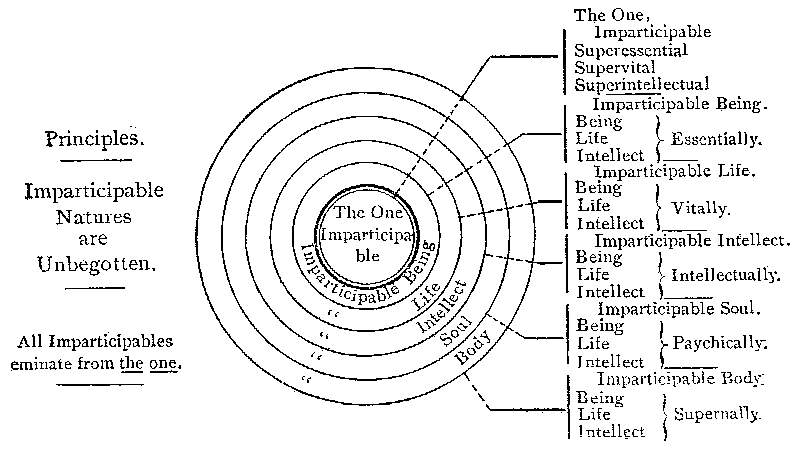
Being-Life-Intellect: We know these well as the three terms of the Intelligible Triad. Being is the first term, and the second, which unfolds from it, is power or life. Everything which is has a vitality to it: that which does not act at all is Dead and is very Death, which is Annwn and Cythraul. We therefore ask that, having been united to our true being, our true vitality may unfold. The third term of the triad is Intellect, which is the same as Understanding: This is true awareness, the capacity to, as it were, "turn around;" to look back upon our origin.

These terms, Being, Life, and Intellect-- or Being-Life-Intellect-- define the Divine Intellect, and they define every participant in the divine intellect. In Christian terms, they can be understood as the Father, the Holy Ghost, and the Son. In the thought of Proclus, they are the first Gods which proceed immediately from the One, and which unfold many succeeding triads which recapitulate the same basic scheme, until we arrive at those we know: Saturn holding the place of Being; Rhea, the place of Life; Jupiter, the Intellect. I have written elsewhere that in the terms of the Celtic theology we may understand the First as Hu the Mighty, the Second as Ced the Earth Mother, and the Third as Hesus, Chief of Tree Spirits, all of which unfold from and are supernally united to the OIW, the First Principle.

And so as we pray to God for Protection, Strength, and Understanding, we may be understood to say, "Grant that I may have my being perfected and united in thee."

At this point we are invoking the highest level of Being, the extremity of Gwynvydd at the unknowable boundary of Ceugant. As the prayer proceeds, we descend into the fullness of Gwynvydd, and then to Abred and Annwn, before returning again to our source, as we shall see.


The Unity of Philosophy

There are some who say that the study of philosophy had its beginning among the barbarians. They urge that the Persians have had their Magi, the Babylonians or Assyrians their Chaldaeans, and the Indians their Gymnosophists; and among the Celts and Gauls there are the people called Druids or Holy Ones, for which they cite as authorities the Magicus of Aristotle and Sotion in the twenty-third1 book of his Succession of Philosophers.
So we read in the History of the Lives of Eminent Philosophers, written by Diogenes Laertius around 150 B.C.

In Barddas we read:

Question. Why is the face turned towards the sun in every asseveration and Prayer?

Answer. Because God is in every light, and the chief of every light is the sun. It is through fire that God brings back to Himself all things that have emanated from Him; therefore it is not right to ally one's self to God, but in the light. There are three kinds of light, namely: that of the sun, and hence fire; that which is obtained in the sciences of teachers; and that which is possessed in the understanding of the head and heart, that is, in the soul. On that account, every vow is made in the face of the three lights, that is, in the light of the sun is seen the light of a teacher, or demonstration; and from both of these is the light of the intellect, or that of the soul.
And again:

Question. Why do we say, Heaven above, and Hell beneath, where there can be no highest in respect of any being, or lowest in respect of any existence? And why God in the highest, and Cythraul in the lowest?

Answer. Because the light is always highest, and above our heads, and it is in the light that God is found, and there can be no Heaven, except in the light; and God and Heaven always go together with light. And the darkness is always the lowest, and Cythraul and hell go together with it.

Book VII of Plato's Republic centers around the famous allegory of the cave. Imagine, Plato writes, that you have spent all your life as a prisoner in a cave, chained to the floor in such a way that you can move your head neither left nor right. Behind you is a fire, before you the cave wall. Between you and the fire men are moving puppets about, and all you can see and all you have ever seen are shadows cast by the puppets upon the cave wall.

But the day comes, and you escape. Making your way up to the surface, out of the darkness, you find a world of dazzling light in which you are totally blind. You come out at night, and look at things in the darkness-- at night the trees resemble the shadows which you had been used to, and the starlight is reminicent of the flickering of the fire.

Last of all he will be able to see the sun, and not mere reflections of him in the water, but he will see him in his own proper place, and not in another; and he will contemplate him as he is.
He will then proceed to argue that this is he who gives the season and the years, and is the guardian of all that is in the visible world, and in a certain way the cause of all things which he and his fellows have been accustomed to behold.

Now this cave is our material world, and the fire our material sun. The master of puppets is the Sublunar Demiurge, who dazzles our eyes with unintelligible images. The true Sun is the Eternal Spiritual Sun, as he is named in the Druid tradition; the Idea of the Good, as Plato calls him. This is the image of the First Cause, the One Itself.

All things in our material world are the images of higher things, and it is through them that we make the ascent, out of the cave, into the light of the Real. And so we are enjoined to worship in the Sun and in the light of the Sun, that, uniting ourself to the material Sun, we may be drawn upward into the light of the Spirit.


Continuing the discussion of God in the Barddas, we read the following, in a section entitled the Bard's Enigma:

There is nothing truly hidden but what is not conceivable;
There is nothing not conceivable but what is immeasurable;
There is nothing immeasurable but God;
There is no God but that which is not conceivable;
There is nothing not conceivable but that which is truly hidden;
There is nothing truly hidden but God.

This is then given in several different forms. The point in every case is that God is ultimately utterly unknowable. This is why the sphere of God is called Ceugant, the "empty sphere."

John Scotus Eriugena-- the name means "John the Scot, the Irishman," distinctions among the various species of Gael having been apparently less important at the time than now-- was a philosopher of the Ninth Century. Another way of saying it is that he was the philosopher of the Ninth Century. He seems to have been among the best-educated men in Western Europe and one of the few who could read Greek and thus access many of the Church Fathers in their original language.

Compare Morgwanwg's Bardic Enigma with these passages from Eriugena's homily on the prologue to the Gospel of John:

The voice of the spiritual eagle resounds in the ears of the Church. [The Eagle is the traditional symbol of St. John the Evangelist.] May our external senses grasp its fleeting sounds, and our interior mind penetrate its enduring meaning. This is the voice of the high-flying bird, not hte one that flies above the material air or ether or around the whole of the sensible world, but the bird which soars above all theory, on the swift wings of the most profound theology and with the insights of the clearest and most sublime contemplation, passing beyond all that is and all that is not.

By 'all that is,' I mean those things that do not entirely escape human or angelic knowledge... By 'all that is not,' I mean those things which transcend the powers of all understanding.

Later, comparing John with Peter, he tells us:

The one reclined on the breast of the Lord, which signifies contemplation, while the other hesitated, which signifies restless action. ... The power of contemplation, wholly purified, penetrates more keenly and swiftly the profound secrets of the divine letters than does action, which is in need of purification.

For Eriugena, then, "that which is not" is the whole realm of boundless possibility uncomprehended by human or even angelic minds, and it is beyond this that God himself abides. The way of contemplation signified by John is the way of immediate knowing. The word "contemplation" in modern language refers to thinking, and "meditation" to the emptying of the mind. This is one of these oddities that come up every now and then in the history of language, like the transformation of the French word blanc, meaning white, into the English black, meaning black. In former times "meditation" meant thought, while "contemplation," especially in a spiritual context, meant the immediate presence and knowing-ness that is beyond thought.

Eriugena's great source was Dionysius the Areopagite, that mysterious figure of the Sixth Century who wove together Procline Neoplatonism with Christian imagery. Dionysius's Mystical Theology begins with the following oration to Divine Darkness:

TRIAD supernal, both super-God and super-good, Guardian of the Theosophy of Christian men, direct us aright to the super-unknown and super-brilliant and highest summit of the mystic Oracles, where the simple and absolute and changeless mysteries of theology lie hidden within the super-luminous gloom of the silence, revealing hidden things, which in its deepest darkness shines above the most super-brilliant, and in the altogether impalpable and invisible, fills to overflowing the eyeless minds with glories of surpassing beauty. This then be my prayer; but thou, O dear Timothy, by thy persistent commerce with the mystic visions, leave behind both sensible perceptions and intellectual efforts, and all objects of sense and intelligence, and all things not being and being, and be raised aloft unknowingly to the union, as far' as attainable, with Him Who is above every essence and knowledge. For by the resistless and absolute ecstasy in all purity, from thyself and all, thou wilt be carried on high, to the superessential ray of the Divine darkness, when thou hast cast away all, and become free from all.
In the New Testament, Dionysius is the companion of St. Paul. His letters to Timothy were lost in ancient times, but coincidentally rediscovered two years after Justinian's banning of the teaching of pagan philosophy. They then formed a major part of the foundation of Christian theology, east and west, for a thousand years. After this time, someone got around to noticing that Dionysius's writings sounded a lot like the writings of Proclus, the last great pagan Neoplatonist. Here is a sample of Proclus's discussion of the First Cause in his Platonic Theology:


Let us now therefore, if ever, abandon multiform knowledge, exterminate from ourselvs all the variety of life, and in perfect quiet approach near to the cause of things. for this purpose, let not only opinion and phantasy be at rest, nor the passions alone which impede our anagogic impulse to the first, be at peace; but let the air be still, and the universe itself be still. And let all things extend us with a tranquil power to communion with the ineffeable. Let us also, standing there, having transcended the Intelligible (if we contain anything of this kind), and with nearly closed eyes adoring as it were the rising sun, since it is not lawful for any being whatever intently to behold him-- let us survey the Sun whence the light of the intelligible Gods proceeds, emerging, as the poets say, from teh bosom of the ocean; and again from this divine tranquility descending into intellect, and from intellect, employing the reasonings of the soul, let us relate to ourselves what the natures are from which, in this progression, we shall considder the First God as exempt. And let us as it were celebrate Him... as more ineffable than all silence, and more unknown than all essence, as holy among the holies, and concealed in the Intelligible Gods.


This, then, is the tradition in which Morganwg is ultiamtely working. It can be seen at once as pagan and Christian, Celtic or Druidic and Platonic. But these are only labels. The enigma remains, the task remains: to abandon multiform knowledge; to leave behind both sensible perceptions and intellectual efforts; to recline, as it were, against the very heart of the Christ who is the summit of all Intelligibles and, soaring as an eagle beyond all that is and all that is not; to encounter there the Great Mystery hidden in a stillness ineffable beyond all silence, a gloom darker than all darkness.


I wanted to write at length about reincarnation today, but time's gotten away from me, so let's take a look at another one of the Theological Triads of Iolo Morganwg, this one concerning God:

 
God is three things, and cannot be otherwise: coeval with all time; co-entire with all essence; and co-local with all mental purpose. Could what is called God be otherwise, it would not be God, since it could be surpassed, and no one is God that can be surpassed. He is also co-sentient with all animation.
 
This is straightforward enough on the surface, but there is more lurking here than we might at first suspect. Let's look at the terms one at a time.

To be coeval with all time means that God is equally present in all times. There was never a moment where God was not, and never a moment when God will not be. Now, this also implies that God is changeless, because if God were to be one certain way at one time, and another way at another time, he would not be equally present to all time-- instead he would be present either partially or in a particular way in one time, and partially or in another particular way at another time.

To be co-entire with all essence means that every being which has existence, derives its existence from God. There is nothing which is outside of God, or which does not participate in God, because the very fact of nonparticipation in God is nonparticipation in reality.

And finally, to be co-local with all mental purpose is precisely to be in possession of all possible knowledge. The reason for that is that every possible mental experience attained by every possible living creature can be understood as a sort of knowledge or information. I may know, for example, what red looks like, but I don't know what it looks like through your eyes. Moreover, I know what it's like to look across the living room and see a red blanket on the couch, but I don't yet know what it will be like to look across the room and see the same red blanket on another part of the couch tomorrow evening. God either possesses that knowledge and every similar form of knowledge, or his knowledge is limited; if limited, he is not God; but if he does possess it, then-- as the argument showed the other day-- God is all beings. I take "co-sentient with all animation" to be another way of saying "co-local with all mental purpose."

(This also means that insofar as any being is in Hell, God is always with them; this is another proof of the ancient view that Hell is not everlasting.)

These three which cannot be otherwise also refer to the planes of existence.

God abides beyond all change. His creative power ever flows outward like heat from a fire, and immediately He produces the empty sphere of Ceugant, which is the source of all essence: this is his co-entirety with all essence.

From essence emanates intelligence, which is the luminous life of Gwynvyd, the source of all mind, the colocality of God with all mental purpose.

From Gwynvyd emanates Abred, which is the world of time, not indeed deprived of God as God is coeval with all time.

And note finally that the Monad presides over the Triad, which unfolds the Monad. This is the structure of all the Celtic triads, which are wisdom-sayings, and it is also part of the Deep Structure of reality itself. 

In the Phaedrus, Plato tells us: 

All soul is immortal, for that which is ever in motion is immortal. But that which while imparting motion is itself moved by something else can cease to be in motion, and therefore can cease to live; it is only that which moves itself that never intermits its motion, inasmuch as it cannot abandon its own nature; moreover this self-mover is the source and first principle of motion for all other things that are moved. 
 
Now, compare with the Fourteenth Proposition of Proclus's Elements of Theology

 
Every being is either immovable or moved. And if moved, it is either moved by itself, or by another: and if it is moved by itself it is self-motive, but if by another it is alter-motive. Every nature, therefore, is either immovable, self-motive, or alter-motive.

For it is necessary, since there are alter-motive natures, that there also should be that which is immov­able, and the self-motive nature, which is a medium be­tween them. For if every alter-motive thing is moved because it is moved by another, motions will be either in a circle, or they will proceed to infinity. But neither will they be in a circle, nor proceed ad infinitum, since all beings are limited by the Principle of things, and that which moves is better than that which is moved. Hence there will be something immovable, which first moves. But if this be so, it is necessary that the self-motive exist. For if all things should stop, what will that be which is first moved? It cannot be the immovable, for this is not naturally adapted to be moved; nor the alter-motive, [14] for that is moved by another. It remains, there­fore, that the self-motive nature is that which is primari­ly moved. It is this, too, which unites alter-motive na­tures to that which is immovable, being in a certain re­spect a medium, moving and at the same time being moved: for of these, the immovable moves only, but the alter-motive is moved only. Every thing, therefore, is either immovable, or self-motive, or alter-motive.
 
Corollary.— From the premises, therefore, it is evident, that of things which are moved, the self-motive nature is the first; but that of things which move other things the immovable is the first.

From this, we can derive the following doctrines:

1. All  thought can be classed under movement, both becuase it is the form of movement appropriate to the Astral level of being, and because it is (usually) tied to physical movement in the human brain. 

2. The ordinary course of thought is almost entirely automatic. Our thoughts are being moved, but we are not the cause. Though alive, we bear a resemblance to that which is dead or soulless, because soulless matter is always moved. Plato goes on to tell us: "Any body that has an external source of motion is soulless, but a body deriving its motion from a source within itself is animate or ensouled." Habitual, addictive, unchosen behvaior is seen as being caused by ghosts in the Chinese tradition, and people who give themselves over to such behavior become ghosts themselves. This is no mere metaphor. In modern America we refer to such people as "zombies," and too often we are all zombies. 

 
3. Insofar as we gain control over the movement of our thoughts, we become self-motive, and take a step closer to the Divine. We cease to be dead and become alive. 

This is what is meant by the following passages from the Barddas

 
Question. In what place is Annwn?
 
Answer. Where there is the least possible of animation and life, and the greatest of death, without other condition.

...

 
Q. What wert thou before thou didst become a man in the circle of Abred?
 
A. I was in Annwn the least possible that was capable of life, and the nearest possible to absolute death, and I came in every form, and through every form capable of a body and life, to the state of man along the circle of Abred, where my condition was severe and grievous during the age of ages, ever since I was parted in Annwn from the dead, by the gift of God, and His great generosity, and His unlimited and endless love.
 

4. Prior to the self-motive is the immovable: That which, while imparting movement to others, remains entirely still in itself. This is what is meant by Intellect or Divine Mind. It is only from this place of stillness that we can truly choose, because only that which is in stillness can choose either to move or not to move. 

It follows that our Great Pilgrimage is from Annwn, which is almost altogether alter-motive; through the circles of Abred, in which we attain to the self-motive; and to Gwynvyd, at which stillness becomes possible. We must then either divide Gwynvyd and say that its lower part is self-motive, its higher part immovable, or else we must say that it is the Self-Motive and, at its height, the Immovable, but that the Ultimate Immovable is beyond Gwynvyd. How can that be? The extremity of Gwynvyd borders Ceugant, and here is the closest to stillness and immovability that may be attained, but as all creatures have their origin and their being in the One, which is God, all creaturely stillness is surpassed by the eternal divine stillness. And so: 

Ultimate Stillness is found only in the One, in Ceugant beyond all Gwynvyd. 

Ultimate Death is found only in the Cythraul darkness below all Annwn. 

It is better to be able to function on multiple levels of existence than one only. Therefore, our journey is not merely to enter into the final stillness, but to become able to move from stillness to self-motion, from self-motion to alter-motion, according as we choose. But we can only choose rightly if we are united to God. 

This has further implications for the work of meditation. It seems to me that ordinary thinking is nearly always alter-motive. The work of discursive meditation is the work of becoming self-motive. The final work is to become immovable. But the immovable which never moves more closely resembles the Dead than the Living. The goal, rather, is to become immovable and yet able to impart motion. The immovable cannot be influenced; the self-motive is able to act. But the alter-motive too has its uses: the work of "creating good habits" is precisely the work of putting the power of alter-mobility to good use.  


The Rational Animal


Let us recall that the root of the word "Man" is the same as the root of the word "Mind." Part of the definition of man is "a rational animal."

Morganwg's Christ


Let us also recall the progression of the soul in the thought of Iolo Morganwg. Every soul has its beginning in Gwynvyd, the luminous life, but descends to the depths of Annwn, the mineral creation and the very border of the Cythraul, the primordial chaos. Over the course of long ages, the soul rises from the cauldron of Annwn and works its way through the circles of incarnate life in Abred. Arriving at last at the level of humanity, the soul stands at at the border between Abred and Gwynfydd. The soul's work then is to release herself from the bonds of matter and restore herself to her proper divine place in Gwynfydd, which is the realm of Luminous Life.

The role of Jesus Christ in the soul's progression is described thusly in Barddas:

 
Teacher. Dost thou know what thou art?
 

Disciple. I am a man by the grace of God the Father.
 
T. Whence earnest thou?
 
D. From the extremities of the depth of Annwn, where is every beginning in the division of the fundamental light and darkness.
 
T. How earnest thou here from Annwn?
 
D. I came, having traversed about from state to state, as God brought me through dissolutions and deaths, until I was born a man by the gift of God and His goodness.
 
T. Who conducted that migration?
 
D. The Son of God, that is, the Son of Man.
 
T. Who is He, and what is His name?
 
D. His name is Jesus Christ, and He is none other than God the Father incarnate in the form and species of man, and manifesting visible and apparent finiteness for the good and comprehension of man, since infinitude cannot be exhibited to the sight and hearing, nor can there, on that account, be any correct and just apprehension thereof.
 

Elsewhere, we read the following account of the soul's progression:

 
Q. Through how many forms didst thou come? and what happened unto thee?
 
A. Through every form capable of life, in water, in earth, and in air. And there happened unto me every se-verity, every hardship, every evil, and every suffering, and but little was the goodness and gwynfyd before I became a man.
 
Q. Thou hast said, that it was in virtue of God's love thou earnest through all these, and didst see and experience all these; tell me how can this take place through the love of God? And how many were the signs of the want of love during thy migration in Abred?
 
A. Gwynvyd cannot be obtained without seeing and knowing every thing, but it is not possible to see and to know every thing without suffering every thing.
In order to return to the light of Gwynfydd man must know everything, do everything-- suffer everything.

Gwynvyd, Intellect, Christ

Let us, further, recall the three primary beings in the system of Plotinus. First there is the One, unknowable, ineffable, abiding beyond all things. After the one, produced from the one as heat is produced by a fire, is Intellect.

Intellect is the universal mind, but we must not think of it in the way that we ordinarily think about mind. There are two differences between Intellect as understood by Plotinus, and "mind" as we ordinarily talk about it.

First, Intellect is not the level of discursive thinking. The sort of thought that goes "I'm hungry-- I wonder what I have in the fridge?" is not Intellect. The sort of thought that goes, "I'm hungry, but I dont' know what's in the fridge. It seems to me that I have a pattern of waiting until my blood sugar crashes to find something to eat, and at that point my brain is too foggy to come up with anything and I end up eating a cookie. I should do something about that" is closer to Intellect, insofar as it is both deliberate and concerned with patterns. But neither of these are Intellect, because at the level of Intellect there is no difference between the knower and the object of knowledge.

Second, Intellect is Real Being. The phenomena of the sensory world are always passing into and out of existence, but the structures of Intellect, diverse and yet absolutely united, are eternal. Being eternal, they are real. Plotinus calls Intellect Itself "The One God who is all the Gods." Thomas Taylor explains that Intellect "is all Beings."

After Intellect is Soul Itself. Soul has a higher phase, which looks toward Intellect, and a lower phase which tends toward matter. But every being which is alive, is alive by virtue of having a soul, and every soul exists by virtue of Soul Itself.

It should be clear to anyone that there is an obvious parallel between the Three Primary Beings and the Christian Holy Trinity. The One identical to God the Father, Intellect to the Logos, his Son, and Soul to the Holy Spirit.

Throughout the ages, some Christians and members of related traditions have noticed this and embraced it. Others have denied it and condemned Plotinus. Others have embraced Plotinus but organized his system a bit differently, so that the One is identified with the entire Holy Trinity and the succeeding levels with subordinate beings.

In the third category are thinkers like Ficino, who identified Intellect with the realm of the angels and Soul with the World Soul. In the second are Christians in the tradition of Tertullian, who famously denounced Greek philosophy. In the first category are many Christian esotericists, including, from what I can tell, modern thinkers like C.W. Leadbeater, and also the whole of the Ismaili tradition within Islam.

But I believe that Iolo Morganwg is in the first category as well. Consider the rest of the exchange on the nature of Christ:

Teacher. Why is He called the Son of God?
 
Disicple. Because He is from God in His essential works, and not from His uncreated pre-existence, that is, He is second to God, and every Second is a son to the primary First, in respect of existence and nature. That is to say, Jesus Christ is a manifestation of God in a peculiar manner, and every one is a son to another, who is primary, and the manifested is a son to him who manifests. And where God is seen or comprehended otherwise than as a species and existence beyond all knowledge and comprehension, such cannot take place except in what is seen differently to the attribute of God, in respect of the non-commencement and unchangeableness of His being, His nature, and His quality.
 

On this view, then, the Second Being is Intellect. Intellect can be understood as a Being who is All Beings, the One God who is all Gods, and as a level of existence, beyond the level of matter or ensouled matter. That is to say, the Intellect of Plotinus is the same as the Gwynvydd of Morganwg. Christ, then, is Gwynvyd.

Christ conducts the migration of all souls to Gwynvyd, and in order ot attain this level, the soul must "be all things, know all things, and suffer all things." What does this mean?

Mary's Room

In a series of papers published in 1982 and 1986 a philosopher of mind named Frank Jackson presented the following argument against Physicalism. Physicalism, recall, is the belief that only matter and energy exist.

Imagine a girl named Mary who lived in a black and white room and interacted with the world solely via a black and white TV. Perhaps her skin was painted black and she only wore white clothes, or her skin was painted white and she only wore black clothes. The point is that Mary had never seen color. And yet, over the course of her time in her black and white room Mary, via her black and white TV, learned everything that there is to know about color as a function of light waves. She knew, that is, exactly what happened when light bounced off an object at such and such a frequency to appear to the eye as red or blue or green, and she knew about the cones and rods in the human eye, and the different sets of cones and rods in other animal eyes. In fact Mary spent so much time studying color that she knew everything that could ever be learned about it in this way, even those details which have thus far eluded our own science of Optics.

And then, one day, when there was no more possible information to be learned, Mary stepped out of her room, and for the first time beheld the color red.

Now Jackson asks: Did Mary learn anything new?

Of course we must answer Yes. Now, instead of learning about red, she learned what it was like to see red.

Another way of saying this is to say that instead of learning about red discursively, she learned gnostically. No longer was there a separation between the knower and the object of knowledge.

Conclusion

If Christ is Intellect, and if Intellect contains all possible knowledge, and if Intellect truly is union with the object of knowledge, then Christ must know all things, do all things, and suffer all things. Otherwise his knowledge is limited in the same way that Mary's knowledge is limited before she emerges from her room; he has discursive knowledge only.

To say that Man is a rational being is to say that man begins to participate in Intellect. To say that his aim is to attain Gwynvydd is to say that his aim is to return to his existence in Intellect. To say that Christ conducts his migration is both to say that Christ is a man who has undergone the journey from Abred to Gwynvydd, and to say that Christ is all men as they rise from Abred to Gwynvydd. And to say that Christ is all men as they rise from Abred to Gwynvydd is also to affirm again that Christ is Intellect, Gwynvydd, itself.


I'm unusually busy this week, and so for today's post I need to choose between writing something short but clear or long but messy. Yesterday I chose "long but messy," so let's reverse course today, and resume looking at the Triads of Iolo Morganwg. The work that we have as "Barddas" was compiled after Morganwg's death by John Williams ab Ithel, and as such it contains a number of different documents, some overlapping, some rather different from one another. A brief but fascinating chapter in the "Theology" section is entitle Triads of Bardism. These are seven short triads which form a coherent whole. I want to look at each of them one at a time, and then see what picture emerges when all are taken together.

Here is the first of the Triads of Bardism:

 
God made the world of three substances: Fire; Nature; and Finiteness.

Let's look at each of these terms, in reverse order.

First we have Finiteness. "Finitude" or even "Finity" are less awkward than "Finiteness." I don't speak Welsh, and it may be that the Welsh of the Barddas is very beautiful, but the English is quite often awkward, and this forms the major barrier to entry. Push past it, and there is something to learn here. Finitude or "finiteness" is the condition of every created being. Paradoxically, it is also the activity of God within each created being.
 

Everything in our World Below, being one thing, is thereby rendered not another thing. As we have discussed elsewhere, Greek word ousia is often translated "being," but it especially means "particularity" or "particular being." In the physical world, ousia is primarily particular things as particular things-- and not members of a genus or species. "Hopper the Cat" is ousia primarily, "cat" secondarily, "animal," um, "tertiarily." and in the physical world, ousia is especially not-something-elseness. God, on the other hand, being one thing is also everything.

Nature, in common usage, means something like "woods" or "the out of doors." But it can be better understood by considering how we use it when we describe "the nature of" something. Why is my cat sitting on my keyboard? Why is she trying to catch the words I'm typing on the screen with her paws? That's just her nature. Why do I want another cup of coffee? That's my nature. From what are these particular natures derived? From Nature itself of course, which must mean something like "that which provides the particularity of things." But this Nature Itself will not be any one particularity, because then it would have a nature, rather than being Nature. It is a unity, then, and superessential-- above ousia-- but it isn't Unity Itself, because it is still involved in particularity. It can best, then, be seen as a medium between Finitude and our First Substance, which is Fire.

Fire unites all things to itself; to enter into fire is to become fire. And it is by fire that all things are rendered visible, and by fire, or its progeny, heat, that anything is able to move or act. Unity, Intelligibility, Act or Power are the three primary terms, the Triadic Unity which follows immediately from the First or Simple Unity. In the Oracles we read:

All things are the progeny of One Fire.
 
God proceeds these three, brings them forth, and from their mixture brings all the worlds into being.

And again we read,

When, after all the phantoms are banished, thou shalt see the holy and the formless fire, the fire that darts and flashes through the hidden depths of the universe, hear thou the Voice of Fire.

And so we may see all these three, Finitude, Nature, Fire as proceeding from One Power, which is God. And that implies, too, that we can follow them in reverse order. From particular natures, we can ascend to Nature, from the contemplation of Nature to the contemplation of the Holy and Formless Fire which preceedes it; from the Fire which is all things united to that fundamental unity which is prior to all things, and calls them into being. 


The Journey Through Abred


In Barddas, we read the following dialogue:
 
Q. How often may one fall in Abred?

A. No one will fall once of necessity, after it has been once traversed, but through negligence, from cleaving to ungodliness, until it preponderates over godliness, a man will fall in Abred. He will then return to the state of man, through every form of existence that will be necessary for the removal of the evil, which was the cause of his fall in Abred. And he will fall only once in Abred on account of the same ungodliness, since it will be overcome by that fall; nevertheless, because of many other impieties he may fall in Abred, even numberless times, until every opposition and Cythraul, that is, all ungodliness, shall have been vanquished, when there will be an end to the Abred of necessity.
 

Q. How many have fallen in Abred? and for what cause have they fallen?
 

A. All living beings below the circle of Gwynvyd have fallen in Abred, and are now on their return to Gwynvyd. The migration of most of them will be long, owing to the frequent times they have fallen, from having attached themselves to evil and ungodliness; and the reason why they fell was, that they desired to traverse the circle of Ceugant, which God alone could endure and traverse. Hence, they fell even unto Annwn, and it was from pride, which would ally itself with. God, that they fell, and there is no necessary fall as far as Annwn, except from pride.

The One and the Many

Here are the second, third, and fourth propositions from Proclus's Elements of Theology:

 
Proposition 2. Every thing which partakes of The One is alike one and not one.

For though it is not The One itself — since it partic­ipates of The One and is therefore other than it is — it experiences [2] The One through participation, and is thus able to become one. If therefore it is nothing besides The One, it is one alone, and will not participate of The One but will be The One itself. But if it is something other than The One, which is not The One but a par­ticipant of it, it is alike one and non-one, — one being, indeed, since it partakes of oneness, but not oneness it­self. This therefore is neither The One itself, nor that which The One is. But, since it is one and at the same time a participant of The One, and on this account not one per se, it is alike one and not one, because it is something other than The One. And so far as it is multiplied it is not one; and so far as it experiences a privation of number or multitude it is one. Every thing, therefore, which participates of The One is alike one and not one.
 

Proposition 3. Every thing which becomes one, becomes so by the partici­pation of The One, and is one so far as it experi­ences the participation of The One.

For if the things which are not one become one, they doubtless become so by a harmonious alliance and association with each other, and experience the presence of The One, though they are not that which The One is. Hence they participate of The One, so far as they allow themselves to become one. But if they are already one, they will not become one: for that which is, does not become that which it already is. But if they become one from that which was previously not one, they will possess The One, since a certain one was ingenerated in their nature. [And this ingenerated one must be de­rived from The One itself. Everything, therefore, which becomes one, becomes so by the participation of The One, etc.]
 
 
Proposition 4. Every thing which is united is different from The One itself.

For if it is united it will participate in a certain re­spect of The One, so far as it is rightly said to be united. That, however, which is a participant of The One is both one and not one. But The One itself is not both one and not one: for if this was so, again the one which is in it would have both of these, and this would take place ad infinitum, if there was no One itself at which it is possible to stop; but every thing being one and not one, there will be something united, which is different from The One. For if The One is the same as the united, it will be infinite multitude. And in a similar manner each of the things of which the united consists will be infinite multitude. Every thing, there­fore, which is united is different from The One itself.


Transmigration

Finally, here is a selection from Plato's Phaedo on the fate of the unjust soul after death:


Socrates: The soul which has been polluted, and is impure at the time of her departure, and is the companion and servant of the body always, and is in love with and fascinated by the body and by the desires and pleasures of the body, until she is led to believe that the truth only exists in a bodily form, which a man may touch and see and taste, and use for the purposes of his lusts,—the soul, I mean, accustomed to hate and fear and avoid the intellectual principle, which to the bodily eye is dark and invisible, and can be attained only by philosophy;—do you suppose that such a soul will depart pure and unalloyed?
 
Cebes: Impossible.
 
Socrates: She is held fast by the corporeal, which the continual association and constant care of the body have wrought into her nature.
 
Cebes: Very true.
 
Socrates: And this corporeal element, my friend, is heavy and weighty and earthy, and is that element of sight by which a soul is depressed and dragged down again into the visible world, because she is afraid of the invisible and of the world below—prowling about tombs and sepulchres, near which, as they tell us, are seen certain ghostly apparitions of souls which have not departed pure, but are cloyed with sight and therefore visible.
 
Cebes: That is very likely, Socrates.
 
Socrates: Yes, that is very likely, Cebes; and these must be the souls, not of the good, but of the evil, which are compelled to wander about such places in payment of the penalty of their former evil way of life; and they continue to wander until through the craving after the corporeal which never leaves them, they are imprisoned finally in another body. And they may be supposed to find their prisons in the same natures which they have had in their former lives.
 
Cebes: What natures do you mean, Socrates?
 
Socrates: What I mean is that men who have followed after gluttony, and wantonness, and drunkenness, and have had no thought of avoiding them, would pass into asses and animals of that sort. What do you think?
 
Cebes: I think such an opinion to be exceedingly probable.
 
Socrates: And those who have chosen the portion of injustice, and tyranny, and violence, will pass into wolves, or into hawks and kites;—whither else can we suppose them to go?
 
Cebes: Yes, said Cebes; with such natures, beyond question.

Gathered Thoughts


A major focus of my work here is to take disparate elements of the world's spiritual traditions-- the fragmented Western tradition above all, but helped along by Eastern ideas from time to time-- and to set them alongside one another, and see what emerges.

Morganwg gives us an image of the soul attempting to rise to the Circle of Ceugant, which is the empty sphere traversed by God alone. We saw yesterday that God, or the One, is superessential, above all particularity.

Now the One must be one alone, and this is proved in the following way. Everything which exists that depends upon something else for its existence is called contingent. But if all beings were contingent, there could be no particular beings, because every thing, depending on something else for its existence, would never be able to come into existence. Therefore there must be something which is noncontingent, and by virtue of which all contingent beings have their existence. This something must be radically simple, and without qualities, otherwise it would be a compound, and the members of the compound would depend on a third thing for their existence. Even if that third thing was simply their shared unity, that unity would itself be the only noncontingent being. Therefore there is only one noncontingent being, and this being we call the One or God.

Because God is both radically simple and superessential, He (say She or It, none is actually accurate) remains forever out of reach. Ceugant is the empty sphere.

Now to become good means to become like God, because God is the Good and there is nothing Good which is not made Good by the participation in God. This is another way of saying, as Proclus above, nothing becomes One except by participation in the One. But, again, God is superessential and radically, permanently distinct from every form of ousia, even the most exalted.

It therefore follows that the journey of creatures to God is unending.

This, in turn, is the basis for two doctrines.

First, the doctrine of the transmigration of souls. If it is the case that God wills by his nature that every thing should become like him, which is to say, to become Good as He is Good; and if it is also the case that some beings are capable of a greater degree of participation in God than others; then it is necessarily the case that beings must evolve. Hence an animal, which is capable of limited forms of virtue trained by habit, may become a human, who is capable of higher forms of virtue, and a human a hero or saint, who is capable of transcending death and materiality. Evolution implies devolution-- given that it is possible to choose the Good, it is also possible to fail to choose it, or to choose Evil, which to say, nothingness and dissolution; this would then entail a descent into a lower state of being.

Second, the doctrine of permanent evolution. That is to say, it is not the case that, after death, our capacity to change or develop ceases, as is held by the Roman Catholic Church. This is the basis for their doctrine of eternal damnation-- Unrepented sin requires punishment; following death, change is impossible; repentance is a form of change; therefore, following death, unrepented sins must be punished and that punishment is incapable of ending, as the sin can no longer be expiated nor the punishment transformed into mercy. It is also the basis of the doctrine of eternal Paradise-- any pleasant state in the Afterlife, in Christian teaching, may be expected to endure forever; moreover, one's particular station in the hierarchy of Heaven is one's station for good. But the doctrine of the superessential nature of God suggests that even beings which have transcended the physical world and ascended to a better state still have an unending journey ahead of them, and may continue to unfold and to grow in wisdom, power and bliss, forever.


Proclus's Elements of Theology, Proposition 1

Every multitude partakes in some respect of The One.

 
For if it in no way or degree participates of The One, neither will the whole be one, nor each of the many things from which multitude arises, but each mul­titude will originate from certain or particular things, and this will continue ad infinitum. And of these in­finites each will be again infinite multitude. For, if multitude partakes in no respect of any one, neither as a whole nor through any of its parts, it will be in every re­spect indeterminate. Each of the many, whichever you may assume, will be one or not one; and if not one will be either many or nothing. But if each of the many is nothing, that likewise which arises from these will be nothing. If each is many, each will consist of infinites without limit. But this is impossible. For there is no being constituted of infinites without limit, since there is nothing greater than the infinite itself; and that which consists of all is greater than each particular thing. Neither is any thing composed of nothing. Every mul­titude therefore partakes in some respect of The One.


The One is the First Principle, and that by virtue of which all other things have their existence. What Proclus is telling us here-- or reminding us-- is that unless anything has unity of some kind, it cannot exist at all. The alternatives are unity, multiplicity, or non-existence. Obviously the non-existent does not exist. But anything which has multiplicity but no unity will also not exist-- it will consist of fragments, and then fragments of fragments, endlessly divisible, with no part ever able to come together as a whole. No two parts will ever be able to interact with each other, because to do so, they would need to share some common property. But if they shared a property in common, that would be a form of unity, and, lacking one, there is no unity. No part will even be able to be "one part," because to be "one part" is to be one particular thing. Instead there willl only be parts of parts of parts of parts of parts of parts of parts, extending endlessly forever.

One easy way to understand this-- and a way that Plato himself would have approved-- is to consider mathematics. Every number, multiplied by 1, remains itself. What this means is that there is always a certain hidden 1 for every number. 2 x 1 = 2, 400 x 1 = 400, π x 1 = π. 

The Identity of the Good and the One

Plato taught that the One is identical with the Good. In the Republic, discussing the establishment Justice in the Soul, he tells us that the just man is one who has become one out of many:

In reality Justice was such as we were describing, being concerned however, not with the outward man, but with the inward, which is the true self and concernment of man: for the just man does not permit the several elements within him to interfere with one another, or any of them to do the work of others,—he sets in order his own inner life, and is his own master and his own law, and at peace with himself; and when he has bound together the three principles within him, which may be compared to the higher, lower, and middle notes of the scale, and the intermediate intervals—when he has bound all these together, and is no longer many, but has become one entirely temperate and perfectly adjusted nature, then he proceeds to act, if he has to act, whether in a matter of property, or in the treatment of the body, or in some affair of politics or private business; always thinking and calling that which preserves and co-operates with this harmonious condition, just and good action, and the knowledge which presides over it, wisdom, and that which at any time impairs this condition, he will call unjust action, and the opinion which presides over it ignorance.

The identity of the Good and the One was the theme of Plato's only public lecture, the text of which is lost to us, but which was described by some of his contemporaries-- including Aristotle, who claimed not to understand it. (The failure to privilege Plato over Aristotle is the great mistake of Western civilization-- but that's a story for another time.)

The One is Superessential

Following Plato, Proclus will also tell us that the One is "Superessential." This is a word which has no English meaning, and the eye trained in American English tends to pass over it. In every day use, "essential" means "really important" and "super" means "really really," so at best, we get the idea that "The One is superessential" means "The One is a very big deal." 

Now the word "essential" is rooted in "essence," and thus shares the same root as the Latin word "esse," which means "to be." Knowing this, we can take a step further, and say that "The One is superessential" means "The One is beyond being." This is closer to the point, but we're still missing the target. The trouble is that this gives us the impression that the One does not exist, or that the entire thing is a sort of paradox. 

The Greek word which is translated as essentia in Latin or essence in English is ousia, and "superessential" is hyperousia. Ousia does not mean "being," or at least, not in the same way that we mean it in English. Originally it actually refers to the boundaries which mark a property line-- and, as an aside, it's worth remembering that "property" was not a secular concepts with the ancients as it is with us; rather, the boundary line between properties was a sacred thing, presided over by a God. That said, knowing this will help us get to the real meaning of the term. Ousia denotes a kind of particularity-- to be ousia is to be one thing above many. But the One cannot be one thing out of many, because then there will be things which do not participate in the One-- and here we're back to the problem of the parts of parts of parts of parts described above. Rather the One, the Good, is above particularity, not one thing in a set of things, but simultaneously present to but beyond all particular things. 

Neoplatonisms

Proclus was a pagan, and, indeed, one of the last great philosophers of the Pagan world. His six-volume Theology of plato is deeply concerned with applying the dieas that he learned in the work of Plato to the particular gods of the ancient Greek world. And so the Demiurge or Creator-God of the Timaeus, left unnamed by Plato, is identified with Zeus, the paradigm, or model on which he creates the world, with Ouranos, and so on through a cascading series of triads. The One, for Proclus, is called God or the First God, but is otherwise left unnamed. The One is without qualities, and so cannot be part of a triad, as are the gods that follow from him. But also for Proclus, all of the Gods are super-essential-- above particularity-- not just the One. 

Before Proclus, Plotinus's system was much simpler. For Plotinus there are three primary hypostases-- the One, Divine Intellect, and the Universal Soul. These can be identified with Ouranos, Cronos, and Zeus, with Zeus again as Creator, looking to Cronos as his paradigm. Myth plays a minimal part in Plotinus's system, and ritual no part at all; Plotinus famously refused to attend sacrifices, stating "It is for the Gods to come to me, not me to go to them." 

Sometime after Proclus, a writer who went by the pen-name of Dionysius the Areopagite assigned the entire Christian Holy Trinity to the place of the One. For Dionysius, the One is triadic, or, rather trinitarian. In place of the layered triads of Gods in Proclus's work, Dionysius has choirs of angels-- 9 in all, 3 groups of 3. But For Dionysius, only the Holy Trinity is superessential. The angels are not. 
 
After Dionysius, the Ismaili tradition within Islam preserves the One as completely unitary, with no triads or trinities, as in Proclus. But here the One is God, or Allah. Intellect and Soul are secondary entities, exalted indeed, but not the First. In this tradition, Mohammed is sometimes said to shine with "the Light of Intellect," and Ali with "the Light of Soul." Allah remains forever beyond knowing. 

Of course, many years even before Plotinus, Philo of Alexandria had applied Platonic principles to his native Jewish religion, reasoning that Plato must have studied the books of Moses. 

The Names of God


In the Barddas of Iolo Morganwg, we read the following:

Einigan the Giant beheld three pillars of light, having in them all demonstrable sciences that ever were, or ever will be. And he took three rods of the quicken tree, and placed on them the forms and signs of all sciences, so as to be remembered; and exhibited them. But those who saw them misunderstood, and falsely apprehended them, and taught illusive sciences, regarding the rods as a God, whereas they only bore His Name. When Einigan saw this, he was greatly annoyed, and in the intensity of his grief he broke the three rods, nor were others found that contained accurate sciences. He was so distressed on that account that from the intensity he burst asunder
 
And elsewhere:

 
Why is it not right that a man should commit the Name of God to vocalization, and the sound of language and tongue?
 
Because it cannot be done without misnaming God, for no man ever heard the vocalization of His Name, and no one knows how to pronounce it; but it is represented by letters, that it may be known what is meant, and for Whom it stands.

But what does it mean that men worshipped the name of God, and not God himself? Why is it that the name of God cannot be pronounced?

Imagine a name. Don't pick a personal name-- just pick a noun, the first thing in your field of vision. Around me I see "computer," "coffee cup," "keyboard," and "cat." (Notice the hard-c sounds.) Each one of these words contains information. I hear the word "cat." Immediately, I am given access to certain information: Cats are four-footed predatory animals, companions of humans, smaller than dogs but larger than mice, given to sleeping, sulking and skulking. All this emerges from the word "Cat." On its own, however, "cat," k-a-t, is a mere syllable. To a Spaniard or a Chinaman, ignorant of English, it means nothing at all. On the other hand, let either hear the word "gato" or "mao," and they will gain access to the same information that I do when I hear "kat."

The particular cat sitting next to me right now is named Hopper. When I hear that name, "Hopper," and associate it with a cat, I gain a great deal more information. Hopper is orange in color, nervous around unfamiliar humans, frightened of dogs, affectionate with familiar humans and with other cats; he was found in a box and brought to a cat shelter in Santa Barbara, where he was adopted by a family for their son's 8th birthday. He is four years old, and I could go into detail about his biography, but I won't. 

Notice, though, that the name suggests a story. The name is not the cat. The story is also not the cat. A neighbor might have a different name for Hoppper, referring to him as "that orange cat," and might have a different story, like, "We see him skulking around here sometimes." 

Now a cat is relatively simple being-- though I suppose you shouldn't tell the cats I said that. But it's not just that "cat," "gato," "mao," "felis," and so on all point to the same thing. Imagine something greater than a cat, like the Earth. Imagine our American, our Chinaman, and our Spaniard-- and set the clock back far enough in history that they are ignorant of one another and unable to share information via the internet. One calls the planet we live on Earth, the other calls it Tierra, the third calls it Tiqiu. They mean the same, but both their name and the story which accompaines the name will be radically different. Moreover, and critically, it is impossible to really have the same experience of Earth and Tiqiu and Tierra. 

Now, cats, Hopper the Cat, and the planet Earth are all examples of particular ousias, as we used that term earlier. For Aristotle, both Hopper the Cat and the planet Earth are truly ousia, while a category like "cat" or "planet" is ousia secondarily. But all are ousia-- named, particular substances, things which are "this" but not "that." This is a useful way of thinking about things, which is why Aristotle's works were picked up and re-purposed by the later Platonic commentators, starting with Porphyry

But God, as we have seen, is beyond ousia-- or, in English, superessential. 

And please note well: While debates exist about the role of Platonic philosophy within the Christian  churches, the superessential nature of God is accepted by anyone. God as superessential and radically simple is Catholic doctrine. Dionysius the Areopagite is still venerated as a saint by the Orthodox, who are smart enough to not let historians dictate their religion to them.

Names are assigned to ousias, and stories follow from names. Names and stories are not meaningless. They have immediate power. Hopper is a very entertaining cat, I hear his name and I smile and feel like laughing. Other names provoke me to wrath, or sorrow, or delight, or wonder. Many of these names will be meaningless to you, because you haven't learned the stories. The name is the title, the story is the book.

God; The One, the Good; Ouranous; Allah; God the Father; Holy Trinity; YHVH; IAO; OIW. These are Names of God. Appended to each name is a story. God is bigger than a cat, and God is bigger than the Earth. A story about Hopper can be learned, in its basics, in an hour. That story will be limited, though, because he's a four year old cat; I can tell you all about him, but if you haven't lived all four years of his life with him, you won't know the details of the story as I do. But I also don't know the story the same way as the other members of my household, or the other cats, or the neighbors, or the birds that he likes to argue with. If a story about a cat can take four years to learn and still not be complete, what can we say about a story about God? Surely it takes a lifetime to learn. And even then it still falls short. And not partially short, as in the case of the cat. Infinitely short. What this means is that an infinite number of names, and an infinite number of stories, would never be enough to describe or contain God. And that, furthermore, means that we must allow many names, and many stories, if we want to know God at all. 


We've seen that the teachings of the Mysteries conceived of our material world in a real sense the world of the Dead, with the God of the Dead as its ruler. And we've seen that, as long as we abide here, under Death's dominion, we are, in a certain sense, ghosts or phantoms. It remains to discuss the matter of our escape.

But in order to do that, we need to look again at the reason for our descent.

Plotinus tells us that we begin our existence still in the presence of God. This is why he can ask, "What can it be that has brought the souls to forget the father, God, and, though members of the Divine and entirely of that world, to ignore at once themselves and It?"

The Barddas of Iolo Morganwg also teaches this:

God made all living beings in the circle of Gwynvyd at one breath

So why is it that, having been created in the presence of God, who is all Life, we have fallen to this world of Death?

Plotinus gives the answer as "self-will." Now, the Greek word here is tolma, and it has a very particular meaning in this context. Its ordinary meaning is something like "audacity." In the philosophy of the Pythagoreans, this sort of audacity prompts the generation of the Dyad from the Monad, the Two from the One. Geometrically, the generation of the Two from the One is the generation of the Line from the Point.

This can be a difficult idea to grasp, because, to our our ordinary way of thinking, there's nothing especially wrong with drawing a line rather than a point. And yet, the Pythagoreans of Plotinus's day identified the Dyad and the generation of the Line with the departure from God and the very origin of Evil!

How can this be?

I believe the answer is simple: Tolma is the state of affairs in which the higher part of the soul, the nous, is enslaved to the lower parts, the desires and appetites. In this condition we are driven here and there by our desires, conscious after a certain fashion but never in control of ourselves. We are, in effect, akin to ghosts or phantoms, or the figures of a dream. And the world in which we find ourselves is itself a kind of dream-world, or ghost world, entirely illusionary.

More on the Mysteries

There were many mystery schools in the ancient world. The Eleusinian is well known, and so are the Bacchic, the Orphic, and the Mysteries of Ceres.

The Mysteries were universally schools of initiation, in which the aspirants went through a series of personal purifications over a length of time, tyupically including abstinence from food, wine, and sex, and then enaced a ritual drama over the course of one or more days. The ritual drama was based on a myth and consisted of the re-enactment of that myth, and the myth was typically concerned with the descent of a deity into the Underworld and his or her restoration to life.

In the work of the Mysteries, and also in the work of Philosophy, we discover the truth about our condition. We encounter the God of this World and we transcend him. And in so doing, we can cease to see him as an enemy, or as a jailer, and start to see him, and his world, as a teacher. In the work of discovering our condition and reversing it, we cease to be subjective beings or ghosts, lost in a Dream World. We wake up from the dream, we die to this world, and we learn to function as human beings.

In ancient times, one Mystery School began to eclipse the others, due at once to its effectiveness, the enthusiasm of its initiates, and the ruthlessness of some of its leaders. But that it was a Mystery School like the others we may learn from the words of one of its great initiates:


What shall we say then? Shall we continue in sin, that grace may abound? God forbid. How shall we, that are dead to sin, live any longer therein? Know ye not, that so many of us as were baptized into Jesus Christ were baptized into his death? Therefore we are buried with him by baptism into death: that like as Christ was raised up from the dead by the glory of the Father, even so we also should walk in newness of life. For if we have been planted together in the likeness of his death, we shall be also in the likeness of his resurrection: Knowing this, that our old man is crucified with him, that the body of sin might be destroyed, that henceforth we should not serve sin. For he that is dead is freed from sin.
 

Now if we be dead with Christ, we believe that we shall also live with him: Knowing that Christ being raised from the dead dieth no more; death hath no more dominion over him. For in that he died, he died unto sin once: but in that he liveth, he liveth unto God. Likewise reckon ye also yourselves to be dead indeed unto sin, but alive unto God through Jesus Christ our Lord.


The Christian Mysteries and Druidry

Iolo again:

...but they would be gods, and attempted to traverse the Ceugant. This, however, they could not do, wherefore they fell down to Annwn, which unites with death and the earth, where is the beginning of all living owners of terrestrial bodies.

In another section of the Barddas we read the following:
 

Teacher. Dost thou know what thou art?

Disciple. I am a man by the grace of God the Father.

T. Whence earnest thou?

D. From the extremities of the depth of Annwn, where is every beginning in the division of the fundamental light and darkness.

T. How earnest thou here from Annwn?

D. I came, having traversed about from state to state, as God brought me through dissolutions and deaths, until I was born a man by the gift of God and His goodness.

T. Who conducted that migration?

D. The Son of God, that is, the Son of man.

T. Who is He, and what is His name?

D. His name is Jesus Christ, and He is none other than God the Father incarnate in the form and species of man, and manifesting visible and apparent finiteness for the good and comprehension of man, since infinitude cannot be exhibited to the sight and hearing, nor can there, on that account, be any correct and just apprehension thereof. God the Father, of His great goodness, appeared in the form and substance of man, that He might be seen and comprehended by men.

Conclusion

Here is the picture that emerges from all of this.

We have, all of us, our origin in the Divine. But we-- beings like us-- begin our existence as phantoms or ghosts, driven about by the winds of desire. This drives us to descend into the limits of the universe, which is material incarnation. In the language of mythology, this is described variously as Adam (Nous) and Eve (Life) succumbing to the temptation of the serpent (Desire), eating from the Tree of Knowlege, and descending into the material world (Skins of Animals), ruled by Sin and Death (Sublunar Demiurge); the rape of Persephone (Soul) while gathering flowers (material desires) by Hades (the Sublunar Demiurge) and her descent into the Underworld (material incarnation); the descent of Pwyll (mind) into Annwn (world of the Dead) and his agreement with Arawn (Lord of the Realm of the Dead, Sublunar Demiurge). 

Iolo describes Jesus Christ as he who "conducts our migration" through Abred, as he is "God in the form of a Man." Now this makes sense of the teaching of Christ as the "Second Adam"-- he is literally Adam himself, having descended utterly into matter and risen, by slow degrees, to be restored to the spiritual realm; he stands in for and is all mankind, but he is also eternally God and eternally beyond material existence. In the same way, Perseophone is the Soul Itself, who must be restored to her mother, Ceres, the higher part of the Soul. Pwyll is the mind descending into Annwn, and in his triumphant return to his seat of Dyfed he demonstrates the way of ascent from Annwn/Abred into the light of Gwynfydd. Each of these figures may "conduct our migration." Each demonstreats the principles, and we may follow them by initiation into their mysteries, by cultivating virtue, and by spiritual practice including meditation and prayer. But follow we must.


Arawn, Lord of Annwn

The above is a stylized image intended as a depiction of Arawn, Lord of Annwn. The source is a Google image search; the image is also used by a Druid order hitherto unknown to me, apparently based in Washington. Annwn is, as we have seen, the realm of the Dead, and according to the Mabinogion, Arawn is its ruler. 

The First Branch of the Mabinogion concerns the adventures of Pwyll, Prince of Dyfed. At the beginning of the story, Pwyll finds that he has offended Arawn, and agrees to do whatever the latter asks in order to make amends. Arawn asks Pwyll to change places with him. For a year and a day, Pwyll will wear his semblance, rule his castle, and sleep in his bed. At the end of this time, he will meet with Arawn's enemy, who contends with him for rulership of Annwn. Pwyll must give him a single blow, but not more than this. 

Now, the Mabinogion is a literary and very much a medieval work, not ancient mythology, but traditional Celtic lore is woven into it, sometimes in a garbled fashion, and there is much we can learn from this story.

Pwyll's name means mind, perception or wisdom. During his time in Annwn, he lives in Arawn's home and sleeps in Arawn's bed, wearing Arawn's form. And Arawn's wife is the most beautiful in the world. Despite having every opportunity to have access to the lady, Pwyll declines, and does not lay a hand on her at night. At the end of his time, he delivers a single blow to Hafgan, Arawn's opponent, but refrains from striking again. Hafgan is defeated, the kingdom of Annwn is united under Arawn, and when Pwyll returns to his own realm of Dyfed he finds that it has prospered in his absence.

The Prince of Dyfedd and the Descent of the Soul

Let's look at this story in terms of the ideas we've been exploring. 

Pwyll's name means intelligence or mind; he thus symbolizes the incorporeal part of man. His name is significant in another way too, which we'll come to. By descending into Annwn, he descends into the World of the Dead. This world, as we have seen, is the world of Matter. Thus Pwyll's descent into Annwn is the soul's descent into the body. 

But it doesn't end there. 

By agreeing to Arawn's terms, Pwyll has accepted Justice. During his sojourn in Annwn, Pwyll demonstrates self-mastery or Temperance, especially in his refusal of intimacy with Arawn's wife. Facing Hafgan, he demonstrates Courage; administering but a single blow, he demonstrates Wisdom. Having done these things, he is able to return to his own realm, and to discover that it has been well-governed in his absence. He faces the temptations of both sex and violence, and responds with virtue. His soul is now rightly ordered, with strength acting in service to reason, and the desires no longer given free reign. 

Now it is clear that Pwyll and Arawn are mirrors of one another, and their respective kingdoms are also themselves. Pwyll's government of Annwn is also his government of Dyfed, and his transcendence of the limitations of the material world is his government over himself. His descent into Annwn is his incarnation in a physical body. His refusal of the temptations of the flesh allows him to unite his body under himself as ruler, and to begin the process of ascent from incarnation. He has, we may suppose, have faced Arawn in the forest hundreds of times before this in prior incarnations. Was his name "Pwyll," intelligence, before?

The Lord of Annwn and the Father of Lies

The Sophist is a dialogue of Plato whose subject seems straightforward, but may not be so.

One of Plato's concerns in his dialogues is the distinction of the real from its imitations. In the Gorgias, for example, he suggests that there is an art of health and strength, but also an art which imitates this. The first is the art of the doctor and the physical trainer, but the second is the art of the fashion artist the aesthetician. The first produces healthy bodies, but the second only creates a semblance of it. Or to give another example, the baker produces sweet foods which we love to eat; the doctor produces medicines, which are often foul but produce health. (At that time a doctor's job was to produce health, as odd as it may seem to us). Most of us prefer the semblance to the real thing, and this is our problem, but it doesn't say anything about the reality of the situation. If you were to set a doctor and an ice cream man before a jury of children, they'll obviously prefer the latter. Our souls, in their unpurified state, are those children. 

According to Plato, the Sophist imitates the Philosopher in just this same way. 

After a long discussion of the sophist's nature and how, exactly, he may be defined, the two characters in teh dialogue-- Theaetetus and the Elean Guest-- tell us the following:

Guest: Then we may class him as a wizard and an imitator of some sort. 

Theaetetus: Certainly.

Guest: Come then, it is now for us to see that we do not again relax the pursuit of our quarry. We may asay that we have him enveloped in such a net as argument provides for hunting of this sort. He cannot shuffle out of this.

Theaetetus: Out of what?

Guest: Out of being somewhere within the class of illusionists. 

Theaetetus: So far I quite agree with you. 

Guest: Agreed then that we should at once quarter the ground by dividing the art of image making...

And so the sophist is explicitly declared to a magician or wonder-worker. The guest then divides the art of image-making into two forms, which will be very familiar to those who know anythign about the iconographic tradition in the Orthodox Church. There are images which are intended to resemble forms; these are called "icons." And then there are illusionary images, which are called "phantasms." 

The dialogue then makes a metaphysical point about the existence of non-being. 

The truth is, my friend, that we are faced with an extremely difficult question. This "appearing" or "seeming" without really "being," and the saying of something which yet is not true-- all these expressions have always been and still are deeply involved in perpelexity. It is very hard, Theaetetus, to find correct terms in which one may say or think that falsehoods have real existence...

And so the sophist imitates the philosopher in the same way that the baker imitates the doctor or the aesthetician the physical trainer. Where the philosopher leads the mind to truth, the sophist produces lies. In this way he is a kind of magician or wonder-worker, seducing the minds of wealthy young men. But-- critically-- the images themselves have a kind of reality, a being of non-being. 

The Sophist and the Sublunar Demiurge

The Sophist appears to discuss a particular class of people in Plato's day, viz. phony philosophers who sold their teachings to the parents of rich kids for money. According to Iamblichus, this is only a surface meaning. The Sophist is not a mere pedant for hire. Rather, he is an image of a particular feature of Iamblichus's cosmology, the Sublunar Demiurge. 

Now the word "demiurge," you probably know, refers to the creator of the material world. The work of the Demiurge is discussed at length in Plato's Timaeus. But to the later Platonists, there were three demiurgi. The first is the Father of the Demirurgi. The Second is the Heavenly Demiurge. And the third is the Sublunar Demiurge. 

Remember that, on the cosmology of both the ancient and the medieval worlds, our physical world begins at the Moon. Above the Moon there is order and stability. The super-lunar cosmos-- that is, the spheres of the planets, the Sun, and the visible stars-- is thus an image of eternity. Beyond this is the eternal Heaven of God. Below the changeable Moon, we have the realm of change, process, division, and decay. We thus have three realms, which we can call the Sublunar, the Astral, and the Celestial. Or in our terms, Abred, the depth of which is Annwn, which is the realm of change and death; Gwynfydd, the starry realm of luminous life; and the invisible Ceugant.

Now each of these three realms has its ruling Power, who is an image of the ruler of the next realm up. This is its creator or Demiurge. 

Were Iamblichus and the later Platonists correct in their beliefs regarding the Sophist? Well, we don't "really" know, but it would make sense. We know that Plato's inner teachings were not written down, but were kept secret. We know that in one of his letters, he tells us the following:

 
I must expound it to you in a riddling way in order that, should the tablet come to any harm “in folds of ocean or of earth,” he that readeth may not understand.
 
The matter stands thus: Related to  the King of All are all things, and for his sake they are, and of all things fair He is the cause. And related to the Second are the second things and related to the Third the third. About these, then, the human soul strives to learn, looking to the things that are akin to itself, whereof none is fully perfect.

And we know that the Sophist was the first in a trilogy of dialogues, of which the first concerns the Sophist, the second, the Statesman, and the third was to have concerned the Philosopher. This would seem like an image of the three kings, the three demiurgi. (The Philosopher was either never written, was lost, or was kept secret.) 

In any case, we have the image of a creator-god of this material world. We have a material world which is a world of illusions, and also a world of death. And consider the following, from the Chaldaean Oracles: 


Stoop not down unto the Darkly-Splendid World; wherein continually lieth a faithless Depth, and Hades wrapped in clouds, delighting in unintellible images, precipitous, winding, a black ever-rolling Abyss; ever espousing a Body unluminous, formless and void.

That passage was used by the Hermetic Order of the Golden Dawn specifically as an invocation of the element of Earth. 
 
To be continued...


Accounts of the Fall

What is it that binds us here, to this world of darkness and shadow? Or, to put it in the terms that we've been exploring with Iolo Morganwg, what is the cause of our origin in Annwn and our long sojourn through the realm of evil in Abred?

Plotinus asked the same question:
 
What can it be that has brought the souls to forget the father, God, and, though members of the Divine and entirely of that world, to ignore at once themselves and It?


Here is a part of his answer:
 
The evil that has overtaken them has its source in self-will, in the entry into the sphere of process, and in the primal differentiation with the desire for self ownership. They conceived a pleasure in this freedom and largely indulged their own motion; thus they were hurried down the wrong path, and in the end, drifting further and further, they came to lose even the thought of their origin in the Divine. A child wrenched young from home and brought up during many years at a distance will fail in knowledge of its father and of itself: the souls, in the same way, no longer discern either the divinity or their own nature; ignorance of their rank brings self-depreciation; they misplace their respect, honouring everything more than themselves; all their awe and admiration is for the alien, and, clinging to this, they have broken apart, as far as a soul may, and they make light of what they have deserted; their regard for the mundane and their disregard of themselves bring about their utter ignoring of the divine.
 

Before we discusss this passage, let's look at another selection, from the Fourth Ennead. Here Plotinus gives us what is my personal favorite account of hte mystical experience of Divine Union in all of our literature:

Many times it has happened: Lifted out of the body into myself; becoming external to all other things and self-encentered; beholding a marvellous beauty; then, more than ever, assured of community with the loftiest order; enacting the noblest life, acquiring identity with the divine; stationing within It by having attained that activity; poised above whatsoever within the Intellectual is less than the Supreme...
 
But the state of union is not to last:

...yet, there comes the moment of descent from intellection to reasoning, and after that sojourn in the divine, I ask myself how it happens that I can now be descending, and how did the soul ever enter into my body, the soul which, even within the body, is the high thing it has shown itself to be.

As an aside, notice that the first descent is "from intellection to reasoning." Intellection is the state of higher knowing in which there is no distinction between the knower and the object of knowledge. I've talked about this many times, but it bears repeating: This is a concept that we have lost in the modern world, and lost in the English language. The closest English word for this state is "intuition," which 1. we typically denigrate, 2. even if we don't, we see as a kind of helpful but fleeting faculty, something less real than reasoning, and 3. has a different meaning anyway. In the older way of thinking, Intellection comes first. After intellection comes reason, which is the sort of discursive thought that enables us to grasp concepts like "If All A are B, and All B are C, then all A are C." That sort of reasoning is called ratio in Latin, and is the root of our word "rationalism." Rationalism, therefore, is at once a kind of cosmic regicide and self-decapitation, in which the existence of the Highest is denied and a lower raised up in its place.

The Entombment

But let's return to Plotinus. Considering the discussion of previous philosophers on the subject, he writes:

 
Heraclitus, who urges the examination of this matter, tells of compulsory alternation from contrary to contrary, speaks of ascent and descent, says that "change reposes," and that "it is weariness to keep toiling at the same things and always beginning again"; but he seems to teach by metaphor, not concerning himself about making his doctrine clear to us, probably with the idea that it is for us to seek within ourselves as he sought for himself and found.
 
 
Empedocles says that it is law for faulty souls to descend to this sphere, and that he himself was here because he turned a deserter, wandered from God, in slavery to a raving discord- reveals neither more nor less than Pythagoras and his school seem to me to convey on this as on many other matters; but in his case, versification

We have to fall back on the Divine Plato, who uttered many noble sayings about the soul, and has in many places dwelt upon its entry into body so that we may well hope to get some light from him.


Everywhere he expresses contempt for all that is of sense, blames the commerce of the soul with body as an enchainment, an entombment, and upholds as a great truth the saying of the Mysteries that the soul is here a prisoner. In the Cavern of Plato and in the Cave of Empedocles, I discern this universe, where the breaking of the fetters and the ascent from the depths are figures of the wayfaring toward the Intellectual Realm.
 
In the Phaedrus he makes a failing of the wings the cause of the entry to this realm: and there are Periods which send back the soul after it has risen; there are judgements and lots and fates and necessities driving other souls down to this order.
 
 
In all these explanations, he finds guilt in the arrival of the soul at body...

Now, the "failing of the wings" is a reference to Plato's model of the soul in the Phaedrus. In this dialogue, he presents the soul as a winged chariot pulled by two horses. One of the horses represents desire for things of the flesh. When the charioteer loses control of it, it crashes the whole thing towards the Earth-- the wings fail-- and here we are.

And the discussion of the body-as-tomb takes place both in the Cratylus and the Gorgias. In the latter, Plato wrote, "Perhaps we are actually dead, for I once heard one of our wise men say that we are now dead, and that our body is a tomb, and that that part of the soul in which dwell the desires is of a nature to be swayed and to shift to and fro." The line about "being swayed to and fro" is almost certainlymeant to call to mind the ghosts of the Underworld, who are often portrayed as powerless and nearly mindless shades:

 
Then the ghosts of the dead swarmed out of Erebus – brides, and young men yet unwed, old men worn out with toil, girls once vibrant and still new to grief, and ranks of warriors slain in battle, showing their wounds from bronze-tipped spears, their armour stained with blood. Round the pit from every side the crowd thronged, with strange cries, and I turned pale with fear. Then I called to my comrades, and told them to flay and burn the sheep killed by the pitiless bronze, with prayers to the divinities, to mighty Hades and dread Persephone. I myself, drawing my sharp sword from its sheath, sat there preventing the powerless ghosts from drawing near to the blood, till I might question Teiresias.’
 
 
The preceding comes from the Odyssey. At the bidding of Circe, Odysseus has gone to the realm of Hades to speak with the ghost of Teiresius, the seer. Why Teiresias? As Circe tells him, "His mind is still unimpaired, for even in death Persephone grants him mental powers, so that he alone has wisdom, while the others flit like shadows.”

Abred is Annwn

What emerges from all of this is the secret teaching of the Mystery Schools, hinted at by Plotinus above. While we perceive Annwn, the World of the Dead, as the lowest part of Abred, the truth is rather worse than that. Abred is Annwn, and as long as we remain here, bound to our body, enchanted by its desires, we remain in the world of the Dead.

At the beginning of this post, I shared the image of the Devil from the Waite-Smith tarot deck. In a dark world, he keeps two souls enchained. This is precisely the image of bodily life that Plato wants to share. And this is our condition in Abred: We are slaves of the Devil, who is Hades, the Lord of the Dead.

But again, how did this happen? 

Pride and the Fall

In Barddas, Iolo gives us the following account of the Fall:

 
God made all living beings in the circle of Gwynvyd at one breath; but they would be gods, 3 and attempted to traverse the Ceugant. This, however, they could not do, wherefore they fell down to Annwn, which unites with death and the earth, where is the beginning of all living owners of terrestrial bodies.
 
Question. Where is Annwn?
 
Answer. In the extreme limits of the circle of Gwynvyd. That is, living beings knew not how to distinguish evil from good, and therefore they fell into evil, and went into Abred, which they traversed until they came back into the circle of Gwynvyd.
 
Q. What ignorance did they commit?
 
 
A. They would venture on the circle of Ceugant, and hence became proud; but they could not traverse it, consequently they fell into the circle of Abred. 

And this account, of course, reminds us and is meant to remind us both of the fall of Lucifer and his angels, and of the disobedience of Adam and Eve in the Garden of Eden. This seems somewhat different from the accounts of Plato and Plotinus. But is it? Or is there a way that the method of escape and ascent given by Plato and Plotinus, by Iolo and the Druidic tradition, and by Jesus Christ and his disciple Saint Paul, are one and the same? 

These are the questions that I'm going to explore next time. 
Today, a selection of triads from the Barddas preceding the previous one, which shed more light on it:
 
13. The three states of existence of living beings: the state of Abred in Annwn; the state of liberty in humanity; and the state of love, that is Gwynvyd in Heaven. 

14. The three necessities of all animated existences: a beginning in Annwn; progression in Abred; and plenitude in Heaven, that is, the circle of Gwynvydd; without these three things nothing can exist but God. 

15. Three things are necessary in Abred: the least of all animation, and thence a beginning; the material of all things, and thence increase, which cannot take place in any other state; and the formation of all things out of the Dead, hence diversity of existence.

16. Three things cannot but happen to all living beings by the justice of God: co-sufference in Abred, ecause without that none could obtain the perfect knowledge of any thing; co-participation of equal privilege in the love of God; and co-ultimity, through the power of God, in respect of such as are just and merciful. 
 
In Iolo's vision, as we have seen, every soul has its beginning in Annwn, its progression in Abred, and its culmination in Gwynvydd. Humanity is at an intermediate state; still incarnate in Abred, but able, to a greater or lesser degree, to peer into the higher Reality of Gwynvydd. 

Abred is incarnate existence. Its lowest depth is Annwn, which encompasses the Underworld and the mineral creation, the closest possible there is to death. The Chaos prior to the creation is called Cythraul or Devil. This is evil absolute, and it is total disorder, total powerlessness. Through an act of mercy, God organizes the Cythraul, brings it into life and order. 

Now, creative act of God can be viewed in two ways. From the perspective of God, which is Eternity, the Cythraul is immediately animated, organized, and perfected. Time is a moving image of eternity, and within Time that which is immediate in Eternity must unfold sequentially. And so from the perspective of the human soul, the process unfolds across vast ages, as incarnation follows up incarnation until the soul reaches its plentitude in Gwynvydd. And even arriving in Gwynvydd the journey is incomplete. As Ceugant is traversed by God alone, it remains ever out of reach. In the same way, in Utter Chaos, not one thing can be said to exist, because to be "one thing" is to have both unity and particularity, and unity requires order, particularity requires distinction, and "to exist" requires God. Therefore the Cythraul too remains forever out of our reach, but in the opposite direction. 

From the perspective of God, the act of Creation is an outpouring of infinite love and mercy. Hence Plato, "|Good was he, and in one who is good there never arises about anything whatsoever any grudge; and so, being free of this, he willed that all things should come to resemble himself as much as possible." From the perspective of Cythraul, the act of Creation was a slaying; hence the deaths of Ymir, Tiamat, and all other primordial giants and dragons. From the perspective of Mankind, the creation is a journey, in which we rise from the cauldron of Annwn, traverse the circles of Abred, and find our completion in Gwynvydd.

If you've ever tried to help a drug addict, you can see the same process at work. From your perspective, you performed a work of mercy; from the addict's perspective, you took away their joy; the addict who recovers receives the act of mercy and begins a journey toward becoming who they were intended to be. The memory of their addiction, kept before the mind's eye, becomes an incentive toward recovery. Hence another triad: 

 
There are three benefits to be had from Cythraul: the defection of evil; a view to goodness; and the triumph of victory over what is contrary to the beneficial.
 
Iolo's Seventeenth Triad reads:

The three necessary occasions of Abred: To collect the materials of every nature; to collect the knowledge of every thing; and to collect strength to overcome every adverse and Cythraul, and to be divested of evil; without this traversing of every state of life, no animation or species can attain to plenitude.  
 
Overall, this triad presents Iolo's evolutionary vision of the incarnate human soul, and the purpose of material existence. We have our beginning-- according to this view-- in the Cauldron of Annwn, which is identical with the mineral creation. Over the course of long ages we rise through the various forms of material life, plant, animal, and finally human. The human is the balance point, wherein the evil of Abred is balanced by the light of Gwynfydd; here we may press onward and establish ourselves in the Luminous Life of Gwynfydd, or else fall back into animal existence for a time. 

I want to zero in on one of the terms he uses here, "Cythraul." This word means "Devil" in Welsh, and in Iolo's theology it stands in for the principle of Evil, opposed to the Good. This principle, however, has a rather different meaning than that found either in dualistic systems such as those of Gnostics or Manichaeans, or even in traditional Christian theology. In these systems, whatever else the principle of Evil is, it is a principle of Power. In Iolo's vision, it is quite the opposite-- a principle of utter powerlessness. 

Elsewhere in Barddas we read:

Cythraul is destitute of life and intention--a thing of necessity, not of will, without being or life, in respect of existence and personality; but vacant in reference to what is vacant, dead in reference to what is dead, and nothing in reference to what is nothing. Whereas God is good with reference to what is good, is fulness in reference to fulness, life in life, all in all, and light in light.

In The Mysteries of Britain, Lewis Spence elaborates:

God is goodness and power, and is opposed in duality to Cythraul, darkness and powerless inability . God mercifully united Himself with this lifelessness or evil with the intention of subduing it unto life or goodness, and from this intellectual existences and animations sprang. 

These began in the depths of Annwn, or the abyss, the lowest and least grade, for there can be no intellectual existence without gradation, and in respect of gradation there cannot but be a beginning, a middle, an end or extremity-- first, augmentation, and ultimate or conclusion. 
 
This view both of evil and of God is a bit foreign to our usual way of thinking about these things. It isn't a new conception, however, nor foreign to the ideas that I've been developing on this blog. Compare this account to Plato's account of the Demiurge's reason for creation in Timaeus 30A:

Now let us say through what cause the Creator constructed becoming and this All. Good he was, and in one who is good there never arises anothering whatosever of grudge, and so, being free of this, he willed that alll things should come to resemble himself as much as possible. That this above all is the lordliest principle of becoming and Cosmos one must receive, and correctly so, from wise men. Since he wanted all things to be good and, to the best of his power, nothing to be shoddy, the God thus took over all that was visible, and, since it did not keep its peace but moved unmusically and without order, he brought it into order from disorder, since he regarded the former to be in all ways better than the latter. 

This idea sees good as order and harmony, and, in Plato, it is directly linked to the harmonies of music. (Remember that professor from a while back who claimed that Plato wanted to ban music? Here we see the reality, which is that music has a specific metaphysical meaning in the work of Plato. It is united both to mathematics and the practice of the virtues. Its opposite is Chaos, which is inharmonious, disorderly, unmusical. It is also utterly weak-- evil accomplishes nothing. Chaos is linked to the Dyad in numbers, and to Matter, which is incapable of accomplishing anything on its own but is only the final expression of active Spirit.

If some of these ideas seem familiar, there's a reason for that. A version of this teaching-- simplified, but apparently still quite helpful for some people-- has in recent years been taken up by the pop intellectual Jordan Peterson. Now, by the way, you know the meaning of the hysterical opposition Peterson has attracted from the media. And I think you can also see the hidden meaning of Materialism, the belief that Matter is the only reality and mind or spirit a mere "epiphenomenon."

Each of us has within us certain capacities, a certain level of energy, and a certain destiny or telos. In keeping with the Druidical teachings, we can call this latter our personal Awen. This is the summit of what we can accomplish in this incarnation. Each of us also comes equipped with a whole series of vices and negative tendencies. If you pay attention, you will discover that each of your vices is in fact the root of a virtue. The vain and pretentious are often natural leaders who can do a world of good if they can temper their vanity with humility. The violent are often those who possess both great will and great strength, but need to learn to use them in service of a high cause, and not their passions. Addicts are very often seeking a higher state of consciousness, and programs like AA and NA can teach them to find that in a direct encounter with the divine, rather than a bottle or a needle. Notice that the person living from their vices is 1. powerless, being driven from one thing to the next by whims of the moment; 2. incapable of accomplishing anything; 3. easy prey for the manipulative, including those who wish to sell 

In Thaeatetus, Plato teaches us that the goal of the philosophical life is to become like God. The Timaeus as well as Iolo's triads teach us exactly what this means. Just as the Creator impresses order onto the primordial chaos of existence, we must, with divine aid, impress order and virtue onto all that is chaotic and inharmonious within ourselves. 

The journey of the soul in Abred is precisely this process of becoming like God, by gathering, over long ages, the knowledge of the nature of all things, that we may overcome the Cythraul within and take our place in the Luminous Life of the Gods. 

The next two Theological Triads of the Barddas read: 

2. Three things proceed from the three primeval Unities: All Life; All Goodness; All Power. 

3. God consists necessarilyh of three thingts: the greatest in respect of life; the greatest in respect of knowledge; and the greatest in respect of power; antd there can be only one of what is greatest in any thing.

These two triads are best read together and in reverse order.

The second triad is the familiar Intelligible Triad. The Supreme God is understood as having life, which in this case stands for being; knowledge, which is to say, mind or intellect; and power, which is life or activity. 

But in the prior triad, goodness, life, and power are said to proceed from the three unities, which are God or Being; Knowledge or Intellect; and Liberty or Soul. We can therefore see that life in this triad stands for being; goodness, in this case, for Intellect, for to know the fullness of Truth is to be good, and evil is always rooted in a lie; and power stands in for life or activity. These three are found at every level but resolve into unity in Ceugant, the Highest. 
Section II of the Barddas of Iolo Morganwg is entitled "Theology," and opens with a long series of triads, largely concerning hte nature of God. As an ongoing project, I want to share some of these triads and provide a brief commentary based on the Platonic-Druidic philosophy I've been developing here. 

The First Triad

There are three primeval Unities, and more than one of each cannot exist: one God; one truth; and one point of liberty, and this is where all opposites equiponderate. 

Naturally, the first triad is one of the most difficult. I would rather have started with any of the succeeding five or ten. This raises the question, of course, of why this one comes first? Set before all that follows, it acts as a kind of roadblock, or, in esoteric terms, a Watcher Upon the Threshold. We can either work with this first Triad, or give up and turn back. 

Let's break it down, piece by piece. 


One God

The Druidic tradition is repleat with deities. We have Hu the Mighty, and Ced the Earth Mother, and Ceridwen the Moon-Goddess who is also a form of Ced. We have Esus and Hesus, Taranis, Toutatis and Cernunnos. If Morganwg is teaching monotheism, should his writings be discarded as non-Druidic? Or if we would preserve them, must we discard the gods, and submit to monotheism? 

The answer to both is "No." The One God is the One Itself, the First Cause which precedes all things, and even precedes existence. Proclus, the last great pagan philosopher of antiquity, wrote of the One that nothing at all can be said of it. It was not even to be understood-- for Proclus-- as the leader of a triad, which makes it utterly unique in his thought. 

I have written before that we can use the term "Awen" for the One in Druidry. And, of course, those who see the First Cause as triadic (or Trinitarian) are perfectly free to disagree with Proclus. 

The realm of being which can only be traversed by the unitary God is called Ceugant in the Druid tradition. 

One Truth

Let's turn to Proclus again. Criticizing another philosopher named Origen (not, apparently, the Christian Church Father, but another Origen), he writes

Origen ends in intellect and the first being, but omits the One which is beyond every intellect and every being. And if indeed he omits it, as something which is better than all knowledge, language, and intellectual perception, we must say that he is neither discordant with Plato, nor with the nature of things.

What Proclus is saying here is that the One is prior to knowledge, language, and intellectual perception. In what follows he will discuss that which immediately follows upon the One, which are the very highest of the Gods. These Gods are called "Intelligible," because they can be known by the highest faculty of the Mind-- and only by the highest faculty of the mind. They are beyond the material world entirely; they cannot be encountered via the senses. And yet-- this is critical-- they are more real than the things of the material world, and they determine everything which is found in the material world. What is true about them is eternally true, while truth has no fixed existence in the material world, which is the world of becoming. 

This, then, is the meaning of One Truth. The One Truth is that which immediately proceeds from the One Itself, which is God or the First God. This is the highest of hte gods, starting with the First Triad and unfolding from there. Gathered into a unity, these are also One God, and One Truth. 

This Truth is also Gwynfydd in the Druid, the Intellectual Realm of luminous life. 

One Point of Liberty

...and this is where all opposites equiponderate. This is the hardest of the three to understand. But if we follow the preceding method of interpretation, it will become easier. The Point of Liberty is the third level of being, which is called Abred. Abred is the realm of material existence as it is encountered by the soul. That is to say, it isn't Matter Itself, which is a lower thing, called Cythraul ("Devil"), but matter encountered by mind. It is a paradox that it is here, in this realm of limitation and imprisonment, that the soul is able to free itself. This is because it is only by working against limitation that anything is able to be created, and only by experiencing suffering that suffering may be overcome. And it is also because it is only here that there can be found those beings who are in need of liberation, and have begun to work towards it. In Abred, Good and Evil are balanced, these "opposites equiponderate," and thus either may be chosen. God abides alone in Ceugant, and Gwynfydd is the realm of liberated beings. At the bottom of Abred is Annwn, the realm of the Dead; its inhabitants have not yet begun the journey. 


Yesterday I shared a particular assignment of the classical virtues to the Four Elements, viz:

Earth: Courage

Water: Justice

Air: Wisdom

Fire: Temperance

 
In the comments section, JPRussel mentioned that this differs from the assignment given to the elements in the Dolmen Arch system. 

I wanted to share, first, why I assign the elements in this fashion, and, second, some alternatives.

Systems of Correspondence

Structures like this one are called "systems of correspondence." They are universal in magical systems, and, in fact, in traditional systems of learning in general. The Cabala itelf is little more than one vast system of correspondences-- I believe it was Israel Regardie that referred to the whole system as a "filing cabinet." The point of such systems is to allow one to immediately contact particular states of consciousness, and thereby to produce particular modes of change. 

Again, these systems are not limited to magic, but occur in pre- and non-modern modes of thinking in general. For example, as Western culture has its seven traditional virtues, and Helleniuc culture its four, traditional Chinese culture has five. It's actually not very easy to translate these into English, but, roughly speaking, they amount to: Benevolence, Righteousness, Propriety, Wisdom, and Faithfulness. (Notice, as an aside, that these are different from the four virtues of Plato, and that cultivating these five, rather than our four or seven, produces a different sort of virtuous person. This is a clue to the deeper meaning of cultural difference.) 

In Taoist philosophy and Traditional Chinese Medicine, these five virtues have the following correspondences:
 
Benevolence-- Wood Element-- Liver-- Sour-- Springtime-- Green-- Vice:Anger Jupiter

Propriety-- Fire Element-- Heart-- Summer-- Bitter-- Red-- Vice:Excitement Mars

Faithfulness-- Earth Element-- Spleen-- Present or Late Summer-- Yellow-- Vice:Anxiety Sweet-- Saturn

Righteousness-- Metal Element-- Lungs-- Autumn-- Pungent-- White-- Vice:Grief Venus

Wisdom-- Water Element-- Winter-- Kidneys-- Salty-- Blue-- Vice:Fear Mercury
 
This system of correspondences allows a Taoist adept, or a TCM practitioner, both to cultivate particular states of consciousness in themselves and even to treat disease in their patients. For example, a client suffering from a lung condition might be found to have been attacked by an excess of grief. This can be treated by a qigong exercise which at once opens the chest and activates the muscles along the lung meridian, while the patient visualizes inhaling healing white light into the lungs and exhaling smoky gray light containing grief and sorrow. This can be combined with acupuncture and massage focusing on the lung points, and regularly taking pungent herbs in soup and tea. 

Such systems of correspondences are not arbitrary, but they also aren't universal. It's neither one right way, nor anything goes. To give an example, the season of Winter may be plausibly assigned to the element of Water or Earth, as both are slow, heavy, and cold. It makes rather less sense to assign Winter to Air-- unless, perhaps, you live in a part of the world in which Winter is marked by wind storms. It makes very little sense at all to assign the element of Fire to the Winter season-- unless you're using the elements in a different way, which I'll discuss in a moment.

 Personal Elements

The arrangement of the elements that I provided yesterday is personal to me, as I said, but I want to talk a little about why this is so. 

The virtue of Courage is defined by Plato in the Laws as a knowledge of divine goodness that sustains us through every danger, and also through every pleasure. He is also at pains in the Laws to point out that Courage is the first and lowest of the virtues-- although it holds together cities like Sparta and Crete, it is insufficient to elevate the soul to the higher worlds. Aristotle, meanwhile, points out in Nichomachaean Ethics that Courage is not the opposite of cowardice, but a mean between cowardice and rashness. For Aristotle as for Plato, all of the virtues are means, with vices of excess and deficiency on either side. 

Now, when I consider the virtue of Courage, I find that I am not lacking in the ability to face danger. Not that I throw myself into dangerous situations on purpose-- not these days, anyway-- but I have on a number of occasions had the opportunity to face physical danger and death, and acted in a way that I felt was appropriate. 

On the other hand, one of my greatest vices is my inability to see projects all the way through. My harddrive is full of half-written novels, but no finished ones. I can read Spanish and Latin at a child's level (Iulia puella parva est); I can identify 1 or 200 words in Chinese and write the corresponding characters. I know the guitar well enough to play in a punk band, provided none of my bandmates is older than 16. I have a similar degree of proficiency in the dao or Chinese broadsword, and less in the jian, the Chinese straight sword. I recently acquired a bata, or Irish fighting stick, and if my pattern holds, in a year I'll know it well enough to fight an unarmed civilian.  

What's the point of all this self-effacement?

Only the following: When it comes to assigning an element to Courage, I ask myself: "What is it that I need in order to cultivate the virtue?" For me, the answer is stability and endurance. Of all the elements, Earth represents this most strongly-- to my mind at any rate. And so I assign the virtue of Courage to the element of  Earth, which is to say, I ask the powers of Earth for help in developing Courage. 

But that doesn't mean this is a universal assignment. If I had no problem with stick-to-it-iveness, but I was terrified of physical danger, I might invoke Fire for Courage, as I might find its burning strength a great help in facing my fears. If, on the other hand, my issue was one of rashness-- that is, an excessive love of danger for its own sake-- I might invoke the calming power of Water. Finally, if I simply needed help getting started on my projects or adventures, I might invoke Air.

And I repeat the process with the remaining virtues.

Justice is defined as a right relationship between things. Plato describes it in the Republic as every part of the soul performing its own correct task; Aristotle defines it in the Ethics as giving everything what is due to it. I personally, usually, invoke Water to cultivate Justice. The reason for this is that Water is binding, unifying, and giving. I have a tendency toward selfishness and an equal tendency to be temperamental; these things stand in the way of giving to others what is due to them, whether a tip at a restaurant or a kind word on the street, and in the way of proper relationships with the people in my life, who often need my love rather than irritation or sarcasm.

Wisdom is described by Plato in the Phaedo as a separation of the soul from the body, and contact with the higher reality of the spiritual world. To my mind Air perfectly symbolizes this idea, as Air is the element of the sky (which is the symbol of the Noetic world), the mind, and Form. 

Temperance, finally, means self-control, and for me this is symbolized by Fire, which is above all the element of power. Real power is power over the self, especially the lower self and its cravings. 

In order to cultivate these virtues, I often say the following prayer, especially in the morning:

May I take up my hammer to work,
May I take up my cup to give,
May I take up my book to learn,
May I take up my sword and live.

The hammer symbolizes the gnomes who labor in the north; the cup is the cauldron of life; the book is the wisdom of philosophy and nature; the sword is my personal symbol of success and self-mastery.

External Elements, and Other Arrangements

In a sense, this way of working with the elements is a form of medicine, taylored to the individual. When designing a system of magic or initiation, it seems that it is often more important to choose a more universal arrangement. 

It seems to me that a more universal Druidic arrangement might look like this:

Earth: Courage
Water: Wisdom
Air: Justice
Fire: Temperance

This again draws on Plato's Laws, which describes Courage as the first and lowest of the virtues, and Justice as a mean between Wisdom and Temperance. Water has straightforward associations with wisdom in Celtic lore, in the form of the Salmon of Wisdom who dwells in the sacred well. The animal associated with Justice is the Hawk of May, whose name, "Gwalchmai," is the Welsh form of Gawain, who was in the oldest tales one of the most important of Arthur's knights; his encounter with the Green Knight is itself a lesson in Justice. Temperance, finally, is assigned to Fire. In ordinary American English the word "temperance," if it's used at all, means something like "Not getting drunk," and maybe also "...and keep it in your pants, too." Its original meaning in Greek, dikaiosune, means "self-mastery." This is the final virtue, as Fire is the highest of the elements. 

The following arrangement works equally well:

Earth: Justice
Water: Temperance
Fire: Courage
Air: Wisdom

This arrangement follows the assignment of the virtues to the parts of the human soul, and the parts of the soul to energy centers in the body, in Plato's Republic. To the abdomen, which is called the "lower dantien" in Chinese internal alchemy and the lower cauldron in the Dolmen Arch system, corresponds the  Epithymia, which is the lowest part of the soul, the appetites for food and reproduction that we share in common with every animal. To this center corresponds the element of Water. The proper virtue here is Temperance, as Temperance is control over the appetites and the re-direction of the generative power of the lower cauldron toward productive ends. To the heart, which is called the middle dantien or middle cauldron, corresponds the Thymos, and the element of Fire. The Thymos is the seat of the social emotions, and here the proper virtue is Courage, which compels a warrior to stand with his comrades on the battle-field. The head, which is the upper dantien or cauldron, is the seat of the Nous, and the element of Air. The Nous is the reasoning mind, and also the part of the mind that extends beyond ordinary reason and is capable of direct contact with the higher worlds. Only the Nous can attain the virtue of Wisdom. 

Finally, Justice is the unity of all three parts of the soul, and their performance of their proper function, under the command of the Nous. United, the soul functions as a microcosm of the whole world, and thus the element of Earth is associated with the body as a united whole, and also has special reference to the lower body as it conveys the upper body through the material world. 

Ladders of Virtue

The later Neoplatonists assigned multiple definitions to each of the four virtues. These definitions then corresponded to the highest form of that virtue a person could achieve, depending upon their particular station in life. The virtues were arranged into hierarchies. In the writings of Plotinus, the virtues exist at two levels, the political and the purificatory. The political virtues are given the definitions of Plato's Republic and Laws; their cultivation allows us to exist together in society. But having established himself in the political virtues, the philosopher then cultivates the purificatory virtues, based on Plato's Phaedo, which aim at the union of the soul with God. This simple twofold hierarchy of virtue was then elaborated into four by Porphyry and seven by Iamblichus. 

It seems to me that a Druidical take on this system would work by assigning the elements to the virtues in different ways at different degrees of initiation. Perhaps one assignment exists at the first degree, another at the second, but at the third, the initiate must discover his own set of correspondences. There is much to think about here. 
The following selections are from the Ruth Majercik translation, published by the Prometheus Trust. The fragments of the Oracles are frequently found in other sources; the commentary in Fragment 46 is provided by Proclus, in 47 by Olympiodorus, in 48 again by Proclus.

Fragment 44:

The Father mixed the spark of soul with two harmonious qualities, Intellect and divine Will, to which he added a third, pure Love, as the guide and holy bond of all things.

Fragment 46:

(It is necessary)... to propose the virtues which, from creation, purify and lead back (to God),

...Faith, Truth, and Love,
that praiseworth triad.
 
Fragment 47:
 
 
Divine Hope, which descends from Intellect and is cetain, concerning which the oracle says:
 
 
May fire-bearing Hope nourish you...

 
Fragment 48:

"For all things are governed and exist in these three (virtues)," says the oracle. For this reason, the gods counsel the theurgists to unite themselves with God by means of this triad.

 
***

Application

The four cardinal virtues discussed again and again by Plato are Prudence, Temperance, Justice, and Courage. Each is given slightly different definitions in different dialogues, and later commentators interpreted these as hierarchies of virtue. For example, at the level of ordinary life, Courage might consist in not turning aside from one's task either from danger or for the sake of pleasure. Ascending the spiritual hierarchy, Courage becomes a total disregard of death, as the soul no longer identifies itself with the body.

To these four Christianity added three more: Faith, Hope, and Charity. The original four were called the cardinal virtues; the additional three, the theological, as they were supernatural in nature.

It has always seemed to me that in the Druidic tradition we might make use of the theological virtues, but I did not see how they could be grounded in pagan thought, as they seem thoroughly Christian in origin. The Oracles provide the answer. Faith, Truth, and Love are in fact higher virtues, which have (as our translator Ruth Majercik writes in her introduction) an anagogic effect. Hope may have been understood as a fourth virtue, as in Chaldean and late Platonic theology every Triad is lead by a Monad, so a triad of virtues may be preceded by, or proceed from, a single virtue.

It could be, then, that we could assign the four cardinal virtues to the four material elements, and the three Chaldean virtues to the three modes of spirit. 

How? 

There are many ways. In my own way of thinking, Earth is courage, Water justice, Air Wisdom, and Fire temperance. Faith may then be assigned to Spirit Above, Truth to Spirit Below, and Love to Spirit Within. Hope may be seen to either connect the material virtues to the spiritual, or else to be a higher virtue from which the spiritual virtues proceed. 
In another world, I would like the following thing to happen. 

For a year and a day, the initiate prepares himself, studying the teachings, gathering in fellowship with others, spending time in nature. At the end of this time they prepare to make his Retreat and Obligation, if they choose. And that is done in the following manner.

In public, he sets one piece of technology on a large stone. Any old stone? No, the Stone of Rebirth. The spirit who dwells in the stone has conducted many on this journey.

A cell phone, an apple watch, a set of virtual reality goggles, a bluetooth headset. Now, it can't just be any old thing-- it must be something to which the initiate himself or herself has been attached. That phone you can't keep more than two feet away from. Not the one you need for work-- no, the one that you keep checking because someone might have posted a Tweet, or liked your video. 

Imagine the scene. It should be early Spring, I think-- a time for rebirth. The place is a large tract of forest land, managed and maintained by an assembly of Druid-monks who live in hermitages. Paths wind among the trees, guiding visitors through a network of shrines and small circles of standing stones. Here and there are small buildings, heated by wood stoves and lit by candlelight, that serve the various purposes of the monks. Everything here is sacred. Even the bathrooms are sacred. There are no septic tanks to be drained every year or two, but wooden humanure assemblies dedicated to the God of Decomposition. 

Beyond the well-ordered paths and woods tended by the Druids is an open wilderness, with only narrow to guide human visitors through the trees. Before this woodland is a wide open space, surrounded by evergreen trees. A sacred grove; one passes an image of Nemetona as one enters through an archway of woven branches. At the back of this space is another archway. Overtopping the arch is an image of the goddess Elen; underneath, a path leads through the archway, down into the deep wilderness beyond. 

And in the center of the clearing stands the stone of rebirth, over which a white cloth is spread. Here stands the Aspirant, dressed in ceremonial regalia. What color? Does he wear the green of the beginner, perhaps? Or the black of the last hour before dawn? Certainly, the sign of the Three Rays of Light /|\ is drawn on his forehead in charcoal, and the charcoal must have come from a fire which he tended overnight. And in either case, he is flanked by two archdruids in white robes.


The aspirant sets his iPhone-- the latest model, the 25, the one that can interface directly with the chip in your brain that was developed by early 21st century conservative folk hero Elon Musk-- on the Stone of Rebirth, and, standing nearby, a white-robed Archdruid passes him the Hammer of Sucellos, the Good Striker, who is also Silvanus, the Woodland God. The initiate raises it overhead and cries out, "I renounce thee, Ahriman!" 

And he brings down the hammer onto the cell phone and shatters it into a thousand pieces. 

The assembly of Druids raises a cheer. A light seems to shine from the aspirant's face; tears well in his eyes. He is free, really free! 

Songs follow, and prayers. The cloth is taken from the stone, holding the fragments of the iPhone, and disposed of; other Druids whose task this is are careful to gather any stray fragment that may have fallen onto the ground.

The Archdruid whose duty it is to conduct the Great Initiation leads him under the archway of branches, into the Wildwood. How long will he spend there? I want to believe that it will be forty days at least. Forty days, for the first initiation; seven, for a yearly renewal of vows; perhaps three, for an occasional retreat. Of course it will be at least a year and a day for priests, longer than that, for some hermits like the Taoist immortals or the medieval anchorites, who have now become legendary. 

Our initiate is an ordinary believer, dedicated to the New Way, but still a part of society. He will return in forty days. He will have written his own scripture, out there in the wild, and the Sacred Mountain will have given him a new Name, which he will keep secret.

He can, perhaps, expect persecution from society, which regards any sort of technological renunciation as treason, and declares the deliberate withholding of technology by parents to be child abuse. He may be imprisoned for his beliefs, or even killed-- yes, this has happened, and when it does the Druids gather the bodies of their martyred friends and bury them under the trees, and the spirits of those happy Dead are added to the rank of protectors in Gwynfydd. 

Or perhaps this is many centuries later, and the persecutions have long since come to an end, having served only to create an invisible army of Druid guardians. Time will tell. 

In either case, this is where I want to be, and where I want to live. I need a phone, these days. I have to check my schedule at work. And if I didn't have a phone, I couldn't listen to audiobooks during my two hours daily commute, and I'd know so much less. And, and, and... And there it sits, two feet away from me, as I type this.

Many years ago I made my own retreat into the Wildwood, and I climbed the Sacred Mountain and received my own secret scripture. And one day, I'm going to smash this phone with the hammer of Sucellos, and walk the paths of Elen into the deep woods, the realm of Silvanus, singing the Druid's prayer--


Dyro Dduw dy Nawdd;
Ag yn nawdd, nerth;
Ag yn nerth, Deall;
Ag yn Neall, Gwybod;
Ac yngwybod, gwybod y cyfiawn;
Ag yngwybod yn cyfiawn, ei garu;
Ag o garu, caru pob hanfod;
Ag ymhob Hanfod, caru Duw.
 
 
/|\


I know I promised to continue the discussion of Christian Platonism this time, but the Muse speaks as she will, and just now she's led me to write a long discussion of Druidry and Platonism, while the next post on Christianity is only half finished. So we're going to shift gears a bit, and return to Christianity next time. It may be worth mentioning that this is the longest post by far that I have ever written for this blog.

Platonic Druidry, Druid Platonism

 
I should start by saying that to say “Druid Platonism” is a bit redundant. The modern Druid Revival-- which is the sort of Druidry I’ll be discussing here-- was heavily influenced by Platonism from the beginning, and for a very good reason. No one really knows what exactly the ancient Druids believed in. All we have are a few fragmentary records, largely written down by their enemies, and some hints in the archaeological record. When the Druid Revival began in the 18th Century in Wales and England, its proponents were forced to look around for sources to fill in the patchwork of legends with which they’d been left.
 
 
A century prior, an influential group of Anglican theologians and philosophers at Cambridge had drawn on Plato and Platonism to combat the rising tides of materialism and Calvinism in English academic circles and the English Church. The work of the Cambridge Platonists is almost certainly part of the hidden backdrop of the Druid Revival, though I’ve never heard anyone discuss it directly. Meanwhile, contemporary with the Druid Revival, there was a more direct revival of Platonic philosophy in the work and the person of Thomas Taylor.
 
 
Taylor-- pour out a glass of beer to his Genius-- is the first author to have translated the works of Plato into English, as well as those of Aristotle, Proclus, Plotinus, Porphyry and Iamblichus. Taylor’s translations were read by William Blake, one of the founding fathers of the Romantic movement and-- critically-- one of the chiefs of the Order of Bards, Ovates, and Druids. They were also read by Ralph Waldo Emerson, G.R.S. Meade, and later by the founders of the Golden Dawn. Since then, even as his works have gone out of print, the fingerprints of Thomas Taylor are all over the alternative and nature-oriented spiritual traditions of Britain and North America.
 
 
But did I say alternative? Is it really so? Emerson is one of the founding fathers not only of American letters but of American culture. The movement that Blake inspired produced many of the greatest works of poetry in the English language. His influence, Taylor’s influence and, above all, the influence of Plato and the later philosophers in the Platonic tradition is all over American and English literature and art, and all of the best of it. Wordsworth and Coleridge, Shelley, Keats, Emerson, Tennyson, Yeats-- we have them all thanks to Plato and the late Platonists, and we have the Platonists thanks to Taylor.
 
 
Well, that was a big digression to make a small point-- Platonism has been part of contemporary Druidry since it’s beginnings, and so it doesn’t require any sort of radical change to draw upon it. What I want to do here, though, is to go into detail about some of the ways that we can use Platonic ideas to think about the concepts, practices, and gods of the Druid Revival.
 
 
Not Dogma

 
Before we proceed, I want to emphasize that nothing that follows should be taken as a statement of doctrine or “belief.” I’m not trying to present a set of opinions that you have to “believe in” to be a Druid, or to present the One True Druidry, or anything similar.
Moving right along. Let’s ask the question: If Druidry is already Platonic, why call it Druidry at all? Why not just call it “Platonism” or “Celtic Platonism” and be done with it?
 
 
A Difference of Emphasis

 
Inscribed over the entrance to the Academy at Athens were the words “Let No One Enter Here Who Does Not Know Geometry.” Following his predecessors, the Pythagoreans-- you didn’t think Plato came out of nowhere, did you?-- Plato used mathematics as a bridge between the sensible and the Intelligible worlds.
 
 
We discussed how this works in the first post in this series. There, I gave the example of the Pythagorean Theorem: Though the perfect Right Triangle it describes exists nowhere in sensible reality, it shapes and determines hte geometries of all the imperfect triangles of our material world.
 
 
Numbers themselves function in the same way. Consider one. No, not The One-- not yet, at any rate. Just stick with 1 itself, the first number you learned when you first started to count. (My daughter learned it when she was only one years old; “One” was one of her first words.) One is a number, but it is more than that: It is the basis for all number. How many numbers 2 are there? Just one. How many 3s? Just one. And so on. Thus 1 provides being and unity to every number which follows it; the One Itself is the same principle applied to all things.
 
 
In the world of Druidry, all of the foregoing holds good. Indeed, many Druids are very familiar with number symbolism, sacred geometry, and so on-- and I encourage those that don’t know these things to get to know them!
 
 
But the focus of Druidry is not the world of Number, but the world of Nature. Numbers and mathematical formulae are examples of Ideas, the Intellectual Powers that shape the succeeding worlds of Psyche and Matter.
 
 
There are other Ideas. If A:B::C:D, then A:C::B:D. This is an example of a logical formula. It can be applied to mathematics in the form 2:4::6:12 therefore 2:6::4:12. But it can also be applied to human society in a form like If the King is to the City as the Nous is to the Soul, then the King is to the Nous as the People are to the Soul. This analogy, in fact, is one of those that undergird Plato’s political writings.
 
And Ideas can also be found in the world of Nature.
 
 
The most fundamental tenet of a Platonic Druidry, then, is the encounter with the Ideas as they manifest in the world of Nature.
 
 
The Idea in Nature

 
What does this look like in practice? Well, one of the really fun things about Druidry is that, while its roots are ancient, it’s a young tradition. And the sciences that strongly relate to it-- that would be ecology and systems theory-- are also very young. So there is a lot of work still to be done-- and we get to do it all!
 
But here is an example, drawn from my time spent working in the wilderness in Oregon. There lands west of the Cascade Mountains are covered by temperate rainforests, and the dominant trees in these forests are huge conifers-- Douglas Firs, Grand Firs, Western Red Cedar and Western Hemlock. The trees grow to enormous size, and provide a home in their massive canopies for countless birds, mammals and insects. But they also block the sun completely, so that only a few shade tolerant understory plants (mainly salal, swordfern, and Oregon graperoot) grow in the understory.
 
And then they die.
 
Now, when the old trees die, they die standing up. For months, years, or longer, a tree will rot from the inside out, becoming a gigantic snag standing in the middle of the forest. Eventually it falls. Sometimes it falls in the wind, but in this case, let’s say it’s something more violent. Let’s zoom in on one single tree-- an ancient, majestic Douglas Fir, grown brittle and dry with age.
 
And watch, as a blast of lightning pours down from Heaven and strikes the tree. There is a terrible roar as the trunk of the great tree is shattered by the strike. It crashes to the Earth and instantly great walls of flame pour forth in every direction.
 
A moment ago, there was a mature and beautiful but static and unchanging old forest. Now there is heat, fire, and chaos, and death and terror for the creatures who live in this place. Birds fly in every direction, deer and elk scramble to keep ahead of the blaze. Tree after tree is consumed with flames like a gigantic bonfire.
 
And when you come back, a few days or a week later, where there once was a forest, there is now a smoking ruin of ash and soot and blackened branches.
 
Sounds terrible, doesn’t it?
 
Keep watching.
 
The first plants to make their appearance are weeds. In this part of hte world, that often means hardy blackberry and Scotch broom; government scientists call them “invasive” because they grew somewhere else before Europeans arrived here (from somewhere else) and spend enormous amounts of money to try to remove them, but fail. To the plants it doesn’t matter. The lightning and the fire have released enormous amounts of organic fertilizer that had been locked up the giant trees, and now they’re growing like your lawn would if you covered it in fertilizer and ignored it for a month.
 
The weeds provide food for insects, which themselves feed birds and mammals. The thicker clumps of weeds provide homes for rodents, racoons, foxes and feral cats (some of these are government approved; others are not.) Shrubs appear, and provide nesting places for birds.
 
Year by year, the weeds die, and their bodies, mixed with the manure provided by the animals, becomes part of the soil, which is also enriched by the wood char lying everywhere. The soil thickens, and taller shrubs and small trees begin to grow. Ash and alder in low lying areas, oaks on open grounds and slopes. Where the fir trees had grown as nearly a monoculture, now many different types of plants and animals thrive here.
 

Over time, the landscape will stabilize into an oak woodland, with clusters of oak trees broken up by open areas, grazed by elk and black tail deer. Predators which are capable of hunting these will follow in due course.
 
 
And eventually, the oaks themselves will give way to the seedlings of fir trees and other conifers. They will grow tall, overshadow the oak, and, after a long time, the old forest will be restored. And the conifers will grow old, dry up, and die, and then with a new blast of fire from the heavens the cycle will start again.
 
 
The terms change, but the relations remain constant.
 
 
Imagine the forest. It grows old and brittle and unchanging. Fire comes and chaos and pain-- but out of chaos, new life. See this as a pattern, just like the Pythagorean Theorem or the logical formula given above. Have you ever seen it manifested in your own life? I know I have. What about the life of a people or a nation, or an entire civilization?
 
 
The One



As we’ve discussed, the First Term in Platonism is the One; it is from the One that everything which exists has its being. The One is also called the Good, because the highest term is identical to Goodness Itself.
 
 
In Druidry, we have an equivalent to the One in the term Awen, and the idea of the Three Rays of Light.
 
 
Awen is a Welsh word meaning “muse” or “inspiration;” a poet can be called “awenydd,” “one who has Awen.” In contemporary Druidic thought, Awen is the highest principle; we can thus understand it as another name for the One. Indeed, it is helpful to see that this highest term can be given different names in different traditions. In the Chinese philosophical tradition, “Tao” expresses the same idea. Neither One, nor Tao, nor Awen entirely characterizes the First Principle, as this is impossible for the human mind. Rather, each name we give to it allows us to understand it in a different way. In the poetic mode of thought common to all the Celtic peoples, Awen or inspiration is a perfect name for it. It teaches us to see, in the beauty of works of art and literature, something akin to the same power that produces the entire cosmos, that expresses itself in Nature, and that is also to be seen any time a human being lives according to his or her full potential.
 
 
Although we each have our own Awen, at the beginning of our lives it isn’t very clear; our souls are muddled and their parts disconnected, and we are weighed down with countless accretions from our culture or our personal karma, or elsewhere. The work of discovering and living one’s Awen is the work of encountering one’s true being and true purpose, and uniting ourselves to it. In just the same way, the task of the philosopher in the Platonic tradition is the gradual withdrawal from the world of sensibles, opinions and created things, to union with the Divine.
 

The Three Rays of Light

 
Awen is symbolized by the image of Three Rays of Light. These are named Gwron, Plenydd, and Alawn in Welsh, and their names are said to signify Knowledge, Power, and Peace. These three express the same idea as the Intelligible Triad that we discussed last time. Peace, Alawn, is Being Itself, the still and absolute center. Power, Plenydd, is Life, the activity of being. Knowledge, Gwron, is Nous, the awareness of being. These three together are Awen, which is also known by the name OIW, the highest expression of the Divine which can be understood by the human mind.
 
 
The third term in every Platonic Triad has two powers: It both returns to the first, and also recapitulates the first at a lower level. Thus from the third term in one triad, succeeding triads arise. From these triads are the unfolding of all the many Gods which bring the world of experience into being.
 
 
Succeeding Triads

 
Imagine the relationship of the Sun to the Earth. First there is the Sun, abiding in itself. Next, there is the light that shines forth from the Sun. Third, the light is received by the Earth. Now the process of creation begins, as the light is received by the Earth and turned into energy for living beings and the bodies of plants. From the interaction of Light and Earth, life emerges.
 
 
In Druidic terms, the Sun Itself is the OIW. The light which emerges is Hu the Mighty, the Great Druid God who drives forth darkness. The Earth is Ced the Earth Mother, who brings forth all living things.
 
 
These Three are another articulation of the Intelligible Triad. They also reveal another Platonic Triad, that of abiding, processing, and reversing. The Sun abides; the light goes forth; receiving the light, the Earth reflects it back to the Sun. If you were able to stand on the surface of the Sun, you could see the Earth, and what you were seeing would be the Sun’s light reflected back to you. In just the same way, our souls descend from the Eternal Unity of Spirit into material incarnation, and rise back up again to Spirit. (Is there a part of our soul which abides eternally, as the Sun stays where it is and shines its life forth? That’s a fine debate; Plotinus thought so, Iamblichus disagreed. What do you think?)
 
Here is another Triad, drawn from Plato’s Timaeus.
 
 
First there is the Form. The form is received by something which is at once form-like and yet altogether formless and without quality. The Formless provides the substance to the Form, and from these the Formed emerges. This triad of the Form, the Formless, and the Formed can also be called Father (Form), Mother (Formless), and Son (Formed). In Druidry, these are the Triad of Hu, the light; Ced, the substance, and their progeny, Hesus, Chief of Tree Spirits.
 
 
Hesus is an interesting figure. His name is a variation on the old Gaulish deity Esus, with the H added to emphasize the presence within his being of the power of Hu the Mighty, his progenitor. In the Druid traditions that I follow, he is the Power that dwells in the heart of the Sacred Oak, the guide of Druids, patron of healers, and teacher of wisdom. As the master of the trees, Hesus is the master of all forests and all plant-life. As the master of plant life, he is the master of the basis of Life Itself, as this is made possible only by the plants which absorb the light of the Sun and form it into food for succeeding orders of creatures. As we approach the forest, we can turn our minds toward Hesus and ask him to guide us to wisdom.
 
 
Ones and the One
 
Little is known of the ancient Celts and their religious practices, as I said above. We do know one very interesting thing about their religion, and that is their method of naming the Gods. Many divine names, it seems, were not so much names as titles. “Cernunnos,” for example, is one old Celtic God; his name means “he of the horns.” And, appropriately, Cernunnos was a Horned God. “Belenos” was another god; his name appears to have meant “the shining one” or the bright one”; in Roman Gaul he was seen as a form of Apollo. “Epona” is a goddess; her name means “she of the horses.”


Cernunnos


Belenos


Epona
 
 
And so here we have the convention: the suffix “unos” is added to a quality to give the name of a God; the suffix “ona” is added to give the name of a goddess. “Unos” and “ona,” meanwhile, are derived from the word for One.
 
 
In the thought of the late Platonic philosopher Proclus, the Gods are those beings which have their being in the One Itself. They can also be called “henads,” which means “unities;” the Gods particularize the One, bringing forth succeeding series of beings. A Goddess of Horses is absolute divinity manifesting as the power which brings into being horses and everything which relates to them. “Epona,” then, is a perfect name for this being “The One of the Horses.”
 
 
One of the issues that modern Druids who want a more polytheistic approach to their spirituality face is the paucity of available deities. Anyone who wants to work with the gods of Greece and Rome has an abundance of sources, the names and stories of hundreds of gods, spirits, and heroes. But those looking for a more Celtic “flavor” to their spiritual life are in a bind.
 
Knowledge of the old naming formula allows us to overcome this issue. Assume all the following to be true:
 

1. Awen is also called the One, and is the power which underlies all being.
2. Gods are beings which are most closely united to the One.
3. Everything in the world of our experience has its source in a God.
4. It’s much easier for a human mind to interact with a God if we have a name and a gender to assign to it.
 

We can use the old Celtic naming convention to designate Gods, which can then become the objects of prayer and contemplation.
 
 
How does this work? It’s simple. If you want to interact with a deity, and don’t have a name for it, look up the word for whatever it governs in Welsh or another Brythonic Celtic language. Then tack on “Unos” or “Ona.” Which one? That’s sort of up to you. The gods are designated masculine or feminine to show that, in addition to having unity, they have the power to generate: Generation is accomplished through gender. Masculinity can be defined as the sort of creativity which generates new forms by going outside of itself and mingling with other things. Femininity is the sort of creativity which generates new forms by drawing things into itself and mingling them with its own substance and power. If you’re want to bless your garden, and if gardens seem feminine to you, you might pray to “Garddona”-- that’s the Welsh word “gardd” for garden, with “ona” added on. If you’re out walking through the woods on a winter’s day and you find yourself moved by the beauty of the snow falling, you might give thanks to “Gwyntonos,” the “one of the snow.”
 
 
Now, it needs to be said that the words that will result from this process will almost always be complete nonsense. That’s okay. In fact, it’s important. By being unintelligible, the foreign word allows us to rise above the thinking mind. That’s also a reason to use words in a language you yourself don’t know, by the way-- saying “The One of the Snows” in English could work, but it doesn’t have the same power to kick your thinking above the level of dianoia. In magic, these sorts of half-comprehensible names for gods and spirits are called “the barbarous names of evocation,” and the old books include severe injunctions never to change them.
 
 
Since there are still people who speak the modern Welsh tongue-- and since getting offended about other people using languages is a popular past-time these days-- it would be even better to use an extinct language. A dictionary of Old Gaulish would be particularly useful, as there are no old Gauls around either to understand what you’re saying or get offended about your saying it. But, of course, you can always decide that you don’t care those sorts of things, and use whatever words you can come up with on Google Translate.
 

Beauty
 
 
Beauty is one of the most important parts of Platonic philosophy, and one about which we haven’t much to say. But Platonic philosophy isn’t all reading and math homework. Plato had a sense of humor, and also a sense of raunchiness, though both of these are often lost in the later commentators. Beauty and erotic love are central concerns for Plato.
 
 
Now Beauty, in this tradition, is not any kind of mere prettiness, and it isn’t a matter of “taste” or “in the eye of the beholder.” Beauty in an object is the living presence of Beauty Itself, which is the presence of the Divine. Oh, and Beauty isn’t just physical beauty. This is something that is often very hard for modern people to understand, but in the Platonic tradition, “beauty” can be found both in physical objects, like a beautiful forest or a beautiful face, and in beautiful actions. Beautiful actions, of course, are those which arise from the virtues.
 
 
Nor is the practice of Platonic philosophy all reading and thinking about stuff. Techniques both of contemplative meditation and ritual magic (theurgy) were taught in the Platonic schools. Different branches of the tradition emphasized one or the other-- Plotinus emphasized meditation, Iamblichus theurgy, and so on. But both are important. Just now, though, I’d like to talk about a particular technique of meditation which focuses on the contemplation of Beauty. This practice allows us to approach a particular object of beauty and to raise our consciousness by progressive degrees to the Divine.
 

Plato tells us how this works in the Symposium, a dialog which is especially concerned with the nature of Love, or Eros. In the dialog, Socrates relates how he was initiated into the nature of love by his teacher, a priestess named Diotima. Diotima teaches Socrates to move from the contemplation of a single beautiful image-- or person-- to beauty itself. “Starting with individual beauties, the quest for the universal beauty must find him ever mounting the heavenly ladder, stepping from rung to rung-- that is, from one to two, and from two to every lovely body, form bodily beauty to the beauty of institutions and laws, from institutions to learning, and from learning in general to the special lore that pertains to nothing but the beautiful itself-- until at last he comes to know what beauty is.”
 
Whoever has been initiated so far in the mysteries of Love and has viewed all these aspects of the beautiful in due succession, is at last drawing near the final revelation. ANd now, Socrates, there bursts upon him that wondrous vision which is the very soul of the beauty he has toiled so long for. It is an everlasting loveliness which neither comes nor goes, which neither flowers nor fades, for such beauty is the same on every hand, the same then as now, here as there, this way as that way, the same to every worshiper as it is to every other.
 

Nor will his vision of the beautiful take the form of a face, or of hands, or of anything that is of the flesh. It will be neither words, nor knowledge, nor a something that exists in something else, such as a living creature, or the Earth, or the Heavens, or anything that is-- but subsisting of itself and by itself in an Eternal Oneness, while every lovely thing partakes of it in such sort that, however much the parts may wax and wane, it will be neither more nor less, but still the same inviolable whole.
 

In the Symposium, Plato is talking about erotic love, and so the contemplation he discusses begins with the beauty of another person. Contemplating that person, the lover then considers what makes them beautiful, and then contemplates how that same beauty is manifest in others. In this way, he comes to realize how that beauty goes beyond any one individual. He then proceeds to contemplate what qualities that produce the sort of physical beauty he is contemplating are also manifest in human society at its best, in laws and the institutions of culture, in just actions and virtuous behavior. At this point, he attempts to realize a unified principle which underlies the beauty in question. Finally, he progresses, if he can, from a particular unifying principle, to unity itself, by seeing how the particular principle of beauty he has discovered is found in every form of beauty, and participates in what Diotima calls “the open sea of beauty.”
 
 
All this is very abstract, and we would do better to explain it by example. But now, as befits our purpose, let’s turn to the special emphasis of the Druid tradition: The Natural World.
 
 
A Druid Meditation on Natural Beauty
 
This practice takes the contemplation of beauty described in the Symposium and applies it to that most Druidly of actions: Taking a walk in the woods.
 

Step 1. Before you begin, either before you step out your door or before you step onto the path into the woods, say a prayer such as the following:
 

Oh Hesus, Chief of Tree Spirits, guide of Druids and teacher of wisdom, I pray that, as I venture into the Green World which is your kingdom, you will guide my soul to such wisdom as it is able to attain.
 
I like to then make a small offering at the beginning of any forest path before I enter. This can be as simple as pouring out a bit of water from your bottle. I say something like “In the name of Hesus, Chief of Tree Spirits, I pour out this water in offering to the spirits of this place. As you receive this offering, may I receive your wisdom.”
 

Step 2. Just walk. As you do, try to clear your mind of any stray thoughts, and focus your attention on the world around you. Keep an eye out for birds and animals, smell the air, touch the trees and the ground.
 
 
Step 3. Eventually, you will come across something particularly beautiful, on which you want to focus your attention and which you want to make the subject of your meditation. It may be the entire scene, or it may be some detail of it, like orange leaves in late Autumn or the scent of blackberries on the air in Summer, or it may be some particular object, like a bird’s nest in an ancient oak tree or a sunlight rippling on the surface of a stream.
 

Step 4. Focus your attention on the object of your contemplation. Experience it, enter into it, let yourself be totally enraptured with the beauty of it. Do this for as long as you like. You don’t have to be in any particular posture, by the way-- if it’s a static object, like a tree, you can stand or sit in a suitable meditation pose, but if it’s a larger scene, you can continue walking, slowly and reverently. Just make sure your body is poised but comfortable enough to not get in your way, and focus your attention on the object, filling your entire awareness in this way.
 

Ask yourself, what is it that makes this object beautiful?
 
 
If you’re focusing on a bird’s nest in a tree, it may be that you found yourself moved by the way that something as ancient as a centuries-old tree provides a home for the newborn life of the baby birds. It may be the interplay of solidity, represented by the tree, and fluidity, represented by the nest and its inhabitants; or it may be the interplay of the straight lines of hte branches with the circular lines of the nest. Any answer is correct.
 

Step 5.
Consider where else in the natural world the same sort of beauty can be found. It might be that, in the same way that an ancient tree provides shelter for birds, a different and far more fleeting form of life, a tidal pool provides a home for molluscs and crustaceans, and your own gut is home to countless micro-organisms which aid you in the work of digestion. Or it could be that the interplay of solidity and stability seen in the birds and their tree can also be seen in a stream making its way through a stone channel or in fish spanning underneath a fallen log in a pool. Or it could be that the same relationship of straight and circular is also found in a lake overflowing into a stream or winds gathering into a vortex.
 
 
Step 6. From this contemplation, see if you can derive a general principle. “The ancient, abiding life which creates the home for the new and transient life.” “The creative power of the union of stability and change.” “The spiral as union of the circular and the straight.”
 
 
Step 7. Move in your mind from the realm of nature to the realm of human society and culture. Where can the same principles be found in humanity at its best? Perhaps the same care of the ancient and abiding for the young, different and fleeting can be seen in the way that the best constitutions are framed with the care of many generations in mind, far past those the framers themselves will ever see. And this same principle can be seen in wise parents that lay up savings for their children, their grandchildren, and beyond-- or in family stories and traditions, passed down from generation to generation. The interplay of stability and change can be seen in this way also, as laws that permit change but limit its pace and its direction, and the same laws as household rules laid down by parents for their children. The union of line and circle can be seen in a well-designed farmer’s market, which leads you on a straight path to circle through the stalls of the many vendors, or in the best forms of cultural practice, which allow periods of movement and change to alternate with periods of circling back toward old ways.
 

Step 8. Consider the foregoing, and add in a contemplation of how you can best make use of the same principle in your individual life. Maybe you could do some work toward making your own lawn or garden more like the tree, providing a stable home for those fleeting forms of life, butterflies and pollinators. Or maybe you could do a better job of providing a stable example for the young and changeable people you know. Or maybe it’s time to circle back to something you once knew and did well-- or to move forward in a line toward the next circle.
 
 
Step 9. Let us suppose that all of the ideas which you have experienced so far emanate from a single principle. We can give it a name, and here we can draw on the Celtic Naming Conventions given previously. “Hengoedenona” would mean something like “The One of the Old Tree” or, more poeticly, the Old Lady of the Trees. Solethylifunos is a combination of the words that (according to Google Translate) mean “Solid” and “Fluid” with the -unos suffix; it could be said to mean “The One Who Moves and Abides.” “Cylchalinnelona” is the Lady of Line and Circle.
 
 
Address yourself to this power and thank it, in your own words, for its wisdom. Try to reach out with your mind, letting go of all the details and particularities previously encountered, and stand only in the presence of this power, which is a God. Ask that you may manifest its light and its wisdom in your own life and bring its blessings with you back to the world of experience. If you want, you can create an image of the God in your mind; whatever seems appropriate, let it be filled and overflowing with light. As you speak to it, slowly allow everything but the Light to melt away, and imagine that Light spilling over from the ineffable One, through teh God that bears it, to you and to the entire world.
 

Step 10. Close with a suitable prayer. The Gorsedd or Universal Druid’s Prayer may be particularly appropriate:
 

Grant, oh God (Goddess, Gods, etc),
Thy Protection,
And in Protection, Strength,
And in Strength, Understanding,
And in Understanding, Knowledge,
And in Knowledge, the Knowledge of Justice,
And in the Knowledge of Justice, the Love of it,
And in the Love of Justice, the Love of All Existences,
And in the Love of All Existences, love of hte Gods, and the Earth, and all Goodness.
AWEN.
 
 
You may find it helpful, when you return to your home or your car or wherever you started, to write down any insights that came to you during this practice.
 

Profile

readoldthings

December 2024

S M T W T F S
1234567
891011121314
1516 17 18192021
22232425262728
293031    

Syndicate

RSS Atom

Most Popular Tags

Style Credit

Expand Cut Tags

No cut tags
Page generated Jan. 1st, 2026 01:35 am
Powered by Dreamwidth Studios