The Gorsedd Prayer is one of Iolo's most famous and enduring contributions, and forms a major part of the piety of many modern Druid organizations and individual Druids. In Barddas he gives several different forms, but that which is best known and used most often reads as follows:

Grant, O God, Thy protection;
And in protection, strength;
And in strength, understanding;
And in understanding, knowledge;
And in knowledge, the knowledge of justice;
And in the knowledge of justice, the love of it;
And in that love, the love of all existences;
And in the love of all existences, the love of God.
God and all goodness.

Grand, Oh God, that we may unfold into light the knowledge contained in this prayer, for herein is the entirety of the Druid theology condensed.

Let's look at the beginning of the prayer, and what I think of as its first division:

Grant, Oh God, Thy Protection,
And in Protection, Strength,
And in Strength, Understanding.

We begin with an invocation of God.

Now, it is the nature of Druidry that no doctrine is given as an imperative, so that even a holy invocation may be modified according to the understanding of the individual Druid. Some pray, rather, "Grant, Oh Gods," or, "Holy Ones," "Goddess," or "Great Spirit." We will return to this point at the end. For now, let us consider the prayer as given: We begin by invoking God, with no specific denomination given. And so this is an invocation of God-as-such, or "Divinity Itself." This is identical with the First Principle, also called the Good or the One.

Now, the First Principle, being the Good Itself, wills by its very existence the good of all things; and being One, causes the unity of all things. To become unitedly that which we are is to become good, and this occurs only ever by participation in the First Principle.

Following the invocation of God, we first ask for three blessings: Protection, Strength, and Understanding. Each unfolds from the prior: From God, Protection; form Protection, Strength, from Strength, Understanding. We must therefore understand these three individually and as arising from each other.

"Protection" always means "to be preserved from harm." What is harm? Any deviation from the good-- and to be good, remember, is to be united, which is to say, is precisely to be. We first, then, ask for the preservation of our being and-- what is the same thing-- its union to God.

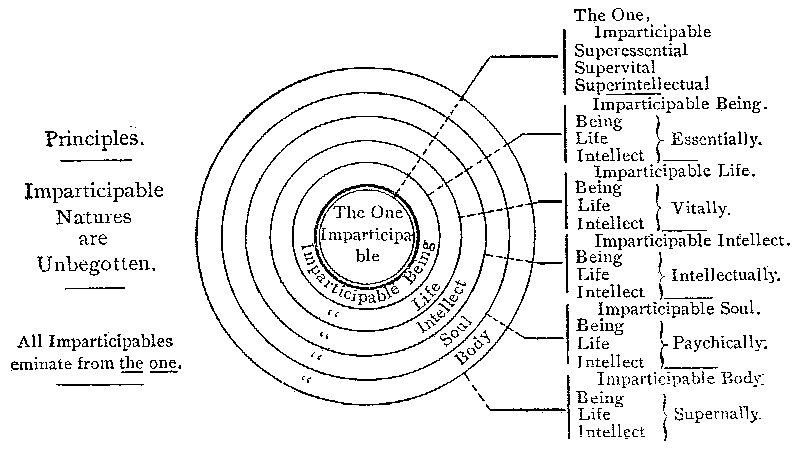
Being-Life-Intellect: We know these well as the three terms of the Intelligible Triad. Being is the first term, and the second, which unfolds from it, is power or life. Everything which is has a vitality to it: that which does not act at all is Dead and is very Death, which is Annwn and Cythraul. We therefore ask that, having been united to our true being, our true vitality may unfold. The third term of the triad is Intellect, which is the same as Understanding: This is true awareness, the capacity to, as it were, "turn around;" to look back upon our origin.

These terms, Being, Life, and Intellect-- or Being-Life-Intellect-- define the Divine Intellect, and they define every participant in the divine intellect. In Christian terms, they can be understood as the Father, the Holy Ghost, and the Son. In the thought of Proclus, they are the first Gods which proceed immediately from the One, and which unfold many succeeding triads which recapitulate the same basic scheme, until we arrive at those we know: Saturn holding the place of Being; Rhea, the place of Life; Jupiter, the Intellect. I have written elsewhere that in the terms of the Celtic theology we may understand the First as Hu the Mighty, the Second as Ced the Earth Mother, and the Third as Hesus, Chief of Tree Spirits, all of which unfold from and are supernally united to the OIW, the First Principle.

And so as we pray to God for Protection, Strength, and Understanding, we may be understood to say, "Grant that I may have my being perfected and united in thee."

At this point we are invoking the highest level of Being, the extremity of Gwynvydd at the unknowable boundary of Ceugant. As the prayer proceeds, we descend into the fullness of Gwynvydd, and then to Abred and Annwn, before returning again to our source, as we shall see.

The Circles

Nov. 6th, 2023 08:23 pm
Another passage from Barddas, on the Circles of Existence: 

 
The Circle of Abred, in which are all corporal and dead existences.
 
The Circle of Gwynvyd, in which are all animated and immortal beings.
 
The Circle of Ceugant, where there is only God. The wise men describe them thus, in three Circles.

As we have seen, the extremity of Abred is Annwn, the realm of the Dead; and this can also be seen as the meeting point of Abred and Cythraul, the Devil and Primordial Chaos. 

I've said a great deal from within the Druid perspective on these ideas. I want to look a little more at Iolo's Druidry from a kind of "outside perspective," analyzing them, rather than understanding them. This mode of thinking, which is related to the sophistry employed by our university professors, is a lower mode to be sure, but it has its uses. 

Now, the great open question regarding Morganwg is precisely what were his sources, and, of course, the great question about our modern Druidry is what links it has to the Druidry of the ancient world. The old answer, which was untrue, was "It is the ancient Druidry, preserved down the ages." The current answer is, "It is not the ancient Druidry but a modern movement inspired in part, but only in part, by what we know of the ancients, intended to meet the spiritual needs of modern people."

To me, the second answer is more than sufficient-- but I wonder if it is not true either. 

I've already discussed the great Ninth Century clergyman and philosopher of Ireland, John Scotus Eriugena. Eriugena's great work was entitled the Periphysion. I've only begun to explore Eriugena in detail, but from what I can tell, the essence of his metaphysics was a four-layered system of ontology, which exactly replicates the ancient Four Worlds of the Neoplatonists: 

Nature includes both God and creation and has four divisions: nature which creates and is not created (God), nature which creates and is created (the Primordial Causes), nature which is created and does not create (the Created Temporal Effects), and nature which is neither created nor creates (Non-Being).
 
This division of things in a descending hierarchy from that which creates and is uncreated to that which neither creates nor is created is identical to the ontology of Proclus, who divides things into that which is immovable; that which moves itself and moves others; that which is only moved. 

And so, again, we see a source for Iolo's thought in the mystical Christianity of the Celtic world, and particularly in Eriugena. Eriugena's source was Dionysius, and Dionysius was (probably) a student of Proclus. 

So is modern Druidry simply Classical or Medieval, and Platonic, rather than ancient and Celtic? 

Let us remember that Proclus didn't come out of nowhere. "Neoplatonism" is marked by scholars to begin with Plotinus, several centuries earlier, but "Neoplatonism" is a Neologism. Plotinus thought of himself as a follower of Plato, and it is only in very recent times that university professors, themselves blinded by the parochialism of their profession, have suggested that he was anything but. The ancients themselves saw the Philosophers of Greece as one example of a type, which included the Brahmins of India, the Magi of Persia, the sages of Chaldaea and Egypt-- and the Druids of the Celts. Pythagoras was said to have sojourned among the Druids. In all likelihood "Platonism" is only the specifically Greek expression of a Great Tradition common to the Indo-European peoples. If the specifically Celtic expressions were lost to time, it was natural enough to fill them in with their analogs from other, better-preserved sources, from Greece to India. This many modern Druids have done. 


Finally, we need to take off our modern way of looking at these things. To the modern mind, a book is an object, an idea is a creation, and a truth is a discovery. But on the older way of looking at things, Truth is eternal, Ideas are living and more than living, and books very often have their own spirits, and to encounter them is to come under their power.


The Moral Argument for Reincarnation


The Christian moral argument for the existence of reincarnation is very straightforward. It is as follows:

1. At least some babies will die before baptism. This has always been the case, and would even be every maternity ward had priests standing in every delivery room to baptize every baby upon emergence from the womb, because between 10 and 25% of all pregnancies end in miscarriage.

2. An infant in the womb, or in the first two or three (some say seven) years of life, is incapable of sin.

3. Therefore, there will always be some babies who die in a state of total innocence.

The next part of the argument:

1. Accoreding to the Christian account sinless baby, upon death, may go either to Heaven or to Hell. (There are two other options within Roman Catholicism, which we will come to in due time.)

2. If to Hell, God is a monstrosity, for he has deliberately formed certain lives for no purpose other than to torment them for all time. Such a being is not a "God" but a monstrous demon, and we should pray for its defeat and ultimate repentance.

3. If to Heaven, and if Hell is a possibility for human beings once they become capable of sin, then universal human infanticide becomes a moral imperative. The reason is that eternal Hell is the worst imaginable evil, while Heaven is the greatest possible good. Earthly life is a mixture of good and evil in which evil typically predominates. By universal abortion, we may spare all human beings both of the comparatively moderate evils of Earthly life and the possibility of the greatest possible evil in Hell, while guaranteeing the greatest possible good to all in Heaven.

4. If God has created a situation in which universal infanticide is a moral imperative, then God is not and cannot be good. Such a God is no "God" but a monstrous demon, and we should pray for its defeat and ultimate repentance.

The final part of the argument:

1. The most just solution to the foregoing is simply that infants who die in the womb or in the early years of life are given another chance.

2. God always does what is most just.

3. Therefore, reincarnation exists.

Possible Variations:

1. An unbaptized infant goes not to Hell, but to the Limbus Infantium, a place of maximum natural happiness but deprived of the supernatural happiness which is caused by the beatific vision, which is to say, the vision of God. If this is not as cruel as a Hell of conscious torment, it is still needlessly cruel, as God has necessarily created some human souls which could experience the beatific vision but deprived them of it through no fault of their own. On the other hand, as maximum natural good (Limbo) is still preferable to maximum supernatural evil (Hell), we would still be justified in arguing for universal infanticide. Therefore, this is false.

2. An unbaptized baby goes to Heaven, but only after a sojourn in Purgatory. This is not taught in the tradition as far as I know. This runs into two problems. First, the nature of Purgatory is a mixture of good and evil-- according to the tradition one suffers, but is comforted by the presence of the saints, including the Queen of Heaven herself, and one's own guardian angel, and one's suffering can also be alleviated by the prayers of those on Earth. We may therefore say that, like Earthly life, Purgatory is a mix of good and evil, but that there the good predominates, owing to the direct experience of the saints and angels and the guarantee of Heaven at the end of the line. This therefore also argues for universal infanticide, and is therefore false.

3. Quem di dilligunt, adulescens moritur. This means "Whom the gods love, die young." This is the view that infants who die before baptism are conveyed directly to Heaven, but that the rest of us will also, universally, reach Heaven after a certain period of time which may well include a sojourn in Hell. On this perspective, the loss of a child, while a catastrophe from the perspective of the parent, is a blessing, indeed, a special grace, from the perspective of the child. Unlike the rest of us, who will have to wait an uncertain length of time before achieving Paradise, our lost children have been granted the grace of direct admission into the Kingdom of Heaven, without an earthly sojourn or the risk of temporary Hell. This only works if universal salvation is true, and could still be considered an argument for infanticide. Nevertheless, it is the best alternative.

What Which Cannot Be True

Some Christian saints have taught that "Even martyrdom is not enough to wash away the stain of heresy." That is to say, even if one loves Christ enough to die for Him, one will still be tormented in Hell for all of time if one happens to have gotten some of the details of his biography wrong. In many cases, the options on offer are equally plausible, and sometimes require specialized knowledge of ancient and medieval philosophy to even tell apart. Does homoiousios make more sense to you then homoousios? How about qui ex Patri filioque procedit? Into the fire with you! This bit of nonsense, unfortunately still preached by many, is contradicted by the following argument:

1. Jesus said unto him, Thou shalt love the Lord thy God with all thy heart, and with all thy soul, and with all thy mind. This is the first and great commandment.

2. Greater love hath no man than this, that he lay down his life for his friends.

Therefore, one who accepts martyrdom out of love has fulfilled the first and great commandment. (He said nothing at all about prefering homoousia to homoiousia.)


The Dead

More of a personal post today. Today is All Souls Day in the Christian calendar, the final part of Hallowtide, the Dark Triduum that began last night with Halloween. In other traditions we can call it Samhain or Calan Tachwedd. The intention is the same. This is the Time of the Dead.

Notice that the Dead come in three forms during the tree days. The spirits of Halloween are frightful beings. Here we see the images of skeletons crawling from their graves, vampires prowling in the night, and so on. The spirits of All Saints Day, by contrast, are exalted beings. We may call these the Mighty Dead; like all cultures with any wisdom (and unlike certain Protestant sects in the United States) we revere them, and ask for their guidance. The third day is the day to honor our own Dead-- our friends and family members who have died, and our own ancestors.

Sixteen Ghosts

Sixteen is not commonly found on the list of sacred numbers, and its use is uncommon. It is, however, the number of the figures of Geomancy, and so we can believe that it has a certain power and a certain symbolism. Significantly, it is the number of each of our twice-great grandparents.

The question sometimes comes up, how one may both venerate one's ancestors and believe in reincarnation. And the answer is veyr simple. Except for the Druze tribe of Lebanon, who apparently reincarnate almost immediately after dying, most people spend a fair bit of time in the Spirit World between incarnations. How much time? Well, it seems to vary. Some sources suggest that a given person lives 3 human lives in a thousand years. Plato in the Phaedrus suggests that we only live once during that time. Recent research into reincarnation shows that children

My own view is that we probably, under ordinary circumstances, are born around 3 or 4 times in a given millennium. Notice that this means that we spend more time in the Spirit World than out of it. Three long human lifespans might total 250 years, or a quarter of a millennium. Given that, it's worth considering-- if you lived in, say, New England, but had a vacation home in Florida where you spent 3 months out of the year, would you be more of a New Englander, or more of a Floridian? In the same way, I think it's only the extraordinary strangeness of the time we live in that leads us to see ourselves as primarily bodily or incarnate beings.

In any case, given this, under ordinary circumstances one's great-great grandparents might reasonably be expected to still be hanging around in the Spirit World, and also to have had more than enough time to process the events of their last incarnation. It follows that, of all our ancestral dead, they will be in the best position to take an active role in guiding and shaping our own lives.

To that end, I've spent a fair bit of time researching my own Sixteen Ghosts. Who were they? What were their lives like? How did their actions in life shape who I have become, and how do they guide me from the World Beyond? Five of them were immigrants-- two from Italy, one from Scotland, one from Prussia, a fifth was Irish. Some of the rest were children of immigrants from Ireland or Germany. Others, meanwhile, were from families who had lived in Pennsylvania for many generations, since the 1700s or earlier.

Like many American mongrels, I'm nuts for ethnic history, and I can give you my pedigree to within a percentage or two; I'm tempted to go on at length about the ethnic character of my forebears. Since I can already hear my readers yawning, I won't do that. More interesting than blood-quanta, is the question of how these people lived, the forces that shaped their lives, the virtues and the character they brought to those lives. Even in 1900, it took an extraordinary amount of courage to cross the Atlantic Ocean and start a new life in a foreign country. How can I live up to that legacy? How can I manifest the same courage, and how can I honor their lives with my life? 

And for the readers here, who were your Sixteen Ghosts? How did they shape your life, and how can you honor them? 

The Month of the Holy Souls

In the Roman Church, the entire month of November takes its character from the holidays which open it, and is dedicated to the Holy Souls in Purgatory. My view of the Afterlife is more complicated than that of Rome, of course. I view "Purgatory" as a catch-all term for all those spirits who have no ascended beyond human incarnation. The Holy Souls, then, include those spirits whose deeds in life have led them to either the darker parts of the Spirit World or to wander the Earth as a ghost, but also those who abide in the pleasant parts of the Afterlife. (Actually, I also include our life incarnate in the body as a part of Purgatory, but let's leave that aside for now. The point is that this is a fine time of year to honor the Dead, and I propose to do that. Periodically either over this month, or during the entirety of this cross-quarter period, I'll post something in honor of my own ancestors (the Holy Souls) or other dead people whom I admire, but who may not formally fit the definition of a "saint" according to Rome. Happy Hallowtide!


In Barddas we read:

Some have called God the Father HEN DDIHENYDD, because it is from His nature that all things are derived, and from Him is the beginning of every thing, and in Him is no beginning, for He can not but exist, and nothing can have a beginning without a beginner. And God the Son is called IAU, that is, God under a finite form and corporeity, for a finite being cannot otherwise know and perceive God. And when He became man in this world, He was called JESUS CHRIST, for He was not from everlasting under a finite form and body. And the man who believes in Him, and performs the seven works of mercy, shall be delivered from the pain of Abred, and blessed for ever be he who does so. Jesus Christ is also called GOD THE DOVYDD; and He has also other names, such as PERYDD, and GOD THE NER, and GOD THE NAV.

Now, "Hen Ddihenydd" means "ancient and unoriginated one"; apparently it is the Welsh translation of "Ancient of Days." "Iau" means "Younger," in that the Son is younger than and generated from the Father-- but it also means "Jupiter" and is, I believe, the modern Welsh name for Thursday (Dies Iovis, Jupiter's Day). Notice, too, that the word IAU is a cognate of IAO, which is an ancient Gnostic name for the Supreme Deity. The suggestion is that the God whom we can see and name as Supreme Being, IAO, Iuppiter or Jesus Christ, is himself an image of the Hidden One, the First Father. This idea is also found in the Oracles, where we read:

 
The Father perfected all things, and delivered them over to the Second Mind, whom all Nations of Men call the First.

The titles given to Christ mean: Dovydd, the Tamer; Perydd, the Cause; Ner, the Mighty or Energy; Naf, the Shaper or Creator. And elsewhere in Barddas we encounter other Names of God, including a poem which reads:
 

Duw, Dofydd mawr, Ionawr, Iau.
Ener, Muner, Ner, Naf ydyw.
 
Each of these represents one facet of the Second Mind, the Divine Intellect, who is God as He appears to human minds. As we have discussed before, since God is superessential, the names are inexhaustible, both in their particular meanings and in their variety. The particular Names are given to humanity through inspiration, as we read in Dionysius:

Let the rule of the Oracles be here also prescribed for us, that we shall establish the truth of the things spoken concerning God, not in the persuasive words of man's wisdom, but in demonstration of the Spirit-moved power of the Theologians, by aid of which we are brought into contact with things unutterable and unknown, in a manner unutterable and unknown, in proportion to the superior union of the reasoning and intuitive faculty and operation within us. By no means then is it permitted to speak, or even to think, anything, concerning the superessential and hidden Deity, beyond those things divinely revealed to us in the sacred Oracles

This is from the Areopagite's treatise on the Divine Names, which then proceeds to analyze many of the Names of God.

 Let us come to the appellation "Good," already mentioned in our discourse, which the Theologians ascribe pre-eminently and exclusively to the super-Divine Deity...

For, even as our Sun----not as calculating or choosing, but by its very being, enlightens all things able to partake of its light in their own degree----so too the Good----as superior to a sun, as the archetype par excellence, is above an obscure image----by Its very existence sends to all things that be, the rays of Its whole goodness, according to their capacity. By reason of these (rays) subsisted all the intelligible and intelligent essences and powers and energies.
 
Readers of this blog will, of course, have no trouble identifying the source of this particular idea of Dionysius's.

This tradition, of reciting, contemplating and meditating upon the revealed Divine Names is an ancient one. We may well believe that the Druids of old practiced it, and it is preserved, as we see, in Dionysius, the great disciple of Proclus (or the great companion of Saint Paul, or both). Many know that the system of transcendental meditation is based on the repitition of one of the Names of the Hindu pantheon. The tradition of Dhikr, the meditative recitation of all of God, is an Islamic version of the practice. Moreover, the Ismaili tradition within Islam explicitly understands the Names to refer to the second divinity, Divine Intellect, their understanding of which is drawn from the writings of Plotinus

Morganwg-- perhaps we should call him Saint Iolo Morganwg, or Niomh Iolo Morganwg-- was a trickster, to be sure-- just as the mysterious author of the Dionysian letters was a trickster. If Dionysius merits the title "saint," "holy," then so in my view does Morganwg. Perhaps we might call him "Niomh* Iolo Morganwg." And, reading from the deep well of the Barddas, we might pray,

Niomh Iolo Morganwg, ora pro nobis!

 
*(Yes, I did that on purpose, feel free to share if you get the joke.)


The Unity of Philosophy

There are some who say that the study of philosophy had its beginning among the barbarians. They urge that the Persians have had their Magi, the Babylonians or Assyrians their Chaldaeans, and the Indians their Gymnosophists; and among the Celts and Gauls there are the people called Druids or Holy Ones, for which they cite as authorities the Magicus of Aristotle and Sotion in the twenty-third1 book of his Succession of Philosophers.
So we read in the History of the Lives of Eminent Philosophers, written by Diogenes Laertius around 150 B.C.

In Barddas we read:

Question. Why is the face turned towards the sun in every asseveration and Prayer?

Answer. Because God is in every light, and the chief of every light is the sun. It is through fire that God brings back to Himself all things that have emanated from Him; therefore it is not right to ally one's self to God, but in the light. There are three kinds of light, namely: that of the sun, and hence fire; that which is obtained in the sciences of teachers; and that which is possessed in the understanding of the head and heart, that is, in the soul. On that account, every vow is made in the face of the three lights, that is, in the light of the sun is seen the light of a teacher, or demonstration; and from both of these is the light of the intellect, or that of the soul.
And again:

Question. Why do we say, Heaven above, and Hell beneath, where there can be no highest in respect of any being, or lowest in respect of any existence? And why God in the highest, and Cythraul in the lowest?

Answer. Because the light is always highest, and above our heads, and it is in the light that God is found, and there can be no Heaven, except in the light; and God and Heaven always go together with light. And the darkness is always the lowest, and Cythraul and hell go together with it.

Book VII of Plato's Republic centers around the famous allegory of the cave. Imagine, Plato writes, that you have spent all your life as a prisoner in a cave, chained to the floor in such a way that you can move your head neither left nor right. Behind you is a fire, before you the cave wall. Between you and the fire men are moving puppets about, and all you can see and all you have ever seen are shadows cast by the puppets upon the cave wall.

But the day comes, and you escape. Making your way up to the surface, out of the darkness, you find a world of dazzling light in which you are totally blind. You come out at night, and look at things in the darkness-- at night the trees resemble the shadows which you had been used to, and the starlight is reminicent of the flickering of the fire.

Last of all he will be able to see the sun, and not mere reflections of him in the water, but he will see him in his own proper place, and not in another; and he will contemplate him as he is.
He will then proceed to argue that this is he who gives the season and the years, and is the guardian of all that is in the visible world, and in a certain way the cause of all things which he and his fellows have been accustomed to behold.

Now this cave is our material world, and the fire our material sun. The master of puppets is the Sublunar Demiurge, who dazzles our eyes with unintelligible images. The true Sun is the Eternal Spiritual Sun, as he is named in the Druid tradition; the Idea of the Good, as Plato calls him. This is the image of the First Cause, the One Itself.

All things in our material world are the images of higher things, and it is through them that we make the ascent, out of the cave, into the light of the Real. And so we are enjoined to worship in the Sun and in the light of the Sun, that, uniting ourself to the material Sun, we may be drawn upward into the light of the Spirit.


Continuing the discussion of God in the Barddas, we read the following, in a section entitled the Bard's Enigma:

There is nothing truly hidden but what is not conceivable;
There is nothing not conceivable but what is immeasurable;
There is nothing immeasurable but God;
There is no God but that which is not conceivable;
There is nothing not conceivable but that which is truly hidden;
There is nothing truly hidden but God.

This is then given in several different forms. The point in every case is that God is ultimately utterly unknowable. This is why the sphere of God is called Ceugant, the "empty sphere."

John Scotus Eriugena-- the name means "John the Scot, the Irishman," distinctions among the various species of Gael having been apparently less important at the time than now-- was a philosopher of the Ninth Century. Another way of saying it is that he was the philosopher of the Ninth Century. He seems to have been among the best-educated men in Western Europe and one of the few who could read Greek and thus access many of the Church Fathers in their original language.

Compare Morgwanwg's Bardic Enigma with these passages from Eriugena's homily on the prologue to the Gospel of John:

The voice of the spiritual eagle resounds in the ears of the Church. [The Eagle is the traditional symbol of St. John the Evangelist.] May our external senses grasp its fleeting sounds, and our interior mind penetrate its enduring meaning. This is the voice of the high-flying bird, not hte one that flies above the material air or ether or around the whole of the sensible world, but the bird which soars above all theory, on the swift wings of the most profound theology and with the insights of the clearest and most sublime contemplation, passing beyond all that is and all that is not.

By 'all that is,' I mean those things that do not entirely escape human or angelic knowledge... By 'all that is not,' I mean those things which transcend the powers of all understanding.

Later, comparing John with Peter, he tells us:

The one reclined on the breast of the Lord, which signifies contemplation, while the other hesitated, which signifies restless action. ... The power of contemplation, wholly purified, penetrates more keenly and swiftly the profound secrets of the divine letters than does action, which is in need of purification.

For Eriugena, then, "that which is not" is the whole realm of boundless possibility uncomprehended by human or even angelic minds, and it is beyond this that God himself abides. The way of contemplation signified by John is the way of immediate knowing. The word "contemplation" in modern language refers to thinking, and "meditation" to the emptying of the mind. This is one of these oddities that come up every now and then in the history of language, like the transformation of the French word blanc, meaning white, into the English black, meaning black. In former times "meditation" meant thought, while "contemplation," especially in a spiritual context, meant the immediate presence and knowing-ness that is beyond thought.

Eriugena's great source was Dionysius the Areopagite, that mysterious figure of the Sixth Century who wove together Procline Neoplatonism with Christian imagery. Dionysius's Mystical Theology begins with the following oration to Divine Darkness:

TRIAD supernal, both super-God and super-good, Guardian of the Theosophy of Christian men, direct us aright to the super-unknown and super-brilliant and highest summit of the mystic Oracles, where the simple and absolute and changeless mysteries of theology lie hidden within the super-luminous gloom of the silence, revealing hidden things, which in its deepest darkness shines above the most super-brilliant, and in the altogether impalpable and invisible, fills to overflowing the eyeless minds with glories of surpassing beauty. This then be my prayer; but thou, O dear Timothy, by thy persistent commerce with the mystic visions, leave behind both sensible perceptions and intellectual efforts, and all objects of sense and intelligence, and all things not being and being, and be raised aloft unknowingly to the union, as far' as attainable, with Him Who is above every essence and knowledge. For by the resistless and absolute ecstasy in all purity, from thyself and all, thou wilt be carried on high, to the superessential ray of the Divine darkness, when thou hast cast away all, and become free from all.
In the New Testament, Dionysius is the companion of St. Paul. His letters to Timothy were lost in ancient times, but coincidentally rediscovered two years after Justinian's banning of the teaching of pagan philosophy. They then formed a major part of the foundation of Christian theology, east and west, for a thousand years. After this time, someone got around to noticing that Dionysius's writings sounded a lot like the writings of Proclus, the last great pagan Neoplatonist. Here is a sample of Proclus's discussion of the First Cause in his Platonic Theology:


Let us now therefore, if ever, abandon multiform knowledge, exterminate from ourselvs all the variety of life, and in perfect quiet approach near to the cause of things. for this purpose, let not only opinion and phantasy be at rest, nor the passions alone which impede our anagogic impulse to the first, be at peace; but let the air be still, and the universe itself be still. And let all things extend us with a tranquil power to communion with the ineffeable. Let us also, standing there, having transcended the Intelligible (if we contain anything of this kind), and with nearly closed eyes adoring as it were the rising sun, since it is not lawful for any being whatever intently to behold him-- let us survey the Sun whence the light of the intelligible Gods proceeds, emerging, as the poets say, from teh bosom of the ocean; and again from this divine tranquility descending into intellect, and from intellect, employing the reasonings of the soul, let us relate to ourselves what the natures are from which, in this progression, we shall considder the First God as exempt. And let us as it were celebrate Him... as more ineffable than all silence, and more unknown than all essence, as holy among the holies, and concealed in the Intelligible Gods.


This, then, is the tradition in which Morganwg is ultiamtely working. It can be seen at once as pagan and Christian, Celtic or Druidic and Platonic. But these are only labels. The enigma remains, the task remains: to abandon multiform knowledge; to leave behind both sensible perceptions and intellectual efforts; to recline, as it were, against the very heart of the Christ who is the summit of all Intelligibles and, soaring as an eagle beyond all that is and all that is not; to encounter there the Great Mystery hidden in a stillness ineffable beyond all silence, a gloom darker than all darkness.


I wanted to write at length about reincarnation today, but time's gotten away from me, so let's take a look at another one of the Theological Triads of Iolo Morganwg, this one concerning God:

 
God is three things, and cannot be otherwise: coeval with all time; co-entire with all essence; and co-local with all mental purpose. Could what is called God be otherwise, it would not be God, since it could be surpassed, and no one is God that can be surpassed. He is also co-sentient with all animation.
 
This is straightforward enough on the surface, but there is more lurking here than we might at first suspect. Let's look at the terms one at a time.

To be coeval with all time means that God is equally present in all times. There was never a moment where God was not, and never a moment when God will not be. Now, this also implies that God is changeless, because if God were to be one certain way at one time, and another way at another time, he would not be equally present to all time-- instead he would be present either partially or in a particular way in one time, and partially or in another particular way at another time.

To be co-entire with all essence means that every being which has existence, derives its existence from God. There is nothing which is outside of God, or which does not participate in God, because the very fact of nonparticipation in God is nonparticipation in reality.

And finally, to be co-local with all mental purpose is precisely to be in possession of all possible knowledge. The reason for that is that every possible mental experience attained by every possible living creature can be understood as a sort of knowledge or information. I may know, for example, what red looks like, but I don't know what it looks like through your eyes. Moreover, I know what it's like to look across the living room and see a red blanket on the couch, but I don't yet know what it will be like to look across the room and see the same red blanket on another part of the couch tomorrow evening. God either possesses that knowledge and every similar form of knowledge, or his knowledge is limited; if limited, he is not God; but if he does possess it, then-- as the argument showed the other day-- God is all beings. I take "co-sentient with all animation" to be another way of saying "co-local with all mental purpose."

(This also means that insofar as any being is in Hell, God is always with them; this is another proof of the ancient view that Hell is not everlasting.)

These three which cannot be otherwise also refer to the planes of existence.

God abides beyond all change. His creative power ever flows outward like heat from a fire, and immediately He produces the empty sphere of Ceugant, which is the source of all essence: this is his co-entirety with all essence.

From essence emanates intelligence, which is the luminous life of Gwynvyd, the source of all mind, the colocality of God with all mental purpose.

From Gwynvyd emanates Abred, which is the world of time, not indeed deprived of God as God is coeval with all time.

And note finally that the Monad presides over the Triad, which unfolds the Monad. This is the structure of all the Celtic triads, which are wisdom-sayings, and it is also part of the Deep Structure of reality itself. 


The Use of an Enemy

Some writers make a habit, others a whole career, of writing about things they disagree with. This sort of thing constitutes most "political writing" in the present time, which upon closer examination turns out to be largely the verbal equivalent of pointing and shrieking. That said, it can sometimes be useful to look at what you aren't, as a means of clarifying what it is that you are. And it is for that reason that I'm going to talk about the Roman Catholic Church.

Of course, anyone familiar with traditional Roman Catholic theology that the differences between my views and those of the Magisterium are considerable on a considerable number of matters. But today I just want to talk about two, and how these two stem from one common origin.

Two Stories

I have to drive a lot these days. This has its obvious down sides, but the upside is that I get to spend a great deal of time listening to talks and audiobooks. Occasionally I run out of things to listen to, or my phone dies, or I forget what I had planned, and I turn on the AM radio. In my area we have two Catholic stations, Relevant Radio and the Guadalupe Radio Network. Their perspectives are slightly different. Relevant Radio seems to cater to the sort of audience that thinks Catholic Answers is high theology. Guadalupe is more intersting; a priest on one of its shows made the only on-air reference to Plotinus that I've ever heard on any radio station-- and it's worth noting that he was citing Plotinus favorably and as an authority, in order to explain something about the nature of God. The same priest then, paradoxically but perfectly in keeping with Church tradition, went on to describe the "great disaster" of the "re-awakening of the old Celtic and Germanic Gods." That said, any God is better than no God, and so I'm grateful for these stations and the discussions they field. Frequently there are call-in shows, where a listener calls the station with a problem which the show host, often but not always a priest, tries to solve for them. And it's here that I'm reminded of exactly why I'm not and never again will be a member of the Roman Catholic Church.

Story 1. Yesterday, on one of the shows, a man called in to ask why he sometimes gets a strange sense about certain people, that they seem to have an evil "vibe" or aura about them. The host answered that many people have that feeling sometimes. He then went on to say that sometimes it's God intervening with a message directed at us that we should avoid a person or a situation, but that most of the time the other person is just having a bad day. And so his message wasn't precisely that we should ignore our instincts, but that we should certainly downplay them. And, critically, if we do have a sense or feeling about a situation that turns out to be accurate it isn't an accurate sensation on our part but rather a deliberate intervention, by God Himself, into the course of ordinary events.

Story 2. An Irish woman living in Baltimore called in to ask about a strange practice at a church she attended in her girlhood. It seems that, unlike most American churches, in this church the bread used for Communion was baked by one of the parishioners. And so instead of little round communion hosts, they had pieces of actual bread for communion. The woman, with great exasperation, described the constant presence of crumbs on the floor, and asked whether or not such practices are actually acceptable. The priest replied that while it is technically okay to have bread for communion baked locally, most churches prefer to order hosts specially made by companies set up for that purpose. It's much more expensive-- he went on-- but they're more convenient and you never have to deal with crumbs. The originally caller hung up the phone satisfied with her answer.

Connection and Disconnection

What unites these two stories on seemingly disparate topics is what I think of as a theology of disconnection. In the first story, anyone who has had any experience with these things can tell you that it is simply the case that we can learn to both perceive and to act on planes of reality other than the physical. This is what is meant by the various "planes of being" of Occult Philosophy and the worlds or levels of classical Platonism. The planes or worlds are not metaphorical; they are real levels of being, ontologically distinct from one another. To develop spiritually-- and mentally-- is to become able to function-- to act and to perceive-- on higher levels.

Many of Plato's works are structured precisely to produce this sort of spiritual-mental change in the reader. If one reads the Republic as a work of "political philosophy," as many modern people are trained to, one encounters it as a series of propositions which one can either accept or reject. What do you think of justice? Can it be best defined as a right relationship between the different parts of the soul or city? Would it really be a fine thing to be ruled by philosopher kings? (I answer: We've tried the alternative, and the idea looks increasingly appealing.)

But the text of the Republic makes it clear at the outset that the description of the ideal city is meant as an image of justice in the human soul. The work of constantly keeping the image of the soul and the city simultaneously present in the mind forces the reader to come to see the pattern which underlies both, and thereby to begin to function at the level of patterns.

According to this way of looking at things, if one has a "sense" about somebody, it isn't that it is necessarily correct. Often our psychic senses (the word "psychic" refers to "psyche," which means "soul") are clouded. It is, however, an indication that we have begun to function at a level higher than our individual mind, and this is something that we should pursue. The mainstream of the Catholic Church doesn't have room for this. Having been taught by Aristotle, rather than Plato, it sees minds as confined to brains just as do the materialists it opposes. It therefore requires regular "special interventions" by God in order to account for human psychic experiences.

There's nothing wrong with special interventions by God, of course; we should all be grateful for such things when they happen. The problem is precisely that this is a fragmented worldview, in which atomic individuals exist unconnected to one another and to the life of the spirit. The fragmentation is so complete that any exception to it requries a special intervention but nothing less than the Lord of the Universe Himself-- even great saints and archengels can't talk to you without God lending a hand. The alternative point of view is not a fragmented but a holistic worldview, in which each of us participates collectively in the many unfolding layers of reality.

The example of the communion hosts may seem rather removed from this, but it isn't really. In the case of the parishioner baking bread for communion, everyone knows what they are eating, what it is made out of, and who made it. The parishioner himself or herself is given a special role in parish life, and every member of the congregation can say to themselves, "This bread was baked by one of us." In the usual way of doing things, the hosts simply come from "somewhere"-- like most things in American life, they are made by some large corporation somewhere out there. In the example of the "locally made" hosts there is, in other words, an awareness of the whole which is also present in the layered ontology of the Platonic view, and absent in psychic Aristoteleanism.

The Reality of Connection

The truth is that we are always connected; there is in this Universe no fragmentation. God is absolute unity, and also absolute reality; it follows that the opposite of God is absolute dis-unity but also, therefore, absolute unreality. Therefore disconnection is always illusory, as the defining feature of the unreal is that it does not exist! The Devil Himself-- Cythraul, in the Druidic terms I've been using-- is precisely this, the tendency toward nonexistence.

We are always connected, via all of our actions, all of our words, and all of our thoughts. The question is-- To what are we connected? To a local baker and a local family? Or to a distant corporation-- however well-intentioned-- which we do not know and, critically, cannot love? To a short walk or drive across town with freshly-baked bread, or to an international transportation system and a system of industrial agriculture which requires massive inputs of petroleum and toxic fertilizers and pesticides? To the souls of our neighbors, or only to ourselves? This is our choice.

In the Phaedrus, Plato tells us: 

All soul is immortal, for that which is ever in motion is immortal. But that which while imparting motion is itself moved by something else can cease to be in motion, and therefore can cease to live; it is only that which moves itself that never intermits its motion, inasmuch as it cannot abandon its own nature; moreover this self-mover is the source and first principle of motion for all other things that are moved. 
 
Now, compare with the Fourteenth Proposition of Proclus's Elements of Theology

 
Every being is either immovable or moved. And if moved, it is either moved by itself, or by another: and if it is moved by itself it is self-motive, but if by another it is alter-motive. Every nature, therefore, is either immovable, self-motive, or alter-motive.

For it is necessary, since there are alter-motive natures, that there also should be that which is immov­able, and the self-motive nature, which is a medium be­tween them. For if every alter-motive thing is moved because it is moved by another, motions will be either in a circle, or they will proceed to infinity. But neither will they be in a circle, nor proceed ad infinitum, since all beings are limited by the Principle of things, and that which moves is better than that which is moved. Hence there will be something immovable, which first moves. But if this be so, it is necessary that the self-motive exist. For if all things should stop, what will that be which is first moved? It cannot be the immovable, for this is not naturally adapted to be moved; nor the alter-motive, [14] for that is moved by another. It remains, there­fore, that the self-motive nature is that which is primari­ly moved. It is this, too, which unites alter-motive na­tures to that which is immovable, being in a certain re­spect a medium, moving and at the same time being moved: for of these, the immovable moves only, but the alter-motive is moved only. Every thing, therefore, is either immovable, or self-motive, or alter-motive.
 
Corollary.— From the premises, therefore, it is evident, that of things which are moved, the self-motive nature is the first; but that of things which move other things the immovable is the first.

From this, we can derive the following doctrines:

1. All  thought can be classed under movement, both becuase it is the form of movement appropriate to the Astral level of being, and because it is (usually) tied to physical movement in the human brain. 

2. The ordinary course of thought is almost entirely automatic. Our thoughts are being moved, but we are not the cause. Though alive, we bear a resemblance to that which is dead or soulless, because soulless matter is always moved. Plato goes on to tell us: "Any body that has an external source of motion is soulless, but a body deriving its motion from a source within itself is animate or ensouled." Habitual, addictive, unchosen behvaior is seen as being caused by ghosts in the Chinese tradition, and people who give themselves over to such behavior become ghosts themselves. This is no mere metaphor. In modern America we refer to such people as "zombies," and too often we are all zombies. 

 
3. Insofar as we gain control over the movement of our thoughts, we become self-motive, and take a step closer to the Divine. We cease to be dead and become alive. 

This is what is meant by the following passages from the Barddas

 
Question. In what place is Annwn?
 
Answer. Where there is the least possible of animation and life, and the greatest of death, without other condition.

...

 
Q. What wert thou before thou didst become a man in the circle of Abred?
 
A. I was in Annwn the least possible that was capable of life, and the nearest possible to absolute death, and I came in every form, and through every form capable of a body and life, to the state of man along the circle of Abred, where my condition was severe and grievous during the age of ages, ever since I was parted in Annwn from the dead, by the gift of God, and His great generosity, and His unlimited and endless love.
 

4. Prior to the self-motive is the immovable: That which, while imparting movement to others, remains entirely still in itself. This is what is meant by Intellect or Divine Mind. It is only from this place of stillness that we can truly choose, because only that which is in stillness can choose either to move or not to move. 

It follows that our Great Pilgrimage is from Annwn, which is almost altogether alter-motive; through the circles of Abred, in which we attain to the self-motive; and to Gwynvyd, at which stillness becomes possible. We must then either divide Gwynvyd and say that its lower part is self-motive, its higher part immovable, or else we must say that it is the Self-Motive and, at its height, the Immovable, but that the Ultimate Immovable is beyond Gwynvyd. How can that be? The extremity of Gwynvyd borders Ceugant, and here is the closest to stillness and immovability that may be attained, but as all creatures have their origin and their being in the One, which is God, all creaturely stillness is surpassed by the eternal divine stillness. And so: 

Ultimate Stillness is found only in the One, in Ceugant beyond all Gwynvyd. 

Ultimate Death is found only in the Cythraul darkness below all Annwn. 

It is better to be able to function on multiple levels of existence than one only. Therefore, our journey is not merely to enter into the final stillness, but to become able to move from stillness to self-motion, from self-motion to alter-motion, according as we choose. But we can only choose rightly if we are united to God. 

This has further implications for the work of meditation. It seems to me that ordinary thinking is nearly always alter-motive. The work of discursive meditation is the work of becoming self-motive. The final work is to become immovable. But the immovable which never moves more closely resembles the Dead than the Living. The goal, rather, is to become immovable and yet able to impart motion. The immovable cannot be influenced; the self-motive is able to act. But the alter-motive too has its uses: the work of "creating good habits" is precisely the work of putting the power of alter-mobility to good use.  


The Rational Animal


Let us recall that the root of the word "Man" is the same as the root of the word "Mind." Part of the definition of man is "a rational animal."

Morganwg's Christ


Let us also recall the progression of the soul in the thought of Iolo Morganwg. Every soul has its beginning in Gwynvyd, the luminous life, but descends to the depths of Annwn, the mineral creation and the very border of the Cythraul, the primordial chaos. Over the course of long ages, the soul rises from the cauldron of Annwn and works its way through the circles of incarnate life in Abred. Arriving at last at the level of humanity, the soul stands at at the border between Abred and Gwynfydd. The soul's work then is to release herself from the bonds of matter and restore herself to her proper divine place in Gwynfydd, which is the realm of Luminous Life.

The role of Jesus Christ in the soul's progression is described thusly in Barddas:

 
Teacher. Dost thou know what thou art?
 

Disciple. I am a man by the grace of God the Father.
 
T. Whence earnest thou?
 
D. From the extremities of the depth of Annwn, where is every beginning in the division of the fundamental light and darkness.
 
T. How earnest thou here from Annwn?
 
D. I came, having traversed about from state to state, as God brought me through dissolutions and deaths, until I was born a man by the gift of God and His goodness.
 
T. Who conducted that migration?
 
D. The Son of God, that is, the Son of Man.
 
T. Who is He, and what is His name?
 
D. His name is Jesus Christ, and He is none other than God the Father incarnate in the form and species of man, and manifesting visible and apparent finiteness for the good and comprehension of man, since infinitude cannot be exhibited to the sight and hearing, nor can there, on that account, be any correct and just apprehension thereof.
 

Elsewhere, we read the following account of the soul's progression:

 
Q. Through how many forms didst thou come? and what happened unto thee?
 
A. Through every form capable of life, in water, in earth, and in air. And there happened unto me every se-verity, every hardship, every evil, and every suffering, and but little was the goodness and gwynfyd before I became a man.
 
Q. Thou hast said, that it was in virtue of God's love thou earnest through all these, and didst see and experience all these; tell me how can this take place through the love of God? And how many were the signs of the want of love during thy migration in Abred?
 
A. Gwynvyd cannot be obtained without seeing and knowing every thing, but it is not possible to see and to know every thing without suffering every thing.
In order to return to the light of Gwynfydd man must know everything, do everything-- suffer everything.

Gwynvyd, Intellect, Christ

Let us, further, recall the three primary beings in the system of Plotinus. First there is the One, unknowable, ineffable, abiding beyond all things. After the one, produced from the one as heat is produced by a fire, is Intellect.

Intellect is the universal mind, but we must not think of it in the way that we ordinarily think about mind. There are two differences between Intellect as understood by Plotinus, and "mind" as we ordinarily talk about it.

First, Intellect is not the level of discursive thinking. The sort of thought that goes "I'm hungry-- I wonder what I have in the fridge?" is not Intellect. The sort of thought that goes, "I'm hungry, but I dont' know what's in the fridge. It seems to me that I have a pattern of waiting until my blood sugar crashes to find something to eat, and at that point my brain is too foggy to come up with anything and I end up eating a cookie. I should do something about that" is closer to Intellect, insofar as it is both deliberate and concerned with patterns. But neither of these are Intellect, because at the level of Intellect there is no difference between the knower and the object of knowledge.

Second, Intellect is Real Being. The phenomena of the sensory world are always passing into and out of existence, but the structures of Intellect, diverse and yet absolutely united, are eternal. Being eternal, they are real. Plotinus calls Intellect Itself "The One God who is all the Gods." Thomas Taylor explains that Intellect "is all Beings."

After Intellect is Soul Itself. Soul has a higher phase, which looks toward Intellect, and a lower phase which tends toward matter. But every being which is alive, is alive by virtue of having a soul, and every soul exists by virtue of Soul Itself.

It should be clear to anyone that there is an obvious parallel between the Three Primary Beings and the Christian Holy Trinity. The One identical to God the Father, Intellect to the Logos, his Son, and Soul to the Holy Spirit.

Throughout the ages, some Christians and members of related traditions have noticed this and embraced it. Others have denied it and condemned Plotinus. Others have embraced Plotinus but organized his system a bit differently, so that the One is identified with the entire Holy Trinity and the succeeding levels with subordinate beings.

In the third category are thinkers like Ficino, who identified Intellect with the realm of the angels and Soul with the World Soul. In the second are Christians in the tradition of Tertullian, who famously denounced Greek philosophy. In the first category are many Christian esotericists, including, from what I can tell, modern thinkers like C.W. Leadbeater, and also the whole of the Ismaili tradition within Islam.

But I believe that Iolo Morganwg is in the first category as well. Consider the rest of the exchange on the nature of Christ:

Teacher. Why is He called the Son of God?
 
Disicple. Because He is from God in His essential works, and not from His uncreated pre-existence, that is, He is second to God, and every Second is a son to the primary First, in respect of existence and nature. That is to say, Jesus Christ is a manifestation of God in a peculiar manner, and every one is a son to another, who is primary, and the manifested is a son to him who manifests. And where God is seen or comprehended otherwise than as a species and existence beyond all knowledge and comprehension, such cannot take place except in what is seen differently to the attribute of God, in respect of the non-commencement and unchangeableness of His being, His nature, and His quality.
 

On this view, then, the Second Being is Intellect. Intellect can be understood as a Being who is All Beings, the One God who is all Gods, and as a level of existence, beyond the level of matter or ensouled matter. That is to say, the Intellect of Plotinus is the same as the Gwynvydd of Morganwg. Christ, then, is Gwynvyd.

Christ conducts the migration of all souls to Gwynvyd, and in order ot attain this level, the soul must "be all things, know all things, and suffer all things." What does this mean?

Mary's Room

In a series of papers published in 1982 and 1986 a philosopher of mind named Frank Jackson presented the following argument against Physicalism. Physicalism, recall, is the belief that only matter and energy exist.

Imagine a girl named Mary who lived in a black and white room and interacted with the world solely via a black and white TV. Perhaps her skin was painted black and she only wore white clothes, or her skin was painted white and she only wore black clothes. The point is that Mary had never seen color. And yet, over the course of her time in her black and white room Mary, via her black and white TV, learned everything that there is to know about color as a function of light waves. She knew, that is, exactly what happened when light bounced off an object at such and such a frequency to appear to the eye as red or blue or green, and she knew about the cones and rods in the human eye, and the different sets of cones and rods in other animal eyes. In fact Mary spent so much time studying color that she knew everything that could ever be learned about it in this way, even those details which have thus far eluded our own science of Optics.

And then, one day, when there was no more possible information to be learned, Mary stepped out of her room, and for the first time beheld the color red.

Now Jackson asks: Did Mary learn anything new?

Of course we must answer Yes. Now, instead of learning about red, she learned what it was like to see red.

Another way of saying this is to say that instead of learning about red discursively, she learned gnostically. No longer was there a separation between the knower and the object of knowledge.

Conclusion

If Christ is Intellect, and if Intellect contains all possible knowledge, and if Intellect truly is union with the object of knowledge, then Christ must know all things, do all things, and suffer all things. Otherwise his knowledge is limited in the same way that Mary's knowledge is limited before she emerges from her room; he has discursive knowledge only.

To say that Man is a rational being is to say that man begins to participate in Intellect. To say that his aim is to attain Gwynvydd is to say that his aim is to return to his existence in Intellect. To say that Christ conducts his migration is both to say that Christ is a man who has undergone the journey from Abred to Gwynvydd, and to say that Christ is all men as they rise from Abred to Gwynvydd. And to say that Christ is all men as they rise from Abred to Gwynvydd is also to affirm again that Christ is Intellect, Gwynvydd, itself.


The Name of Nature

In the Oracles we are told:

Look not upon Nature, for her name is fatal.
We saw yesterday that mathematical principles are media which link the Sensible World of our experience to the Intelligible World of pure mind. The term that Plotinus uses for such principles is logoi, the plural of Logos. Now, like everything else, the logoi exist at a particular level of reality. They aren't sensible-- you cannot see or touch or hold the Pythagorean Theorem-- but they are directly involved in shaping matter. Their level of being is usually referred to simply as Nature, the generator of the physical world.

This is what the verse in the Oracles cited above is referring to. This is another area where we find difficulty in working with some of the ancient texts. To us, this sentence, "Look not upon Nature, for her name is fatal" means something like, "You're going to be killed if you go into the woods." We're left to assume that the Oracle is referring to Jason or some such thing.

Of course, this isn't the case at all. "Fatal," in this context, refers to "fate." In other words, Nature is deterministic. 1+1 always equals 2, whether in the case of two monkeys, two stars, or two atoms; there are no other possible outcomes. The logoi determine matter.

As we have seen, mathematical propositions are not the only types of logoi. Logical formula are another. If all p are q; And if s is p; Then s is also q. This is true for all objects p, q, and s. All men are mortal. Socrates is a man, therefore Socrates is mortal. All crows are black. Jim is a crow, and therefore Jim is black. All coffee is healing to the soul, including the cup I am about to make. And so on.

The games of Eric Berne and the Drama Triangle of Stephen Karpman are also logoi, and also deterministic. When one is drawn into a dramatic triangle, one takes on the assigned role regardless of the other players. A Hero is a Hero whether their Villain is Zionism, Terrorism, Globalism, Fascism, Black Lives Matter or Ben Shapiro. 

But learning these things has been greatly useful to us. We study mathematics in order to reason numerically, logic in order to learn to think clearly, transactional psychology in order to act deliberately.  So what does the Oracle mean when it tells us not to look upon Nature?

One of the most important Occult maxims tells us, "What you contemplate you imitate." This was a truth well known to the ancients. The act of contemplation belongs to Intellect, and Intellect ultimately unites with whatever it looks upon. Spend too much time looking upon the deterministic logoi of Nature, not employing them properly, as a ladder to the superior realms, but simply as tools for the manipulation of matter, and you too will become deterministic. 

This, of course, explains one of the oddest features of modern life-- why our best scientists are so unbearably stupid. 

And of course, this has important implications for Druidry and similar traditions as forms of "Nature Spirituality." Nature in the sense used by the Oracles is everywhere, at all times. But right now I'm sitting at my desk, in my house, staring at a computer. After I press "Send" I'm going to go on a walk in the woods out back. Probably I'll bring that coffee I was just talking about with me, and give some as an offering to the genii loci. I'll find a place to meditate, maybe do some qigong, certainly pray to the spirit of the place. It's obvious to anyone that if I refer to "nature spirituality," I'm talking about the walk in the woods, not the time spent sitting at a computer. And so we see that by "Nature" we mean something a little different from Nature as a plane of being. No-- "Spirituality" as a class of activity must refer to anagoge or anagogy, that is, the elevation of the awareness to higher levels of being. This can be accomplished by various means, including art, physical movement, the reading of sacred scripture. When we say "Nature spirituality," in this case, we are using the word "Nature" in its more common form, meaning something like "The out of doors" or, better, "That which is not created by Man." Nature spirituality, then, is anagogy accomplished in the out of doors, by means of encountering the logoi of Nature in Nature. 
Here is how Plato described the purpose of mathematical studies in the Republic:

All number has also an elevating effect; it raises the mind out of the foam and flux of generation to the contemplation of Being.

And:

Let our second branch of education be geometry... The use of geometry, to which I refer, is the assistance given by it in the contemplation of the Idea of Good, and the compelling the mind to look at true Being, and not at generation only.
 
Now, it was of course obvious to him that these studies had practical uses, and he especially singles out their uses to the general in war. Agamemnon, he notes, would have been a rather poor general if he'd been unable to count his feet, let along his soldiers; the uses of geometry in war are also obvious. 

Of course, Arithmetic is also very useful in the art of making money. Plato dismisses this: 

to our higher purpose no science [than arithmetic] can be better adapted; but it must be pursued in the spirit of a philosopher, not of a shopkeeper. It is concerned, not with visible objects, but with abstract truth

And has little patience for the use of geometry as simply a tool for art and construction:

the present mode of pursuing these studies, as any one who is the least of a mathematician is aware, is mean and ridiculous; they are made to look downwards to the arts, and not upwards to eternal existence. The geometer is always talking of squaring, subtending, apposing, as if he had in view action; whereas knowledge is the real object of the study. It should elevate the soul, and create the mind of philosophy; it should raise up what has fallen down, not to speak of lesser uses in war and military tactics, and in the improvement of the faculties.

This is one of the challenging things that modern people face when we begin to study the Platonic tradition. We are used to a kind of nested hierarchy of sciences in which Psychology can be reduced to Biology, Biology to Chemistry, Chemistry to Physics, and Physics to Mathematics. And we are used to both assuming this scientific hierarchy as an a priori, and to the belief that it somehow works as a proof of Materialism. Somehow proponents of this point of view never get around to asking what the height of the number 2 is, or its breadth, its mass, or its location in space, how long it has lasted and when it might be expected to conclude. 

The ancient view of Mathematics, passed on by Pythagoras to Plato and then forward through the whole tradition of ancient philosophy, is also the more realistic. Mathematical objects are not material objects. They have no dimensions, no location, and no duration. They have no existence in matter. And yet they constantly act upon the material world, defining and delimiting it. We are able to interact with them through the medium of the physical world-- by writing a problem on a chalkboard, or by practicing the classical art of the geometer with a stake in the ground. In this way, Mathematics serves as a bridge between the Sensible World-- that is, the world we grasp with our ordinary five senses-- and the Intelligible World, what we might ordinarily think of as the world of spirit, pure Mind. 

Proclus described it thusly, in his commentary on the Elements of Euclid

Mathematical being necessarily belongs neither among the first nor among the last and least simple of the kinds of being, but occupies the middle ground between the indivisible realities and divisible things characterized by ever variety of composition and differentiation. The unchangeable, stable, and incontrovertible character of the propositions about it shows that it is superior to the kinds of things that move about in matter. But the discursiveness of mathematical procedure, its dealings with its subjects as extended, and its setting up of different prior principles for different objects--- these give to mathematical being a rank below that indivisible nature that is completely grounded in itself. 
 
For the ancients, Mathematics had an anagogic function. That is, it elevated the soul, allowing it to function on higher levels of being. The objects of mathematics exist at a level between the perfectly simple Ideas and the material world. They are not the only such objects. Logical formulae also serve this purpose, and the syllogism functions as well as the geometrical theorem in elevating the mind. But love, too, has an anagogic power, and so does music, as Plato shows in the Symposium and Phaedrus.  

In the writings of Proclus, Plato is regularly given the epithet "Divine." "The Divine Plato" teaches this, "As the Divine Plato writes," and so on. Not only Plato is given this title. Plotinus, Iamblichus, and others are also Divine. "Divine" was rather like "Saint," a word which simply means "Holy." But when Proclus mentions Aristotle, he refers to him instead as Daemoniacal. Because I find Aristotle irritating, I like to pronounce this "demoniacal" and to treat it as its English homonym. But of course, that isn't what Proclus means. The daimones, as I've discussed many times here, are intermediaries between humans and the gods; in the Symposium. They elevate human souls to the divine, and distribute the energies of the divine into matter. 

Traditionally, one began the study of Aristotle with the Organon, a collection of logical treatises beginning with the Categories. In later centuries (that is, after about the year 200) one began first with the Isagoge or Introduction of Porphyry, which then became the standard introduction to logic during the Middle Ages. One then proceeded through Aristotle's physical, metaphysical, and ethical works, and only then began to study Plato. Aristotle's works functioned as a sort of Outer Initiation, preparing the mind for the Inner Initiation of Plato. 

The great philosopher of the Catholic Church in the Middle Ages was Saint Thomas Aquinas. Aquinas was an Aristotelean. In his work he refers to Aristotle simply as "The Philosopher," and rarely disputes with him on anything. With Plato, on the other hand, he is constantly quarreling. This was a reversal of a longstanding tradition. Augustine, the Catholic Church's first great theologian, was a Platonist strongly influenced by Plotinus and Porphyry. Aquinas's great contemporary, Saint Bonaventure, was a Platonist, as Augustine had been, but in the end Aquinas ended up carrying the day. His Dominican Order's Thomistic theology provided the intellectual grounding for the Roman Church, with Bonaventure's Franciscans providing a kind of minority report. 

I'm wondering if this wasn't the great error of the Western world, and I wonder if it doesn't ultimately amount to prefering the Daemoniacal to the DIvine. 

Joan's Law

Oct. 16th, 2023 09:00 am
A short post today on something that I've been thinking about for a while. There are a number of little rules, heuristics and aphorisms I've discovered or adopted over the years, and I'd like to share them here from time to time. Today is one I'm calling Joan's Law

(By the way, there is a trap hidden in this post-- see if you can spot it.)

Meet Joan

I once worked for a company-- let's not name them-- with an accountant I'll refer to as "Joan." Joan was a very interesting sort of accountant, in that she appeared to be terribel at math. I'm not sure how one gets an accounting job while being bad at math, but Joan did. I know that Joan was bad at math because every time you got your paycheck at this company, you had to carefully go through it and look for errors. When, almost inevitably, errors were found, you then had to bombard Joan with calls and texts in order to get your paycheck corrected.

Now, here's the other thing about poor old Joan-- her errors only ever went in one direction. Both I myself and everyone I knew were regularly paid the incorrect amount, but it was always less than we were owed, never more. Then as now I can understand being poor at math-- many people are, though it's an odd trait for an accountant. But one would imagine that, if simple innumeracy were the issue, the errors would be just as likely to be in our favor as the company's. And yet they never were. What ever could explain this discrepancy?

Well, you know the answer as well as I do. Joan wasn't bad at accounting. Joan was a shyster, and she was bad at honesty. Her sister and brother-in-law were the company's owners, and were themselves, well, let us say "given to morally dubious decision-making." 

What's the Point? 

The reason I'm talking about this is that it's occurred to me that we have a lot fo Joan's running around our society. Indeed, we all seem to play Joan from time to time. Not that we are all involved in scamming our sibling's employees. No, most of our-- can I call it Joaning? We do most of our Joaning in other areas of life. Above all, for most of us, most of our opinions are nothing but Joan. 

Let me give you two examples. 

What do aliens, Atlantis, extra-sensory perception, reincarnation, ghosts, Bigfoot, the lost city of Troy, reincarnation, astrology, and the theory of primitive matriarchy have in common? 

Taken one at a time, not very much. There's every possiblity, after all, that we may live in a world in which interstellar travel has been discovered by one or more alien species, but not a world in which a large primate has remained hidden for centuries in the North Americna wilderness, or a world in which the Dead occasionally speak with living human beings, but in which no individual can perceive future events by any means; or a world in which an urban civilization had formed on at least one Atlantic island by the year 10,000 B.C., but not in which any society has been ruled primarily by women. And yet, when we find supposed "skeptic investigators" looking into any of these matters, they always come up with the same answer: No. No aliens, no at Atlantis, no telepathy, no precognition, no matriarchs, no magi, no nothing. (By the way, did you notice that I snuck Troy in there? That's to illustrate a point; at one time one was required to believe that Troy was a myth, until someone went out and found it. What was the evidence, prior to Schliemann's excavation of Troy, that it had not existed? There was none.)

Here's another example. What do reparations, abortions, climate change, trade unions, immigration, gay marriage, and gun control have in common? Again, taken one at a time, nothing at all. It's easy to imagine being in favor of reparations for slavery but oppposed to further immigration, and it's equally easy to imagine believing that abortion is fine but that gay marriage is not. But we all know that in practice, if I know your position on any one of these issues, I know your opinion on all the rest of them. 

And the reason, just as in the case of so-called "paranormal phenomena," is that what you call "your opinions" are not actually your opinions. They're a set of opinions dictated to you by somebody else, which you dutifully repeat. And you do this not because you've examined them one at a time, but, ultimately, as a demonstration of allegiance. One cannot be a good member of the Skeptic community while believing in Bigfoot and reincarnation but not any of the others. No more can one be a good Woke Democrat while supporting gun rights and restrictions on abortion, even while towing the party line on all the other issues. 

And so I'd like to call this phenomenon Joan's Law.

Joan's Law states that if a series of repeated actions, whether in the form of accounting errors or expressions of opinion, don't seem to make sense, but all tilt in one particular direction, the tilt is the point. That is-- the accounting errors aren't errors, they're scams; the opinions aren't opinions, they're statements of loyalty. In fact, I'd suggest that loyalty tests are actually very common in human groups, and that proofs of loyalty underlie a great deal of human behavior, especially behaviors that don't otherwise make sense. 

And so a Corollary to Joan's Law: If someone's actions don't make sense to you, try to figure out who they are trying to impress. 


Today's post is not fun, but it's something that I felt that I had to say. 


The Situation

Yet another war has broken out, as you're doubtless aware. As of this writing, it's unclear where it's going or when it will end. If we're very fortunate, it will be confined to Gaza, which will be horrible enough. If not, it will spill over into Lebanon and Syria at least, which runs the risk of drawing in the United States and Iran in turn. At that point the powers involved might just well decide that the Ukrainian war and this war are the same war after all, in the same way that everyone decided that the Sino-Japanese War and Anglo-German War were the same war after 1941 or so.

This is not a blog about current events and it's not a blog about politics. As originally conceived, it is a blog about books. And the reason I want to say something about current events is that I'm concerned that some of the books that we have on offer will make very bad guides for the present moment. To say it another way, I believe that we need better bards.

Let me be more specific. There are two stories which I love very much which I think are utterly useless for the present moment, and I worry that since many of my generation were raised on them, they will be floating around in our heads and, whether we realize it or not, guiding our actions. What stories are these?

One is The Lord of the Rings, by J.R.R. Tolkien.

The second is not a book but a movie, though I often imagine that in a thousand years schoolchildren will be forced to read its screenplay the way that modern children read Shakespeare's plays. Of course, I'm talking about Star Wars.

And there is a third, hovering in the background of these and informing both, which we'll get to.

Good and Evil

Both of these are war stories, and that's helpful enough to have on hand in a time of war. The trouble is the way that they present war. In both of these stories, as you know, the war is between a Good Side and an Evil Side. The Good Side is all Good, and the Evil Side is all Evil. Moral ambiguity concists only in the possibilty that some characters may move between sides. Once they have done so, however, they then become entirely good or entirely evil as the case may be. Darth Vader, once redeemed, is good; Saruman, once fallen, is evil.

Since the outbreak of war on Saturday, I've seen many, many comments on the war between Hamas and Israel, and every last one of them has framed this conflict in these terms. One side must be good, and equivalent to Aragorn and Luke Skywalker, and the other side must be evil, and equivalent to Sauron and Darth Vader. There are no other possibilities. 

Hovering in the background, of course, is that ur-story, the creation myth of the modern world:

The story of World War II.

This is our great modern epic, which has now so consumed the collective imagination that we cast every conflict past or present in its terms. Indeed, as the capacity for reason has diminished-- especially among public intellectuals-- it seems our moral compass consists entirely in determining, in any given situation, which side represents Hitler. New Hitlers are always turning up; in my life, Hitlers have included Saddam Hussein, Osama bin Laden, Slobodan Milosevic, George W. Bush, Saddam Hussein again, Barack Obama, Moammar Qadaffi, Donald Trump, and Vladimir Putin. And, right on cue, today I saw a right-wing commenter on Twitter frame the new war in the Middle East in precisely these terms: "Ask yourself, which side would Hitler support?"

If you think that these sorts of stories are applicable either to the Russo-Ukrainian War, the war between Israel and Hammas, or any third and nightmarish war which may result from the combination of these two, let me make a suggestion. Find someone you know who supports the opposite side to the one you do, and ask them to make their case to you in detail. Don't say a word; just let them regail you with tales of the atrocities of the Palestinian terorists, the Israeli Defense Forces and settlers, the Russian Army, the Ukrainian Army, the Azov Batallion, on and on and on. I'm not going to do this for you, by the way. If you're a reader who supports the Palestinian Resistance and hates the Zionists, or who supports the state of Israel and hates anti-Semites, don't bother lecturing me in the comments; I'll just ban you. Do the work on your own. Talk to someone who disagrees with you, and ask them why. By the end, you will either understand that you are not the side of the good guys anymore than they are, or you will scream at them to shut up. I'm afraid the second choice is unfortunately common these days, and it's a choice I want to circumvent if I can.

There Is Another Way To Look At War

Humans think in stories as surely as we count with numbers. If we want a different way of thinking-- about any situation-- we need a different story to think with. And so in this case we'll need a war story. The good news is that, as Western people, we are heir to one of the greatest war stories of all time. It's a powerful, dark, difficult and thought provoking story. It's a story with heroes on both sides-- and the heroes are real heroes, the sons of gods. It's a story where men make bad decisions, and good ones, rise to the occasion or are brought low by their own pettiness. It's a story about a war in which the very gods themselves took part, siding with one force or the other as the occasion demanded.

I'm talking, of course, about Homer's Iliad.

You probably know the story; if not, you should. But let's take a moment anyway and review the facts.

The Iliad begins in the ninth year of the Trojan War. A great coalition of Greek city-states has united against the kingdom of Troy, in order to rescue Helen, the bride of the king of Sparta, taken captive by the Trojan Prince Paris. Over the course of nine years the Greeks have pushed their way through the Trojan lands, and now besiege the sacred city of Illion itself.**

(**You've probably heard that it was a ten year siege of a city called Troy, and that's how I learned it too. But the poem makes continuous references to the Greek armies having conquered many different cities of the Trojans, which implies that Troy was a kingdom or empire and Ilion its capital. Achilles himself tells us that "With my ships I have taken twelve cities, and eleven round about Troy have I stormed with my men by land." And yet everyone claims that the war was a ten year long siege, and that's what you'll see repeated by sources like Wikipedia. No, I don't know why.)

Over the course of the poem, the Greeks and the Trojans fight back and forth, and neither side is able to defeat the other. The gods themselves intervene. Poseidon and Hera and Athena fight alongside the Greeks; Zeus and Aphrodite and Ares stand with the Trojans. The heroes contest with one another. Aeneas, the Trojan son of Aphrodite, contends with Diomedes, and is only saved from death by the intervention of his mother and Apollo. Patroclus, companion of Achilles, kills Sarpedon the son of Zeus. Hector, great leader of the Trojans, kills Patroclus in his turn. 

Patroclus is the companion of Achilles, greatest of the Greek warriors, and up until now Achilles has behaved like a sulking child. At the beginning of the story his captive bride is taken away by Agamemnon, and Achilles withdraws from the fighting, refusing to intervene to save the Greeks from certain defeat. When he finally, grudgingly, allows his men to return to the fight he still refuses to go himself, and Patroclus is only killed because he was wearing Achilles' armor and mistaken for Achilles himself.  Now Achilles, filled with rage, sacrifices a number of Trojan soldiers on Patroclus's funeral pire and marches into battle, girt with new arms and armor made by Hephaestos. Armed by the gods, he kills Hector before the walls of the city.

Thorughout the story, as I've said, Achilles has behaved like a spoiled brat, while Hector has been brave and sympathetic, an honorable  leader of men. And now, not even Hector's death is enough to appease Achilles. He mutilates Hector's body and drags it behind his chariot around the walls of Troy. Oh, and he sacrifices a number of Trojan warriors on the funeral pire of Patroclus to boot. It's still not enough; like a child having a tantrum, he can't calm himself, and he falls to brooding, periodically taking a break to drag poor, dead Hector around some more. 

At the very last, Priam, Hector's aged father, comes to Achilles to beg for the body of his son to be returned to him. And now, after 24 books of sulking and murder, Achilles relents. He invites the old man to his tent, and together they drink, and eat, and tell stories. They weep for the dead on both sides. Achilles returns Hector's body with a promise that the Greeks will obey a truce for twelve days, so that Priam will have time to bury his son. 

Here is how the story ends: 

 
Forthwith they yoked their oxen and mules and gathered together before the city. Nine days long did they bring in great heaps of wood, and on the morning of the tenth day with many tears they took brave Hector forth, laid his dead body upon the summit of the pile, and set the fire thereto. Then when the child of Morning, rosy-fingered Dawn, appeared on the eleventh day, the people again assembled, round the pyre of mighty Hector. When they were got together, they first quenched the fire with wine wherever it was burning, and then his brothers and comrades with many a bitter tear gathered his white bones, wrapped them in soft robes of purple, and laid them in a golden urn, which they placed in a grave and covered over with large stones set close together. Then they built a barrow hurriedly over it keeping guard on every side lest the Achaeans should attack them before they had finished. When they had heaped up the barrow they went back again into the city, and being well assembled they held high feast in the house of Priam their king.
 
Thus, then, did they celebrate the funeral of Hector, breaker of horses.
 

The End.

The Iliad is a very difficult book for modern readers. Its ending is not triumphant. The Death Star does not explode. The ring is not cast into the fire. Hitler does not shoot himself in a bunker. It ends in the funeral of a good man, with more war still to be fought. It is a hard story, a bitter and a sad story. And in that it is more thoughtful than every World War II remake that the past 80 years has given us-- very much including our fanciful and self-aggrandizing account of the war itself.

In the Iliad, there isn't a right side and a wrong side. The war began long before the text itself, with Paris, prince of Troy, carrying off Helen, wife of the Spartan King Menelaus. But Paris was promised Helen by Aphrodite, a goddess, and some sources claim she went willingly; in any case Paris himself is no mere robber. He is also known as Alexandros, "defender of men," a name that he was given for heroic deeds in his childhood. And the Greeks are not the Star Wars rebels or Tolkien's elves. Agamemnon, their supreme commander, sacrificed his own daughter to Artemis to ensure victory. And victory he was given, but for his deeds the gods allowed him to be murdered by his own wife upon his return to Argos. There are heroes on both sides, villains on both sides, gods on both sides.

It is a story for our time, and it is the story of our wars.

An Hour For Men

Let me tell you a hard truth. And for this I'm going to have to ask that the children and the faint of heart leave the room; this isn't for you.

Star Wars and The Lord of the Rings are stories for children. Moreover, the story on which they are based, the tale of our heroic struggle against evil in World War II, is a lie. The Second World War was a war like other wars. The Nazis were guilty of monstrous war crimes. And so was our great ally, the Soviet Union, a monstrous prison-state which would have been destroyed if not for American aid. And so were we. At Dresden and Hamburg, Tokyo, Hiroshima and Nagasaki we murdered hundreds of thousands of people, most of them civilians. World War II was a war like other wars; we celebrate it because our side happened to win. 

Now, there is an easy way to misunderstand what I'm saying, and so I'm going to address it now. My point is not that America should not have been involved World War II, or that we were "just as bad" as the Nazis. My point is that there were evil deeds on both sides, and there were good men on both sides. Again, we like to use the word "Nazi" as a stand-in for "evil," but it's easy to see that this isn't so. Imagine that you are a German of military age. The year is 1944. To the east, the Red Army is rolling through Poland, bringing murder, rape, and mass enslavement. To the West, the Americans and their British allies are advancing through France, and the New York Times has just published the Morgenthau Plan to reduce Germany to an agrarian society after the war. For years British and American planes have been raiding German cities, killing indiscriminately. You loathe Hitler, and you believe the rumors you've heard about the camps at Dachau, Auschwitz and elsewhere. But everyone knows what the Soviets have done at places like Katyn Forest, and your cousin who survived Dresden has told you what the Americans are capable of. What do you do? 

In real life, evil doesn't dress up in a black helmet, and good doesn't wear white wizard robes. There are no good or evil people. There are only good or evil actions.

And--

This is the really hard part--

In real life, unlike in fantasy stories, two people can both choose good, and still end up on opposite sides of a conflict. They can even end up killing each other. This is what it means to say that "The gods fought on both sides" of a war. This, actually, is why polytheism is more realistic than monotheism, especially as regards life on Earth.

A Thought Experiment


Let's illustrate the point.

Suppose a family member, a member of your household, got into a conflict with a neighbor. How it began doesn't matter. Let's just say that it became, over the course of months, one of those intractible human conflicts marked by tit for tat retaliations, with each side blaming the other. Let's say that when you tried to talk to your family member-- let's say it's your son-- about the matter, it was clear that both sides were at fault, and had done terrible things, but that he had started it. Maybe the neighbor was another boy, and your son called called him a name, and the other boy hit him, and your boy retaliated by getting his friends together to beat up the other boy. On and on and on.

It's a terrible situation, right? And a situation all too common among human beings. The right thing to do is to have both sides sit down, admit their own part in the conflict, apologize for their misdeeds and forgive the other's. That's what should happen.

But-- Uh oh.

It looks like the neighbor kid's snapped. The beating he took from your son and his friends was the last straw. Now he's coming over to your house with a knife.

Your son is in the back yard. You yell, but he doesn't hear you. There's the neighbor kid. He runs into the backyard and knocks your son down. There he is, holding the knife, about to kill your son. But now, as luck has it, you have a gun in your hand, and a clear shot.

What do you do?

There's no good side in the conflict, and your son started it in any case. You can imagine what drove the neighbor kid to react this way-- imagine his fear and humiliation as your son and his friends beat him into the ground behind the school. Now you have a chance to shoot and kill him on top of it, and become a murderer. Would you do it anyway?

I would, and I'll bet you would too.

Why? Because the other kid is evil? Because he's no better than a nasty orc or a Stormtrooper or-- worst of all-- A Nazi?

Grow up.

I'd shoot him and you'd shoot him because it would be the right thing to do. It would be the right thing to do not because he is evil, but in spite of the fact that he is not evil. In the final analysis, it would be the right thing because duty to family is a part of the virtue of piety, and piety is a part of Justice. 

It's a horrible thing to think about. No one wants to face a situation like that. But in this real world, situations like this are far more common than fights with orcs or goblins or stormtroopers or "Nazis."

Why Talk About This

If we are fortunate, and pray to God that we will be, the latest conflict in the Middle East will be resolved quickly. But there's a chance that it won't be. If so, many of us are going to have to make choices. They are going to be hard choices.

What I want is for us all to make them with our eyes open, like men. If we have to choose sides, let us each choose the right side. 

The right side is not the side of the elves, or the angels. The right side is not the side of whoever is fighting "Nazis." There are no Nazis. There never really were, in the mythical sense. There are only other human beings, all a mix of good and evil, some more good on the balance, some more evil. 

The right side is the one which Justice demands you support. Not me, not your cousin, not your favorite YouTuber: You. Justice is a virtue, and it has a clear definition: It consists entirely in right relationships. Now loyalty or Fidelity is a component of Justice, and each of us has groups which rightly demand our loyalty. In order to act justly, we must decide which groups those are, and act accordingly.  

In the Iliad, the Greek kings join Menelaeus and Agamemnon because that is what Justice demands of them. The Trojans also had allies; the Amazons fought alongside them, and so (after the events of the Iliad) did the Aethiopians. When Memnon, king of the Aethiopians, obeyed the summons to war, he obeyed the command of Justice; when Achilles slew Memnon as he had slain Hector, he too obeyed the commands of Justice. It's not cinematic, it's not satisfying, it doesn't make us feel better about ourselves. But it's real.

Obedite mandata Iusticiae-- "Obey the commands of Justice." Let this be our slogan, and not "Kill the Nazis." We'll likely feel worse about ourselves, and worse about whatever killing we do or our side does. And I'd suggest that that's a very good thing. 
On Tuesday we began to discuss the ideas of Russ Gmirkin, a scholar who believes that the Hebrew Bible was actually compiled around the year 270 B.C. by Jewish scholars at Alexandria, following a program for national re-vitalization derived from Plato's Republic and Laws

Today I want to begin to carry the conversation forward in two directions. First, I want to talk a little more about the reasons that I don't trust Gmirkin or other academics on this topic. And then I want to speculate about whether Gmirkin is not only right, but whether the same thing happened again 300 years later in the creation of Christianity. 

A Hermeneutic of Suspicion

First I'd like to talk about why I think Gmirkin may be wrong, and as I do this you're going to notice something, which is that I'm not going to present any evidence that he is wrong. There are two reasons for this. The first and most important is simply that to actually challenge Gmirkin's thesis would require a research project as extensive as Gmirkin's own, and the results would be a book, not a blog post. Such an undertaking would be a very worthy contribution to the conversation and I commend anyone who wants to undertake it-- but since I want to talk about this on Tuesday, October the 12th of the year 2023 and not sometime in the early '30s, I'm obviously not going to begin it today.

The second reason is that I want to make the point that it's okay to challenge academics, professors, doctors, and people with PhDs. This is an age of meaningless, authoritarian slogans like "Follow the Science!" And it's an age in which people mistake intelligence for the ability to repeat the opinions of college professors and journalists, and stupidity for the unwillingness to repeat those opinions. I want everyone reading this to know that if a public figure says something that doesn't sound right to you, you have ever right to challenge them. 

And so in this case I want to give three reasons for applying what I'll call a "hermeneutic of suspicion" to claims like those of Mr. Gmirkin. 

The Lindy Effect

This is a term coined by Nassim Taleb in his early book The Black Swan. If all the rest of Nassim Taleb's ideas are forgotten but the concept of the Lindy Effect remains, he will have nevertheless made a great contribution to the collective human mind. 

The Lindy Effect tells us that for most cultural phenomena, if you want to know how much longer it will last, look at how long it has gone on. This is easy to see if you look at pop music, where fads are very brief and so very noticeable. What is everyone's favorite song this year? That's the one no one is going to want to listen to next year. 

But the Lindy Effect applies at larger scales, too, to include long-term cultural, political and even religious trends. Above all, if a phenomenon looks like the Next Big Thing, and if it looks like it's going to endure and change things forever-- well, oddly enough, it's the moment you notice it and start thinkin g of it that way that it's probably reached its peak. 

It's hard for Millennials and nearly impossible for Zoomers to realize this, but the cheesy music, bad architcture, and ugly modern art that now defines the Roman Catholic Church were once the cutting edge of cool. The guitar mass, which is now universally understood as the lamest thing on Earth, was once taken very seriously and seen as a sign that a particular church was moving in the right direction. In fact it isn't too much to say that, forty or fifty years ago, the guitar mass had exactly the status that the Traditional Latin Mass does today-- it was edgy and hip, a way to live one's faith and push back against an authority grown stale. Who would grant it that status now? 

Lindy phenomena can be observed at every scale. Because I'm old, I've had to google which songs are at the top of the charts in the United States today. Apparently they include a tune called "Paint the Town Red" by something called "Doja Cat," "Snooze" by SZA, and "Cruel Summer" by Taylor Swift, the latter presumably being a cover of a song I didn't like 35 years ago. The Lindy Effect tells us that these songs will be near hte top of the charts a month from now, but will be largely forgotten in 2025. On the other hand, the humble cockroach first appears in the fossil record around 300 million years ago, and as such it may be expected to endure for another 300 million years. Not all phenomena are Lindy phenomena. If you know that a certain technology is 80 years old,  you can expect it to endure for 80 more years. On the other hand, if you that know a human being is 80 years old, you probably can't expect him to endure for 8 more years. 

The Hellenistic Origins theory of the Bible emerged in 1993, and was given a major boost by Gmirkin's first major work on the topic in 2006. If it is a Lindy-type phenomenon, we can expect it to hang around through the 2050s before being supplanted by the next, next big thing. What will that be? We can't know, anymore than we can know what song will replace "Paint the Town Red" at the top of the charts. But we can know that something will, and that when it does, the Hellenistic theory will appear obviously wrong in the same way that "Paint the Town Red" will sound embarrasingly old. 

But is it a Lindy phenomenon? 

The Structure of Scientific Revolutions

If you haven't read Thomas Kuhn's Structure of Scientific Revolutions, now is the time to change that. Kuhn is one of those very rare thinkers who have turned the lens of sociology and anthropology onto the academic establishment, rather than treating it as a privileged position immune to study. Kuhn looked at hte standard view of the scientific process, which saw it as a gradual, cumulative effort by which our knowledge of hte universe is slowly increased by disinterested men in laboratory coats, and he showed that it was all wrong. Science grows not incrementally but suddenly, in teh form of revolutions, and those revolutions have a structure which can be analyzed in the same way that a political theorist might analyze the way that political revolutions occur. Moreover, the effect of a scientific revolution isn't, or isn't necessarily, a quantitative "increase in knowledge." What happens instead is that a model or "paradigm" which is produced, which provides answers to certain longstanding questions while leaving room for additional research. At first, that "additional research" confirms the paradigm, but after a while new discoveries fail to further the paradigm and, in fact, problems with the paradigm emerges. This produces a frantic reaction on the part of the Establishment-- by which I mean nothing other than "elderly professors whose careers are based upon the old model and who therefore have financial, social, and emotional incentives to defend it." But time progresses, more problems with the old model appear and-- crucially-- more and more of the old professors die off. A new paradigm is usshered in with great fanfare as the final answer to all of the old questions. And the cycle repeats itself. 

The example that Kuhn gives in the start of his book comes from the field of Optics:

Today's physics textbooks teach students that light is photons, i.e. quantum-mechanical entities that exhibit some characteristics of waves and some of particles.... That characterization of light is, however, scarcely half a century old. Before it was developed by Planck, Einstein, and others early in this century, physics texts taught that light was transverse wae motion, a conception rooted in a paradigm that derived ultimately from the optical writings of Young and Fresnel in the 19th century. Nor was the wave theory the first to be embraced by almost all practitioners of optical science. During the 18th century the paradigm for this field was provided by Newton's Opticks, which taught that light was material corpuscles. At that time p hysticists sought evidence, as the early wave theorists had not, of the pressure exerted by light particles impinging on solid bodies. 
 

Exactly the same kinds of paradigm shifts occur in other academic fields, including those which can't be strictly characterized as "sciences," such as history and archaeology. To give an example rather more personal to me, when I was studying anthropology in college, I was taught that the first humans in North America were the Clovis People, who wandered through an ice-free corridor in Candaa wielding a particularly deadly type of spear technology, the Clovis Point, around 13,000 years ago. The Clovis culture then quickly wiped out most of the large mammals in North America and then disappeared. "Clovis First" was a serious dogma among archaeologists, and one could be laughed at at best, characterized as "insane" (literally) and have one's career destroyed at worst, for daring to question it. 

You won't be surprised to discover that it isn't true. By the early 2000s, evidence had started to mount that Clovis First was wrong. Sites like Meadowcroft Rock Shelter in Western Pennsylvania and Monte Verde in Chile had been conclusively dated to thousands of years before Clovis. By the time I graduated college, archaeologists had begun to grudgingly accept that another culture existed at least 2,000 years prior to the appearance of the Clovis People. But not much earlier than that. 

And now that model is being thrown off in its turn. As of this month, a new study has confirmed that a set of footprints in the American Southwest date to between 21,000 and 23,000 years ago. The old paradigm will be discarded, a new one enforced, until it is discarded in its turn. 

Now, the Clovis Point was initially discovered in 1926. Prior to this, the academic Establishment insisted that human habitation of the Americas was 2,000 years old, at most. And even this was rather grudging; during the 19th century some had insisted that American Indians may only have been here for a few centuries prior to European contact. 

That there was an agenda behind the late dating for North American settlement ought to be obvious. If the native population had only just gotten here, that made it rather easier for Euro-Americans to justify displacing them. Of course, there are also agendas involved in the early dates, and in establishing just who the earliest settlers were. . American Indian tribal governments have regularly worked to prevent anthropologists from looking at ancient remains, because scientific testing might (and often does, or seems to) confirm that today's Indians displaced previous populations as they have been displaced in their turn. 

And so we have three issues. First, the structure of scientific revolutions appears to be very robust-- that is to say, it does accurately describe the way that science advances. Second, changes in the content of scientific knowledge are not driven exclusively by a disinterested desire for knowledge, but are always shaped and influenced by other political and cultural dynamics.

And third, I think we can say with certainty that the further one gets from the material sciences, and especially when we are talking about a cultural "hot button" like when the Americas were settled, or who the original settlers were or-- say-- who wrote the Bible, the more likely it is that a given paradigm is going to be influenced by cultural or political factors. 

And so we have as much reason to doubt the Hellenistic Paradigm as we have reason to believe that the Quantum Mechanical paradigm of the structure of light will eventually be supplanted. Moreover, we have as much reason to suspect the motives behind the Hellenistic Paradigm as we have reason to suspect the motives behind late dates for Indian settlement of the Americas.

Reasoning from the Evidence

There is a third problem, which relates to the entire field of history especially as it extends further backward into the past and borders on archaeology. And this is simply that in most cases, most of the evidence simply does not exist. 

Imagine archaeologists in a thousand years digging up the remains of your house. Could they reconstruct it, based on what they found?

Suppose only 3% of it still existed. In that case, it's possible that they could come up with a vague approximation of your house provided that A. that 3% was randomly distributed, so that it was 3% of your kitchen, 3% of your bedroom, 3% of your bookshelf, etc, and B. they had a good idea of other houses from the same historical period. 

But now suppose they discovered 3% of your house, but that that 3% consisted of one corner of your living room. Could they reconstruct your house? Now it's much less likely. In fact, they couldn't even say for certain that they had discovered part of a house. If the 3% was a corner of your kitchen, it might well be part of a restaurant, or the breakroom of an office building. If the 3% was just a bathroom, it could literally be part of any imaginable building. 

Now, suppose someone discovered the 3% of your house that is a bathroom, and insisted based on the evidence that they had discovered a public restroom. Suppose someone else challenged them, suggesting that, actually, that bathroom could easily have been part of a house. Based on the evidence, who has the stronger positoin? The first one is claiming to have discovered a bathroom, and can present a bathroom as evidence; the second is claiming to have discovered a house, and presents a bathroom as evidence. It's very likely that the first claim will appear stronger-- and of course, it is wrong. 

We're in much the same position when we try to reconstruct the distant past-- except that we have far less than 3% of the evidence. Actually it can be somethign of a shock to realize just how much of history we almost certainly don't know about. The existence of the Sumerian civilization was discovered by accident, and only in the 19th century. George Washington had no idea that there was such as thing as a Sumerian. Gobekli Tepe, which is currently believed to be the oldest site of monumental architecture in the world, was discovered in the 1960s and only begun to be excavated in 1993. The site is nearly 12,000 years old. When I was born nobody knew about it, and nobody had any idea that anyone could have built such a thing 12,000 years ago. Moreover, you would risk mockery and derision for suggesting it. How many Sumers are still undiscovered, and how many Gobekli Tepes will never be discovered, because they've long since been destroyed? It's not just that we don't know. It's that 1. We can't know, but 2. We can reasonably guess that the number is greater than zero. Probably much greater. 

A schoolchild in Washington's Virginia who answered the question, "What was the earliest civilization in Mesopotamia?" with "Babylon," would be giving the correct answer. And they would be wrong. Another schoolchild in the year of my birth who answered the question, "What is the oldest architectural site in the world" might point to Neolithic burial mounds in Europe. They would also be giving the correct answer, and they would also be wrong.

Conclusion

As promised, I have not raised a single problem with Gmirkin's thesis. What I have raised, I believe, are reasons to treat new claims about the antiquity of the Bible and its composition with a great deal of suspicion. That doesn't mean Gmirkin is wrong in his view that the Pentateuch was composed in B.C. 270 by Jewish Platonists at Alexandria. He may yet be right. And if you want to know the truth, my own biases are such that I hope that he is right, and I plan to explore that more in posts to come. 

But if something seems off about the idea, and you're not sure what, you're perfectly justified in ignoring it. Chances are very good that, 50 years from now, everyone will be ignoring it. Of course, by then they'll be onto something else-- if current trends hold, sometime in the early 2100s the Bible will finally be discovered to have been written in a small town in New Hampshire sometime late last Thursday. And you'll be justified in ignoring that, too. 


I'm unusually busy this week, and so for today's post I need to choose between writing something short but clear or long but messy. Yesterday I chose "long but messy," so let's reverse course today, and resume looking at the Triads of Iolo Morganwg. The work that we have as "Barddas" was compiled after Morganwg's death by John Williams ab Ithel, and as such it contains a number of different documents, some overlapping, some rather different from one another. A brief but fascinating chapter in the "Theology" section is entitle Triads of Bardism. These are seven short triads which form a coherent whole. I want to look at each of them one at a time, and then see what picture emerges when all are taken together.

Here is the first of the Triads of Bardism:

 
God made the world of three substances: Fire; Nature; and Finiteness.

Let's look at each of these terms, in reverse order.

First we have Finiteness. "Finitude" or even "Finity" are less awkward than "Finiteness." I don't speak Welsh, and it may be that the Welsh of the Barddas is very beautiful, but the English is quite often awkward, and this forms the major barrier to entry. Push past it, and there is something to learn here. Finitude or "finiteness" is the condition of every created being. Paradoxically, it is also the activity of God within each created being.
 

Everything in our World Below, being one thing, is thereby rendered not another thing. As we have discussed elsewhere, Greek word ousia is often translated "being," but it especially means "particularity" or "particular being." In the physical world, ousia is primarily particular things as particular things-- and not members of a genus or species. "Hopper the Cat" is ousia primarily, "cat" secondarily, "animal," um, "tertiarily." and in the physical world, ousia is especially not-something-elseness. God, on the other hand, being one thing is also everything.

Nature, in common usage, means something like "woods" or "the out of doors." But it can be better understood by considering how we use it when we describe "the nature of" something. Why is my cat sitting on my keyboard? Why is she trying to catch the words I'm typing on the screen with her paws? That's just her nature. Why do I want another cup of coffee? That's my nature. From what are these particular natures derived? From Nature itself of course, which must mean something like "that which provides the particularity of things." But this Nature Itself will not be any one particularity, because then it would have a nature, rather than being Nature. It is a unity, then, and superessential-- above ousia-- but it isn't Unity Itself, because it is still involved in particularity. It can best, then, be seen as a medium between Finitude and our First Substance, which is Fire.

Fire unites all things to itself; to enter into fire is to become fire. And it is by fire that all things are rendered visible, and by fire, or its progeny, heat, that anything is able to move or act. Unity, Intelligibility, Act or Power are the three primary terms, the Triadic Unity which follows immediately from the First or Simple Unity. In the Oracles we read:

All things are the progeny of One Fire.
 
God proceeds these three, brings them forth, and from their mixture brings all the worlds into being.

And again we read,

When, after all the phantoms are banished, thou shalt see the holy and the formless fire, the fire that darts and flashes through the hidden depths of the universe, hear thou the Voice of Fire.

And so we may see all these three, Finitude, Nature, Fire as proceeding from One Power, which is God. And that implies, too, that we can follow them in reverse order. From particular natures, we can ascend to Nature, from the contemplation of Nature to the contemplation of the Holy and Formless Fire which preceedes it; from the Fire which is all things united to that fundamental unity which is prior to all things, and calls them into being. 


Maybe I should have mentioned that we'd be closed for Columbus Day. But I suppose I'm a creature of an older world, one in which heroes were not despised as being subject to the same evils as the rest of us, but honored for achieving greatness despite being subject to the same evils as the rest of us. 

In any case, what I want to talk about today is something quite different. 

A few months ago I became aware of a scholar named Russel Gmirkin, and his theories on the origin of the Bible. These pertain directly to this blog and to what has become its main focus. In this post I want to briefly outline Gmirkin's ideas, my take on them, and why I felt it was important to open the discussion today. This post is necessarily going to skim the surface of some very deep waters. I'd ask readers familiar with these ideas to be patient, as I'll need to introduce them in a rather simplified form and it will take some time to fill them out. 

Who Wrote the Pentateuch?

In the standard interpretation, the Pentateuch, or the first five books of the Bible, were written over several centuries, starting around 1000 B.C. and winding up no later than 450 B.C. This interpretation itself is revisionist. Traditionally, these books were  believed to have been written by Moses himself sometime shortly after the exodus from Egypt. Some people still believe this. The sorts of circles that believe in "Biblical inerrancy," profession of Mosaic authorship is a kind of test of faith. I don't personally understand this form of Christianity, and every encounter I've ever had with it has left me shaking my head and wondering what the appeal could possibly be. And so I won't say much more of it. The 1000-500 B.C. interpretation was the one that I learned, and I was unaware until this past Summer that it had been challenged in a serious way. But challenged it has been. 

One of the major themes, or perhaps the major theme, I've been developing on this blog has been the application of the ideas found in Plato and his successors to the spiritual traditions into which I've personally been initaited, be it Roman Catholicism or Revival Druidry. The ease with which this can be done shouldn't surprise us. The parallels between the ideas of Plato and those found in the Bible were obvious to the ancients. As the books of the Pentateuch were ascribed to Moses, who had lived a thousand years before Plato, it seemed obvious that Plato and other Greek philosophers had studied with Jewish teachers and been influenced by the Mosaic writings. This is discussed by various Church Fathers, including Origen, who mentions in his Contra Celsum that Pythagoras and Plato had both been influenced by Moses; Eusebius, who wrote, "What is Plato but Moses writing in Attic Greek?"; and others. It was this idea that allowed Philo of Alexandria to contribute to the development of Middle Platonism, despite being a Jew and not a pagan. 

But what if the chain of influence actually went in the other direction? Apparently, no one thought of this until 1993, when a scholar named Niels Peter Lemche noted that external evidence for the existence of the Pentateuch only appears in the record after the Third Century B.C. Following Lemche, Gmirkin undertook to date the Pentateuch based on available evidence, and concluded that it was in fact written by Jewish scholars in Alexandria around the year 270 B.C.

Caveats

Now, "No one noticed it until smart people like us finally evolved 2,000 years later" is an enormous red flag, and it's the sort of thing that we find all over historical scholarship, archaeology, and, above all, anything having to do with the origins of Christianity. Gmirkin's works are only available at academic prices, and so in order to figure out what he has to say, it's necessary for most of us without access to university libraries to follow the old workaround of reading the introductions and summaries on Amazon and listening to as many podcast interviews with the author as we can. If you do this, you'll find that Gmirkin's interviewers regularly reveal themselves to be totally insincere, more interested in pushing "New Atheist" propaganda than seriously thinking about these issues. Podcasts like "MythVision" on YouTube combine occasionally interesting scholarship with an obvious agenda and a deeply unpleasant attitude. In many of these interviews, one is reminded very much of the work of Morton Smith, whose book Jesus the Magician combines a very interesting discussion of ancient magic with obvious anti-Christian bigotry and the constant oozings of Smith's own deeply unpleasant personality. 

And so the first caveat in approaching Gmirkin's work is that he is working in a field with an agenda, and that it isn't too much to call that agenda is the "deconstruction" and destruction of traditional Western culture, and Christianity above all. 

The second caveat is simply to always bear in mind the problem of fraud and dishonesty in the academy. It's simply the case that, at this moment in time, much of what comes out of the academy is nonsense and deliberate lies. I don't know Mr. Gmirkin and I won't libel him here. He seems sincere. But I simply don't trust professors on principle, and I don't recommend that you do either. 

Back to Gmirkin

All that said, the evidence that Gmirkin has gathered is compelling. And to be quite honest with you, the most compelling evidence of all is simply to read Plato, already being acquainted with the Judeo-Christian tradition. It becomes clear that either Plato was indeed influenced by Moses, as both ancient authorities and modern scholars like Margaret Barker (a very interesting woman, deserving a post of her own at some point) believe, or that Gmirkin and his school is right. 

Both the theological and moral innovations attributed to Christianity and Judaism are equally present in the works of Plato. 

In Plato's Crito, Socrates, in prison awaiting execution, is given the chance to escape. His friends have bribed the guards; there is a ship waiting. Won't he come to safety? Socrates refuses, teaching that one must never return injustice for injustice. In this he anticipates both the moral core and the narrative climax of the New Testament. 

In I Alcibiades, we learn that to follow the rule of the passions is to be identical with a slave. In Theaetetus, we learn that our goal should be to become like God. In the Republic, we are taught to see this world as a cave of shadows, and the real world as a spiritual reality brought into being by the Idea of the Good, which is an image or Son of the Good Itself. We are also taught that God can only be seen as good and unchangeable; an ideal society would abandon the teaching of Homer and Hesiod because they portray the gods and heroes as evil and given to change.  In the Timaeus, we learn of the Demiurge, a good deity who created the universe and who gave the rule of the material world to his offspring, the secondary gods. In the Laws, we are given the constitution of an ideal society. This society venerates its traditional gods with temples and festivals, but looks to the One God above all. In Laws we are given a definition of love: "To will the good of another"; this is the definition preserved in the Catechism of the Roman Catholic Church. We are given a law for marriage: A man should have one wife, and if he is caught with anyone else, including another man or a slave, he should be punished with a loss of citizenship. Again and again, the moral teachings of Christianity are anticipated by Plato.

Wild Speculations

For some time I've been wondering whether Christianity were not deliberately created by Platonist philosophers in late Antiquity, rather than evolving naturally out of Judaism as we've been told. I had been considering this, and whether I should talk about it, before I encountered Gmirkin. I was planning on writing a post entitled "Wild Speculations," which would go over the evidence, and conclude by saying, "I don't think that this is true. But I think that htere is a 10% chance it is true." Gmirkin's work would seem to bolster the case. And so I still don't know that I think it's true, but now I think that there is a 20% chance it is true.

But here is where Gmirkin's take and mine differ. In his iterviews, Gmirkin portrays Plato as a kind of great historical supervillain, a "dark genius" (actual quote) secretly manipulating us all from behind the scenes. 

He never stops to ask what seems to be the obvious question: 

What if Platonism is true? 

It never seems to occur to him to notice that the world into which Plato was born was one in which people were regularly sacrificed to the gods, in which killing babies was perfectly normal, genocide was the standard way of war, and in which "goodness" and "brute, physical strength" were more or less identical. Into that world Plato introduced the idea that justice is not the same as taking what one wants, happiness is not identical with pleasure, and the sort of courage that leads to success in war is the least of the virtues. Plato's world was emphatically not ours. 

And so my view is that, if this theory is correct, then we have Plato and his followers to thank for the fact that we live in a world in which most of us don't believe that we ought to regularly ought to barbecue human beings or leave babies to be devoured by wolves, and in which we have some knowledge, however partial, of the existence of the God of the Universe, and not merely the particular gods of the Earth. Raise a statue to the Divine Plato, pour out some beer in his name, because it may be ultimately due to him that you won't have to worry about being speared and hung from a tree in honor of Odin or eaten at a feast of Huitzilipochtli. 

Something Is Moving


The reason that I felt compelled to post this today is that I logged onto JMG's blog this morning and saw that there was a lengthy discussion of Gmirkin and the possibilities he has raised there yesterday. These sorts of things happen very often-- I write something, or I come up with an idea, and then I find that other people with whom I share a connection are talking about the same thing at the same time or just before or just after, but unconnected with me. These sorts of synchronicities are the traces of forces moving in the higher worlds, like ripples in the water.

In the last few years, Plato has exploded; I see people talking about him everywhere, when I never used to. And now the conversation, guided by unseen hands, has moved in this direction. In the unseen world, something is moving, and it's telling me that we need to talk about this now. But why? That's what I want to explore this week. 


The Journey Through Abred


In Barddas, we read the following dialogue:
 
Q. How often may one fall in Abred?

A. No one will fall once of necessity, after it has been once traversed, but through negligence, from cleaving to ungodliness, until it preponderates over godliness, a man will fall in Abred. He will then return to the state of man, through every form of existence that will be necessary for the removal of the evil, which was the cause of his fall in Abred. And he will fall only once in Abred on account of the same ungodliness, since it will be overcome by that fall; nevertheless, because of many other impieties he may fall in Abred, even numberless times, until every opposition and Cythraul, that is, all ungodliness, shall have been vanquished, when there will be an end to the Abred of necessity.
 

Q. How many have fallen in Abred? and for what cause have they fallen?
 

A. All living beings below the circle of Gwynvyd have fallen in Abred, and are now on their return to Gwynvyd. The migration of most of them will be long, owing to the frequent times they have fallen, from having attached themselves to evil and ungodliness; and the reason why they fell was, that they desired to traverse the circle of Ceugant, which God alone could endure and traverse. Hence, they fell even unto Annwn, and it was from pride, which would ally itself with. God, that they fell, and there is no necessary fall as far as Annwn, except from pride.

The One and the Many

Here are the second, third, and fourth propositions from Proclus's Elements of Theology:

 
Proposition 2. Every thing which partakes of The One is alike one and not one.

For though it is not The One itself — since it partic­ipates of The One and is therefore other than it is — it experiences [2] The One through participation, and is thus able to become one. If therefore it is nothing besides The One, it is one alone, and will not participate of The One but will be The One itself. But if it is something other than The One, which is not The One but a par­ticipant of it, it is alike one and non-one, — one being, indeed, since it partakes of oneness, but not oneness it­self. This therefore is neither The One itself, nor that which The One is. But, since it is one and at the same time a participant of The One, and on this account not one per se, it is alike one and not one, because it is something other than The One. And so far as it is multiplied it is not one; and so far as it experiences a privation of number or multitude it is one. Every thing, therefore, which participates of The One is alike one and not one.
 

Proposition 3. Every thing which becomes one, becomes so by the partici­pation of The One, and is one so far as it experi­ences the participation of The One.

For if the things which are not one become one, they doubtless become so by a harmonious alliance and association with each other, and experience the presence of The One, though they are not that which The One is. Hence they participate of The One, so far as they allow themselves to become one. But if they are already one, they will not become one: for that which is, does not become that which it already is. But if they become one from that which was previously not one, they will possess The One, since a certain one was ingenerated in their nature. [And this ingenerated one must be de­rived from The One itself. Everything, therefore, which becomes one, becomes so by the participation of The One, etc.]
 
 
Proposition 4. Every thing which is united is different from The One itself.

For if it is united it will participate in a certain re­spect of The One, so far as it is rightly said to be united. That, however, which is a participant of The One is both one and not one. But The One itself is not both one and not one: for if this was so, again the one which is in it would have both of these, and this would take place ad infinitum, if there was no One itself at which it is possible to stop; but every thing being one and not one, there will be something united, which is different from The One. For if The One is the same as the united, it will be infinite multitude. And in a similar manner each of the things of which the united consists will be infinite multitude. Every thing, there­fore, which is united is different from The One itself.


Transmigration

Finally, here is a selection from Plato's Phaedo on the fate of the unjust soul after death:


Socrates: The soul which has been polluted, and is impure at the time of her departure, and is the companion and servant of the body always, and is in love with and fascinated by the body and by the desires and pleasures of the body, until she is led to believe that the truth only exists in a bodily form, which a man may touch and see and taste, and use for the purposes of his lusts,—the soul, I mean, accustomed to hate and fear and avoid the intellectual principle, which to the bodily eye is dark and invisible, and can be attained only by philosophy;—do you suppose that such a soul will depart pure and unalloyed?
 
Cebes: Impossible.
 
Socrates: She is held fast by the corporeal, which the continual association and constant care of the body have wrought into her nature.
 
Cebes: Very true.
 
Socrates: And this corporeal element, my friend, is heavy and weighty and earthy, and is that element of sight by which a soul is depressed and dragged down again into the visible world, because she is afraid of the invisible and of the world below—prowling about tombs and sepulchres, near which, as they tell us, are seen certain ghostly apparitions of souls which have not departed pure, but are cloyed with sight and therefore visible.
 
Cebes: That is very likely, Socrates.
 
Socrates: Yes, that is very likely, Cebes; and these must be the souls, not of the good, but of the evil, which are compelled to wander about such places in payment of the penalty of their former evil way of life; and they continue to wander until through the craving after the corporeal which never leaves them, they are imprisoned finally in another body. And they may be supposed to find their prisons in the same natures which they have had in their former lives.
 
Cebes: What natures do you mean, Socrates?
 
Socrates: What I mean is that men who have followed after gluttony, and wantonness, and drunkenness, and have had no thought of avoiding them, would pass into asses and animals of that sort. What do you think?
 
Cebes: I think such an opinion to be exceedingly probable.
 
Socrates: And those who have chosen the portion of injustice, and tyranny, and violence, will pass into wolves, or into hawks and kites;—whither else can we suppose them to go?
 
Cebes: Yes, said Cebes; with such natures, beyond question.

Gathered Thoughts


A major focus of my work here is to take disparate elements of the world's spiritual traditions-- the fragmented Western tradition above all, but helped along by Eastern ideas from time to time-- and to set them alongside one another, and see what emerges.

Morganwg gives us an image of the soul attempting to rise to the Circle of Ceugant, which is the empty sphere traversed by God alone. We saw yesterday that God, or the One, is superessential, above all particularity.

Now the One must be one alone, and this is proved in the following way. Everything which exists that depends upon something else for its existence is called contingent. But if all beings were contingent, there could be no particular beings, because every thing, depending on something else for its existence, would never be able to come into existence. Therefore there must be something which is noncontingent, and by virtue of which all contingent beings have their existence. This something must be radically simple, and without qualities, otherwise it would be a compound, and the members of the compound would depend on a third thing for their existence. Even if that third thing was simply their shared unity, that unity would itself be the only noncontingent being. Therefore there is only one noncontingent being, and this being we call the One or God.

Because God is both radically simple and superessential, He (say She or It, none is actually accurate) remains forever out of reach. Ceugant is the empty sphere.

Now to become good means to become like God, because God is the Good and there is nothing Good which is not made Good by the participation in God. This is another way of saying, as Proclus above, nothing becomes One except by participation in the One. But, again, God is superessential and radically, permanently distinct from every form of ousia, even the most exalted.

It therefore follows that the journey of creatures to God is unending.

This, in turn, is the basis for two doctrines.

First, the doctrine of the transmigration of souls. If it is the case that God wills by his nature that every thing should become like him, which is to say, to become Good as He is Good; and if it is also the case that some beings are capable of a greater degree of participation in God than others; then it is necessarily the case that beings must evolve. Hence an animal, which is capable of limited forms of virtue trained by habit, may become a human, who is capable of higher forms of virtue, and a human a hero or saint, who is capable of transcending death and materiality. Evolution implies devolution-- given that it is possible to choose the Good, it is also possible to fail to choose it, or to choose Evil, which to say, nothingness and dissolution; this would then entail a descent into a lower state of being.

Second, the doctrine of permanent evolution. That is to say, it is not the case that, after death, our capacity to change or develop ceases, as is held by the Roman Catholic Church. This is the basis for their doctrine of eternal damnation-- Unrepented sin requires punishment; following death, change is impossible; repentance is a form of change; therefore, following death, unrepented sins must be punished and that punishment is incapable of ending, as the sin can no longer be expiated nor the punishment transformed into mercy. It is also the basis of the doctrine of eternal Paradise-- any pleasant state in the Afterlife, in Christian teaching, may be expected to endure forever; moreover, one's particular station in the hierarchy of Heaven is one's station for good. But the doctrine of the superessential nature of God suggests that even beings which have transcended the physical world and ascended to a better state still have an unending journey ahead of them, and may continue to unfold and to grow in wisdom, power and bliss, forever.


Proclus's Elements of Theology, Proposition 1

Every multitude partakes in some respect of The One.

 
For if it in no way or degree participates of The One, neither will the whole be one, nor each of the many things from which multitude arises, but each mul­titude will originate from certain or particular things, and this will continue ad infinitum. And of these in­finites each will be again infinite multitude. For, if multitude partakes in no respect of any one, neither as a whole nor through any of its parts, it will be in every re­spect indeterminate. Each of the many, whichever you may assume, will be one or not one; and if not one will be either many or nothing. But if each of the many is nothing, that likewise which arises from these will be nothing. If each is many, each will consist of infinites without limit. But this is impossible. For there is no being constituted of infinites without limit, since there is nothing greater than the infinite itself; and that which consists of all is greater than each particular thing. Neither is any thing composed of nothing. Every mul­titude therefore partakes in some respect of The One.


The One is the First Principle, and that by virtue of which all other things have their existence. What Proclus is telling us here-- or reminding us-- is that unless anything has unity of some kind, it cannot exist at all. The alternatives are unity, multiplicity, or non-existence. Obviously the non-existent does not exist. But anything which has multiplicity but no unity will also not exist-- it will consist of fragments, and then fragments of fragments, endlessly divisible, with no part ever able to come together as a whole. No two parts will ever be able to interact with each other, because to do so, they would need to share some common property. But if they shared a property in common, that would be a form of unity, and, lacking one, there is no unity. No part will even be able to be "one part," because to be "one part" is to be one particular thing. Instead there willl only be parts of parts of parts of parts of parts of parts of parts, extending endlessly forever.

One easy way to understand this-- and a way that Plato himself would have approved-- is to consider mathematics. Every number, multiplied by 1, remains itself. What this means is that there is always a certain hidden 1 for every number. 2 x 1 = 2, 400 x 1 = 400, π x 1 = π. 

The Identity of the Good and the One

Plato taught that the One is identical with the Good. In the Republic, discussing the establishment Justice in the Soul, he tells us that the just man is one who has become one out of many:

In reality Justice was such as we were describing, being concerned however, not with the outward man, but with the inward, which is the true self and concernment of man: for the just man does not permit the several elements within him to interfere with one another, or any of them to do the work of others,—he sets in order his own inner life, and is his own master and his own law, and at peace with himself; and when he has bound together the three principles within him, which may be compared to the higher, lower, and middle notes of the scale, and the intermediate intervals—when he has bound all these together, and is no longer many, but has become one entirely temperate and perfectly adjusted nature, then he proceeds to act, if he has to act, whether in a matter of property, or in the treatment of the body, or in some affair of politics or private business; always thinking and calling that which preserves and co-operates with this harmonious condition, just and good action, and the knowledge which presides over it, wisdom, and that which at any time impairs this condition, he will call unjust action, and the opinion which presides over it ignorance.

The identity of the Good and the One was the theme of Plato's only public lecture, the text of which is lost to us, but which was described by some of his contemporaries-- including Aristotle, who claimed not to understand it. (The failure to privilege Plato over Aristotle is the great mistake of Western civilization-- but that's a story for another time.)

The One is Superessential

Following Plato, Proclus will also tell us that the One is "Superessential." This is a word which has no English meaning, and the eye trained in American English tends to pass over it. In every day use, "essential" means "really important" and "super" means "really really," so at best, we get the idea that "The One is superessential" means "The One is a very big deal." 

Now the word "essential" is rooted in "essence," and thus shares the same root as the Latin word "esse," which means "to be." Knowing this, we can take a step further, and say that "The One is superessential" means "The One is beyond being." This is closer to the point, but we're still missing the target. The trouble is that this gives us the impression that the One does not exist, or that the entire thing is a sort of paradox. 

The Greek word which is translated as essentia in Latin or essence in English is ousia, and "superessential" is hyperousia. Ousia does not mean "being," or at least, not in the same way that we mean it in English. Originally it actually refers to the boundaries which mark a property line-- and, as an aside, it's worth remembering that "property" was not a secular concepts with the ancients as it is with us; rather, the boundary line between properties was a sacred thing, presided over by a God. That said, knowing this will help us get to the real meaning of the term. Ousia denotes a kind of particularity-- to be ousia is to be one thing above many. But the One cannot be one thing out of many, because then there will be things which do not participate in the One-- and here we're back to the problem of the parts of parts of parts of parts described above. Rather the One, the Good, is above particularity, not one thing in a set of things, but simultaneously present to but beyond all particular things. 

Neoplatonisms

Proclus was a pagan, and, indeed, one of the last great philosophers of the Pagan world. His six-volume Theology of plato is deeply concerned with applying the dieas that he learned in the work of Plato to the particular gods of the ancient Greek world. And so the Demiurge or Creator-God of the Timaeus, left unnamed by Plato, is identified with Zeus, the paradigm, or model on which he creates the world, with Ouranos, and so on through a cascading series of triads. The One, for Proclus, is called God or the First God, but is otherwise left unnamed. The One is without qualities, and so cannot be part of a triad, as are the gods that follow from him. But also for Proclus, all of the Gods are super-essential-- above particularity-- not just the One. 

Before Proclus, Plotinus's system was much simpler. For Plotinus there are three primary hypostases-- the One, Divine Intellect, and the Universal Soul. These can be identified with Ouranos, Cronos, and Zeus, with Zeus again as Creator, looking to Cronos as his paradigm. Myth plays a minimal part in Plotinus's system, and ritual no part at all; Plotinus famously refused to attend sacrifices, stating "It is for the Gods to come to me, not me to go to them." 

Sometime after Proclus, a writer who went by the pen-name of Dionysius the Areopagite assigned the entire Christian Holy Trinity to the place of the One. For Dionysius, the One is triadic, or, rather trinitarian. In place of the layered triads of Gods in Proclus's work, Dionysius has choirs of angels-- 9 in all, 3 groups of 3. But For Dionysius, only the Holy Trinity is superessential. The angels are not. 
 
After Dionysius, the Ismaili tradition within Islam preserves the One as completely unitary, with no triads or trinities, as in Proclus. But here the One is God, or Allah. Intellect and Soul are secondary entities, exalted indeed, but not the First. In this tradition, Mohammed is sometimes said to shine with "the Light of Intellect," and Ali with "the Light of Soul." Allah remains forever beyond knowing. 

Of course, many years even before Plotinus, Philo of Alexandria had applied Platonic principles to his native Jewish religion, reasoning that Plato must have studied the books of Moses. 

The Names of God


In the Barddas of Iolo Morganwg, we read the following:

Einigan the Giant beheld three pillars of light, having in them all demonstrable sciences that ever were, or ever will be. And he took three rods of the quicken tree, and placed on them the forms and signs of all sciences, so as to be remembered; and exhibited them. But those who saw them misunderstood, and falsely apprehended them, and taught illusive sciences, regarding the rods as a God, whereas they only bore His Name. When Einigan saw this, he was greatly annoyed, and in the intensity of his grief he broke the three rods, nor were others found that contained accurate sciences. He was so distressed on that account that from the intensity he burst asunder
 
And elsewhere:

 
Why is it not right that a man should commit the Name of God to vocalization, and the sound of language and tongue?
 
Because it cannot be done without misnaming God, for no man ever heard the vocalization of His Name, and no one knows how to pronounce it; but it is represented by letters, that it may be known what is meant, and for Whom it stands.

But what does it mean that men worshipped the name of God, and not God himself? Why is it that the name of God cannot be pronounced?

Imagine a name. Don't pick a personal name-- just pick a noun, the first thing in your field of vision. Around me I see "computer," "coffee cup," "keyboard," and "cat." (Notice the hard-c sounds.) Each one of these words contains information. I hear the word "cat." Immediately, I am given access to certain information: Cats are four-footed predatory animals, companions of humans, smaller than dogs but larger than mice, given to sleeping, sulking and skulking. All this emerges from the word "Cat." On its own, however, "cat," k-a-t, is a mere syllable. To a Spaniard or a Chinaman, ignorant of English, it means nothing at all. On the other hand, let either hear the word "gato" or "mao," and they will gain access to the same information that I do when I hear "kat."

The particular cat sitting next to me right now is named Hopper. When I hear that name, "Hopper," and associate it with a cat, I gain a great deal more information. Hopper is orange in color, nervous around unfamiliar humans, frightened of dogs, affectionate with familiar humans and with other cats; he was found in a box and brought to a cat shelter in Santa Barbara, where he was adopted by a family for their son's 8th birthday. He is four years old, and I could go into detail about his biography, but I won't. 

Notice, though, that the name suggests a story. The name is not the cat. The story is also not the cat. A neighbor might have a different name for Hoppper, referring to him as "that orange cat," and might have a different story, like, "We see him skulking around here sometimes." 

Now a cat is relatively simple being-- though I suppose you shouldn't tell the cats I said that. But it's not just that "cat," "gato," "mao," "felis," and so on all point to the same thing. Imagine something greater than a cat, like the Earth. Imagine our American, our Chinaman, and our Spaniard-- and set the clock back far enough in history that they are ignorant of one another and unable to share information via the internet. One calls the planet we live on Earth, the other calls it Tierra, the third calls it Tiqiu. They mean the same, but both their name and the story which accompaines the name will be radically different. Moreover, and critically, it is impossible to really have the same experience of Earth and Tiqiu and Tierra. 

Now, cats, Hopper the Cat, and the planet Earth are all examples of particular ousias, as we used that term earlier. For Aristotle, both Hopper the Cat and the planet Earth are truly ousia, while a category like "cat" or "planet" is ousia secondarily. But all are ousia-- named, particular substances, things which are "this" but not "that." This is a useful way of thinking about things, which is why Aristotle's works were picked up and re-purposed by the later Platonic commentators, starting with Porphyry

But God, as we have seen, is beyond ousia-- or, in English, superessential. 

And please note well: While debates exist about the role of Platonic philosophy within the Christian  churches, the superessential nature of God is accepted by anyone. God as superessential and radically simple is Catholic doctrine. Dionysius the Areopagite is still venerated as a saint by the Orthodox, who are smart enough to not let historians dictate their religion to them.

Names are assigned to ousias, and stories follow from names. Names and stories are not meaningless. They have immediate power. Hopper is a very entertaining cat, I hear his name and I smile and feel like laughing. Other names provoke me to wrath, or sorrow, or delight, or wonder. Many of these names will be meaningless to you, because you haven't learned the stories. The name is the title, the story is the book.

God; The One, the Good; Ouranous; Allah; God the Father; Holy Trinity; YHVH; IAO; OIW. These are Names of God. Appended to each name is a story. God is bigger than a cat, and God is bigger than the Earth. A story about Hopper can be learned, in its basics, in an hour. That story will be limited, though, because he's a four year old cat; I can tell you all about him, but if you haven't lived all four years of his life with him, you won't know the details of the story as I do. But I also don't know the story the same way as the other members of my household, or the other cats, or the neighbors, or the birds that he likes to argue with. If a story about a cat can take four years to learn and still not be complete, what can we say about a story about God? Surely it takes a lifetime to learn. And even then it still falls short. And not partially short, as in the case of the cat. Infinitely short. What this means is that an infinite number of names, and an infinite number of stories, would never be enough to describe or contain God. And that, furthermore, means that we must allow many names, and many stories, if we want to know God at all. 


Profile

readoldthings

December 2024

S M T W T F S
1234567
891011121314
1516 17 18192021
22232425262728
293031    

Syndicate

RSS Atom

Most Popular Tags

Style Credit

Expand Cut Tags

No cut tags
Page generated Jan. 1st, 2026 10:42 am
Powered by Dreamwidth Studios