Gathered Accidents

A great many of the philosophers associated with the Platonic tradition either have names that begin with P, or else feature a P very prominently. This includes:

Pythagoras
Parmenides
Plato
Philip of Opus
Philo of Alexandria
Plutarch of Chaironeia
Apuleius
Plotinus
Porphyry
Plutarch of Athens
Proclus

And we might also mention Apollonius of Tyana and his biographer, Flavius Philosostratus. According to Grimm's Law, Ps and Fs are equivalent sounds in Indo-European languages, as in pater and father, so we're justified in including F-names in our survey.

Later, in the Renaissance, we have Marsilio Ficino and Pico della Mirandala.

The exceptions to the rule include Iamblichus, Olympiodorus, Damascius, Simplicius and Syrianus in ancient times and Thomas Taylor in our own. On the other hand, two of the most important modern Platonist philosophers are Pierre Grimes and John Vervaeke, and V is also equivalent to P-- see the German Vater.

In a similar way, the genre of punk rock, which defined much of my (badly) misspent youth, exists in large part thanks to three men of Celtic origin named John.

John Lydon is an ethnic Irish Catholic from London. You might know him better by his stage name Johnny Rotten, under which he performed as lead vocalist for the Sex Pistols.

John Cummings was an American of Irish descent from Queens, New York. Performing under the name Jonny Ramone, he was the guitarist and leader of The Ramones.

John Mellor was the son of a Scottish diplomat who grew up overseas. In 1976 he was asked to join a band that would rival the Sex Pistols. He agreed, and, performing under the name Joe Strummer, became the lead vocalist for The Clash.

The Ramones, The Clash, and the Sex Pistols were the three most important bands of the early punk movement. It might be argued that the Damned were the first to release an album in the UK, but their success was limited-- probably due to a lack of Gaels or Johns. Oddly enough, medieval Christian theology was strongly shaped by two other Gaelic Johns, viz. John Duns Scotus ("John Duns, the Scotsman") and John Scotus Eriugena ("John the Scot, an Irishman"). But let us return to our subject. Prior to the Sex Pistols, John Lydon had lived with a group of men known locally as the "Four Johns," because there were four of them, and all were named John. One, Simon John Ritchie, would later join the Sex Pistols under the stage name "Sid Vicious."

In addition to "John" the related sounds "Joe" and "Jones" also featured prominently in the punk movement. The Ramones' vocalist, born Jeffrey Hyman, performed under the name "Joey Ramone." The Sex Pistols' guitarist was named "Steve Jones." The Clash featured both a Jones and a Joe, with John Mellor performing as Joe Strummer alongside lead guitarist Mick Jones (a Welshman). Influential on both the Ramones and the Sex Pistols were the New York Dolls, fronted by Johnny Thunders. Like the Damned, their success was limited-- perhaps because Thunders (John Gonzale) was of Italian and not Gaelic descent.

In addition to Johns, Joes, and Joneses, the early punk movement featured an outsized number of Jews, including Joey and Tommy Ramone, Johnny Thunders (1/4 Jewish), Richard Hell, Mick Jones (half Jewish), Bernie Rhodes (Jewish manager of the Clash and the Sex Pistols), and the ill-fated American Jewish groupie, Nancy Spungen. One must be careful about saying such things these days, lest one run afoul of online Jew haters such as E. Michael Jones (an Irish Catholic).

What Does It All Mean?

Patterns like this aren't limited to Platonism or to Punk. You'll find similar patterns in other currents. Following Aristotle there was Al-Kindi, Avicenna, Averroes, and Aquinas. Averroes and Avicenna were actually named Ibn-Sina and Ibn-Rushd, but received the Perpipatetic "A" in translation. After punk came grunge, but rather than sharing a letter or an ethnicity, its major exponents shared an early death by drug or suicide. See: Kurt Cobain of Nirvana, Lane Staley of Alice in Chains (dead on the same day, 10 years apart), Chris Cornell of Soundgarden, Mother Love Bone's Andrew Wood, and Chester Bennington of Stone Temple Pilots. Pearl Jam's Eddie Vedder escaped this fate, but the young actor who played the role of "Jeremy" in the band's most famous video seems to have been taken in his place.

To some, the accumulation of coincidences like these are like little calling cards, left by the sinister conspiracy of freemasons or Satanists or Cabalists or Pagans or Occultists-- or, often enough, Jewish Freemason Satanic Pagan Occultists-- who control our world through endless, public, magic rituals.

To others, these are the signatures of the archons, those Demonic Entities who rule our material world, or, rather, those Space Aliens who control life on Earth, or, rather, that cabal of sinister Nerds who have programmed the computer simulation that we take for reality.

I myself am nowhere near sufficiently advanced in mental illness to accept these sorts of explanations. But neither am I a believer in "coincidence." The theory of coincidence states that there can be events without meaning. But in the occult tradition, such a thing is not possible, because the level of reality on which "meaning" exists is higher than material reality, and relates to it as cause to effect. You can have meaning without matter, but you can't have matter without meaning.

In the fully developed theology of Iamblichus and Proclus the work of the gods is carried out upon the material plane by the aid of the daimones. Daimones are intermediary beings, greater than men or heroes, less than the gods themselves. Unlike gods, daimones are capable of evil; they can also appear very frightening to us. Saint Augustine didn't like the daimones at all, which is why the word "daimon" or "demon" now means "evil spirit." 

One of the best books on paranormal phenomena in general is Patrick Harpur's Daimonic Reality. Harpur points out that the daimones always have a strong trickster element. Trickster? By that I mean the archetype of deception and magic, the thinning of boundaries, the liminal. From our perspective, the daimones don't really make sense, and there is often an element of deception or confusion when they act. One of the other great contemporary books on paranormal phenomena, The Trickster and the Paranormal by George P. Hansen, makes this case in great detail. Hansen points out that elements of the Trickster archetype are always associated with the paranormal, and the paranormal is often associated in some way with trickster phenomena. As daimones mediate between the divine and human worlds, they are naturally always gathered under the Trickster. In the Grecian theology the trickster is Hermes, the god of magic, the market, and thieves, the conveyor of the will of Zeus and cunductor of souls to (and from) the Underworld. The great ancient patron saint of the daimonic, Iamblichus, tells us that all magicians have share Hermes as a patron. Now, every particular daimon is suspended from one of the particular Gods, and its job is to mediate between the God and the material world. But the daimones as a genus and the entire shifting, liminal, gray boundary area that they rule-- that is governed by Hermes.

And so I wonder if accumulated coincidences like those documented above this aren't meaningless, but are instead traces left by the daimones, hints of their role in channeling a particular current of ideas into reality. One of those currents is the high philosophical tradition represented above all by Plato. This is a great current which has endured for millennia. But there are other currents with briefer shelf-lives. Genres of modern pop music are the easiest to identify. Notice how "punk" refers to not just to a form of music but to an aesthetic, a range of social behaviors, a sub-culture and even a political stance. These together form a current in the Astral Light into which one can easily be swept. The particular songs, on their own, are just collections of chords; typically based around the I-IV-V chord progression, they're not dissimilar to other forms of Western folk music, going back generations. And yet somehow the encounter with this set of chords, in this setting, can quickly transform an ordinary adolescent into someone who looks more like this:



Where else do we see the daimones moving? I don't know, but I suggest a criterion. Wherever we see at once great movements within the culture or the intellect, and accumulations of absurdities, with a hint of divine laughter in the background-- there they are. 

(Disclaimer: Because this is the internet, I probably need to add... In the name of all the daimones, please take this post with a grain of salt.)

The Platonic End Run

The goal of this series of posts has been to describe the theory of transacational analysis, and to demonstrate how it makes sense of human sin and human suffering. Basically, transactional analysis shows us that most of our actions and our mental states are not chosen. Rather, our actions are chosen for us, by patterns rooted in social custom and in the experiences of our childhood, often (though not always) traumatic. I have presented the Platonic model of the soul and a set of practices for its purification. The reason for this is to do a kind of end-run around modern psychology and psychotherapy. By returning to older models and alternative conceptions of the soul, we can circumvent the Parent-Adult-Child system and the three toxic categories of the rescue game. 

Let's take a moment to return to transactional analysis as such, and see what Eric Berne thought about the means of overcoming games.

In Games People Play, Berne writes that the goal of transactional analysis is the attainment of autonomy by the individual. He then defines autonomy as the capacity for awareness, spontaneity, and intimacy.

By awareness, he means the capacity to experience reality on its own terms, unconditioned by cultural expectations. Above all, he means the capacity to be present

By spontaneity, Berne means the capacity to choose one's own actions.

And by intimacy, the capacity to have relationships with other individuals uncorrupted by games. 

The first two terms refer to the individual's relationship with himself, the second to the larger social world in which he participates. In our terms, all three relate to the development of virtue, to justice within the soul and the purification of the nous. 

Notice that none of these concepts are foreign either to the Platonic tradition or other, related, traditions of spiritual development. The capacity for an unconditioned experience of reality is precisely the goal of Taoist internal alchemy. The unconditioned child, capable of present awarness and active relationships, is identical to the yuan shen (元神) or "original spirit." For Plotinus, the present is the closest one can come to eternity while incarnate; the past is one step, the future two steps removed. True awareness of the present is thus the closest one can come to awareness of eternity. 

Of course, for Berne, as a trained psychotherapist, freedom from games is attained on the psychotherapist's couch and in the group therapy session. Now, this is where Berne's system seems inferior to the work of the ancients. We are used to these sorts of things. The therapist's couch appears banal, the therapy group, somewhat ridiculous. But is it really so? Can't we rather see in the therapist's couch an analogue to the dialogues of Socrates? And aren't the collective dialogues of the Republic and the Symposium-- and even the Laws-- akin to group therapy? And we might an earlier and more effective echo of the Socratic practices in the private Confessional and the group Confiteor of the Christian Church. 

The one practice derived from Plato that I haven't discussed explicitly, then-- but which is just as important as the others-- is the dialogue. This is too large and important a concept to go into here, and so we'll save it for a future post, or series. 

The Path to the Child is Through the Adult

Although mainstream psychotherapy seems to have minimized Eric Berne in favor of medication and odd techniques like EMDR, many of his ideas have gotten loose into the popular culture. Among the most harmful of these is that of the Inner Child, and I want to talk about this for a moment. 

Like many things, the idea of the Inner Child isn't harmful in its natural habitat, that is, the process of transactional analysis. Here the capacity to reveal the Natural or Unconditioned Child is the goal of a therapeutic process which includes coming into awareness of the games that one plays, healing the Conditioned Child, and learning to reason as an Adult. On its own, the Inner Child seems to have escaped especially into New Age circles, where he does a great deal of harm.  

So let us be clear: The Inner Child isn't Peter Pan. Peter Pan lacks the capacity to grow up, and so he lacks the capacity to either reason as an Adult or to make rapid judgments as a Parent. Don't get me wrong, he's great fun to be around-- as long as everything's going well. But what happens when disaster strikes-- as it always does, in human life? In a crisis, we need to be able to make snap judgments rooted in trained opinion, and then we need to reason as to the best course of action. To take an extreme example, imagine an EMT coming upon a mass casualty event. (Don't imagine it too strongly, as we don't need to bring it into manifestation.) But suppose it's a plane crash, or a train derailment. Our EMT must immediately take stock of the injured and sort them into three categories. Light injuries need to be ignored for now-- but so do mortal injuries. The first will keep, and the second can't be kept. Priority must be given to those whose injuries are life-threatening but amenable to treatment. Hard choices must be made, and discipline maintained in the face of danger. The Child ego state cannot do this. An adult reasons, a parent opines, but a child emotes. In a crisis, the Child's response is the temper tantrum. 

And as our society has careened from crisis to crisis for two decades, we've also seen our capacity for resopnse to crisis reduced to screaming and wailing. At best we manage to shift into a Parental state, judging and condemning, but directing our judgments only at others, the other side, our perceived enemies. This lasts for a time, and then we're back to bawling again. At times the Parent and Child ego states are indistinguishable-- which makes perfect sense, given that many of us have been raised by people who are themselves permanent children. 

Here again we can turn to the Platonic tradition for guidance.

Four, Three, Two, One

Inscribed above the entrance to Plato's Academy were the words "Let no one enter who is ignorant of Geometry." This seems reasonable enough if we think of the Academy as a modern school, but rather odd if we consider it to have been more akin to an ashram or monastery. The latter are centers of spiritual development-- what has geometry to do with God? 

For us, nothing. For the ancients, everything. 

In keeping with the usual custom of the ancient world, Plato's inner teachings were kept secret, not revealed to the public or in the dialogues. We have only hints of what these teachings may have been, but these are very suggestive. Among the best sources for Plato's inner teachings is his wayward student Aristotle, whose work is peppered with sideswipes and direct attacks at his longtime teacher. From the Republic, we know that Plato divided the powers of the soul into four: sensation, opinion, reason, and intellection, in ascending order from the purely physical to the purely intellectual. From Aristotle, we know that each of these was assigned to the numbers of the tetrad: 

 
Mind [that is, noesis or intellection] is the monad, science or knowledge [reason] the dyad (because it goes undeviatingly from one point to another), opinion the number of the plane, sensation the number of the solid; the numbers are by him expressly identified with the forms themselves or principles, and are formed out of the elements; now things are apprehended either by mind or science or opinion or sensation, and these same numbers are the Forms of things. 
 

In the teachings of Plato, we must ascend from the sensory to the spiritual, the outward to the inward, the complex to the simple, step by step. And there is no skipping steps. We must move from the Four, the sensory knowledge of the world of the Four Elements that we share with the animals, to the Three, the capacity to govern our perceptions by traind opinions. We move from the Three, the world of opinions that we share with the other members of our society or our group, to the Two, the capacity to think original thoughts and acquire knowledge directly for ourselves. We move from the Two, which is knowledge in process and knowledge of objects, to the One, which is the nondual state of union, where there is no distinction between knower and known, subject and object. Now this unitive state is the state of our original existence, as we have declined from the One, the state of union with the Divine, to the Two, the realm of Ideas, to the Three, the phantoms of the collective soul, to finally settle in the Four, the world of matter. To ascend to the unitive state is to return to our original condition, in which we have the capacity to choose, to create, and to relate. This, then, is the true Inner Child, the true Yuan Shen. But it is not reached through the world of sense or opinion, but only by cultivating the trained opinions of the Parent, and the reasoning capacity of the Adult. 

To put it in archetypal terms, the Conditioned Child is Peter Pan. He is incapable of maturity, incapable of relationships; he can only play or pout when his fun is spoiled. The Natural Child is Mabon, the Child God. Now Mabon is imprisoned below the Earth, and is only freed after a series of arduous adventures. His prison is Neverland; to be stuck there is to be stuck in the world of Sense and Opinion. (This is also the imprisonment of Ulysses on the island of Circe.) His freedom is the attainment of sovereignty over the reason and union with the noetic realm. 

Becoming Non-Contingent


And another way of saying this is that our goal is to become non-contingent beings. In traditional theology, the argument from contingency states that for everything that exists, there is a cause; therefore everything is contingent upon the existence of something else. But it is impossible for there to be an infinite number of contingent things, because if everything requires something else to exist, nothing could ever come into existence. Therefore there must be a non-contingent being. Moreover, there can only be one such being, as, if there were more than one-- even if there were only two-- then both would have to share some third thing in common in order to both be said to "exist." They would, therefore, depend upon that third thing for their existence, and that would be the actual one non-contingent being. 

The goal of the spiritual life is union with God, and, as Plato wrote in the Theaetetus, to become like God. And this is another way of saying, to gain the capacity to choose our actions, rather than having them chosen for us by our cultures, backgrounds, and childhood circumstances. Our work, then is-- insofar as it is possible-- to become non-contingent beings, dependent for our actions and our choices upon nothing-- save God alone. 

The End


In these posts, I've outlined a perspective on human psychology that derives from Transactional Analysis, especially the work of Eric Berne and Stephen Karpman. But the the approach that I have suggested in response is rooted in a far older model, rooted in magical theory and practice, but more deeply in ancient and medieval Christianity, and ultimatley in the philosophy of Plato. I want to briefly review what we've said so far, and then conclude with some notes for future study and practice.

The Theory

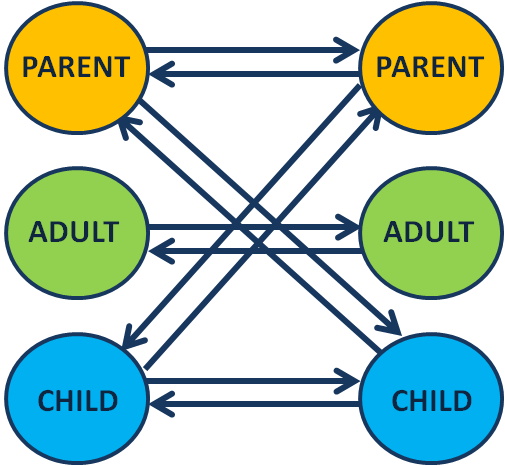
Eric Berne writes that every individual has within them three possible ego-states.

The Parent is the ego state derived from their own parents. When the Parent acts directly, the individual behaves as if they were one of their own parents. When the Parent is indirect, the individual acts as their parent instructed them to act. The Parent is especially concerned with judgment, opinion, and (naturally) the rearing of children.

The Adult is the ego state which is capable of reason and objective analysis of facts.

The Child is the ego state which is preserved from childhood. The Child has two forms: the Natural Child and the Adapted Child. The Natural Child is intuitive and capable of creativity and spontaneity. The Adapted Child is an ego state typically formed by the child in response to adverse circumstances; we might call it the Hurt Child or Traumatized Child. The Child is primarily emotional, for good or ill.

Relationships between individuals are relationships between ego states, and not always consciously. Two adults-- make them husband and wife-- complaining over a beer about the problems of the world these days are relating Parent to Parent. The same two adults carefully reviewing their finances and deciding how much of a certain amount of money should be directed toward investments versus paying down debts are relating Adult to Adult. Finally, the same two Adults, getting dressed up to go out for the evening, with expectations of still more fun upon their return, are relating Child to Child.

The existence of each ego state is necessary. The Parent ego state allows for actual parenting to take place; the Adult for serious problem-solving; and the Natural Child for joy in life. Problems arise when a particular state takes over inappropriately. If Wife says to Husband "Let us review our finances," (Adult-Adult) and Husband responds, "You're always hassling me!" (Child-Parent), a crossed relationship has taken place.

Many social interactions are basically scripted and ritualized. This is okay. But social games are particular scripted interactions which result in drama and emotional turmoil. The turmoil appears to arise unintentionally through the interaction, but it is actually the purpose of the interaction. Moreover, this purpose is hidden from one and often both of the participants. This is what makes it a game.

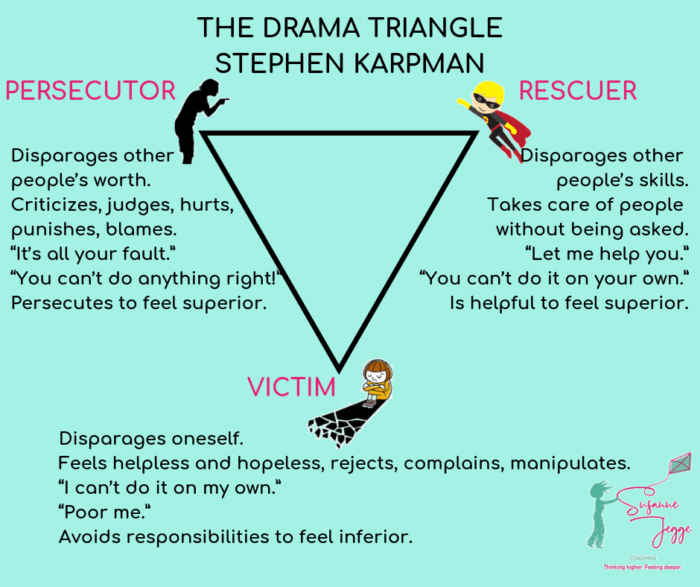
Finally, the Karpman Drama Triangle is a model which accounts for many of the problems we face in social life. This describes a type of game with three roles. The Victim is always innocent and always under attack. The Persecutor is always guilty and always attacking the Victim. The Rescuer is here to save the Victim. All of these roles are pathological.

The Platonic Psychology

In the Republic of Plato, the soul is divided into three parts:

The Nous is what we usually think of as the "mind." It includes the capacity for thought and opinion, sensory knowledge, and contact with spiritual realities.

The Thymos is sometimes translated "spirit" or even (poorly) "anger"; we might better think of it as "vitality." The Thymos is the seat of courage and aggression, social emotions and the drive for status and success.

The Epithymia is the seat of the passions and appetites.

As in the Berne model, none of these is "bad" or "good," each simply has its proper role in the functioning of the soul. The Republic of Plato is an extended analogy which compares the soul to a city. A properly ordered soul is akin to a kingdom in which the nous governs the epithymia with the aid of the thymos. A disordered soul is akin to a democracy in which the thymos and epithymia use their majority to rule the nous.

Justice is the proper order of the soul. In order to establish Justice, we suggested several practices designed to purify each part of the soul. For the nous, prayer and religious ritual. For the thymos, charitable giving and forgiveness. And for the epithymia, fasting, delayed gratification, and quiescent or apophatic meditation.

Notice that there is a meditative practice appropriate to each. For the nous, both discursive meditation and what is called "contemplative" meditation. For the thymos, forgiveness meditation and loving-kindness meditation. For the epithymia, quiescent meditation.

I want to now suggest a couple of additional practices, which may be controversial, and then discuss the ways that the Berne model and the Platonic model interact.

Give Your Cattle A Large Field

In the Daode Jing we read "To give your sheep or cow a large spacious meadow is the way to control him." As in the case of the Republic, passages in this text referring to politics are usually interpreted as actually, or additionally, describing psychic and meditative practices. And we can apply this advice here. The nous is meant to rule, but it need not rule by repression. Thymos and epithymia have their proper place. Simply try to destroy them and problems will immediately follow.

In the case of the thymos, the natural aggression and team-spirit must be allowed to direct itself toward a socially and personally constructive, or at least harmless, end. We can see how this works by preferring again to C.S. Lewis's description of the psychic economy as a whole:

 
Without the aid of trained emotions the intellect is powerless against the animal organism. I had sooner play cards against a man who was quite sceptical about ethics, but bred to believe that ‘a gentleman does not cheat’, than against an irreproachable moral philosopher who hadbeen brought up among sharpers. In battle it is not syllogisms that will keep the reluctant nerves and muscles to their post in the third hour of the bombardment. The crudest sentimentalism about a flag or a country or a regiment will be of more use. We were told it all long ago by Plato.

As Lewis shows, the emotions, trained in the spirit of cooperation and comeradery, can be critical for the survival of an individual and an entire nation. The thymos is compared to a warrior, because it is, ultimately, especially concerned with war. And so we must give it a war. Men in particular, and young men especially, seem to literally need war, and to die of despair without it. But to start a war is among the worst of crimes, and to start a war for reasons that amount to "because I was bored" is monstrous evil. What can we do?

Freeing the Thymos

Let me give three suggestions.

Spiritual Warfare. By this I do not necessarily mean exorcisms or the struggle against spiritual powers. Rather, by "spiritual warfare" I mean any activity which engages the thymos, along with others, in a struggle toward a particular end, where the end is moral or spiritual rather than temporal, and especially rather than physically violent. What this looks like will vary from individual to individual. Those fortunate enough to be caught up in alcohol or drug addiction can find a brotherhood of fellow-sufferers in places like Alcoholics Anonymous and Narcotics Anonymous. Others can find the same degree of meaning and purpose in organizations like the Freemasons or the Knights of Columbus. (Knights-- notice the martial symbolism.) For others, organizations like the Lions or the Rotary Club will do.

The requirements are as follows: First, we need an organization; second, we need a obstacle to overcome; third we need a method to overcome it. If at all possible, it should have a religious or spiritual outlook; secular or atheistic organizations have a limited shelf-life and tend to turn toward the poison of ideology to overcome their failure of faith.

I've come to think that we need a new type of fellowship, one suited for people who are geographically dispersed, open to members from different spiritual traditions. Perhaps a Druidic organization, with martial symbolism, but distinct from the organizations which currently exist. Maybe we should talk about this in a later post.

Sports. By "sports" I'm including a broad range of physical activities, from marathon running to martial arts to yoga. The thymos is the strength and the vitality, and the vitality needs to be exercised regularly. Discussing the training of the future rulers of the Republic, Plato begins with music and gymnastic as the training of the soul and the body. (Both are understood more broadly than we would today-- "music" also includes poetry and literature, and "gymnastic" refers to all the forms of physical training which took place in the Greek gymnasium, and not simply to tumbling and the like.) Again, the specific form will vary from person to person, but some form of physical exercise which allows the individual both to train his or her body and to cultivate their vital spirit (qi, prana, nwyfre) is necessary.

Professional Sports. Yes, I know, this will probabyl be the controversial one. But the exact same sort of trained sentiment that Lewis describes as the salvation of soldiers on the battlefield can be channeled into professional sports teams. Indeed, this is the point of professional sports: to allow cities to go to war with one another without anyone having to be killed. I especially recommend this as an antidote should one be inclined to become too involved with politics-- take at least part of the time you would normally spend reading about what those lousy Democrats or those awful Republicans are doing, and watch a football game instead. You will be doing the exact same thing-- participating in the shared emotions of struggle-- but without having to add in the dangerous delusion that the people you hate are evil and need killing, or that your team is here to save the world. There are two symbols which produce a very specific swelling of emotion in my heart; one is an American flag. This the other:


The advantage to the second is that when the Steelers play the Ravens, I'm not likely to convince myself that the Steelers are fighting for justice and goodness and that the Ravens are an unimaginable evil which must be killed.

Of course, this is precisely why the introduction of politics into professional sports a few years back is such an unmitigated evil.

Freeing the Epithymia

The epithymia is simpler than the other two, including as it does those instincts which we share in common with the simplest animals. As such, its care and feeding is somewhat simple, as caring for a pet lizard is comparatively easier than caring for a cat or a dog. The Epithymia simply neds to be indulged.

This is best done at intervals, and it is here that the traditional customs of Christian civilization come in handy. In the old way of doing things, the year is punctuated by fasts, in which the epithymia is restrained, add feasts, in which it is liberated.

Now fasting and feasting both refer, traditionally, to food, and also, often, to drinking alcoholic drinks. Obviously the epithymia has desires beyond those for food and booze. And it is here that the traditions we've inherited often fail, or at least seem to fail. In most of us the desire for sex is nearly as strong as that for food and, in most of us, stronger than the desire for alcohol. And in the Roman Catholic tradition, this desire is specifically regarded as evil, and attempts are made to totally suppress it!

...Or so it seems. And so you would learn if you spoke with a Catholic of the "Traditionalist" school. They would be happy to tell you that sexual intercourse must be limited to the most obvious acts, between husband and wife, and with minimal enjoyment. They'd then explain that this is the "tradition," and that it's only "modernists" who disagree.

One thing you learn when you study older writings-- that is, when you read old things-- is that most of what people think of as an unbroken tradition is anything but. These days, in fact, very often what is called "traditional" in any field of life-- from religion to working out to learning music and languages-- turns out, upon examination, to have been an invention of the Nineteenth Century. The "Traditionalist," in other words, is usually just a partisan of the revolution before the last revolution.

And so it is in this case. In fact, the Church's teachings on sexuality have varied widely over the centuries. Some authorities taught that whatever two married people are doing with their free time is fine, and a priest-confessor shouldn't ask them about it. Others taught that all sexual pleasure is evil, and sex should be as brief as possible and no one should enjoy it. One pope-- I'm afraid the name escapes me-- actually taught that it's only the man who shouldn't enjoy it! And then, very recently, Pope Leo XIII in the 19th Century taught that parish priests ought to grill their parishioners in the Confessional, find out every nasty, dirty little detail of their sex lives that they could, and assign them penance for it (or threaten them with hellfire if they continue).

Obviously I don't support the latter approach, either in the life of a church or the life of an individual. With limited exceptions, training the epithymia needs to include some level of indulgence. There are obviously a few appetites that shouldn't ever be indulged, and these tend to create a cascading series of problems. Here again, though, a measure of indulgence is often better than simple suppression. The obvious example is the addict who goes to the methadone clinic in order to help themselves get off of heroin. Notice that, under ordinary circumstances, methadone use is an evil. As an aid in heroin recovery, it becomes a lesser evil and so, in this case, a good. On the other hand, if you had-- oh, I don't know-- a doctrine which insisted that methadone and heroin use were both equally and mortally sinful, and that if you happened to be hit by a bus upon exiting the methadone clinic you'd go straight to Hell, well... I'm sure you can see the problems this would cause.

And so this is my suggestion for epithymia: For legitimate desires, such as those for food, lovemaking, minor intoxicants and screen usage, a period of abstinence should be balanced by a period of indulgence. For less legitimate desires-- again, strong intoxicants such as heroin are the primary example, but my guess is that the worst forms of screen addictionw ould fall under this as well-- we should be willing to allow ourselves a lesser evil as a stepping stone toward the good. Ignore your inner Pope Leo; he was a jerk who also believed tha

As usual with these posts, I've run out of time, and so we will have to-- really, actually, seriously-- wrap this up tomorrow. See you then!


(I'm not sure why this is an image of Typhon, but there you have it.)

The Many Headed Monster


The difficulty with the Epithymia is simply that it wants, and wants, and wants-- without limit. Left to its own devices, it will spend its time eating, drinking, and having sex and sleeping. A human under the rule of Epithymia is an animal.

As a brief aside, there is a notion found in the writings of Dionysius the Areopagite that is worth exploring further in a future post. For Dionysius, the creation of the universe proceeds upward from the simplest to the most complex-- and this is also a moral evolution. What this means is that, for beings at a certain, lower, level, certain qualities are simply not present. But for beings at a higher level, the presence of these qualities is their good, the absence, their evil.

For example: Life is not present in a stone, and its absence does not harm the stone. But if life is not present in a plant, the plant is dead. To say it another way, it has fallen to the level of a stone. Similarly, movement is not present in a plant. But if movement ceases in an animal, it soon finds itself either eaten by something else or starving to death. This is why the long-term comatose were referred to as "vegetables." Finally, in an animal, morality is simply not present. A cat kills a mouse, a chicken pecks another chicken to death, a male dog forces itself on a female. No harm is done. But a human who torments a animal as a cat torments a mouse, or bullies and murders a weaker human, or violates another sexually, has fallen to the level of a beast. To be ruled by Epithymia is to be bestial.

Don't suppose for a moment that the writings of Dionysius are foreign to the traditions we are discussing here. While his identity was unknown, it seems likely that he was a member of Proclus's school, and there are some who have suggested that he was actually the late Classical pagan philosopher Damascius in disguise! His Christianized Platonism, or Platonized Christianity, was the light of the Christian world for 1500 years, and his partial loss (or total loss, if one is Protestant) in the West has been part of our disaster. Moreover, I am fairly certain that I see Dionysius, along with Origen and John Scotus Eriugena, lurking in the background of Iolo Morganwg's Christian Druidry. More on this at a later date.

For now let us return to the topic, and suggest another way to master the Epithymia. This is the way of Fasting.

Fasting

The word "fast" traditionally refers only to food. Historically, Christians kept either one, two, or even three fasting days per week, every week, and several major periods of fasting throughout the year. What these latter were varied by region. Lent-- the forty days prior to Easter-- and Advent-- the four weeks prior to Christmas-- were always major fasts. Other fast periods included:

Ember Days. This was a series of 3 days around the Solstices and Equinoxes kept as fasts in the Roman Catholic Church. In the older literature, the purpose of these fasts is explicitly to harmonize the soul with the energy of the season-- that is, the Airy energy of the Spring, the Fire of Summer, the Earth of Autumn and the Water of Winter. (You may be used to another arrangement; this is the older one, from what I can tell.)

St Michael's Lent. This is the period from the Feast of the Assumption of Mary on August 15th to the Feast of Saint Michael on September 29th. (Happy Michaelmas, everybody!)

Rogation Days. This was a day, or several days, of prayer and fasting in early Spring, associated with agricultural fertility.

The Dormition Fast. This refers to the 14 days prior to the Assumption of Mary-- or, as the Feast is known in the Orthodox Church, the Dormition (Falling Asleep) of Mary.

Periods of fasting are traditionally followed by periods of feasting. I've written on this topic at length, and so I won't try to recapitulate the whole discussion here. But I do want to make a few additional points.

Traditional fasts in the Orthodox Church are basically time spent as a sober vegan. Fasting rules in the Catholic Church-- which the modern Church in its wisdom, has abrogated-- allow for fish to be eaten, but greatly restrict the quantity of food one intakes; traditionally, the rule was "one meal of no more than 8 ounces plus two snacks; you can also have plain bread and coffee in the morning." For most of us today, however, I believe that the primary focus of fasting need not be food. What I recommend above all is fasting from technology.

The trouble with technology is that it acts upon the epithymia, but it has effects which cascade up through the entirety of the soul. We hear a great deal, these days, about pornography addiction, and a bit about videogame addiction, but in my view the problem is less the content of the screen than the screen itself. To my own mind, it doesn't matter whether a person is addicted to social media, online politics, shopping on Amazon, World of Warcraft, or pornography. The effect on the soul is the same.

And so I strongly recommend regular periods of abstinence. These need not be periods of total withdrawal from all screen or internet use-- though they may be. Instead, they should target whatever form of technology wasts the most of your time. As I wrote,

The nature of the new fast will vary for every person, as everyone's engagement with technology differs, as does their ability to abstain from it. A computer programmer will both have more need and more difficulty in fasting from technology than a professional wilderness guide!

Those who are Christian or willing to work with Christian symbolism can simply use the traditional fasting periods. In addition to providing a regular structure, these also have the advantage that you won't be working alone-- Christians around the world will be fasting in one way or another at the same time. Remember that the thymos is basically social; participating in a fast with others will allow you to tap into the lion's strength. Non-Christians will need to come up with fasting periods on their own. A fasting calendar based on the pagan Wheel of the Year would probably be very helpful, as it would-- like the Christian liturgical calendar-- allow for group participation. At minimum Saturday would work quite well as a day for fasting from technology. Saturn governs discipline, and he is also associated with agriculture. Saturn is equally the planet of Ceres, the Grain Mother; her day is a fine day on which to disconnect from the virtual and reconnect with Nature.

Nor do food and technology exhaust the possibilities for fasting. A 40, 90, or 365-day period of abstenence from alcohol can be very helpful, especially for people who want to learn to drink socially, rather than having to commit to teetotaling. I'm sure that a similar period of withdrawal from caffeine would be of great benefit as well, and if anyone is capable of it, I'd be glad to hear it. (In a fine synchronicity, the hot water pot just finished boiling as I was typing that sentence; time to go pour a cup of coffee). There is a large and growing literature on the benefits of temporary abstinence from sexual activity, and there are entire traditions of internal alchemy based on re-purposing sexual energy for magical and spiritual attainment.

The Capacity for Delay

Like meditation, fasting is as a form of training. Just as a weightlifter develops strength which can be used, and is meant to be used, outside of the gym, so the faster develops the capacity for refusal.

But notice: Traditionally, every fast ends with a feast. Fasting isn't the culinary equivalent of celibacy. During the long stretches of Lent and Advent, the most rigorous and committed faster knows that a long period of feasting is coming. When it comes to taming the Epithymia and mastering addictions, delay is one of the most powerful tools. The way this works is simple: When the Appetite asks for something, rather than telling it "No," tell it, "Okay, but only if you still want it in 30 minutes." Or ten minutes, or an hour, depending on what it is.

This is how I drink alcohol most of the time. I enjoy beer, but when I was younger I tended to overdo it badly. These days, after I drink a glass of beer, I tell myself, "You can have another one if you want it in an hour." Most of the time, it turns out I don't want it anymore. Sometimes I do, and in that case I have it. I do my online shopping the same way. Left to my own devices, I'd have the Amazon truck pulling up to the house every single day, and almost always to bring me still more books. So if I want to buy something online-- or to make any major purchase-- I force myself to wait 24-48 hours. If I still want it, then, okay. But it turns out that I usually don't.

That's all I've got for today.

Join me next week, and we'll wrap up this discussion, and move on to something else which I've wanted to write about here for some time. See you then!
...Or, Epithymia, Part II


Let's pick up where we left off yesterday.

Overcoming the Passions

The Epithymia, as we have seen, may be compared on the one hand to the peasantry or working class of the kingdom of our souls, and on the other to a monstrous enemy who must be overcome.

The monster may be compared to the Greek Typhon. Tyhpon was the child of Gaia and Tartarus-- that is, the Earth and the pit of Hell. He contended with the Gods, and was only overcome by the thunderbolt of Zeus.

Stillness Meditation

Among the most useful exercises for anyone hoping to gain mastery over their passions is the practice of quiescent meditation. I am using the term "quiescent" meditation, or its equivalent, "stillness" meditation, as a catch-all for all of those forms of meditation which work by emptying the mind of thoughts. In some cases, one places one's attention on the breathe, or on a mantra; in others, one simply endeavors to focus on nothing at all; in still others, one repeats, with intention, a prayer such as "I take refuge in Amida Buddha" or "Lord Jesus Christ, son of God, have mercy on me," or "There is no God but God."

In certain circles to which you and I belong, mindfulness, zazen and other forms of "mind-emptying" or "stillness" meditation tend to get short shrift. I'm going to address this before we continue.

It is true that Buddhist meditation techniques are, in the modern world, often ripped from context and applied as a form of antidepressant. It is also true that meditation intensives such as those offered by the Goenka organization do more harm than good (I can say this from experience.) Here again, though, the old injunction holds good:

Abusus non tollit usum.

The abuse of any technique does not take away its legitimate use.

Meditation and Me

I'm going to speak from personal experience here, and for a good reason. All of the techniques that I'm discussing have been developed by groups, in a group context. But each of us has to do the work primarily within our own soul. Under ordinary circumstances, it is only our own personal soul which we can directly experience. I can tell you that I have experimented with working exclusively with discursive meditation, and I have experimented with combining regular discursive meditation with regular mindfulness meditation. For me, the latter works much, much better. The fruit of discursive meditation on its own is that I become much smarter. It also exacerbates my natural tendency to be a space cadet. Once I emerge from a session of discursive meditation, I find it very hard to connect to my physical surroundings, or to the people in those surroundings. Worst of all, I find it more, not less, difficult to control my passions, habits, and reactions. This is precisely the opposite of what I seek from meditation. To put the matter plainly: I'm already smart enough. What I need to develop is self-control, gentleness toward others, and physical coordination.

I've studied and practiced a number of styles of mind-stilling meditation, including vipassana, zazen, and Taoist zuowang. These are all Asian methods, but there are Western and Christian methods of stillness meditation as well. The most prominent are Catholic centering prayer and euchraristic adoration, and, from the Orthodox tradition, hesychasm.

The way that I learned quiescent meditation, and the most common form that I practice, is to sit upright, place my attention at the lower dantien (two inches below the navel), and count my breaths. Inhale 1, exhale 2. I do this for a set length of time-- a timer is crucial for this sort of practice. Buddhist and Taoist traditions have specific mudras, which is to say, positions for the hands, which are designed to cultivate energy in particular ways. Sometimes I use these; other times I place my hands on my thighs. Ultimately I'm going to develop a system of mudras based on the Golden Dawn tradition, but that's a story of another time.

Now, every form of stillness meditation has its own ultimate aim, which is framed within its particular tradition of metaphysics. This is as it should be. At one time, the word "Philosophy" referred as much to a way of life as to a set of mental exercises, and far more to a way of life than to a set of opinions. Each school of philosophy had its own meditative disciplines, appropriate to it. In Taoist zuowang, the ultimate end is to observe the way that things arise and resolve of themselves, by the ongoing activity of the Tao. In hesychasm, the end is the experience of the Uncreated Light. In this post, I don't want to talk about the metaphysical end of meditation, but only of its immediate effects upon the soul and its relationship to the passions.

In any form of quiescent meditation, the first thing that happens when you start is simply that you want to stop. One begins by taking an uncomfortable posture, with the spine held upright and very often the legs crossed. The body immediately rebels. It figits, it itches, it's thirsty. The mind rebels. You need to make a grocery list; you're sure you left the oven on. Best get up and check it. Every time you refuse to give in to impulse, you are practicing self-control. Self-control, or Temperance, is the virtue which Plato associates with the abdomen, the seat of the passions.

Meanwhile, at the same time you are refusing to act from passion, you practice acting from intention. This is the other half of self-control-- acting from choice, rather than from desire. This is also a component of the virtue of Courage, which includes the refusal to turn aside from a rightly chosen end either to avoid pain or to seek pleasure.

Finally, the regular practice of meditation leads to self-knowledge. In meditation, we watch our thoughts, impulses, and desires arise, and we watch them subside again. The first fruit of regular practice is to break our identification with our thoughts. We typically assume that if we think something, or if we feel something, or if we want something, we are that thought, that emotion, or that desire. By watching our thoughts, feelings, and desires arise and subside on their own, without acting on them, we discover that we ourselves are neither thought, nor emotion, nor desire. Going further, we discover that each of these things has causes which are rooted in our bodies, our physical environments, our past, our history, and our circumstances. We watch the behavior of thought and desire exactly as we might watch the activity of birds in a forest or the growing cycles of plants. Just as patient observation of forest over time leads to knowledge of that forest and its residents, so patient observation of the mental processes over time leads to self-knowledge. This is a key to the virtue of Wisdom.

Finally, by the simultaneous practice of observing of all of our internal processes while acting according to a rightly chosen end, we cultivate Justice.

Thus we see that meditation, directed primarily toward the virtue of Temperance, results in the other three virtues as well, and thus to Virtue as a whole. Remember that the words for "ethics" and "morality" come from Greek and Latin roots which both mean "habits."

And so that's my first recommendation. Practice a form of meditation, especially one that forces you to stop doing anything, including thinking. Tomorrow I'm going to discuss fasting, building on our discussion of meditation. Then I'm going to circle back around to discuss something I missed in the post on purifying the Thymos. Finally, I'll wrap up the whole discussion with some final thoughts on social games.

...At least, that's the plan as of right now. But I've noticed that when I set out my plans here, things tend to go differently from what I expected. So we'll see where it goes!


Strength was with his hands in all that he did and the feet of the strong god were untiring. From his shoulders grew an hundred heads of a snake, a fearful dragon, with dark, flickering tongues, and from under the brows of his eyes in his marvellous heads flashed fire, and fire burned from his heads as he glared. And there were voices in all his dreadful heads which uttered every kind of sound unspeakable; for at one time they made sounds such that the gods understood, but at another, the noise of a bull bellowing aloud in proud ungovernable fury; and at another, the sound of a lion, relentless of heart; and at anothers, sounds like whelps, wonderful to hear; and again, at another, he would hiss, so that the high mountains re-echoed. And truly a thing past help would have happened on that day, and he would have come to reign over mortals and immortals, had not the father of men and gods been quick to perceive it.

Hesiod, Theogony

The Monster

We come at last to the purification of the Epithymia, the appetite.

In the Republic, Plato compares this part of the soul to a monster with many heads. In his certainly had the image of Typhon, the hundred-headed offspring of the Earth and Tartarus, the pit of Hell.

The task of overcoming the Monster is not an easy one, and in a real sense is the work of a lifetime. And it's also something that everyone must do for themselves; no one came into this world with your particular stack of appetites, desires, passions and vices, and no one else accumulated the habits that locked those things in place in the same way that you did. And so all of the advice I give must necessarily be general, and some of it may not work for you. That said, I want to give a couple of suggestions here. But first, I want to start with a discussion of what-- in my experience-- does not work.

What You Resist, You Strengthen

In the Republic, as we've seen, the three parts of the soul are compared to a man, his trusty lion, and a monster; but they are also compared to a king, his warriors, and the peasantry. And so the work of overcoming the appetites and establishing Justice in the soul may be compard at once to a battle, and to ruling a population.

We will do well, then, to look for advice both from military and political science. To that end, I want to share a few selections from a pair of Chinese sages.

First, Laotze, from the Daode Jing:

To give your sheep or cow a large spacious meadow is the way to control him.

Next, Sun Tzu, from the Art of War:

In the practical art of war, the best thing of all is to take the enemy's country whole and intact; to shatter and destroy it is not so good. So, too, it is better to capture an army entire than to destroy it, to capture a regiment, a detachment, or a company entire than to destroy them.

Hence to fight and conquer in all your battles is not supreme excellence; supreme excellence consists in breaking the enemy's resistance without fighting.

The highest form of generalship is to baulk the enemy's plans; the next best policy is to prevent the junction of the enemy's forces; and the worst policy of all is to besiege walled cities.

Very often, when people take on the work of overcoming their appetites-- their passions, in the older way of speaking-- they do the exact opposite of what Sun Tzu tells us here. We all know what our worst habit is, and we know that it consists in the regular indulgence of our strongest desire. If you want to change your life, the way to begin is usually not to make a direct assault on this behavior, whatever it is.

Unfortunately, this is an area where the Christian tradition can be unhelpful and even counter-productive. I don't happen to know if this concept, or a related one, exists in Eastern Christianity, but in Roman Catholicism the concept of mortal sin stands directly in the way of any productive approach to the passions.

Mortal sin is the belief that there are certain sins that simply can't be repented without the help of a preist; die after committing one of these but before getting to the Confessional, and it's straight to Hell with you. The net effect of this belief is to turn the process of overcoming the passions into a dire emergency, which is exactly the opposite of the frame of mind that you actually need to maintain in order to do it. And this in turn produces varying levels of neurosis, starting with what's called "scrupulosity." 

The Twelve Step tradition is another one for which I ordinarily have a great deal of praise. Here again, though, a very uhelpful habit prevails, similar to the idea of mortal sin. This is the concept of "going out." If you aren't familiar, in groups like AA or NA, a recovered alcoholic or addict who takes a single drink or drug is said to have "gone out." This is usually expanded to include even things like "near beer," which is 0.5% alcohol, or taking a second painkiller if one is prescribed one a day. Once a recoveree has "gone out," all of the "Time sober" which they had accumulatd immediately evaporates. Upon returning to their regular meeting, they have to identify as a "newcomer" in their "first 30 days of recovery." The negative effect of this attitude should be obviously, and I've seen it work its destructive magic more than once. A person accumulates a fair amount of time sober, and then in a fit of pique or an absent moment takes a single drink or, perhaps a second oxycodin. Well, now they've "gone out"-- and so they now give themselves permission to go on a bender. They turn up a month later, having drunk or drugged themselves nearly to death. 

Needless to say, these are not the approaches I recommend. 

But what do I recommend?

Ask And it Shall Be Given You

...I'm afraid that's a discussion that's going to have to wait for tomorrow. Last night I received a call that my grandmother had suffered a bad fall and was in the E.R. She's home today but could use somebody to come and help around the house. If you read yesterday's post, the significance will be obvious. I'm out of time for today and should in fact have left the house a half hour ago, so I'm going to have to end the discussion here. We'll pick this up tomorrow. In the meantime, if the readers here wouldn't mind offering a prayer for the health and recovery of Mrs. Sylvia Mandes, I'd be very grateful. 


The Nature of Thymos

In order to talk about purifying the thymos, we first need to discuss exactly what the thymos is. Yesterday's discussion was a bit incomplete-- I was in a rush, and realized later that I hadn't finished writing out the definitions of each part of the soul. (I suppose I could go back in and revise that post without mentioning it, Ministry of Truth-style, but honesty is one of the themes of this series of posts, so we'll just leave it as it is.)

The difficulty with translating "thymos" into English is that it combines concepts in a way that we are not used to. There is another difficulty as well, which we'll come to. The easiest way to understand thymos is simply to think of it as the social emotions. In terms used by contemporary evolutionary psychologists, you can think of the epithymia as the "lizard brain," concerned with basic animal wants and needs, and the nous as the human "forebrain," which is capable of reasoning. Between these two is the "mammalian brain," which allows us to form social groups.

But the thymos is not just that. It's also associated with spirit, courage, energy. By spirit, mind, I don't mean the same thing as either "immortal soul" or "elemental Spirit." When one refers to a "spirited horse," the spirit in question is thymos; when you tell someone "You're in good spirits today," this also is thymos.

The Parts of the Soul and the Energy Centers

In traditional anatomy, the nous was centered in the head, the thymos in the heart, and the epithymia in the abdomen. If you're familiar with Chinese internal alchemy, you will notice that these correspond exactly with the three dan t'iens or energy centers. If this suggests to you that there is a half-lost system of energetic anatomy native to the Western world, well, it does to me too, and recovering it is one of my long range projects. For now, though, it's enough to know that this image was a commonplace at one time, and it is preserved in our language to this day.

The Cosmographia is a 12th Century poem written by a one Bernardus Sylvestris, which describes the creation of the world and of mankind. Cosmographia was, at one time, considered orthodox enough to have been read before the Pope. Here is how it describes the creation of the three energy centers in man:

Physis carefully divided the bodily material into three portions... The first she called the head, the second the breast, and the third the loins, according to the properties she found in them. These three in particular of the body's many parts, these narrow chambers ouf ot its general extensiveness she chose to receive the brain, the heart, and the liver, the three foundations of its life. Physis knew that she would not go astray in creating the lesser universe of man if she took as her example the pattern of hte greater universe. In the intricate structure of hte world's body, the firmament holds the preeminent position. The earth is at the lowest point, the air spread between. From the firmament the godhead rules and disposes all things. The powers who have their homes in the ether and the atmosphere carry out its commands, and the affairs of the earth below are governed by them. No less care is taken in the case of man, that the soul should govern in the head, the vital force established in the breast obey its commands, and the lower parts, the loins and those organs placed beneath them, submit to rule. So Physis, skilled artist as she was, prepared the brain as the future seat of the soul, the heart as the source of vitality, and the liver as the source of appetite...

Yes, "Physis" is the Greek world for Nature or the Physical Plane (see how that works?), and in this work, she is explicitly given the role of a goddess. Actually it's almost all goddesses in the Cosmographia; the story opens with Nature complaining to Nous about the Chaos (Silva) that exists before creation, and God, entirely off stage, giving the ladies permission to form the chaos into a universe. One is tempted to read a work like this and dream about a Catholicism that might have been; Sancte Bernarde Silvestris, ora pro nobis.

In any case, the point is that the thymos is located at the heart, and you can hear echoes in our language today when a sports team is described as "having enough heart" to win the game.

Given its social rule, it seems clear that the purification of the thymos is especially important in this discussion of becoming free of social games.

Justice and Thymos

Justice, as we have seen, is that state in which each part of the soul performs its own task in correct relationship to the other parts. The nature of that relationship is stated clearly by Sylvestris above: "the soul should govern in the head, the vital force established in the breast obey its commands, and the lower parts, the loins and those organs placed beneath them, submit to rule."

And so the nous rules from the head, but only with the aid of the thymos; epithymia, as Sylvestris says, "submits to rule."

But why should this be so?

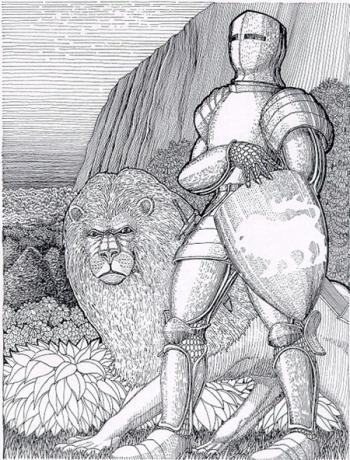
The answer is simply that, left to its own devices, nous is basically powerless against epithymia. In the Republic, Plato gives us an image of each of these parts of the soul. The nous is like a man. Epithymia is a many-headed monster. Alone, the man is powerless against it. He needs help. He gets it in the form of a lion, the thymos. Note that the lion symbolizes at once strength, sociability, and kingship. With the aid of the lion, the man overcomes the monster. Were the lion to serve the monster instead, the man would be devoured. This is the condition that we find oursevles in when we submit to our passions.

In a well-known essay that deserves regular re-reading, the redoubtable C.S. Lewis explains the matter very succinctly:

 
Without the aid of trained emotions the intellect is powerless against the animal organism. I had sooner play cards against a man who was quite sceptical about ethics, but bred to believe that ‘a gentleman does not cheat’, than against an irreproachable moral philosopher who hadbeen brought up among sharpers. In battle it is not syllogisms that will keep the reluctant nerves and muscles to their post in the third hour of the bombardment. The crudest sentimentalism about a flag or a country or a regiment will be of more use. We were told it all long ago by Plato.

One of the tales collected in The Mabinogion concerns a Sir Owain, cousin of King Arthur. After a series of adventures, Owain finds himself wandering in a wasteland.
 
And as he journeyed, he heard a loud yelling in a wood. And it was repeated a second and a third time. And Owain went towards the spot, and beheld a huge craggy mound, in the middle of the wood; on the side of which was a grey rock. And there was a cleft in the rock, and a serpent was within the cleft. And near the rock stood a black lion, and every time the lion sought to go thence, the serpent darted towards him to attack him. And Owain unsheathed his sword, and drew near to the rock; and as the serpent sprang out, he struck him with his sword, and cut him in two. And he dried his sword, and went on his way, as before. But behold the lion followed him, and played about him, as though it had been a greyhound that he had reared.


From then on the lion serves Owain, and helps him in battle against fearsome giants. The implication is that Owain has established Justice in his soul, and I believe that teaching this is part of the purpose of this particular tale. Our goal is to become like Owain ourselves. But how? Let's look at a few different practices intended to train and purify the thymos.

Charity, Forgiveness, Blessing

 
One of the most important teachings of our occult tradition is that our souls are not isolated to our bodies. Material science teaches us that "consciousness" is isolated to individual brains. Now, none of us here believe that sort of thing, but the truth is we tend not to be very far off. Most of us, most of the time, believe in or act like we believe that our consciousness is trapped inside of our individual bodies. Occult philosophy teaches that this is not so. Every time humans come together in a group, we form a group consciousness-- a group soul-- sometimes called an egregore. Each of our psyches is a participant in a larger psyche. Critically, that group soul is not limited to the sum of the individuals who compose it. It has its own life, just as you have a life which is not reducable to the individual lives of your cells. Just as an individual soul can become neurotic or even psychotic, so too an eregore can become toxic.
 
In fact, this is precisely what the games of Eric Berne, the Victim Triangle of Stephen Kartman, and similar models are referring to. If there is a Rescue Game afoot within a group, that group's soul has become neurotic. When games, especially the Rescue Game, reach their peak in intensity, an egregore can go psychotic. Genocides and civil wars, school shootings and murder-suicides are the results of egregores large and small going insane. This work is very serious.
 
Fortunately, we are not without recourse. A Long before the development of social psychology, our Western tradition included a number of techniques for the purification and healing of collective souls.

Charity is a word that we all use often enough; say it and people usually think of either donations to nonprofits or of soup kitchens. I recommend a regular practice of charity, and I recommend making certain seasons and certain days of the week to devote especially to charity. But I am not talking about donating to NGOs, or to working at soup kitchens. By all means, do these things if you feel called to them-- but they are far from the only opens available.

There are other ways to do charity. Leave a $100 tip at a restaurant, and I promise you will make a difference in someone's life. Do this even if you don't get great service. (Do not do this if you find your server attractive, or if they flirt with you. That will ruin it.) If you don't have $100... well, honestly, I think that you do; put aside $20 every first Friday for the next 5 months, and at the end of that time go out to dinner.
 
Or think of somebody you know who might be lonely, or who you just haven't connected with in some time. Think about a way that this person has helped you. Give them a call, or visit them. You might simply talk to them for a while, connect, catch up. But if you can, you might bring up a way that they've helped you, and express your gratitude.
 
Group souls aren't limited to human beings, by the way. We participate in every collective of which are are a part. In the Middle Ages, a common way to refer to someone's entire household was to add the phrase "mouse, cat, and dog." The animals, the plants, and even the physical structures that you spend time around are parts of the collective soul in which you participate.
 
In the Druid tradition, we are encouraged to spend time in nature, and, especially, in getting to know the particular land we our selves live on. What we are doing is becoming active participants in the collective soul of the land, along with the animals and plants, the rocks and the water. You can direct your charity toward Nature as well as toward people. Here again, the things people usually think of aren't very helpful. I'm not talking about donating to Greenpeace or fretting over your "carbon footprint." I bet that there is a trail or a park or a patch of woodland near your house. Go there with a pair of gloves and a trash bag, and pick up all the litter you find. I promise the spirit of the place will appreciate it. Don't ask for permission to do this, and don't make sure everyone sees your big group trash pickup. Just go do it yourself. Don't even tell anyone.
 
Forgiveness is a central feature of the Christian tradition, and it is one of that tradition's great contributions to world spirituality. Of course it is found in other traditions too. It's worth taking a moment to consider just what it means. The words of the Lord's Prayer in English are usually rendered "Forgive us our trespasses as we forgive those who trespass against us." This is too vague. What precisely are "trespasses"? Are we only talking about not getting mad at people who wander onto our lawns?
 
The Latin is more precise. Here the words are Dimite nobis debita nostra, sicut et nos dimitus debitoribus nostris. That is, Forgive us our debts as we forgive our debtors.

When we forgive someone, we aren't accepting their bad behavior, or inviting more of it. We're simply letting go of any idea that they owe us anything. We erase their name from our internal ledger. We stop trying to collect. Most social games go on and on, round after round, precisely because each player is trying to make up for the last game. You victimized me, so now I'm going to victimize you. Oh no, I've been victimized yet again! Well, I'll get you back later. Social games are more like 500 Rummy than Go Fish. If you're down a few points, there's always another round. Forgive, and you walk away from the table entirely.

Blessing as a regular practice is somewhat less well known, though many in our circles are familiar with the idea via the Modern Order of Essenes. The practice of that organization includes the "Blessing Walk." This consists simply in taking an ordinary walk, and mentally directing a blessing at every person you meet.

This is a very good practice, and it's not necessary to be part of the Order of Essenes to put it to use. Actually, it's not even necessary to go out of your way to do a special walk. take any time during the day when you will encounter a number of people. Perhaps it's a walk, perhaps a commute, perhaps a trip to the grocery store. Especially if you would be tempted to become frustrated with people or mentally curse them-- people driving 50 mph in the fast lane, grocery store clerks taking their sweet ass time at the checkout line-- bless them instead. Bless everyone, silently, without them knowing it, and without judgment or exception. Just look at them and silently say a prayer. "God bless you" is enough. If you're squeamish about "praying for people without their permission," you can say "May God bless you," or "May you be blessed."

Most of the world outside of the modern West-- and many within it-- is familiar with the idea of the "evil eye." This is a kind of curse that we can pass onto people when we direct jealousy, anger, or hatred toward them, especially if we do so while looking at them. The unfortunate truth is that platforms like Facebook and Instagram give us the opportunity to look at each other with jealousy on a regular basis. Thus we may find ourselves constantly cursing others and being cursed in our term. Imagine the impact on our collective psyche and our personal karma!

As every (normal) culture knows about the evil eye, so every culture has its remedy. In Ireland of old, it was the custom to say "God bless you" any time you glanced at someone's farm or their house-- or their wife or their daughter, one supposes-- in order to avoid placing the evil eye upon them. I believe that this custom is the origin of the Essene Blessing Walk. Either way, it's a very good habit to get into. I don't know about you, but often when I'm out driving I look at houses and think about what I'd like to buy after we sell our current place. Knowing that the gaze and the thoughts have power, what effect might I have on a home and its residents if I simply look at it and think "I want to live there"?

Another Forgiveness Practice

Unless I'm very wrong, methylethyl is already thinking about another practice, one found within the Orthodox Church at the beginning of Great Lent, in which every member of the parish from the bishop on down to the little children get together and ask one another forgiveness for every sin they have committed against one another over the preceeding year.

This is an excellent practice. I've never experienced it myself, but I can only imagine the profound effect that it must have on the collective soul of the church and its people. We don't need to be Orthodox or even Christian to recognize its value. Imagine if the United States had a similar institution, and there was a certain point-- perhaps just prior to, or just after, every election-- in which every representative in Congress, plus the Supreme Court and the President, ceremonially asked forgiveness from another, for every sin commited since the previous election, by themselves and their constituents. Imagine if this request for mercy was especially directed at the other political party and the representatives of other states and districts. Can you imagine the effect this would have? Now, it would only work if everyone was required to do it. People on the radical Left sometimes have parodies of this practice in which white people have to beg forgiveness from black people or Indians. This is not forgiveness. This is just another form of the rescue game.

On the other hand, I heard of an event some years ago in which American Indian elders from-- I believe-- the Cheyenne or Lakota tribe went on tour simultaneously teaching people about the massacre of their people by American soldiers, and begging forgiveness for massacres that their people had committed against white settlers. Events like that, on a regular basis, and with any group (racial, ethnic, regional, religious) invited to partcipate, would go a long way toward healing the country. Don't hold your breath.

In the meantime, we can adopt a version of this practice, and there are two possibilities. First, we can transfer it to whatever group we happen to be a part of, be it familal, religious, or otherwise. A family can sit down and let every member ask one another for forgiveness once a year-- at the beginning of Lent, if Christian; during another appropriate season, if not. A church or spiritual organization can do it the same way. In ancient times, the Census was originally not just a way of counting people so that bureaucrats could tax them. The purpose of a census was to gather together every citizen in order to make amends to the God of the city. This was always a ritual, and modern pagans might do well to study these sorts of rituals and see how they could be re-worked for modern times. The ancient city was always a spiritual organization, never merely a political one, and the ancients were well aware of the polluting effects of sin upon the collective psyche.

If you are unable to get a group together, you can work with this practice on your own. Pray, enter into a meditative state, and then call to mind, in succession, every member of a group in which you participate. One at a time, imagine any offenses that you are holding against each member of that group. Picture the scenario from their perspective. Imagine yourself saying to them, "I understand why you have acted as you have, and I forgive you." Then tell them, mentally, all the ways that you have sinned against them-- again, remember that sin or hamartia is not an exclusively Christian concept, and we can simply define it as "acting against the Good." How have you acted against this person's good? How have you acted against your own Good? How have you acted against the Good of the group as a whole? Ask for forgiveness, mentally, from eacdh person. Picture the spirit of the group, perhaps as its guardian angel or daimon, or its patron saint if appropriate, and ask for its forgiveness as well.


Penitence and Amendment

In 12 Step programs, the Fifth Step consists of "admitting to God, ourselves, and one other person the exact nature of our wrongs." But the Ninth Step consists of making amends to every person that one has harmed. Now, in popular culture, this is often represented as "apologizing to everyone." But that isn't it, exactly. Sometimes apologies are very helpful, but oftentimes druks and addicts are experts at saying "I'm sorry." Far more helpful is the idea of the amendment, which means a change in behavior. Here again, we will have to examine ourselves carefully. If we have discovered that we like to play the Victim, say, in our family, and initiate rescue games by telling our spouse how awful our child has been to us, we now need to consciously practice a contrary mode of behavior. The sorts of prayer and self-examination we have already engaged in will help us. And so will other techniques, which will also aid us in purifying the Epithymia. We will discuss these tomorrow.


Over the course of this series, we've examined the transactional analysis model of social psychology created by Eric Berne. We've looked at the Drama Triangle of Stephen Karpman. We've discovered that much of our lives, and above all our relationships-- or what we consider to be relationships-- can be understood as destructive social games. These games play out unconsciously, without our control, all the time, and are responsible for a great deal of the misery that we experience. 

Now it's time to talk about what we can do about it. 

...And here, it feels necessary to hedge a little bit. The work of un-learning the sorts of behaviors that we're talking about is the work of a lifetime. In a real sense, it is the goal of all real spiritual practice, as it is identical with what Eliphas Levi called the Great Work: "The creation of a man by himself, especially the total conquest of his faculties and his future." 

This is a tall order, and precisely how to do it is not going to fit into a short blog post. What I propose to do in this post is to provide a rough 

Psychic Anatomy

I'm going to use Plato's tripartite model of the soul in this post. I've discussed this so many times that readers here are probably sick of hearing about it by now. In case anyone is tuning in for the first time, the soul can be divided into three parts:

Epithymia. This consists of all of our instincts and appetites; everything that we share with the lower animals. When you're hungry or tired or "in the mood," that's the Epithymia at work. 

Thymos. This consists of the social emotions, including the desire for success and the instinct toward honorable conduct. C

Nous. This is the reasoning part of the soul. The nous itself is further divided into mere sense-knowledge ("I see a three-sided object"); opinion ("All three-sided shapes are triangles"), reason (Given the height of the triangle and the length of its base, its area is x); and intellection (knowledge of higher realities, inexpressible in language.)

Each of these has its proper role, both individually and in relation to one another. The state in which each part of the soul performs its correct function in relation to the other two is the definition of Justice give by Plato in the Republic; a Just man or woman is precisely that person whose soul is properly ordered.  In the discussion to follow, I'm going to suggest specific practices aimed at the purification of each of the parts of the soul. Let's take these in order. 
 
The Purification of the Nous

Let us begin with the nous, as it is is the highest part of the soul. 

Prayer and Ritual

We will find that we get nowhere without divine aid. This aid must be encountered in two ways: Prayer and Ritual.

By prayer I mean the direct invocation and communication with divine beings. Most of us know what prayer is, and so I don't know that I need to say a great deal about it. One thing that may be helpful to note: Many people from Protestant backgrounds have been raised to believe that prayer must be spontaneous, "from the heart." They make Jesus's condemnation of "vain repetitions" into a condemnation of all repetition, and therefore refuse to engage in formal or liturgical prayer. Often, cradle Protestants carry this attitude with them when they convert to other religions, or to liturgical forms of Christianity. 

And then they sit down to pray find that they have no idea what to say. 

If that's you-- whether your religious orientation is Christian or otherwise-- let me suggest another approach. Liturgical prayer is a technology; its intention is to invoke the presence of the Divine, in whatever form. Once invoked, the right thing to say is--

Nothing at all. 

Remember that the highest part of the soul extends beyond the reasoning mind; it extends, therefore, beyond the sorts of thoughts that can be formed into words. 

A simple but very effective form of prayer is to simply light a candle, say or sing a liturgical prayer out loud, and then be silent. Feel the presence of the god or power you have invoked. Don't feel the need to ask them anything; simply be aware of their presence. If you feel nothing, that's okay. Just be silent. Pay attention to whatever thoughts come into your mind. Remain in stillness for a few minutes, and then blow out your candle. 

This is where prayer bleeds into the second of the two practices, ritual. Rituals are best when performed with two or more persons, but very often this isn't possible. If you happen to be a part of a large religious organization, then you're in luck, and all you need to do is to attend services regularly, but for many of us, ritual is something that we have to do by ourselves. In either case, though, the purpose of ritual was neatly expressed by Carl Jung as "the externalization of the archetypes of the Collective Unconscious." The archetypes, in Jung's theory, are those universal forces that lurk deep in the background of the human mind, and typically act through us without our knowledge or our consent. (If that sounds familiar, given our recent discussions, stay tuned; I hope to discuss Jung at length sometime in the near future.)

It is important not to treat prayer or ritual as a way of getting God or the gods to do something for you. God is not a genie, or a vending machine. The purpose of prayer is not to change God, to get Him to do what you want-- it's to change you, to make you more like him.  

Study and Self-Examination

These work on the next two faculties of the nous, the dianoetic and doxastic powers-- that is, the reason and the opinion. 

By Study, in this context, I especially mean studying those sorts of texts which help us to understand and unlock the hidden parts of the soul. Books like Berne's Games People Play, or books discussing Stephen Karpman's work (there are very many available these days) are one option. There are others, depending on the approach you prefer. 

Develop the habit of reading slowly, and then setting aside time to carefully reflect upon what you have read. This can be blended into prayer through the practice of lectio divina (divine reading). Lectio divine is a traditional mode of meditation taught in the Roman Catholic Church, but it can be profitably employed by anyone; you can find simple instructions here. Some books, like modern fiction novels, can be read in the way that you watch a movie-- quickly, passively, and for entertainment. These sorts of books will not do the work of purifying your nous or changing your behavior, at least not in a way that you can choose consciously. The sorts of books I recommend here must be studied and considered carefully, and in so doing, they become initiations into higher modes of thinking. In this context I especially recommend Plato's Republic. Please, no abridgements or just extractions of the Allegory of the Cave-- read the entire thing cover to cover. 

We must study the works of others in order to gain knowledge of how to work with the soul and a model for how to approach it. Whether you're reading Eric Berne or Plato or smething else, however, what you are reading is a map. One cannot become an explorer, much less a conqueror, by simply studying maps. We must venture into the territory. And the territory, of course, is your own soul, your psyche. Once we have a model of how the psyche works, we need to spend time in self-examination. Read Berne, and carefully go through his "Thesaurus of Games." Do any jump out at you? These are the ones that you're probably playing. Reflect on your own life, and see how the game is playing out, how it's doing its work. Then, learn to watch yourself play. This is the first step to quitting the game. Do the same with Stephen Karpman, Carl Jung, or Plato. If you are a Christian, there are countless books describing the process of "examination of conscience." If you aren't Christian, read them anyway; you still have a concience. 

Next Time, On Life Without Games

The nous is the highest part of the soul, but it does not function in isolation. Alone, against the world of the animal instincts, it fails. It needs the aid of the thymos, and ultimately the appetites must be brought under its power. How do we do this? We'll discuss that tomorrow. 


The Story So Far

Over the course of the last three posts, we've looked at the Transactional Analysis theory of Eric Berne, and the Dramatic Triangle of his student Stephen Karpman. I want to briefly summarize these ideas before we continue.

Transactional Analysis views social life as consisting largely of unconscious games, semi-conscious rituals and pastimes, and conscious (formal) rituals, and conscious procedures and operations. These are collectively known as transactions.

As individuals, we are capable of manifesting three different ego-states, which Berne calls the Parent, the Adult, and the Child. The Parent is concerned with judgment and opinion. The Parent may be overt or covert, and consists in behaviors learned from one's own parents. In the overt or direct Parental ego state, the individual simply behaves like one of his or her parents; in the covert or indirect state, he or she acts as their parent taught him or her to act. The Child is also dyadic. The Natural Child includes the individual's capacity for spontaneity, creativity, and wonder. The Adapted Child consists of behavior patterns learned in childhood, often in response to trauma. The Adult, meanwhile, is capable of reason, planning, and objective analysis.

In the Karpman Drama Triangle, individual's take one of three roles, viz. the Hero or Rescuer, the Victim, and Villain or Persecutor. Very often, these roles are learned in childhood, and so may be considedred functions of the Adapted Child. Although the Rescuer sees himself as a hero, and the victim sees himself as innocent, none of these roles are actually innocent; all are pathological. Their continued interaction produces Drama and human suffering.

And so we have an image of our predicament. We are-- frequently or occasionally, as the case may be-- trapped in a series of programmed behaviors, not at all unlike NPCs in a videogame.

Now the question becomes, what are we to do about it?

The Shadows in the Cave

In The Return of the King, Frodo says the following to Sam regarding the monstrous Orcs:

The Shadow that bred them can only mock, it cannot make: not real new things of its own. I don't think it gave life to the orcs, it only ruined them and twisted them...
 
Like his friend C.S. Lewis, Tolkien was well acquainted with the ideas of Plato, and in this brief quote he is summarizing one of the key ideas of Plato's Republic. This is the allegory of the cave: our material world is akin to a cave in which we have all been imprisoned, and the material objects we encounter here are like the shadows of puppets on the a wall. Unacquainted with reality, we believe that the shadows are all that exists; having never been free, we are unaware that we are imprisoned.

In the previous series on this blog, I discussed the way that these concepts are understood in the tradition of the Druid Revival. This world of Shadows, Plato's Cave, is what we call Abred. In its lowest reaches it is Annwn, the world of the Dead. When we ourselves behave as automotons, we are essentially behaving as if we were ghosts. Thus Abred and Annwn are in a real sense identical to one another; most of our life here in Abred-- this place where we are supposedly alive-- is the life of a ghost. Riffing on the similarity between the Greek word "soma," which means body, and "Sema," which means "tomb," Plato wrote that "Soma is sema," the body is a tomb. I haven't seen a discussion of this anwyhere, but I've often wondered if his "cave" is not a natural cave, but a round barrow, an artificial burial chamber of a type that was employed throughout Europe during the Bronze Age. The goal of the spiritual life is to become aware of the true nature of this world and find our way out of the Cave, into the Sunlight of the Real World.

And so this is a world of the Dead, and it is also a world of Shadows. That is to say: The objects we encounter here with our senses are less than real. But, again, they aren't totally novel. The Shadow cannot create. Rather, they are reflections of a higher, truer, and more real plane of existence.

If all of this is true then two things follow:

First, all of these destructive patterns, including the games analyzed by Berne, the Karpman drama triangle, and the maladapted forms of the Child and Parent ego-state must be relfections, however dim, of higher, truer, and more noble ideals.

Second, the process of overcoming game-playing, roleplaying, and other automatic behaviors of these sorts is identical to the process of escape from Plato's Cave.

The Supernal Triad and the Dramatic Triangle

When we meet with a destructive automatism such as the Karpman drama triangle, our question should be, "Of what higher power or more noble ideal is this a base reflection?" After all, it could not have any existence-- even a shadow's existence-- if it weren't a reflection of something of the higher realms, and ultimately of something in the Divine. The Orcs are always corruptions, never creations.

The Hero and the Hero

Let's start with the Rescuer. Also called the Hero, and for good reason. Hero, in ancient philosophy, is a technical terms. The Heroes were a class of souls intermediate between angels or the higher daimones and ordinary human beings. Like every being, from the archangels on down through the ranks of daimones, to human beings, to animals, plants, and minerals, they exist as part of a chain of emanation from the highest gods. This is why in mythology and legend they are termed "sons of Gods." Romulus is a son of Mars, Aeneas is a son of Venus, and so on. Every being manifests the powers and activities of a particular god on their peculiar level of existence. In Classical times, Socrates, Plato and Pythagoras were venerated as heroes in the series of Apollo. In Christian terms, heroes are called saints; other traditions might call them xian or boddhisattvas. As in modern times, the Catholic and Orthodox churches have procedures for canonizing a person as a saint only after they have died, so in ancient times it was only after death that a man was discovered to have been a hero and to have been fathered by a God. Thus an ordinary soul may be seen to ascend to the rank of "Hero." In Christianity, the goal is for every person to become a saint.

We can say, then, that in the performance of the Rescuer role, an ordinary soul is trying to become a Hero. The trouble is that they are not doing it in the right way, or for the right reasons. The Rescuer rescues for the sake of his own ego, and so he is always looking for Victims, and for Persecutors. He claims his motive is Justice, but it is only a parody of Justice. This is because actual Justice consists in the right relationship between things, and, as we have seen, one cannot have a relationship with a Persecutor or a Victim. Relationships require truth. The Rescuer is always on the lookout for more Victims to save, and so he absolutely cannot allow his Victims to form their own identities or their own opinions. If you look at radical left-wing literature you will find an enormous amount of this sort of thing. Whenever any identified Victim-class-- proletarians, women, people of color-- refuses to accept the identity given to them by the Rescuer-activist, this can be ascribed to concepts like "false consciousness" or "societal Stockholme syndrome." This allows the Rescuer to keep rescuing a Victim no matter what the Victim herself wants.

And so the Antidote to the Rescuer is to develop a sense of Justice. Actual Justice is the right relationship between things, starting with the right relationship between the components of one's own soul. Before we try to help someone, we must ask ourselves if they need our help, if they have asked for it, if the sort of help they're asking for will actually do anything to improve their circumstances, and what we ourselves are getting out of it. If you lend her that six hundred dollars, will it really help her in the long run? When you listen to him rant for hours on the phone about how awful it all is and everything that They've done to him this time, will it improve his circumstances in any way? And if the answer is "No," as it usually is, the next question to ask is, "What are you getting out of it?"

And what about Victims, and Persecutors?

The Victim and the Wise Man

In the first case, it must be said that sometimes we actually are victims-- that is, real victims, rather than Victims with a capital v. Sometimes someone hurts you, and you didn't see it coming, and you didn't have the opportunity to get out of the way. Sometimes a natural disaster forcers you to leave home, or a global disaster forces you to stay in your house for months on end. Sometimes a war breaks out. Sometimes a large number of your political opponents declare that everyone who looks like you or who believes the things you believe is evil, and launches a society-wide campaign to harm you. It really does happen.

These are real situations. The trouble again is how we respond to them. We become Victims when we adopt that role as our identity. We become Victims when we stop trying to either help ourselves, or to learn from a difficult situation, or to maintain our self-control, but instead delight in our suffering, refuse everything that could help us, and make matters even worse than they were. The Victim, then, is a parody of the capacity to be affected by events, which is, also, ultimately, the capacity for wisdom. This may seen odd, but consider that there is no awareness of any kind without change; to become aware of any object of knowledge one must be affected by it, and therefore be changed by it. In this life some things are in our power, many other things are not. Wisdom consists, in part, in knowing the difference; it also consists in learning how to respond to situations, especially those which are largely beyond our control The best illustration of this principle, to my mind, comes from a well-known passage from the Discourses of the Stoic philosopher Epictetus:

How do we act in a voyage? What is in my power? To choose the pilot, the sailors, the day, the hour. Afterwards comes a storm. What have I to care for? My part is performed. This matter belongs to another, to hte pilot. But the ship is sinking; what then have I to do? That which alone I can do; I submit to being drowned, without fear, without clamor, or cursing God; but as one who knows that what is born must likewise die. For I am not an immortal being, but a man; a part of the whole, as the hour is part of the day. Like the hour I must be present, and like the hour I must pass. What matter, whether by drowning or by a fever? For in some way or the other, pass I must.
 
Suppose two men on the ship of Epictetus. They have, let us say, made the voyage together; therefore they have mutually agreed upon all the details that are under their power-- both have helped select the ship, the pilot, the sailors, the hour of departure. But now the storm comes. Both are going to drown. One falls to his knees, throws his head back and screams. He curses God; he curses his friend; he demands the sailors do something, even though he knows they cannot. The other also fall to his knees-- but gently, in control of his body. He is kneeling to pray. He gives thanks for the life that he has lived. He reflects, briefly, on his sins, and asks that they may be forgiven. In his last moments, he asks that his family be blessed and protected. The wave comes. Both men drown. Each is a victim of fate, but only one is a Victim.

The Villain and the Brave Man

Sometimes the ship is sinking, and there is nothing to be done.

But sometimes, the ship is not sinking, but is being sunk. And sometimes there is something that can be done.

Suppose the same two men on the same voyage. But now the ship is attacked, and pirates come on board. Imagine them swinging cutlasses, saying "Yarr," and all the rest of it. Suppose there are women and children on board, and these will surely be taken and sold into slavery if the pirates prevail. And suppose both of our men have swords.

Now, in one sense, we would seem to have a classic Dramatic Triangle. The pirates are the persecutors, the women and childrne, the Victims, the crew and our men with swords, potentially at least, the Heroes.

Suppose one of our men has spent the last year reading books by Eric Berne and Stephen Karpman. He's gotten in touch with his Inner Child, and he read today's blog post and so he knows that line form Epicetus. And so he throws down his sword and stretches out his neck to the pirates, saying, "It would be better to die now that my hour has come, then to play your game and become a Persecutor in my turn."

And the pirates cut off his head. The End.

Except that his friend is still alive, and he still has his sword. There is still something that can be done. But if he is going to do anything, he is going to need to call upon a reserve of violent, aggressive energy from somewhere within himself. This is a major part of the thymos as a component of the soul, and the reason that this word is often interpreted as "anger." It's why I usually translate thymos as heart. If he has the heart, he will unsheathe his sword, charge the pirates, and kick their lousy asses back into the ocean. And you had better believe that he is going to have to act like a Persecutor in order to do so.

And so the Persecutor role is revealed to be a shadow of Courage. Suppose our pirate-slayer, upon defeating his enemies, discovers that actually, he really enjoyed the fight with the pirates. He especially liked how scared they were when he charged them, and how good it felt to hurt them. And so after the voyage, he gets his own ship, and he goes looking for pirates. Before long, he's cleared all the pirates out of the Sea, probably hanging them publicly. But it's still not enough. There have to be other pirates out there. Or friends of pirates. Or people who know pirates, or who could be pirates if given the opportunity. Years go by, bodies hang from the gallows, and our brave man has become a Persecutor in his turn.

And so we see that the antidote to Rescuing is Justice of which Rescuing is a shadow. The antidote to Victimhood is Wisdom, of which victimhood is a shadow. And the antidote to Persecution is Courage, of which Persecution is a shadow.

These three together form the virtue of Temperance, which is self-control derived from self-knowledge.

On another level, the Persecutor is a shadow of the divine capacity of action; the Victim is a shadow of the capacity for affection; and the Rescuer is a shadow of the capacity for reflection. These three are also the supernal triad of Kether, Chokhma, and Binah. On a human level, these manifest as the virtues of patience, which is the capacity to suffer what must be endured; courage, which is the capacity to change what is amanable to change; and wisdom, which discerns between the two.

That, of course, will sound familiar, and it suggests a short spell as an antidote to the Rescue Game:

God grant me to the serenity to accept the things I cannot change, courage to change the things I can, and wisdom to know the difference.

To Be Free Is To Be Alive

Of course, it isn't enough simply to know the words to a prayer or a quotation from Epictetus. To become free of these sorts of automatic behaviors is quite literally to become alive, after spending what seemed like life as ghosts in a ghost-world. This requires a great deal of ongoing work. And there is not one method, but there are many. In the next post I want to discuss some of those methods, and in so doing to together this series of posts and the previous one.


Tolkien famously wrote that the Lord of the Rings was a tale that grew in the telling. If you've ever read any of his early drafts, you know that this is true. The story was initially conceived as another light-hearted adventure for older children, but over the course of his writing it grew into a multi-volume epic far more suited for adults.

In the same way, this series of posts has grown far beyond what I had intended. Today's post was intended as the point of the series. In fact, it was the only thing that I had originally intended to say. But as I've read and thought more on the topic, I believe I've uncovered something larger and deeper, so that today's post will be more of a digression, or perhaps a side-quest. Think of it as the Scouring of the shire sequence at the end of The Return of the King. Can the story go on without it? Yes, as Peter Jackson demonstrated. But something is definitely lost without it-- again, as Peter Jackson demonstrated.

You Cannot Love A Victim

I wrote yesterday that one of the major issues with Karpman's "Dramatic Triangle" is that it makes real relationships impossible. When someone is acting the part of the Victim, or the Rescuer or the Persecutor, the real person is not present, and it is impossible to relate to them. We can only relate to their role. And, crucially, we can't really relate to that either, because it's being performed subliminally. The Victim is posing as someone in need of help, and so we respond to that posture. But the posture is false. The Victim does not want help. They either want to remain in a Victim role permanently, feeding off of the energy of their would-be Rescuer, or else they want to rope in a sucker and "flip the scripts" at the right moment, so that the Rescuer themselves becomes a Victim, and the Victim a Persecutor. In neither case do we have a true relationship. A true relationship requires honesty about intentions; self-awareness on the part of the participants; and respect both for oneself and the other person.

Now, to a certain extent, we are all always roleplaying. This is just a part of human life. Right now I'm playing the role of "blogger." A moment ago I was at the grocery store, playing the role of "shopper." Prior to that I was dropping my daughter off at her school, playing the role of "parent." Before the children woke up I was seated in meditation, playing the role of "occultist." The trouble is not even the roleplaying as such, it is, again, the dishonesty. It is worth recalling Berne's words here:

Procedures may be succesful, rituals effective, and pastimes profitable, but all of them are by definition candid; they may involve contest, but not conflict, and the ending may be sensational, but it is not dramatic. Every game, on the other hand, is basically dishonest, and the outcome has a dramatic, as distinct from a merely exciting, quality.
 
 
Moreover, we need others to play roles. When you're sick, you need someone playing the role of "Doctor." The trouble is that, these days, a great number of people who seem to be playing "Doctor" are actually playing "Con Artist" or "Loan Shark."

Small Talk and Dancing

This may be a digression from a post which is already a digression, but I think it's worth discussing. I've had two readers comment already that they don't like "small talk." I suspect there are more out there who simply haven't said anything. Small talk feels flat and inauthenic, and for a lot of people, we simply don't know what we're supposed to say. How do you respond to an obviously-fake question like, "How are you doing today?" or, worse, "Hot enough for ya?"

Now, I don't have that problem. At one time I did-- I was socially awkward enough as a teen that I probably could have been diagnosed with some form of autistic spectrum disorder, had anyone been interested in performing such a diagnosis (thakfully no one was.) But I spent a number of years forcing myself to learn how to talk to people in different sorts of situations, how to read social cues, and, above all, how to read body language. Now I get along with most people, and I have no problem with the sort of idle chitchat that makes social cohesion possible.
You see, the key to "small talk" is understanding that it's a ritual. I mean this in the usual sense, and also in the technical sense that Berne uses in Games People Play. Rituals, again, are defined as "a series of simple complementary transactions programed by external social forces." Most forms of small talk are highly ritualized. American small talk, in truth, is as structured a ritual as a Japanese tea ceremony. The trouble is that, here in the United States, we don't admit this fact, either to ourselves or to anyone else. Children may be taught politeness, but they are rarely taught, "Because this is the Northeast, our people greet one another with a ceremonial nod of the head, to indicate respect and awareness. After ten to twenty such exchanges, it is customary to add an additionl, 'How are you?' By no means are you to respond to 'How are you?' with any personal details, as this is the height of disrespect. Instead, you must say, 'Doing all right, how about you?' It is acceptable to leave the second question unanswered; if the other person is walking you must not stop them."

I suspect that if "small talk" were framed to us this way, as a ritual of social cohesion, it would make a great deal more sense. We are the sorts of people, after all, who gravitate toward highly ritualized spiritual practices, from the pentagram ceremony of the Golden Dawn to the Divine Liturgy of the Orthodox Church. I'd bet I'm also not the only one here who has practiced East Asian martial arts extensively, and found their formality greatly preferable to the more informal atmosphere found in boxing gyms and the like.

As I was saying, I personally have no problem with small talk, or with talking to people of any kind.

I do, however, have an absolute terror of dancing.

Now, don't get me wrong. I love music. The constraints placed upon my time by work, fatherhood, and the 80 other things I like to cram into my day don't allow me much time to practice these days, but I can play any instrument in the guitar family reasonably well, and I enjoy doing so. And I also like to move, and I'm good at it. The issue isn't one of "not getting" music, or of being uncoordinated. One of the absolute worst experiences for me is when someone tries to force me onto a dance floor. Women often do this to men that they think are "shy," and a number of former girlfriends of mine used to try to do it to me. I hated it. I'm not shy, and I don't mind making a fool out of myself. Many people list "public speaking" as their greatest fear-- but public speaking doesnt' scare me. Dancing scares me. And the reason is simple: When people start dancing to contemporary music, I have literally no idea what to do.

And, what's worse, they all seem to know exactly what to do. They switch seemlessly between pantomiming an epileptic fit, having sex in public, and pretending to be lawn equipment, as though they had some invisible companion telling them exactly what to do. "All right everybody, act like you just washed down 25 sleeping pills with a bottle of vodka. Okay, now we're doin' it doggy style. Now it's time to be a malfunctioning sprinkler system. Back to doggy! Grandpa's lawnmower! Ride 'em cowgirl! Kid staring at a videogame for too long in the 1990s!" All the while whatever appalling music bangs on, Boonta-boonta-boonta-boonta-boonta-boonta...

On the other hand, on those rare occasions when I've participated in more formal dancing, I've enjoyed it greatly. It's structured, it's as graceful as a taijiquan form, the music is pleasant and, best of all, you're told exactly what to do, and exactly when to do it.


I'd like to suggest that contemporary dancing is similar to American small talk. Both are highly structured rituals with their own grammar and their own intended result. But both are, for whatever reason, informal, covert, and even subliminal. I managed to figure out the grammar of small talk a long time ago, though it took far more conscious observation than I suspect it's supposed to. I expect the grammar of modern dancing to remain forever beyond me. Oh well.

You Cannot Love A Victim, Part II

But back to the topic at hand.

As I was saying, it's impossible to truly relate to someone when they're playing a covert role, especially a destructive role like those found in the Victim-Rescuer-Persecutor triangle.

And you also can't relate to someone when you are projecting the role onto them. I want to emphasize this. It's very easy to talk about other people acting like Victims, or like Persecutors or Rescuers. It's important to look inward and realize that we ourselves are often very comfortable playing these roles. And, like everyone playing a role in a drama, we go looking for others to play the other parts. Every Othello needs an Iago, a Cassio, and a Desdemona, and if no one is volunteering he'll assign the roles himself.

Now, most of the time, the people we choose to play the other parts in our drama are other human beings. This is natural enough, of course. But the trouble with people-- living, conscious, ordinary people, people who can talk back to us-- is that they're capable of figuring out the game, and of refusing to play. And so it frequently happens that we go in search of nonhumans to play the parts we need. This is very helpful, because nonhumans either cannot talk, or else talk in a way that it's easy for us to ignore, or in a way that we can easily substitute our own delusions for their actual communications. And this becomes a very big problem indeed, because the combination of the dramatic triangle with personal delusion also goes by the name of religion.

Now, don't get me wrong. I am obviously not saying that all religion is false, or destructive. I am saying two things. First, many people substtitte a combination of drama and delusion for actual religion and actual spiritual practice. Second, for the sake of this post I am taking a very expansive view of the word "religion," to include any form of relationship to or belief in the Unseen. I am not a member of any church-- not really-- but for the sake of this post I must be considered as highly religious, since I spend a considerable amount of time in prayer, meditation, and ritual every single day. People who call themselves "spiritual but not religious" are highly religious, and often the most prone to delusion.

And so for the remainder of this post I'd like to give some examples of beings that are not Victims, and ought not to be treated as such. In each section I will describe the game, and give a rough assessment of the Roles. Then I will give an antithesis. In Berne's work, every game has an antithesis, which is a means by which the game may be stopped. In this case, I intend the antithesis to be a way of thinking about things which should short-circuit the Dramatic Triangle.

The Gods Are Not Victims

The Game: Although it's somewhat less common today, it has for many years been fashionable in pagan circles to see the "Old Gods" as victims of the wicked persecutor, Christianity. Sometimes, as in the case of American Feminist Wicca, this is also wrapped up in another Rescue Game which sees women as the victims of men. Ground zero for this point of view is the 2001 TNT mini-series version of Marion Zimmer Bradley's Mists of Avalon.

In this version of the Game, the Ancestors were peacefully worshiping the Old Gods, and everything was fine. But then along came those dastardly Christians, and they pulled down the statues of our gods, and put churches in their places. And now the Old Ways are lost, and our people suffer under the oppression of the Pale Galilean and his priests and ministers.

This unfortunate point of view has been helped along by many Christians who quite enjoyed playing Persecutor in the Rescue Game, delighting in tales of-- for example-- Saint Boniface cutting down the sacred oak tree of Donar, or mocking "hippies" who "worship trees." (More recently, Christians have shifted into the Victim mode in the Rescue Game, on which more later.)

Antithesis: The pagan philosophers of ancient times all agree that the world is governed by the Gods and overseen by their benevolent providence. If this is the case, is it really possible that the gods could be "defeated" in this way? The truth is that early Christianity in many parts of Europe made a conscious effort not to destroy the pagan cultures it encountered, but to "baptize" them. And so seasonal festivals remained, but they were given a Christian significance. Pagan philosophers like Plato and Aristotle were preserved. Often the gods themselves continued to be worshiped explicitly-- but now they were seen to be under the final dominion of the Holy Trinity. Later, of course, their worship was transferred to saints with suspiciously similar names. Even the Sacred Oak of Donar was not cut down to make toilet paper by greedy lumber barons; its wood was used to make a church.

Moreover, there may be a very good reason why things turned out the way they did. In much of the Old World, pagan worship meant human sacrifice. It isn't pleasant to think about these days, but it's a fact and it's unavoidable. One of my favorite illustrations of this point is recounted in Michael Enright's Lady With A Mead Cup, and concerns the Christianization of Norway. The Norwegian people, it seemed, were reluctant to abandon the worship of the Aesir in favor of Christ. And so the Christian King Olaf made them an offer-- They could remain pagan, he said, but the number of human sacrifices would certainly need to be increased, and the gods would no longer be satisfied with slaves or prisoners of war. Once their own heads were on the chopping block, the nobles were much quicker to accept the new way of doing things. What would you have done?

Now, the immediate temptation is to continue to play the Rescue Game, but to switch roles around, so that now the Christians are Victims. Way back when, the Christians were persecuted by the wicked pagan worshipers of the demonic Old Gods, and now those old devils have made a resurgence and begun persecuting the Christians again! This is a view that has become very popular in certain Right Wing circles in the last few years, thanks to the efforts of a few irresponsible Christian and Jewish authors who I won't name here. What I'm suggesting here, though, is not a conflict between either Innocent Victim Old Gods and Persecuting Christians, or between Victimized Christians and Persecuting Old Gods. What I'm suggesting is that if the world as a whole is governed by divine providence, and if the focus of human religious life changes with the ages (as it seems to), then those changes are themselves overseen and even dictated to us by the Divine. By God, the Gods, or (as I see it) God and the Gods. The Old Ways give way to the New, and then with time they become the Old Ways, and another New Way emerges. Today it seems that the cycle of ages has come round again. The New Ways have become Old again, as they always do. And now another New Way is being born.

This is all as it should be.

The Earth is Not A Victim

Related to and often directly caught up in the idea that the pagan gods are Victims is the idea that the Earth Herself is a Victim. Again, this is often wrapped up in both paganism and feminism. Many ago, I attended an activist gathering in the Pacific Northwest specifically organized around the ideas of radical feminism, radical environmentalism, and Wicca. For these people-- including for myself, at the time-- the Earth, both feminine and divine, was the ultimate Victim. Of course, our thinking was greatly helped along by the fact that the Earth does not speak English and so was unable to say "Shut up, kids, I'm a lot older than you and I'll be here long after you're gone."

Of course, these days, the great Persecutor of the Earth is "Climate Change," which has the added advantage of being highly abstract and difficult to prove. This makes it a perfect vector for the most theatrical sorts of games. As I wrote a little ways back, "invasive species" are another favorite of the defenders of the Earth. Oddly enough, one rarely hears about serious issues like industrial pollutants, the prevalence of artificial carcinogens in the environment, or the decline of world fisheries from the Earth's defenders these days.

Around the time I was attending the radical get-together described above, I was also working for a conservation organization, leading crews on behalf of the Forest Service and Bureau of Land Management in various backcountry locations in the Pacific Northwest. One of the projects to which I assigned was billed to the public as "habitat restoration." It seems that the snowy plover, a little bird who lives on the Pacific Coast, was in danger, and we were there to rescue it. How? By combing the beach for miles, pulling out every last stalk of European beach grass that we could find. Oh, and also Scotch broom, and Himalayan blackberry.

You see, it seems that, unlike the native dune grasses of the Pacific Northwest, the European beach grass tends to grow upward and then die, creating dense piles of organic matter. This matter then forms pockets of soil, which become home, in succession, to shrubs and to trees, finally culminating in forests of Sitka spruce and shore pine, where once there had been only empty sand dunes.

Are you thinking, "Okay, what's the problem? Aren't forests good?" Of course you are, but that's because you're not an environmentalist. You see, the trees and the thick shrubbery beneath them then become habitats for owls, racoons, foxes, skunks, and feral cats. And those no good predators go down to the beach and they eat the poor snowy plovers! Now there are no more empty beaches fully of scattered dune grass and little white birds, but dense forests full of birds and animals, and even more undesirable plants like (fat, juicy, delicious) Himalayan blackberry. it's just awful! Surely we need to spend millions of dollars in federal grants to remove all this grass. At once!

As we used to loudly proclaim at Earth First rallies, "The Earth isn't dying, the Earth is being killed."

Antithesis: The antithesis to this game is simply to become aware of hte fact that the Earth, and the living world of Nature, is much bigger and much older than you, and will be here long, long after you're gone. One of the best ways to do this is to find a piece of woodland or another natural place near your house and really get to know it. Learn the animals, the trees, the plants, the natural history, the water cycle, the geology. Learn to love this place, on its own terms. As you grow in knowledge you'll find out that much of what you considered "nature" is considered "invasive species" by environmentalists. Go into the woods and snack on some Himalayan blackberries, or gather some garlic mustard, dandelion, and plantain greens for sandwiches or spring salads. Or just watch some honeybees at work. Then decide whether or not you care.

The Ancestors Are Not Victims

This goes along with the discussion of the gods above. In this version of the Game, it's not the gods, but our own ancestors, who were irreparably harmed by those dastardly Christians. Or perhaps those dastardly Englishmen, or white people, or whoever.

For the sake of this discussion, I want to focus on the religious dimension of this particular Game. Another day we can talk about the racial/ethnic side. Here again, the story is that the Christians (or perhaps the Muslims, or the Jews, or even the Buddhists, depending on where your particular ancestors are from) came along, and they destroyed all of our beautiful ancient traditions, and now our people live in subdivisions and worship Jesus. It's such a shame.

Now of course, there was in fact a concerted effort to forget much of our traditional culture in the Twentieth Century. This is true for almost every version of "our traditional culture." There is nothing wrong with etiher recognizing this or attempting to reverse it. It becomes a problem, as always, when it becomes a Game. That is, when we ourselves become Victims of the great destruction, or Rescuers looking to save our ancestors, or Persecutors looking for some no good Christians (or whatever) to give a piece of our minds. In one version of this Game, our people are traditional ethnic Roman Catholics, who lived in tightly-knit ethnic neighborhoods in the Northeast and the Upper Midwest. But then along came World War II, and the dastardly Jews got into the government and decided that they would need to break up the ethnic neighborhoods, especially identifying the Irish, Germans, Italians, and Poles for this round of ethnic cleansing. And so-- in an alliance with the lousy Protestants and a few sneaky Catholic Fifth Columnists-- they conspired to import hordes of Southern Blacks to Northern cities, while simultaneously building up faceless, soulless suburban neighborhoods. The suburbs were the carrots, the blacks were the sticks. And here we all are, living in subdivisions while our churches lie in disrepair in the old cities.

Of course, the pagan version has the Christians marching off to Ireland and Germany and Scandinavia and destroying Our People's ancient traditions and converting them, entirely against their will, to a new religion and a new way of life.

Antithesis. The antithesis to this game is to recognize that, as hard as it may seem to you, your ancestors chose their way of life on purpose, for reasons that seemed good to them.

An anecdote may help illustrate the reason they would have done so.

A friend of mine is a member of an American Indian tribe whose reservation is in Texas or Oklahoma. This tribe is now Roman Catholic. The reason? In the 19th century, a terrible drought struck the people's land, and they began to suffer from want of water and food. They did rain dances and prayed to their Sun God, but to no avail. Finally, they went to a Christian missionary for help. He agreed to pray for them, but only on the condition that they take down the statue of their god in the center of their village and allow him to put up a crucifix instead. This was done, and the droubt promptly ended.

Accounts like this are very common in the literature. Valerie Flint's excellent study The Rise of Magic in Early Medieval Europe makes this case in great detail. The fact is, many of the ancient pagans converted to Christianity because the Christian bishops were better at magic than the pagan priests!

Now, it remains to be seen whether this will persist. I personally see very little power in the rituals of the Novus Ordo Catholic Church, for example. Not "no power at all," mind, but little. Here again, though, we mustn't fall into the trap of seeing the modern Catholic Church as the victim of the Novus Ordo or of Vatican II. There's a reason that the overwhelming majority of the world's gigantic Catholic population went along with the reforms, as awful as they might seem to us and, again, if we believe in Divine Providence, we have to see its hand here. My own view is that the burning of the Notre Dame cathedral was an omen of the final denouement of European Christendom. Something new will rise in its place-- perhaps something which looks Christian, perhaps something very different.

That's all for today. Tomorrow I hope to wrap up this series-- but we'll see. Again, it's a tale that is growing in the telling.

In order to continue our discussion, we're going to need two additional concepts. The first of these is the idea of the ego state.

Ego States

We've seen in a previous post that Sigmund Freud's 3 parts of the psyche is essentially the division of Plato, but with the terms reversed. In this way of thinking the appetite, which is the Freudian Id or the Platonic Epithymia, is in control, while the higher part of the psyche, the Freudian Superego or Platonic Nous, is an ephemeral social construct. Berne was originally a Freudian, but broke with classical Psychoanalysis to develop a theory both more subtle and more powerful. Like Freud and like most psychologists-- including our latter-day neuroscientists-- he envisioned a tripartite psyche. But his categories are different from Freud's-- or Plato's-- and quite a bit more subtle than the former's.

According to Berne, we each have within us three possible ego states. This aren't distinct "parts" of the psyche, or of the brain for that matter. Rather, they are three distinct modes in which we can interact with other people. The ego states are:
  • The Parent
 
  • The Adult
  • The Child
It would be easy to see these as akin to the categories of Freud or Plato, but, again, that isn't quite correct. For Berne, the Child ego state is a set of behavioral patterns which carry through from childhood. Some are natural to the individual; these are termed the natural Child. Others are learned in response to outside stimuli; these are the adapted Child. The concern of the Chlidhood is emotion, intuition, creativity and spontaneity.

The Parent ego state is also learned in childhood, but here the individual is not behaving the way they did as a child, but the way that either they saw one of their parents (or a parental figure) behave, or the way that their parents (or parental figures) wanted them to behave. Thus, like the Child, the Parent comes has two forms. These are a little different from the Child, in that only one is an active ego-state. The Parent is especially concerned wtih judgment and opinion. When its influence is direct, the individual takes on the Parent ego-state and acts as one of their parents did. When its influence is indirect, they act as the Parent wanted them to behave.

The Adult, meanwhile, is the ego-state in which we are capable of reason.

In Platonic terms, these can be seen as different levels of the nous. The natural Child, capable of creativity and intuition, is the higher phase of the nous. It is also resembles the concept of yuan shen, or "original spirit," in the Taoist tradition. Yes, this is the origin of the concept of the "Inner Chlid" which has seen so much abuse in New Age circles. One of the principles of Catholic Moral Theology is "Abusus non tollit usum," or "Misuse does not take away right use." The mere fact that a concept has been abused does not render it useless thereby. The Adult is the ordinary reasoning mind or dianoia. The Parent, meanwhile, concerned with judgment and opinion, may be compared to the lower phase of the nous, the seat of doxha or opinion.

It might be better, however, to see the entire discussion as concerned with the Thymos, as Berne was, above all, a social psychologist, and the Thymos is concerned with the social emotions. Again, though, there is another tradition whcih will shed more light on this system from a spiritual and esoteric perspective, and we will come to it in due time. For now, there are two points which we must consider.

First, from the perspective of transactional analysis, it isn't a problem that each of us carries a childlike ego-state within us, or is capable of childish behaviors. As Berne writes, "the Child is in many ways the most valuable part of the personality, and can contribute to the individual's life exactly what an actual child can contribute to family life: charm, pleasure, and creativity." The problem comes in when you have a person who learned inappropriate behaviors in Childhood, or whose Child takes over at inappropriate times or in an unproductive way. People who were abused as children, for example, may carry within them a Child state which is angry, fearful, and aggressive; the lack of proper socialization often leads them to yield to this state too often and at inappropriate times. Seeing a violent parent in every ordinary interaction, they lash out in fear, thinking that they are "fighting back," but are in fact not fighting back against an aggressor but themselves acting aggressively.

Similarly, as the seat of opinion and habit, the Parent is necessary for human survival. Life is difficult and complicated; if we had to take the time to form a reasoned judgment in response to every possible new set of circumstances, we'd never get anything done! An inner Parent who teaches us, "This is the way things are," allows us to navigate the vicissitudes of life. It also allows us to be actual parents to actual children. The problem, again, comes in when the parent takes over at inappropriate times, or when the lessons learned either directly or indirectly from one's parents are destructive. Of course, the classic example is the abused child who grows up to become an abuser. This person may flip from a Child ego-state, protective themselves from non-existent threats, back to a Parent ego-state, abusing a child to enforce compliance as they had once been abused, in a single interaction.

This leads to neatly to the second point. Every relationship into which we enter is between one or more of our ego-states, and one or more of the other person's ego states. This is best illustrated by an image:


Patterns in Relationships

As we can see from the diagram, every person can relate to another in one of 9 different ways, and the other person can respond in one of 9 different ways: that is, as Parent to Parent, Parent to Adult, Parent to Child; Adult to Parent, Adult to Adult, Adult to Child; Child to Parent, Child to Adult, or Child to Child. In all transactions, one participant begins the interaction; this is called a transactional stimulus; the other returns the interaction; this is called the transactional response.

As the above diagram illustrates, it often happens that social interactions or transactions occur between people in different ego-states. A person in their Child state may engage another person in either their Child, Parent, or Adult state. In a marriage, a working spouse might, upon returning home exhausted from a long day at work, lapse into a Child state upon arrival, hoping for their partner to enter into a Parent state and care for him. There's nothing especially wrong with this. In a healthy relationship, the other spouse's Parent is activated in a nurturing mode and cares for their partner. The two can then return to an Adult state to discuss their finances. Then both can shift into Parent mode in order to get their kids through dinner and bed time. After the kids are asleep they can remain in Parent mode if they want to discuss the problems with the youth these days, shift back into Adult if they need to make plans for the weekend or Christmas, or mutually downshift to Child mode if they have fun and games planned for the evening.

From this perspective, it's easy to see how things can go wrong, and they can go wrong in one of two ways. Let's return to the exhausted working parent, returning home from a long day. Since stay-at-home dads seem to be increasingly common, especially in the wake of Covid-- I know of several in my own neighborhood, including myself for several years-- let's make it the wife. She returns home from a long day, and all she wants is to be cared for for a little while, until she can muster the energy to help clean up dinner, get the kids to bed, and so on. In transactional terms, she is in Child mode, approaching her husband's Parent. If he responds with gentle sympathy, perhaps bringing her a glass of wine and magnanimously refusing her offer to help with dinner, all is well. But suppose his own father treated him or his mother badly in moments of weakness, demanding that they "toughen up" because there was "work to be done?" He may then respond inappropriately, frequently by lapsing into Child mode himself. If he responds to her with, "Where do you get off sitting down while I'm busy making dinner!" he is acting the abusive Parent. It also happens quite frequently, as I understand it, that moder men left at home find themselves incapable of such tasks as cleaning, cooking, or looking after the children. In this case she may come home exhausted, hoping quie reasonably for a bit of Parenting for her Child, only to find another Child sitting on the couch, perhaps suckling from a bottle of beer, expecting her to take care of him as she takes care of the rest of her children.

(I hasten to add that this example is not drawn from personal experience. I'm very far from being a saint, but on those days when my wife works and I am at home, I make sure she comes home to a clean house, dinner, and a beverage of her choice. Real men know how to run a vacuum cleaner.)

Finally, transactions may occur between multiple ego-states simultaneously. These are called ulterior transactions, because one of the levels of interaction is hidden. This is very frequently what is happening with games. For example, consider two young adults sitting around a campfire with their friends.

Person A: Did you know there's a creek nearby, away from the fire?
Person B: I had no idea! Would you show me?

On the surface or "social" level this is an Adult-Adult discussion about riparian habitats. Under the surface, on the psychological level, it is a Child-Child discussion about sex.

Another example, drawn from Berne's book:

Salesman: This one is better, but you can't afford it.
Housewife: That's the one I'll take!

On the social level, this is an adult-adult discussion about price. On the psychological level, the salesman's Adult has carefully triggered the housewife's Child. Salesmen are often very good at this, and will vary their tactics depending on what they're selling. The last time we bought kitchen appliances, a shrewd salesman did an excellent job of convincing my wife that we needed a microwave that could also function as a convection oven or an air-fry system, even though the cost was three times that of a normal microwave. In a similar manner, the last time we needed a new car another salesman did an equally good job of convincing me that I'd certainly need a Jeep instead of a more reliable Honda, given all the off-roading I do (I don't). Looking below the surface, it's easy to see a little girl playing house, or a little boy playing with toy cars, in each of these interactions. Again, this isn't necessarily a bad thing. Who doesn't love playing with toy cars? But it can be a bad thing, when ego-states are deliberatley triggered for the purpose of manipulation, or when we are unable to recogize that our Parent or our adapted Child has inappropriately taken control of our reasoning. More on this in a moment.

The Dramatic Triangle

Now I'd like to introduce another concept developed by one of Berne's students, Stephen Karpman. Here again, this is best illustrated by an image:


The Drama Triangle is not so much a game as a set up for multiple games. Drama, in this sense, requires three participants: A Victim, a Persecutor, and a Rescuer or Hero. The Victim is innocent. Something awful is happening to them, and it's not their fault. It's the Persecutor's fault. The Persecutor is guilty. And the Rescuer is here to help.

If you return to the story which opened this series, you can see the three roles in action. The woman who just needs six hundred dollars to keep from being evicted is the Victim. Her Persecutors are legion-- today it's her landlord, tomorrow it's her ex-boyfriend. Her Rescuer, in the story, is you. For now, anyway-- once you get to her apartment and find another man there, you'll switch to Persecutor, as you are meant to, and she'll have a new Rescuer. One who hasn't yet been bilked out of six hundred dollars.

But what happens next?

The Switch

Let's return to the character of our Rescuer as he leaves the apartment that night. No, put the mask back on-- as you leave the apartment that night. You raced over there, your heart pounding, not knowing what you'd find, knowing only that she needed your help. You run up the stairs, two at a time. You grab the door handle. It's locked. You bang on the door. No answer. There's a window; you find it open, crawl through it, land on the floor. Up on your feet--

And there he is, coming out of her bedroom, hastily pulling his shirt on. And there she is, coming out after him, wrapping a blanket around herself.

You start screaming. Don't you? Maybe you tell him to get the hell out. Maybe you grab him, and there's a fight. And before long, there are police sirens, and now you find yourself in the back of a cop car, broken and bewildered.

What happened?

In the days that follow you hear rumors about yourself, how you went crazy, what a creep you acted like.

And slowly, you realize:

She wasn't the victim here. She never was. Not of her ex-boyfriend, not of her landlord, not of you.

No, the real victim...

...Is you.

For a while you hold onto it, this realization of what's happened to you. After a while, you start to wonder if other guys have gone through the same kind of thing. You begin to look online, and you find that, yeah, it's actually not that uncommon. There are even whole groups out there for men who have been abused by women, like you have. Not nearly as many as for women that have been abused by men, of course. But there are some. Soon you discover a whole internet subculture, with an entire philosophy and a political program. And now the whole thing starts to make sense.

You discover, of course, that society is actually run by the demented ideology of Feminism. It took control some time in the '60s, when radical activists, often Jews and frequently on the payroll of the CIA, took over our universities and cultural institutions. From Andrea Dworkin to Gloria Steinem to Angela Davis, these radical feminists took over the culture and created a kind of simulation of reality, convincing men that they themselves are the problem, that we live in a destructive patriarchy, while the actual structure of our society is a dastardly matriarchy.

What happens next? Do you remain in Victim mode, bewailing your fate on every online message board you can get your hands on, calling yourself an "incel" and insisting that it's the fault of the Longhouse Gynocracy that you can't get a date? Do you become a Rescuer, running a forum for Men Going Their Own Way and helping other victims of the Matriarchy to come to terms with what's happened to them? Or do you, perhaps, shift into Persecutor mode, perhaps taking your wrath to YouTube or Twitter and filling the internet with misogynistic tirades about how women should never have been allowed the vote, perhaps... doing something worse.

Roleplaying


The man in the foregoing story played all three roles in the Karpman Triangle. He began as a Rescuer. He met a damsel in distress, and he wanted to help her. He paid her rent. He helped move her furniture. He raced over to her apartment when she said she was in trouble.

Then he suddenly found himself shifted into Persecutor. How did it happen? He didn't have any plan to hurt anyone. He was there to help. But as soon as he met someone else in Rescuer mode-- and with her ensconced in her role as Victim-- his own role shifted, and he became a Persecutor.

After that, of course, he became a Victim. And then, in the usual way of things, he managed to find opportunities to play all three roles as a new member of the Men's Rights internet subculture.

The thing to notice is this:

His victimization was real. These sorts of things really do happen, all the time. The man in my story is a mashup of two different men I know, the women, of two different women. And I know other men who have experienced these sorts of things.

But I know women who have gone through the same kind of thing, in abusive relationships with men. Sometimes they become radical feminists, dedicated to protecting their fellow women from the abuses of the patriarchy. Sometimes they just know that all men are awful.

But there is one thing that the man in my story, and the people on whom he is based, never become:

Honest.

Consider how things began. He was a Rescuer, wasn't he? If asked, he would say that he sincerely wanted to help. Now consider whether this is true. There is one ulterior motive, which he almost certainly had, which is obvious. But he may have had others as well. Perhaps he was, himself, a committed feminist, and when she came into his life and told him about all the ways she had suffered at the hands of men (her ex-boyfriend, her landlord, inevitably her father) he was filled with a righteous desire to help her, and in that way strike a blow for women everywhere. (Don't laugh; I know of one man who found himself in this exact situation, almost down to the details, who believed exactly this.) Perhaps he's simply spent his whole life "helping" people, because he learned to do so caring for his chronically ill mother in childhood, and now he gets an emotional thrill out of it. Perhaps the motive is something else.

The point is this: People who consistently find themselves in the Rescuer role do so because they want to be there. We can imagine plenty of other Rescue Game scenarios, besides the one I've shared here. Who doesn't have the friend who only ever calls them to complain about how badly their life is going? If you offer sincere advice and disengage once they are (inevitably) unwilling to follow it, all well and good. But what if you pick up their call, every single time? What if you listen for hours, only complaining later to your other friends or your mother or your husband about how draining it is to talk to her? Maybe you've even done some research into esoteric and paranormal phenomena, and so you know you're dealing with a Psychic Vampire-- a fact which you share with all and sundry. It hardly matters. At this point, you're clearly in it because you're getting something out of it. You want to be the Rescuer, and if your Victim were to change, the game would be over. But you can't admit it to yourself. You can't be honest.

That Victims are dishonest is equally obvious. Now, we are not saying that there is something wrong with someone because they have been abused. Many people have been abused, and not because they deserved it. It's wrong to abuse people, and it's wrong to be abused. But haven't we all seen the person who finds themselves in the Victim role, again, and again, and again? Or who finds themselves in the Victim role once, and does absolutely nothing about it, even though it's within their power? Or who maybe isn't even really a Victim- it's just that they were once victimized. Or maybe they weren't even victimized, but someone who looked like them was victimized. But it doesn't matter; now they're the Victim forever and ever and ever.

And then there are Persecutors. The odd thing is that, very often, in their own minds, they don't see themselves that way. No-- they see themselves as Victims. This is actually one of the very few things that the sort of sensationalistic killings-- you know, the sort that people like to use as proof of whatever political position they already believed in any way-- actually have in common. The perpetrators, despite obviously being in a Persecutor role, almost inevitably see themselves as victims. And they see their victims, whom they have often never even met before, as Persecutors.

While the Rescue Game is active, therefore, there are no real relationships. True relationships can only occur between real people, not people playing roles. And so real relationships require honesty.

The Rescue Game, Writ Large

From this perspective, it's easy to see that much of 21st century American "politics" consists entirely of games, especially of the "Rescue Game" variety. For any given issue that you can name, our political discourse is defined by a class of Victims, whose innocense is permanent and unquestionable; a class of Persecutors, whose guilt is equally permanent and unquestionable; and a class of Rescuers, who are just here to ehlp.

The most cringe-inducing example of this that I have ever seen took place around ten years ago. A group of left-wing activists who were members of a radical environmental group blockaded a highway leading into a town. The town was a small village on an American Indian Reservation. The activists explicitly defined themselves as "white allies of the Indigenous people." And the purpose of the blockade? Why, that was to prevent a delivery truck from replenishing the town's one liquor store with alcohol. In this way, the White Allies hoped to rescue the innocent Indigenous Victims from the wicked Persecutors and their fire water.

Now, it's worth noting that the activist group in question is, frankly, one of the creepiest I have personally ever seen. It is based in a cult of personality around its leader and is marked by constant purges of low-ranking members for failure to grasp subtle details of radical theory. To put it plainly, it really sucks to be part of this group. But that's not what I want to focus on right now. What I want to point out is that, in this scenario, the activists themselves are the only ones with any agency. The liquor salesmen are wicked Persecutors who simply can't be reasoned with. The poor people of the reservation simply can't help themselves; their oppression, their genetics, the White Man or some other damned thing simply forces them to buy liquor, get drunk, and beat their wives and children.

In fact the Rescue Game often works this way, at least in the minds of its players. Rescuers act; everyone else simply plays a role. At least, that's how it appears on the surface-- at the ulterior level, anyone may initiate a Rescue Game, simply by advertising the role they wish to play, and inviting others to show up. I once watched a woman stand in front of the entrance to a roadside rest center, prominently displaying her breasts. When a man noticed her, she would then approach him and explain that she'd run out of gas, and did he have just a little money so she could get herself and her baby to the next town?

Of course, the Rescue Game is at the root of all of our current "Woke" political movements, from "anti-racism" to "feminism" and "Trans liberation" and everything in between. Unfortunately, as I tried to demonstrate above, it's also at the root of most of the right-wing responses to Wokeism. These largely consist in accepting most of the distinctions drawn by the Woke, but then reversing the identities of the Persecutors and the Victims. Rather than Jews being victims of Antisemitism, we're all victims of a conspiracy of Jews. Whites are victims of black violence, men of misandric matriarchy. "Longhouse gynocracy" remains my favorite term for our supposed condition of female rule, for its sheer histrionic absurdity. And so on.

Religion and the Rescue Game

But there is another area where the Rescue Game manifests itself, and that brings us to the major point of this post. The Rescue Game is at the center of much of modern religion. And it is especially common in those forms of alternative religion in which I myself and many of the readers here participate.

Once again, however, it seems we've run out of time. Tomorrow we'll conclude this series with a discussion of precisely who is not a victim in religious matters, and how we can move on to a life without games. 


The Victim

Everybody's had this experience.

Someone comes into your life. Perhaps they're a friend or a family member; often they're somebody new, met at work or school.

The first thing you learn about them is that they've suffered. She was fired from her last job for following the rules too closely. His last girlfriend cheated on him and stole all his money. Her father drank and ran off with another woman. His professor failed him even though she knew it wasn't his fault he didn't turn in his essay. It wasn't her fault her last roommate kicked her out of the house. It wasn't his fault that he couldn't make it into work that day. It wasn't her fault. It wasn't his fault.

The second thing you learn about them is that it wasn't their fault. They've suffered: And someone always did it too them. In fact, someone is doing it to them right now. Her last boyfriend went psycho and she had to move into a new place. But now the landlord is going to kick her out if she doesn't come up with six hundred dollars by Friday, and there's no way she can do that because she just had to spend all her money having the apartment repainted (no evidence that the apartment has been painted). He needs a place to stay, just for a few nights, so that he doesn't end up on the street (he shows no evidence of having looked for a place to live.) She needs to take the class for free because all her money has to go to take care of her daughter (then why is she always going out to bars?).

And so the third thing you learn is that they need something from you. (And you ignore the parenthesis. For now.)

The third thing you learn is also the fourth thing you learn. And the fifth thing you learn. And the sixth thing you learn. You give her the six hundred dollars so she won't lose her place. Next week she needs your help rearranging her bedroom. The week after that she needs a ride to a doctor's appointment on the other side of town. She'll pay you back once she can find a job, but it's just so hard. She never finds the job. The week after that she doesn't need your help, and someone mentions seeing her out with another guy. The next day you get a series of deranged text messages about how this guy is going to kill her. You stop what you're doing, jump in your car and drive over there. Of course there's another man there (no evidence he means her any harm or even knows about you). You become jealous; you lose your temper; you say things you'll regret later. She accuses you of stalking her and demands you leave.

Congratulations: In the next version of the story, you're the psycho ex-boyfriend. In fact, right now she's telling her new target all about how horrible you were to her. He can't even believe the way you just showed up like that, uninvited! And now he learns that thanks to you spending all her rent money, the landlord is evicting her, and she'll need to move into a new place next week. That is, unless there's some way she can come up with six hundred dollars by Friday...

Games People Play


Interactions like this are as common as they are destructive. In the 1960s, a psychologist named Eric Berne noticed that many of his patients acted out repeated patterns like this one, taking one or another role as the occasion demanded. Originally a Freudian, his close study of actual human behavior lead him to found a new school of psychology called Transactional Analysis. His book Games People Play is the foundational popular text of this school, and I strongly recommend it; I rank it as one of the two or three most helpful books I've ever read that were written by people who lived during the Twentieth Century. According to transactional analysis, if you've participated in any of the interactions I've described above, you've been a player in a very specific sort of social phenomenon called a game.

In the following series of posts, I'm going to discuss Berne's theory of games and similar, simpler social transactions out of which they emerge. I'm going to suggest that a particularly destructive game dominates our political life in America. And I'm also going to suggest that the way that we do religion and spirituality, and above all the sorts of alternative religion and spirituality that are familiar to the readers of this blog, are also highly dominated by games of this sort. Finally, I'm going to suggest a way forward, to a spirituality without games.

The Structure of Transactions

The basic theory of Transactional Analysis is that human beings require social recognition from one another, which Berne called "strokes." In a small child, "strokes" are basically literal. An infant needs to be physically handled, or it can literally die from emotional deprivation. In an adult, a "stroke" may amount to nothing more than a nod of recognition from a neighbor-- but it serves the same purpose. As Berne points out, the use of solitary confinement as a method of torture is proof that adults too may be killed or badly harmed by emotional deprivation.

Most of our interactions, meanwhile-- and especially those which seem to be spontaneous-- are in fact highly structured methods of exchanging strokes. These exchanges are called transactions. In every society transactions are highly structured and repeated, but people often remain entirely unconscious of them.

A simple transaction can be described as follows:

A: Good morning. (1 Stroke.)
B: Good morning. (1 Stroke.)

The End

In this scenario A and B are neighbors but have little else in common. In Berne's terms, each receives 1 stroke from the interaction. It isn't that either has calculated what they need from the other person, or what they're going to give that person. It's that each simply "knows," on a level prior to consciousness, that the level of their relationship demands that each provide the other with a single stroke and receive his stroke in turn. The number of required strokes, the method of providing them, and the obligation to provide strokes at all vary from one culture to another, and are one of the ways of analyzing and understanding that word, "culture." Within the United States, there are some areas in which the obligation to a neighbor consists entirely of a nodded head. To respond with a smile and a "good morning!" is to elicit a sense of confusion and "What does he want?" In other areas, a "Good morning" may easily lead to a (scripted) conversation about weather, grass, and the like. Other factors may influence the sort of transaction to which one is permitted/obligated. Where I live in rural Maryland, for example, men and women very rarely speak to one another. Even husbands and wives don't seem to like each other very much-- at least, I rarely see them demonstrate the slightest interest in being in one another presence-- and to speak with an unaccompanied person of the opposite sex is something of a faux pas.

In any case, the scenario described above is a very simple form of transaction, called a ritual. Rituals, in Berne's words, are stereotyped, simple transactions programmed by external forces. Greeting, leavetaking, and exchanging pleasantries at a checkout line are simple, informal rituals. ("Hi, how are you?"). Formal rituals are more complex and far less subject to individual or regional variability; the apex of these are highly structured rituals like the Catholic mass or the coronation of a king. From Berne's perspective, informal rituals are actually more interesting. Among other things, the informal ritual's lack of an overt script means that you can analyze how well socialized a person is by how effectively they perform them. Consider the man who responds to a stranger's "Hi, how are you?" with, "Oh, I'm terrible. I just got off the phone with my mother-in-law, and it looks like her brother has cancer. Cancer, can you believe it? The doctors are saying they're going to have to remove his lymph nodes. Just imagine. I had a cousin who had lymph nodes removed and his arm swelled up with lymphedema and got all fat and purple, you shoulda seen it. I was worried they were going to have to amputate-- Hey, where are you going!?" Well, such a person has just revealed a great deal about himself, utterly unrelated to his mother in law, her brother, or his cousin.

Now, it's quite possible to have interactions with other people that are not scripted. Such interactions, governed by reason and directed toward specific ends, Berne calls procedures and operations. These are simpler than rituals, in that there are no scripts or lines to remember; one can honestly say something like "I'm heading to Richmond today, do you happen to know if it's better to take 15 than 495?" receive an answer, and move on. Of course they can also be more complex, as in a large group project or a serious planning session. In the case of procedures, the primary form of interaction is transparent and rational-- and as such, there is little to say about them, and so we'll move on.

Pastimes

More complex than informal rituals are pasttimes. Pastimes are defined by Berne as a series of complementary semi-ritual exchanges, organized around a single field of material, whose ultimate purpose is to structure time. In the book, it is in the section on pastimes that Berne's sense of humor begins to emerge; I have a feeling he was a fun guy to spend time around, games or no games.

A large cocktail party otften functions as a kind of gallery for the exhibition of pastimes. In one corner of the room a few people are playing "PTA," another corner is the form for "Psychiatry," a third is the theater for "Ever Been" or "What Became," the fourth is engaged for "General Motors," and the buffet is reserved for women who want to play "Kitchen" or "Wardrobe."
Each of these follows a very strict pattern, and you probably know many of them well. PTA: "The kids these days can't function in the workplace." "It's the overprotective parents; when we were kids they let us play outside until the streetlights came on." Sports Talk: "Did you see the Steelers game last night?" "Sure did, Pickett's finally coming into his own as a quarterback." General Motors: "How do you like the 2018?" "It's great, I really like the automatic doors and the backing camera." And so on.

The purpose of a pastime is to structure time, but it serves several other purposes as well. First, it stabilizes each individual in his or her social role. This role, which is what Jung called the persona, consists essentially of the part the individual plays in the games of his or her choice. I like playing PTA and my favorite role is "grumpy old man"; you like playing General Motors and telling me about your Ford F-150; she likes playing "Ever Been?" and going on about how Europeans have the metric system. According to Berne, an individual's role, and the larger position of which it is a manifestation, stabilizes very early on in life, and we spend most of the rest of our lives justifying that role and that position.

Pastimes also form the basis for ongoing acquaintance and friendship. Two women who meet at a party and play a rousing game of "Ain't it Awful!" are likely to meet up later that week for more of the same. Moreover, the pastimes that one participates in are reflections of social class, and finding a new set of pastimes is a major part of upward mobility. Working class people don't play "Ever Been?" Many upper middle class ("PMC") subcultures frown on "General Motors," and consider "Sports Talk" a major faux pas.

Games

Finally we come to games. Games are akin to Pastimes, but they are distinguished by three key traits. First, they are more complex than pastimes, often involve a series of tightly scripted moves. Beyond that and far more important, games are distinguished by their dishonesty. Two men engaging in "Sports Talk" know that they are talking about the football game and enjoying doing so, even if their specific words and phrases are more or less scripted. But two men playing a game of "I've Got You Now, You Son of a Bitch!" are likely to be totally unaware of their motives, even as each chooses his next move exactly in order to ensure the desired outcome. That outcome, finally, is the third distinguishing feature of games. Every game ends in a carefully pre-determined outcome, even as its players claim totally ignorance, and innocence.

Procedures may be succesful, rituals effective, and pastimes profitable, but all of them are by definition candid; they may involve contest, but not conflict, and the ending may be sensational, but it is not dramatic. Every game, on the other hand, is basically dishonest, and the outcome has a dramatic, as distinct from a merely exciting, quality.


I want to now look at a few specific games detailed by Berne, and then at another model of gamesmanship produced by one of Berne's more recent followers. This will illustrate the scenarios discussed at the beginning of this post. And it will also, we will find, have profound implications for spiritual practice in a world of covert games.

If It Weren't For You

Berne opens his discussion of games by illustrating a marital game he calls "If It Weren't For You." It should be familiar from its very name alone. Berne claims it is the most common of games played by married people, and you can probably guess the moves before I even write them.

Mrs. White complained that her husband severely restrictd her social activities, so that she had never learned to dance. Due to changes in her attitude brought about by psychiatrict treatment, her husband became less sure of himself and more indulgent. Mrs. White was then free to enlarge the scope of her activities. She signed up for dancing classes, and then discovered to her despair that she had a morbid fear of dance floors and had to abandon this project.

Now, we can imagine the same scenario taking place in any number of different forms. Mr. Black had always wanted to live in California, but his whole family was in Massachussetts, where it's always cold and gloomy and everyone is so up tight. If it weren't for them, he'd be living his dream in the warm California Sun. Finally, decided to throw caution to the wind and by a one way ticket to L.A. Within six months he found himself totally out of his comfort zone and moved back to the snow and the cold and the miserable people of the Northeast. Miss Gray had always wanted to find a man and get married, but someone had to take care of her ailing mother and none of her other siblings were willing to help. At last her mother died. Miss Gray had several suitors and went on a number of dates, but soon discovered that she was terrified of sex and so broke off contact with the men once things started moving in too intimate a direction. For a time she lived alone, but then-- never doubt the working of Providence!-- her elder sister came down with M.S. and needed a live in caretaker.

In each of these cases, we see that the person who is "It" in the game, while appearing to suffer, in fact gets exactrly what tehy want. In Berne's example, Mrs. White has carefully chosen a domineering man for a husband, which keeps her from having to face her fears and also allows her to confirm her own belief that all men are tyrants. Mr. White, meanwhile, lives in terror of being alone and has chosen someone who will never leave it. As Berne puts it, their surface-level interaction looks something like, "You can't go out dancing tonight, I need someone to make my dinner!" "You never let me do anything!" But their covert interaction is something more like, "You must never leave, I'm terrified of being alone." "I will stay, as long as you keep me from facing my fears."

Other Games

The Games that Berne describes are as familiar as his pastimes. In "I've Got You Now, You Son of a Bitch!" Mr. A arranges for a plumber, Mr. B, to install a new set of fixtures at a set price. When Mr. B submits his bill, it turns out he's gone several dollars over the agreed upon price, due to unexpected expenses arising. Mr. A calls up Mr. B, they have a good shouting match, and Mr. B agrees to reduce the bill. Mr. A is satisfied that he doesn't have to spend as much money-- but the truth is, he doesn't realy care about the money. He loves shouting at people, and he loves confirming hsi belief that everyone is always trying to screw him over. And the truth is, Mr. B had fun too, because he was playing his own game. When he sits down at the dinner table that night, he'll regale his wife with the story of the awful Mr. A, and she'll get to join him for yet another round of Why Does This Always Happen To Me?

Some games are much more serious, and can have far more serious consequences. Berne points out that the prototypical childhood game for most criminals is not "Cops and Robbers" but "Hide and Seek." When a child plays Hide and Seek, the emotional climax comes when he is discovered-- especially if this comes after a good long chase. Many criminals carry this same behavior into adulthood, seeing how much they can get away with and then secretly delighting in finally getting caught. "Alcoholic" is a four-player game, with roles for the Alcoholic, the Persecutor (often his or her badgering spouse), the Rescuer (sometimes a therapist, sometimes his AA sponsor), and the Enabler (who may also play the Persecutor or the Rescuer, dependingon the number of available players).

If you think about it, I'm sure you can come up with similar games in your own life. I have several family members with whom I hate going out to dinner. Somehow it always happens that no matter what sort of restaurant we pick, no matter the day, no matter the time or the city or the style of food, we always get terrible service. The food is late, it's cold, the order is wrong, the waitress ignores us, she spills our drinks, they charge us for an extra hamburger and refuse to take it off the bill. It happens without fail. For many years I simply put up with this, but then I noticed that these ladies-- they're all ladies-- absolutely love sharing the stories of their awful service, after the fact. In fact, even before I read Berne's work, it became quite clear that the story was the point. These gals love going out to dinner, but by and large they aren't interested in food. They're interested in playing a round of "Aint It Awful!"

But I'm afraid I play my own games, and, if you think about it, I'm sure that-- unless you've done some serious work on yourself-- and I hope you have-- but in most cases, I'm sure you do too.

Tomorrow we're going to continue the discussion, drawing on another thinker in the same tradition, and applying these concepts to the spiritual traditions that inform this blog. In the meantime, I leave you with the thought--

What's your favorite game?


We've seen that the teachings of the Mysteries conceived of our material world in a real sense the world of the Dead, with the God of the Dead as its ruler. And we've seen that, as long as we abide here, under Death's dominion, we are, in a certain sense, ghosts or phantoms. It remains to discuss the matter of our escape.

But in order to do that, we need to look again at the reason for our descent.

Plotinus tells us that we begin our existence still in the presence of God. This is why he can ask, "What can it be that has brought the souls to forget the father, God, and, though members of the Divine and entirely of that world, to ignore at once themselves and It?"

The Barddas of Iolo Morganwg also teaches this:

God made all living beings in the circle of Gwynvyd at one breath

So why is it that, having been created in the presence of God, who is all Life, we have fallen to this world of Death?

Plotinus gives the answer as "self-will." Now, the Greek word here is tolma, and it has a very particular meaning in this context. Its ordinary meaning is something like "audacity." In the philosophy of the Pythagoreans, this sort of audacity prompts the generation of the Dyad from the Monad, the Two from the One. Geometrically, the generation of the Two from the One is the generation of the Line from the Point.

This can be a difficult idea to grasp, because, to our our ordinary way of thinking, there's nothing especially wrong with drawing a line rather than a point. And yet, the Pythagoreans of Plotinus's day identified the Dyad and the generation of the Line with the departure from God and the very origin of Evil!

How can this be?

I believe the answer is simple: Tolma is the state of affairs in which the higher part of the soul, the nous, is enslaved to the lower parts, the desires and appetites. In this condition we are driven here and there by our desires, conscious after a certain fashion but never in control of ourselves. We are, in effect, akin to ghosts or phantoms, or the figures of a dream. And the world in which we find ourselves is itself a kind of dream-world, or ghost world, entirely illusionary.

More on the Mysteries

There were many mystery schools in the ancient world. The Eleusinian is well known, and so are the Bacchic, the Orphic, and the Mysteries of Ceres.

The Mysteries were universally schools of initiation, in which the aspirants went through a series of personal purifications over a length of time, tyupically including abstinence from food, wine, and sex, and then enaced a ritual drama over the course of one or more days. The ritual drama was based on a myth and consisted of the re-enactment of that myth, and the myth was typically concerned with the descent of a deity into the Underworld and his or her restoration to life.

In the work of the Mysteries, and also in the work of Philosophy, we discover the truth about our condition. We encounter the God of this World and we transcend him. And in so doing, we can cease to see him as an enemy, or as a jailer, and start to see him, and his world, as a teacher. In the work of discovering our condition and reversing it, we cease to be subjective beings or ghosts, lost in a Dream World. We wake up from the dream, we die to this world, and we learn to function as human beings.

In ancient times, one Mystery School began to eclipse the others, due at once to its effectiveness, the enthusiasm of its initiates, and the ruthlessness of some of its leaders. But that it was a Mystery School like the others we may learn from the words of one of its great initiates:


What shall we say then? Shall we continue in sin, that grace may abound? God forbid. How shall we, that are dead to sin, live any longer therein? Know ye not, that so many of us as were baptized into Jesus Christ were baptized into his death? Therefore we are buried with him by baptism into death: that like as Christ was raised up from the dead by the glory of the Father, even so we also should walk in newness of life. For if we have been planted together in the likeness of his death, we shall be also in the likeness of his resurrection: Knowing this, that our old man is crucified with him, that the body of sin might be destroyed, that henceforth we should not serve sin. For he that is dead is freed from sin.
 

Now if we be dead with Christ, we believe that we shall also live with him: Knowing that Christ being raised from the dead dieth no more; death hath no more dominion over him. For in that he died, he died unto sin once: but in that he liveth, he liveth unto God. Likewise reckon ye also yourselves to be dead indeed unto sin, but alive unto God through Jesus Christ our Lord.


The Christian Mysteries and Druidry

Iolo again:

...but they would be gods, and attempted to traverse the Ceugant. This, however, they could not do, wherefore they fell down to Annwn, which unites with death and the earth, where is the beginning of all living owners of terrestrial bodies.

In another section of the Barddas we read the following:
 

Teacher. Dost thou know what thou art?

Disciple. I am a man by the grace of God the Father.

T. Whence earnest thou?

D. From the extremities of the depth of Annwn, where is every beginning in the division of the fundamental light and darkness.

T. How earnest thou here from Annwn?

D. I came, having traversed about from state to state, as God brought me through dissolutions and deaths, until I was born a man by the gift of God and His goodness.

T. Who conducted that migration?

D. The Son of God, that is, the Son of man.

T. Who is He, and what is His name?

D. His name is Jesus Christ, and He is none other than God the Father incarnate in the form and species of man, and manifesting visible and apparent finiteness for the good and comprehension of man, since infinitude cannot be exhibited to the sight and hearing, nor can there, on that account, be any correct and just apprehension thereof. God the Father, of His great goodness, appeared in the form and substance of man, that He might be seen and comprehended by men.

Conclusion

Here is the picture that emerges from all of this.

We have, all of us, our origin in the Divine. But we-- beings like us-- begin our existence as phantoms or ghosts, driven about by the winds of desire. This drives us to descend into the limits of the universe, which is material incarnation. In the language of mythology, this is described variously as Adam (Nous) and Eve (Life) succumbing to the temptation of the serpent (Desire), eating from the Tree of Knowlege, and descending into the material world (Skins of Animals), ruled by Sin and Death (Sublunar Demiurge); the rape of Persephone (Soul) while gathering flowers (material desires) by Hades (the Sublunar Demiurge) and her descent into the Underworld (material incarnation); the descent of Pwyll (mind) into Annwn (world of the Dead) and his agreement with Arawn (Lord of the Realm of the Dead, Sublunar Demiurge). 

Iolo describes Jesus Christ as he who "conducts our migration" through Abred, as he is "God in the form of a Man." Now this makes sense of the teaching of Christ as the "Second Adam"-- he is literally Adam himself, having descended utterly into matter and risen, by slow degrees, to be restored to the spiritual realm; he stands in for and is all mankind, but he is also eternally God and eternally beyond material existence. In the same way, Perseophone is the Soul Itself, who must be restored to her mother, Ceres, the higher part of the Soul. Pwyll is the mind descending into Annwn, and in his triumphant return to his seat of Dyfed he demonstrates the way of ascent from Annwn/Abred into the light of Gwynfydd. Each of these figures may "conduct our migration." Each demonstreats the principles, and we may follow them by initiation into their mysteries, by cultivating virtue, and by spiritual practice including meditation and prayer. But follow we must.


Arawn, Lord of Annwn

The above is a stylized image intended as a depiction of Arawn, Lord of Annwn. The source is a Google image search; the image is also used by a Druid order hitherto unknown to me, apparently based in Washington. Annwn is, as we have seen, the realm of the Dead, and according to the Mabinogion, Arawn is its ruler. 

The First Branch of the Mabinogion concerns the adventures of Pwyll, Prince of Dyfed. At the beginning of the story, Pwyll finds that he has offended Arawn, and agrees to do whatever the latter asks in order to make amends. Arawn asks Pwyll to change places with him. For a year and a day, Pwyll will wear his semblance, rule his castle, and sleep in his bed. At the end of this time, he will meet with Arawn's enemy, who contends with him for rulership of Annwn. Pwyll must give him a single blow, but not more than this. 

Now, the Mabinogion is a literary and very much a medieval work, not ancient mythology, but traditional Celtic lore is woven into it, sometimes in a garbled fashion, and there is much we can learn from this story.

Pwyll's name means mind, perception or wisdom. During his time in Annwn, he lives in Arawn's home and sleeps in Arawn's bed, wearing Arawn's form. And Arawn's wife is the most beautiful in the world. Despite having every opportunity to have access to the lady, Pwyll declines, and does not lay a hand on her at night. At the end of his time, he delivers a single blow to Hafgan, Arawn's opponent, but refrains from striking again. Hafgan is defeated, the kingdom of Annwn is united under Arawn, and when Pwyll returns to his own realm of Dyfed he finds that it has prospered in his absence.

The Prince of Dyfedd and the Descent of the Soul

Let's look at this story in terms of the ideas we've been exploring. 

Pwyll's name means intelligence or mind; he thus symbolizes the incorporeal part of man. His name is significant in another way too, which we'll come to. By descending into Annwn, he descends into the World of the Dead. This world, as we have seen, is the world of Matter. Thus Pwyll's descent into Annwn is the soul's descent into the body. 

But it doesn't end there. 

By agreeing to Arawn's terms, Pwyll has accepted Justice. During his sojourn in Annwn, Pwyll demonstrates self-mastery or Temperance, especially in his refusal of intimacy with Arawn's wife. Facing Hafgan, he demonstrates Courage; administering but a single blow, he demonstrates Wisdom. Having done these things, he is able to return to his own realm, and to discover that it has been well-governed in his absence. He faces the temptations of both sex and violence, and responds with virtue. His soul is now rightly ordered, with strength acting in service to reason, and the desires no longer given free reign. 

Now it is clear that Pwyll and Arawn are mirrors of one another, and their respective kingdoms are also themselves. Pwyll's government of Annwn is also his government of Dyfed, and his transcendence of the limitations of the material world is his government over himself. His descent into Annwn is his incarnation in a physical body. His refusal of the temptations of the flesh allows him to unite his body under himself as ruler, and to begin the process of ascent from incarnation. He has, we may suppose, have faced Arawn in the forest hundreds of times before this in prior incarnations. Was his name "Pwyll," intelligence, before?

The Lord of Annwn and the Father of Lies

The Sophist is a dialogue of Plato whose subject seems straightforward, but may not be so.

One of Plato's concerns in his dialogues is the distinction of the real from its imitations. In the Gorgias, for example, he suggests that there is an art of health and strength, but also an art which imitates this. The first is the art of the doctor and the physical trainer, but the second is the art of the fashion artist the aesthetician. The first produces healthy bodies, but the second only creates a semblance of it. Or to give another example, the baker produces sweet foods which we love to eat; the doctor produces medicines, which are often foul but produce health. (At that time a doctor's job was to produce health, as odd as it may seem to us). Most of us prefer the semblance to the real thing, and this is our problem, but it doesn't say anything about the reality of the situation. If you were to set a doctor and an ice cream man before a jury of children, they'll obviously prefer the latter. Our souls, in their unpurified state, are those children. 

According to Plato, the Sophist imitates the Philosopher in just this same way. 

After a long discussion of the sophist's nature and how, exactly, he may be defined, the two characters in teh dialogue-- Theaetetus and the Elean Guest-- tell us the following:

Guest: Then we may class him as a wizard and an imitator of some sort. 

Theaetetus: Certainly.

Guest: Come then, it is now for us to see that we do not again relax the pursuit of our quarry. We may asay that we have him enveloped in such a net as argument provides for hunting of this sort. He cannot shuffle out of this.

Theaetetus: Out of what?

Guest: Out of being somewhere within the class of illusionists. 

Theaetetus: So far I quite agree with you. 

Guest: Agreed then that we should at once quarter the ground by dividing the art of image making...

And so the sophist is explicitly declared to a magician or wonder-worker. The guest then divides the art of image-making into two forms, which will be very familiar to those who know anythign about the iconographic tradition in the Orthodox Church. There are images which are intended to resemble forms; these are called "icons." And then there are illusionary images, which are called "phantasms." 

The dialogue then makes a metaphysical point about the existence of non-being. 

The truth is, my friend, that we are faced with an extremely difficult question. This "appearing" or "seeming" without really "being," and the saying of something which yet is not true-- all these expressions have always been and still are deeply involved in perpelexity. It is very hard, Theaetetus, to find correct terms in which one may say or think that falsehoods have real existence...

And so the sophist imitates the philosopher in the same way that the baker imitates the doctor or the aesthetician the physical trainer. Where the philosopher leads the mind to truth, the sophist produces lies. In this way he is a kind of magician or wonder-worker, seducing the minds of wealthy young men. But-- critically-- the images themselves have a kind of reality, a being of non-being. 

The Sophist and the Sublunar Demiurge

The Sophist appears to discuss a particular class of people in Plato's day, viz. phony philosophers who sold their teachings to the parents of rich kids for money. According to Iamblichus, this is only a surface meaning. The Sophist is not a mere pedant for hire. Rather, he is an image of a particular feature of Iamblichus's cosmology, the Sublunar Demiurge. 

Now the word "demiurge," you probably know, refers to the creator of the material world. The work of the Demiurge is discussed at length in Plato's Timaeus. But to the later Platonists, there were three demiurgi. The first is the Father of the Demirurgi. The Second is the Heavenly Demiurge. And the third is the Sublunar Demiurge. 

Remember that, on the cosmology of both the ancient and the medieval worlds, our physical world begins at the Moon. Above the Moon there is order and stability. The super-lunar cosmos-- that is, the spheres of the planets, the Sun, and the visible stars-- is thus an image of eternity. Beyond this is the eternal Heaven of God. Below the changeable Moon, we have the realm of change, process, division, and decay. We thus have three realms, which we can call the Sublunar, the Astral, and the Celestial. Or in our terms, Abred, the depth of which is Annwn, which is the realm of change and death; Gwynfydd, the starry realm of luminous life; and the invisible Ceugant.

Now each of these three realms has its ruling Power, who is an image of the ruler of the next realm up. This is its creator or Demiurge. 

Were Iamblichus and the later Platonists correct in their beliefs regarding the Sophist? Well, we don't "really" know, but it would make sense. We know that Plato's inner teachings were not written down, but were kept secret. We know that in one of his letters, he tells us the following:

 
I must expound it to you in a riddling way in order that, should the tablet come to any harm “in folds of ocean or of earth,” he that readeth may not understand.
 
The matter stands thus: Related to  the King of All are all things, and for his sake they are, and of all things fair He is the cause. And related to the Second are the second things and related to the Third the third. About these, then, the human soul strives to learn, looking to the things that are akin to itself, whereof none is fully perfect.

And we know that the Sophist was the first in a trilogy of dialogues, of which the first concerns the Sophist, the second, the Statesman, and the third was to have concerned the Philosopher. This would seem like an image of the three kings, the three demiurgi. (The Philosopher was either never written, was lost, or was kept secret.) 

In any case, we have the image of a creator-god of this material world. We have a material world which is a world of illusions, and also a world of death. And consider the following, from the Chaldaean Oracles: 


Stoop not down unto the Darkly-Splendid World; wherein continually lieth a faithless Depth, and Hades wrapped in clouds, delighting in unintellible images, precipitous, winding, a black ever-rolling Abyss; ever espousing a Body unluminous, formless and void.

That passage was used by the Hermetic Order of the Golden Dawn specifically as an invocation of the element of Earth. 
 
To be continued...


Accounts of the Fall

What is it that binds us here, to this world of darkness and shadow? Or, to put it in the terms that we've been exploring with Iolo Morganwg, what is the cause of our origin in Annwn and our long sojourn through the realm of evil in Abred?

Plotinus asked the same question:
 
What can it be that has brought the souls to forget the father, God, and, though members of the Divine and entirely of that world, to ignore at once themselves and It?


Here is a part of his answer:
 
The evil that has overtaken them has its source in self-will, in the entry into the sphere of process, and in the primal differentiation with the desire for self ownership. They conceived a pleasure in this freedom and largely indulged their own motion; thus they were hurried down the wrong path, and in the end, drifting further and further, they came to lose even the thought of their origin in the Divine. A child wrenched young from home and brought up during many years at a distance will fail in knowledge of its father and of itself: the souls, in the same way, no longer discern either the divinity or their own nature; ignorance of their rank brings self-depreciation; they misplace their respect, honouring everything more than themselves; all their awe and admiration is for the alien, and, clinging to this, they have broken apart, as far as a soul may, and they make light of what they have deserted; their regard for the mundane and their disregard of themselves bring about their utter ignoring of the divine.
 

Before we discusss this passage, let's look at another selection, from the Fourth Ennead. Here Plotinus gives us what is my personal favorite account of hte mystical experience of Divine Union in all of our literature:

Many times it has happened: Lifted out of the body into myself; becoming external to all other things and self-encentered; beholding a marvellous beauty; then, more than ever, assured of community with the loftiest order; enacting the noblest life, acquiring identity with the divine; stationing within It by having attained that activity; poised above whatsoever within the Intellectual is less than the Supreme...
 
But the state of union is not to last:

...yet, there comes the moment of descent from intellection to reasoning, and after that sojourn in the divine, I ask myself how it happens that I can now be descending, and how did the soul ever enter into my body, the soul which, even within the body, is the high thing it has shown itself to be.

As an aside, notice that the first descent is "from intellection to reasoning." Intellection is the state of higher knowing in which there is no distinction between the knower and the object of knowledge. I've talked about this many times, but it bears repeating: This is a concept that we have lost in the modern world, and lost in the English language. The closest English word for this state is "intuition," which 1. we typically denigrate, 2. even if we don't, we see as a kind of helpful but fleeting faculty, something less real than reasoning, and 3. has a different meaning anyway. In the older way of thinking, Intellection comes first. After intellection comes reason, which is the sort of discursive thought that enables us to grasp concepts like "If All A are B, and All B are C, then all A are C." That sort of reasoning is called ratio in Latin, and is the root of our word "rationalism." Rationalism, therefore, is at once a kind of cosmic regicide and self-decapitation, in which the existence of the Highest is denied and a lower raised up in its place.

The Entombment

But let's return to Plotinus. Considering the discussion of previous philosophers on the subject, he writes:

 
Heraclitus, who urges the examination of this matter, tells of compulsory alternation from contrary to contrary, speaks of ascent and descent, says that "change reposes," and that "it is weariness to keep toiling at the same things and always beginning again"; but he seems to teach by metaphor, not concerning himself about making his doctrine clear to us, probably with the idea that it is for us to seek within ourselves as he sought for himself and found.
 
 
Empedocles says that it is law for faulty souls to descend to this sphere, and that he himself was here because he turned a deserter, wandered from God, in slavery to a raving discord- reveals neither more nor less than Pythagoras and his school seem to me to convey on this as on many other matters; but in his case, versification

We have to fall back on the Divine Plato, who uttered many noble sayings about the soul, and has in many places dwelt upon its entry into body so that we may well hope to get some light from him.


Everywhere he expresses contempt for all that is of sense, blames the commerce of the soul with body as an enchainment, an entombment, and upholds as a great truth the saying of the Mysteries that the soul is here a prisoner. In the Cavern of Plato and in the Cave of Empedocles, I discern this universe, where the breaking of the fetters and the ascent from the depths are figures of the wayfaring toward the Intellectual Realm.
 
In the Phaedrus he makes a failing of the wings the cause of the entry to this realm: and there are Periods which send back the soul after it has risen; there are judgements and lots and fates and necessities driving other souls down to this order.
 
 
In all these explanations, he finds guilt in the arrival of the soul at body...

Now, the "failing of the wings" is a reference to Plato's model of the soul in the Phaedrus. In this dialogue, he presents the soul as a winged chariot pulled by two horses. One of the horses represents desire for things of the flesh. When the charioteer loses control of it, it crashes the whole thing towards the Earth-- the wings fail-- and here we are.

And the discussion of the body-as-tomb takes place both in the Cratylus and the Gorgias. In the latter, Plato wrote, "Perhaps we are actually dead, for I once heard one of our wise men say that we are now dead, and that our body is a tomb, and that that part of the soul in which dwell the desires is of a nature to be swayed and to shift to and fro." The line about "being swayed to and fro" is almost certainlymeant to call to mind the ghosts of the Underworld, who are often portrayed as powerless and nearly mindless shades:

 
Then the ghosts of the dead swarmed out of Erebus – brides, and young men yet unwed, old men worn out with toil, girls once vibrant and still new to grief, and ranks of warriors slain in battle, showing their wounds from bronze-tipped spears, their armour stained with blood. Round the pit from every side the crowd thronged, with strange cries, and I turned pale with fear. Then I called to my comrades, and told them to flay and burn the sheep killed by the pitiless bronze, with prayers to the divinities, to mighty Hades and dread Persephone. I myself, drawing my sharp sword from its sheath, sat there preventing the powerless ghosts from drawing near to the blood, till I might question Teiresias.’
 
 
The preceding comes from the Odyssey. At the bidding of Circe, Odysseus has gone to the realm of Hades to speak with the ghost of Teiresius, the seer. Why Teiresias? As Circe tells him, "His mind is still unimpaired, for even in death Persephone grants him mental powers, so that he alone has wisdom, while the others flit like shadows.”

Abred is Annwn

What emerges from all of this is the secret teaching of the Mystery Schools, hinted at by Plotinus above. While we perceive Annwn, the World of the Dead, as the lowest part of Abred, the truth is rather worse than that. Abred is Annwn, and as long as we remain here, bound to our body, enchanted by its desires, we remain in the world of the Dead.

At the beginning of this post, I shared the image of the Devil from the Waite-Smith tarot deck. In a dark world, he keeps two souls enchained. This is precisely the image of bodily life that Plato wants to share. And this is our condition in Abred: We are slaves of the Devil, who is Hades, the Lord of the Dead.

But again, how did this happen? 

Pride and the Fall

In Barddas, Iolo gives us the following account of the Fall:

 
God made all living beings in the circle of Gwynvyd at one breath; but they would be gods, 3 and attempted to traverse the Ceugant. This, however, they could not do, wherefore they fell down to Annwn, which unites with death and the earth, where is the beginning of all living owners of terrestrial bodies.
 
Question. Where is Annwn?
 
Answer. In the extreme limits of the circle of Gwynvyd. That is, living beings knew not how to distinguish evil from good, and therefore they fell into evil, and went into Abred, which they traversed until they came back into the circle of Gwynvyd.
 
Q. What ignorance did they commit?
 
 
A. They would venture on the circle of Ceugant, and hence became proud; but they could not traverse it, consequently they fell into the circle of Abred. 

And this account, of course, reminds us and is meant to remind us both of the fall of Lucifer and his angels, and of the disobedience of Adam and Eve in the Garden of Eden. This seems somewhat different from the accounts of Plato and Plotinus. But is it? Or is there a way that the method of escape and ascent given by Plato and Plotinus, by Iolo and the Druidic tradition, and by Jesus Christ and his disciple Saint Paul, are one and the same? 

These are the questions that I'm going to explore next time. 
Proposition

In the United States at the present time, there are approximately 2,000 chimpanzees, 400 elephants, 200 bonobos, 600 giraffes, 13,000 emus, and 4,700 ostriches. 

Many of these animals live in zoos, of course. Some others live on farms, or in managed wildlife refuges. Six years ago, an experimental population of 90 kangaroos was released into the wild in Wyoming. Of course, this is only continuing a process which began 500 years ago. In 1492 there were no horses in North America; today there are 70 million, including 300,000 wild horses. And there are hundreds, perhaps thousands, of zebras in zoos, and at least one wild heard of at least 150 in California. For a time there was a wild population of camels in the American Southwest, abandoned by the United States army during the Civil War; though that population did not survive, we still have at least 3,000 in captivity.

At some point-- maybe over the next century, as JMG thinks, maybe over a thousand or two thousand years, or more-- our civilization is going to collapse, and at some point after that, no memory of us will remain. The creatures that we have imported here from all over the world will remain here, and one day no one will remember that they came from somewhere else.

At some point in the future, North America is going to be a place where hunting peoples are as likely to follow elephants or kangaroos as bison and farming villages are as likely to be patrolled by emus as chickens. I like to think that a future civilization will produce detailed studies of the wild American sasquatch, and that its biologists will scoff at both our disbelief in this well-known animal and at our credulous belief in a creature called the "gorilla" in Africa. 

Digression


Some years ago I wrote a novella set in a future North America in which a remnant population of humans abandons their attempts to rebuild civilization and instead become elephant hunters. It was called "The Elephants Out of Babel". The people in the story had a few fragments of the Bible, and believed themselves to be the survivors of the fall of Babel, which they thought referred to a nearby mega-city whose ruins were now overrun by autonomous robots of various sorts. On a journey to the city, the pair are attacked by an enormous machine built originally as a construction vehicle, complete with a cutting laser, which they believe to be a dragon.

Much later, I discovered that an author named Michael Swanwick had written a novel entitled The Dragons of Babel which also featured a mechanical dragon. This was published in 2008, 3 years after my story was written. But there is no possible way for Mr. Swanwick to have known about me. Another plot point was that one of the characters remembered a variation on the Hail Mary that his mother had sung to him as a child, except that the words were addressed to "Holy Spirit, Mother of God." This would then-- it was implied at the end-- become the basis of a nature-oriented and more female-centric religion, once the survivors abandoned their attempt to rebuild civilization. Yes, I was very much a conventional Leftist at the time, and committed to ideas like radical ecology and eco-feminism. 

Years later I picked up a random book in the science fiction section of a Borders somewhere and found the characters saying a version of the Hail Mary addressed to "Holy Spirit, Mother of God." And again, there was no way at all for the author to have known about me, and I can't even remember what her name was, or what her book was about. But that was when I gave up on the idea that our thoughts are internal to ourselves, or that minds are part of individuals. No, Mind is clearly something in which we participate, and thoughts can be found wherever they like; I never completed my story to the point of publication, and so the thoughts found other vectors for expression in the physical world. 

In my mind still I see a future America in which hunters pursue elephants past the ruins of gargantuan cities. Where do these thoughts come from? 
Today, a selection of triads from the Barddas preceding the previous one, which shed more light on it:
 
13. The three states of existence of living beings: the state of Abred in Annwn; the state of liberty in humanity; and the state of love, that is Gwynvyd in Heaven. 

14. The three necessities of all animated existences: a beginning in Annwn; progression in Abred; and plenitude in Heaven, that is, the circle of Gwynvydd; without these three things nothing can exist but God. 

15. Three things are necessary in Abred: the least of all animation, and thence a beginning; the material of all things, and thence increase, which cannot take place in any other state; and the formation of all things out of the Dead, hence diversity of existence.

16. Three things cannot but happen to all living beings by the justice of God: co-sufference in Abred, ecause without that none could obtain the perfect knowledge of any thing; co-participation of equal privilege in the love of God; and co-ultimity, through the power of God, in respect of such as are just and merciful. 
 
In Iolo's vision, as we have seen, every soul has its beginning in Annwn, its progression in Abred, and its culmination in Gwynvydd. Humanity is at an intermediate state; still incarnate in Abred, but able, to a greater or lesser degree, to peer into the higher Reality of Gwynvydd. 

Abred is incarnate existence. Its lowest depth is Annwn, which encompasses the Underworld and the mineral creation, the closest possible there is to death. The Chaos prior to the creation is called Cythraul or Devil. This is evil absolute, and it is total disorder, total powerlessness. Through an act of mercy, God organizes the Cythraul, brings it into life and order. 

Now, creative act of God can be viewed in two ways. From the perspective of God, which is Eternity, the Cythraul is immediately animated, organized, and perfected. Time is a moving image of eternity, and within Time that which is immediate in Eternity must unfold sequentially. And so from the perspective of the human soul, the process unfolds across vast ages, as incarnation follows up incarnation until the soul reaches its plentitude in Gwynvydd. And even arriving in Gwynvydd the journey is incomplete. As Ceugant is traversed by God alone, it remains ever out of reach. In the same way, in Utter Chaos, not one thing can be said to exist, because to be "one thing" is to have both unity and particularity, and unity requires order, particularity requires distinction, and "to exist" requires God. Therefore the Cythraul too remains forever out of our reach, but in the opposite direction. 

From the perspective of God, the act of Creation is an outpouring of infinite love and mercy. Hence Plato, "|Good was he, and in one who is good there never arises about anything whatsoever any grudge; and so, being free of this, he willed that all things should come to resemble himself as much as possible." From the perspective of Cythraul, the act of Creation was a slaying; hence the deaths of Ymir, Tiamat, and all other primordial giants and dragons. From the perspective of Mankind, the creation is a journey, in which we rise from the cauldron of Annwn, traverse the circles of Abred, and find our completion in Gwynvydd.

If you've ever tried to help a drug addict, you can see the same process at work. From your perspective, you performed a work of mercy; from the addict's perspective, you took away their joy; the addict who recovers receives the act of mercy and begins a journey toward becoming who they were intended to be. The memory of their addiction, kept before the mind's eye, becomes an incentive toward recovery. Hence another triad: 

 
There are three benefits to be had from Cythraul: the defection of evil; a view to goodness; and the triumph of victory over what is contrary to the beneficial.
 
Here are some of the teachings of Plato.


  • Idealism. The material world is determined by the noetic or ideal world. Mind is therefore more real than matter.
  • The tripartite psyche. The human soul consists of three parts. These are the appetitive part, which controls the primal longings for food, sex, and so on; the spirited part, which governs the social emotions; and the nous or higher part, which includes the reason and the capacity for contact with the divine.
  • Moral realism. Goodness actually exists, and in fact has a more real existence than material things, and is more real than evil. The particular virtues, especially Justice, Courage, Temperance and Wisdom, are also real. One becomes just by participating in real Justice.
  • Beauty is real, and the beauty of virtuous actions is the same as the beauty we admire in a face or a landscape. All beautiful things participate in the form of Beauty, and become beautiful thereby. Beauty Itself emanates directly from God, and to be united to Beauty is to ascend to the divine. 
  • True love consists of the love of soul for soul, and to truly love someone is to help them become better. Sexual attraction is merely a step on the road to real love, and we ought to practice sexual restraint.
  • We can imagine an ideal form of government, in which all things are shared in common (Republic) and the working masses are governed by wise philosopher-kings. This, however, is only possible for gods and demigods (Laws), and so an actual constitution must be formulated with the needs of human beings in mind, including property and hierarchy. 
  • Real governments may be produced by constitutions worked out by philosophers, and have as their highest priority the production of virtuous citizens and giving due honor to the gods.
  • In political life, one cannot be both a partisan and a citizen.
  • The goods of the soul are primary, those of the body secondary. Material goods, the possessions of the body, are tertiary. The goods of the body consist in health and strength. A fashionable appearance is a mere imitation of the actual good of the body. 
  • The aim of government is to produce virtuous citizens. 
  • After death, the soul goes to a place of judgment, and is rewarded or punished as it has been virtuous or vicious. Punishment for vice may include reincarnation in the body of an animal corresponding to the vice in question. 


By contrast, here are some of the teachings of modern philosophers, and the modern world generally. 


  • Materialism. Nothing exists except for matter. To the extent that mental phenomena exist at all, they are entirely determined by the material substrate from which they emerge. 
  • The tripartite psyche. The human psyche consists of three parts, the Id, the Ego, and the Superego. The Id, which controls the appetites, especially for sex, is always in control.  Contained in the superego are all the teachings of religion, but these are just coverups or sublimations of the desires of the Id. 
  • Moral relativism. Ethics, insofar as it means anything at all, consists in a series of rules to help people get along better in society. In place of wisdom we have intelligence, which consists in being able to repeat large numbers of other peoples' ideas, provided those other people are unviersity professors. Justice is a word much used, and its definition currently is something like "Governments take revenge against a large population of their own citizens for imaginary crimes." Courage, which consists both in not acting through or being controled by fear, and not acting through or being controled by pleasure, is actively discouraged. Temperance, which consists in self-control and especially control of the appetites, is actively discouraged. Scientists teach that temperance consisting as it does in, acts of will, is impossible. 
  • "Beauty" is a subjective state of preference of one object to another. This preference only exists because it enabled primitive organisms to outcompete other primitive organisms, for some reason. 
  • Love is an epiphenomenon of human bonding hormones such as oxytocin and dopamine. To love someone is to experience sexual and emotional pleasure in their company, and to prefer it to others for the sake of that pleasure.
  • We can imagine an ideal form of government, in which the working masses share all things in common and rule other classes in a dictatorship of the proletariat, and we should bring this government into existence in the real world through as much violence as necessary.
  • In political life, one must be a partisan. 
  • Material goods are primary, and a person's worth may be judged on his possession of them. Physical beauty, demonstrated by a fashionable appearance, is secondary. Goods of the soul, consisting in possession of the virtues, go unmentioned. 
  • The aim of government is to produce wealthy citizens. 
  • At death, the mind dissolves. A human person could never fall through vice into the form of an animal, but the form of an animal may evolve, through vice, into the form of a human being. 


It's interesting to note that the four great apostles of Modernity, viz. Darwin, Freud, Marx, and Nietzche, all taught exact inversions of Platonic philosophy. Freud taught the tirpartite soul of Plato's Republic, but made Epithymia the master and Nous a mere social convention. Marx taught the ideal society of the Republic but gave the dictatorship to the proletariat and demanded it be brought into being in the material world through force. Darwin taught that, rather than a human falling into animal form through evil, an animal may rise to human form through "reproductive fitness," which consists largely in succcessful acts of evil. The despicable maniac Nietzche, claiming "Plato is a coward," taught that virtues are nonexistent and that real morality consists in deliberately cultivating personal evil. 

A very large part of our political divide has, for a long time, consisted in whether one embraces Darwin and Nietzche on the one hand, or Freud and Marx on the other. The first gives us right-wing economics and the "libertarianism" of the late 20th century conservatives; the second left-wing economics and socialism. This has shifted a bit of late as Freud himself has fallen out of fashion. 

What are we to make of all of this? Rather than just shake my fist and curse the world-- as enjoyable as that can be at times-- I want to think about why we've been given this inverted reality and what we're meant to do with it. But that's a blog post for another day. 
Iolo's Seventeenth Triad reads:

The three necessary occasions of Abred: To collect the materials of every nature; to collect the knowledge of every thing; and to collect strength to overcome every adverse and Cythraul, and to be divested of evil; without this traversing of every state of life, no animation or species can attain to plenitude.  
 
Overall, this triad presents Iolo's evolutionary vision of the incarnate human soul, and the purpose of material existence. We have our beginning-- according to this view-- in the Cauldron of Annwn, which is identical with the mineral creation. Over the course of long ages we rise through the various forms of material life, plant, animal, and finally human. The human is the balance point, wherein the evil of Abred is balanced by the light of Gwynfydd; here we may press onward and establish ourselves in the Luminous Life of Gwynfydd, or else fall back into animal existence for a time. 

I want to zero in on one of the terms he uses here, "Cythraul." This word means "Devil" in Welsh, and in Iolo's theology it stands in for the principle of Evil, opposed to the Good. This principle, however, has a rather different meaning than that found either in dualistic systems such as those of Gnostics or Manichaeans, or even in traditional Christian theology. In these systems, whatever else the principle of Evil is, it is a principle of Power. In Iolo's vision, it is quite the opposite-- a principle of utter powerlessness. 

Elsewhere in Barddas we read:

Cythraul is destitute of life and intention--a thing of necessity, not of will, without being or life, in respect of existence and personality; but vacant in reference to what is vacant, dead in reference to what is dead, and nothing in reference to what is nothing. Whereas God is good with reference to what is good, is fulness in reference to fulness, life in life, all in all, and light in light.

In The Mysteries of Britain, Lewis Spence elaborates:

God is goodness and power, and is opposed in duality to Cythraul, darkness and powerless inability . God mercifully united Himself with this lifelessness or evil with the intention of subduing it unto life or goodness, and from this intellectual existences and animations sprang. 

These began in the depths of Annwn, or the abyss, the lowest and least grade, for there can be no intellectual existence without gradation, and in respect of gradation there cannot but be a beginning, a middle, an end or extremity-- first, augmentation, and ultimate or conclusion. 
 
This view both of evil and of God is a bit foreign to our usual way of thinking about these things. It isn't a new conception, however, nor foreign to the ideas that I've been developing on this blog. Compare this account to Plato's account of the Demiurge's reason for creation in Timaeus 30A:

Now let us say through what cause the Creator constructed becoming and this All. Good he was, and in one who is good there never arises anothering whatosever of grudge, and so, being free of this, he willed that alll things should come to resemble himself as much as possible. That this above all is the lordliest principle of becoming and Cosmos one must receive, and correctly so, from wise men. Since he wanted all things to be good and, to the best of his power, nothing to be shoddy, the God thus took over all that was visible, and, since it did not keep its peace but moved unmusically and without order, he brought it into order from disorder, since he regarded the former to be in all ways better than the latter. 

This idea sees good as order and harmony, and, in Plato, it is directly linked to the harmonies of music. (Remember that professor from a while back who claimed that Plato wanted to ban music? Here we see the reality, which is that music has a specific metaphysical meaning in the work of Plato. It is united both to mathematics and the practice of the virtues. Its opposite is Chaos, which is inharmonious, disorderly, unmusical. It is also utterly weak-- evil accomplishes nothing. Chaos is linked to the Dyad in numbers, and to Matter, which is incapable of accomplishing anything on its own but is only the final expression of active Spirit.

If some of these ideas seem familiar, there's a reason for that. A version of this teaching-- simplified, but apparently still quite helpful for some people-- has in recent years been taken up by the pop intellectual Jordan Peterson. Now, by the way, you know the meaning of the hysterical opposition Peterson has attracted from the media. And I think you can also see the hidden meaning of Materialism, the belief that Matter is the only reality and mind or spirit a mere "epiphenomenon."

Each of us has within us certain capacities, a certain level of energy, and a certain destiny or telos. In keeping with the Druidical teachings, we can call this latter our personal Awen. This is the summit of what we can accomplish in this incarnation. Each of us also comes equipped with a whole series of vices and negative tendencies. If you pay attention, you will discover that each of your vices is in fact the root of a virtue. The vain and pretentious are often natural leaders who can do a world of good if they can temper their vanity with humility. The violent are often those who possess both great will and great strength, but need to learn to use them in service of a high cause, and not their passions. Addicts are very often seeking a higher state of consciousness, and programs like AA and NA can teach them to find that in a direct encounter with the divine, rather than a bottle or a needle. Notice that the person living from their vices is 1. powerless, being driven from one thing to the next by whims of the moment; 2. incapable of accomplishing anything; 3. easy prey for the manipulative, including those who wish to sell 

In Thaeatetus, Plato teaches us that the goal of the philosophical life is to become like God. The Timaeus as well as Iolo's triads teach us exactly what this means. Just as the Creator impresses order onto the primordial chaos of existence, we must, with divine aid, impress order and virtue onto all that is chaotic and inharmonious within ourselves. 

The journey of the soul in Abred is precisely this process of becoming like God, by gathering, over long ages, the knowledge of the nature of all things, that we may overcome the Cythraul within and take our place in the Luminous Life of the Gods. 

Over on John Michael Greer's blog the topic of the Changer has come up again, in the context of both climate change and invasive species.

I say "has come up" in the passive voice, though somewhat incorrectly. I brought it up, as did another at the same time and synchronistically, which suggests that the thought was a shared one and its source external.

If you aren't familiar, the Changer is a figure from the folklore of the Pacific Northwest. He appears in many of the legends gathered by the folklorist Ella Clark in her volume Indian Legends of the Pacific Northwest. His job is exactly what it sounds like-- There comes a time for the old world to give away to a new one, and so the Changer comes, and transforms the world. A typical example runs as follows:

Up to this time, stones had had life; bees, flies, and other insects had been giants. The Changer removed life from stones and made the insects less harmful. Crane had been troublesome to many people by tripping them whenever they tried to cross the river. Changer transformed Crane into a bird that could do nothing but wade around in the water looking for fish.

Not all of the Changer's adventures go well, and not all of his changes have results we might like. At one point he goes to the house of a man of Fire. The Man releases the Fire, and it chases the Changer all through the land. The Changer asks for help from various beings, including Boulder, Tree, and River, but no one can help him. Finally, Trail tells tells the Changer, "Lay down on me, and the Fire will pass over you."

***

On Mr. Greer's blog, I posted the following comment:
Years ago, when I lived in California, I used to go on a morning run through a local woodland. It was a beautiful place, open fields with medicinal herbs, light and pleasant tree cover, trails for walkers and horses. It occurred to me one day that the dominant trees in this particular wood were Pacific Live Oak, Eucalyptus, and Canary Palm. One of these is a “native” California tree, the second is Australian, the third, African. According to current environmental dogmas, this was, therefore, no “natural” woodland but a contaminated zone infested with “invasive species.” This did not seem to bother the trees. It also did not bother the understory herbs, which were also a freewheeling mix of California “natives” with imports like fennel, mustard and milk thistle, or the many species of birds, insects and small mammals that also made their homes there.
One day while running the stories of the Changer came forcefully into my mind, and I realized that this was his work. The trees, the plants and many of the animals had been brought here from “elsewhere”– as had many of the humans. And the result was a new world. This was a revelation to me, as I was still a radical environmentalist at the time, full of facile slogans like “The Earth isn’t dying, the Earth is being killed.” No, the Earth is not being killed– least of all by those who have no capacity to harm her. But she is being changed. And in a thousand years, no one will have any idea that oak trees are “from California” but eucalyptus “doesn’t belong here.” There will only be the woods, a place where you can gather acorns for bread, eucalyptus leaves for medicine, and palm syrup to make alcohol.
What's interesting to me to note is that several commentators responded to me by pointing out that the eucalyptus trees increase the risk of fires. This is true, of course; like the many other highly resinous trees that line the Pacific coast, they're prone to going up in flames. But that's totally irrelevant to the point that I was making, which was, "Here is a different world," not "Here is a better world."

It's been clear to me for some time that we are indeed in a new age, and I accept the theory that the Age of Aquarius began in the late 19th century. But I realy think that most of us are still so locked in the model presented by John of Patmos-- and for that matter, the Poetic Edda, Hesiod's Works and Days, and Plato's Politicus-- in which the next age must necessarily be an improvement upon the present one. Unfortunately, the evidence both of history and of occult theory agree that there is no such necessity.

Indeed, to my mind, the following is the very best image of the Age of Aquarius--

The time ofthe Water-Bearer, rising out of the sea at the end of the age of Oceanic Pisces--

Ruled either by Saturn, Lord of the Grave, or Uranus, Lord of Chaos--

Or Both--

Profile

readoldthings

December 2024

S M T W T F S
1234567
891011121314
1516 17 18192021
22232425262728
293031    

Syndicate

RSS Atom

Most Popular Tags

Style Credit

Expand Cut Tags

No cut tags
Page generated Jan. 1st, 2026 03:36 pm
Powered by Dreamwidth Studios