My apologies for the light posting lately. I'm studying for a professional exam that I have to pass, and that's taking up a bit of my time. There's something else, though, that's kept me from writing, and it's something that I really don't like to talk about-- but it directly bears on the theme of this whole series of posts. So I'm going to try discussing it and making sense of it in light of the ideas of Sun Tzu that we've ben discussing here.

Three years ago, I went through a series of traumatic experiences, one after the next. I say three years ago, but that's just when it began. It went on for an entire year-- a series of disasters, one after the next after the next. By the end of that time I'd moved twice, lost a job that I loved and that paid me very well, and lost one of my cats. And those were not the worst things that happened, not by far.

Again, the worst of it was over after a year-- in April 2019, to be precise, when my cat disappeared. Shortly thereafter, we found out my wife was pregnant, and it's been uphill since then. But the ill effects of the year of hell have stayed with me. Emotional pain, intrusive thoughts and memories seem to erupt out of my solar plexus and take over my psyche; when it happens, it's all that I can do to make it through the day intact and take care of the kids. Writing, reading anything not found on a cell phone, or complex thoughts of any kind are not really possible.

For a while, this was pretty much the constant condition of my life. I'd swing back and forth in terms of which memories and which emotions would overtake me, but it was always something. Always. Gradually, over time, things have mellowed out. It went from every day to once or twice a week, and from there to a few times a month. Now it's every few months. Every time the mental storm passes I think "Well, that's probably the end of it." And every time, it returns-- but the gaps are longer each time.

Now, how can I make sense of this all, from Sun Tzu's perspective?

Well, first of all, we need to start with our goal. For me, the goal is the accomplishment of what Eliphas Levi calls the great work:

The Great Work is, before all things, the creation of man by himself, that is to say, the full and entire conquest of his faculties and his future; it is especially the perfect emancipation of his will.
 
That is to say, the total conquest of the soul. The soul, remember, consists of all of our actions and mental representations. 

When the Mental Storm comes over me, I lose this. I retain control of my actions, but only enough to accomplish the bare minimum of is required of me. My representations are clouded. It's like a thin, grey film is placed over my eyes, coloring how I see the world. 

The terrain of battle is my mind, especially my emotions and my representations. Certain external terrains seem to have an impact, including anything that triggers memories of the Lost Year. The cycle of time appears to be every couple of months, now; I've been unable to correlate to any particular lunar or astrological cycle. Every night before I go to bed I do a tarot card reading for the next day, and one card in particular tends to indicate that the Storm is coming.

What of the general, and what about method and discipline? 

We could think of the general as me, or as whatever spiritual powers I call upon for aid. I tend to prefer the latter, and to view myself as the sovereign. Here, things become more complicated. Certain spiritual powers that I work with, whatever their merits are otherwise, have been not merely useless but altogether counterproductive. Doing certain magical rituals seems to reliably bring on the Storm, for reasons that are not at all clear. I don't want this to be the case, because I like doing magic, but at this point it can't be denied. 

So it looks like I need a new general, and a new, or additional, behavioral strategies and coping mechanisms. I have some thoughts on that, but I'm going to keep them to myself for now, keeping in mind the virtue of Silence.

Finally, we need to keep in mind Sun Tzu's dictum that we must know ourselves, and know our enemy. I've done my best to know myself, and to outline that knowledge in the foregoing. What of the enemy? Based on this list of symptoms, what I'm talking about is clearly some sort of post-traumatic stress disorder. I don't like admitting that. It feels like weakness. But it is what it is, and just because you don't want to admit that the enemy's forces are at the gate, doesn't mean they aren't there.

Tomorrow, I'm going to begin wrapping up the Sun Tzu posts with the final 3 chapters of The Art of War. I will probably be more personal in the posts that follow, and discuss Sun Tzu in relation to the war going on in my own psyche. See you then. 
A few notes from Chapter 10 of The Art of War:

The general who advances without coveting fame and retreats without fearing disgrace, whose only thought is to protect his country and do good service for his sovereign, is the jewel of the kingdom.  

This is a very simple but very, very important passage. It is a reminder, above all else, that we must keep our goal in mind at all times, and act in ways to advance it-- regardless of the opinions of other people

And this is where the hard part comes in. I sometimes say that a human being is a ghost driving a monkey. What I mean is that there is a tiny part of us which is a spiritual being with self-will and self-control, and this part can grow and increase in strength if we work at it. Most of us, though, is a big, dumb ape. We are, above all else, social primates. Our instincts, passions and emotions and most of our thoughts are things we share with chimpanzees. The monkey is always with us-- always. And the thing that monkeys want above everything else-- even more than bananas and lady-monkeys-- is to run the monkey-pack. 

If you watch people with this in mind, you'll see that nearly every act that human beings do has this as an ulterior motive. We want power within our group, and we want to protect our turf from the monkey-pack next door-- and to go and take their lady-monkeys and their bananas, if we can manage it. Every monkey-pack has its own Boss, and he's usually surrounded by a couple of Under-Bosses. After the Under-Bosses come a whole bunch of Everyday Monkey Boys, and after them, a few poor Monkey Outcasts. Typically there's one Boss for the boy-monkeys and one Boss for the girl-monkeys, and the two systems of Boss-hood don't really overlap with each other, though they can, especially in online settings where you can't always know who's a boy-monkey and who's a girl-monkey. But the point is, the Boss is always there, and the monkey within you is always going to try to curry favor from the Boss and the Under Bosses; to try to become an Under-Boss or even a Boss yourself one day; and to avoid, above all else, become an Outcast. 

This same system of Bosses, Under-Bosses, Everyday Monkeys and Outcasts exists everywhere. It exists in music scenes, corporate boardrooms, high schools, churches, and internet forums. You can't avoid it, unless you can avoid dealing with human beings altogether. And if you allow yourself to succumb to it, it will completely derail any hope you ever had of conquering your own soul and gaining mastery over your life and your destiny. Because there will always come a time when you have to be willing to accept the Boss's disapproval and become an Outcast in order to pursue your true goals. This is hard, but you have to do it; if you pass it you have passed your first test. But then another test will come, and it will be even harder. Once the monkeys see you don't care about being an Outcast, they will come to you and offer to make you Boss. And this will be very tempting: You will have power, and lady-monkeys, and all the bananas you like. But this is a trap, because no matter how powerful the Boss seems, he's actually the least free of all. He has to constantly work to maintain his power, and he has to constantly give his Under Bosses and Everyday Monkeys what they want-- otherwise they will abandon him, and he won't be Boss anymore. 

So the first test is to accept Outcast-hood.

The second test is to refuse Boss-hood. 

And then comes the third test. 

 Sun Tzu tells us of the failings of the general:

Now an army is exposed to several calamities, not arising from natural causes, but from faults for which the general is responsible. These are:

1. Flight;

2. Insubordination;

3. Collapse;

4. Ruin;

5. Disorganization;

6. Rout.

A few principles underlie all of these.

Flight occurs when a general sends his army against another without adequately assessing the enemy's strength. Disorganization occurs when a general fails to give clear orders and organize clear divisions in his ranks. These two both result, then, from inadequate preparation. Rout is an extreme form of flight.

Insubordination occurs when a general fails to be sufficiently firm with his subordinates; collapse occurs when he is too harsh with them. Ruin occurs when he is so harsh that his various officers rebel and do their own thing. 


Sun Tzu tells us that these are the six ways of courting defeat, and they apply to life as well as to war.  In life as in war, the basic principle is to determine what your goals are, determine how they may be accomplished, and keep a unified focus on them.

It is easy to see how one can bring ruin upon oneself by any of these means. 

Let's have an example from my personal history, shall we?

When I was 24 I took an AmeriCorps job in Oregon. I was living in Pittsburgh at the time, 50 miles from where I grew up in Western Pennsylvania; I had never been further west than Chicago, and that only once. I had, on the other hand, worked for AmeriCorps before, in Pittsburgh. I enjoyed my first AmeriCorps year, which I spent teaching English as a Second Language to visitors from East Asia, and I thought that this would be similar. My knowledge of Oregon came from meeting a group of anarchist tree-sitters from Eugene several 5 years previously-- from what they told me, I figured the whole state would be a hippie Mecca.

As it turns out, I was 100% wrong about everything. Where my first AmeriCorps job was fun and exciting, this one was to consist of sitting in an office in a homeless shelter writing grant proposals all day. That would be bad enough, but it was made even harder by the fact that I did not know then (and do not know how) to write a grant proposal. 

The town that I was sent to, meanwhile, was exactly the opposite of what I expected. I assumed that since it was about an inch away from Eugene on a large map, it would be similar to Eugene in culture. Nope. The town turned out to be a burned out, meth-addled ruin, as most towns outside of the few bigger cities are. (Call it White Privilege in Action.) 

Oregon in the winter is also the gloomiest place in the entire world, and I arrived in mid-January. The town I was living in is in a valley. During the day, the cloud would raise up to the top of the surrounding mountains; at night it would settle back down again and become a blanket of fog, but never did it part and let the sun's raise through.


So I found myself with no friends, nothing to do, and a job I hated, in a town I hated, under a perpetual black cloud. Within two months I was suicidally depressed within 2 months. The job was a failure and remains a black mark on my work history and my life history, 14 years later. That is what comes from inadequate preparation.

Why was I there? What did I want? I didn't know. When I found out how different it was from my expectations, why didn't I leave? Well, I didn't want to offend anybody. But I offended them anyway by being a shit employee. That's how you bring ruin on your army. 
I'm struggling to get through the end of this book, and I can't decide if it's a legitimate waning of interest or the Watcher at the Threshold. I'm going to assume it's the second, and keep pushing here until we're done. On the other hand, I know that what I'm saying is beginning to sound repetitive, so, as I said earlier, I'm going to go quickly through the remaining sections of the text. 


Chapter X of The Art of War concerns terrain. Sun Tzu begins by telling us about the six kinds of ground:


1. Accessible ground;
2. Entangling ground;
3. Temporizing ground;
4. Narrow passes;
5. Precipitous heights;
6. Positions at a great distance from the enemy. 


Sun Tzu spends a fair bit of this chapter discussing issues with which we are already familiar in a bit more detail. We should occupy high places, because these are hard to attack, and our movements cannot be dictated by the enemy. We should strongly garrison narrow passes, to prevent the enemy's movements; but we should not attack such positions unless we have overwhelming force.

"Entangling ground" is interesting: This is the sort of ground that is very defensible but difficult to re-occupy once you leave it. These are strong positions from which you can sally forth to meet the enemy-- but if he is prepared for you, you're in serious trouble, because you won't be able to return to your place of safety if you're forced to retreat.

The psychic environment, both internally and externally, can be seen to have every one of these sorts of terrain. Our own minds are naturally precipitous heights, reached by narrow passes. We can garrison the passes to our minds by being careful of our attention. Anything we pay attention to is something that we receive into our consciousness. To direct our attention to things which provoke our passions and induce addiction and bad habits is to bring on an attack of the Enemy. To direct our attention to that which raises us Higher is to garrison the passes with strong armies. 


Chapter 9 of The Art of War continues to give us more details regarding the reading of terrain and its application to warfare, including:

Country in which there are precipitous cliffs with torrents running between, deep natural hollows, confined places, tangled thickets, quagmires and crevasses should be left with speed and not approached.

While we keep away from such places, we should get the enemy to approach them; while we face them, we should let the enemy have them on his rear.

If in the neighborhood of your camp there should be any hilly country, ponds surrounded by aquatic grass, hollow basins filled with reeds, or woods with thick undergrowth, they must be carefully routed out and searched; for these are places where men in ambush or insidious spies are likely to be lurking.

Movement amongst the trees of a forest shows that the enemy is advancing. The appearance of a number of screens in the midst of thick grass means that the enemy wants to make us suspicious.

The rising of birds in their flight is the sign of an ambuscade. Startled beasts indicate that a sudden attack is coming.

When there is dust rising in a high column, it is the sign of chariots advancing; when the dust is low, but spread over a wide area, it betokens the approach of infantry.

While most of us are unlikely to find ourselves in the position of watching for signs of advancing chariotry, we can understand the basic principles here as understanding and making use of terrain and watching for signs of the enemy.

Let's consider these ideas from the perspectives of Heaven and Earth. By Heaven, of course, I mean Astrology, and by Earth I mean the astral reflection of the physical environment. When it branches out in different directions, it shows that parties have been sent out to collect firewood. A few clouds of dust moving to and for signify that the army is encamping.

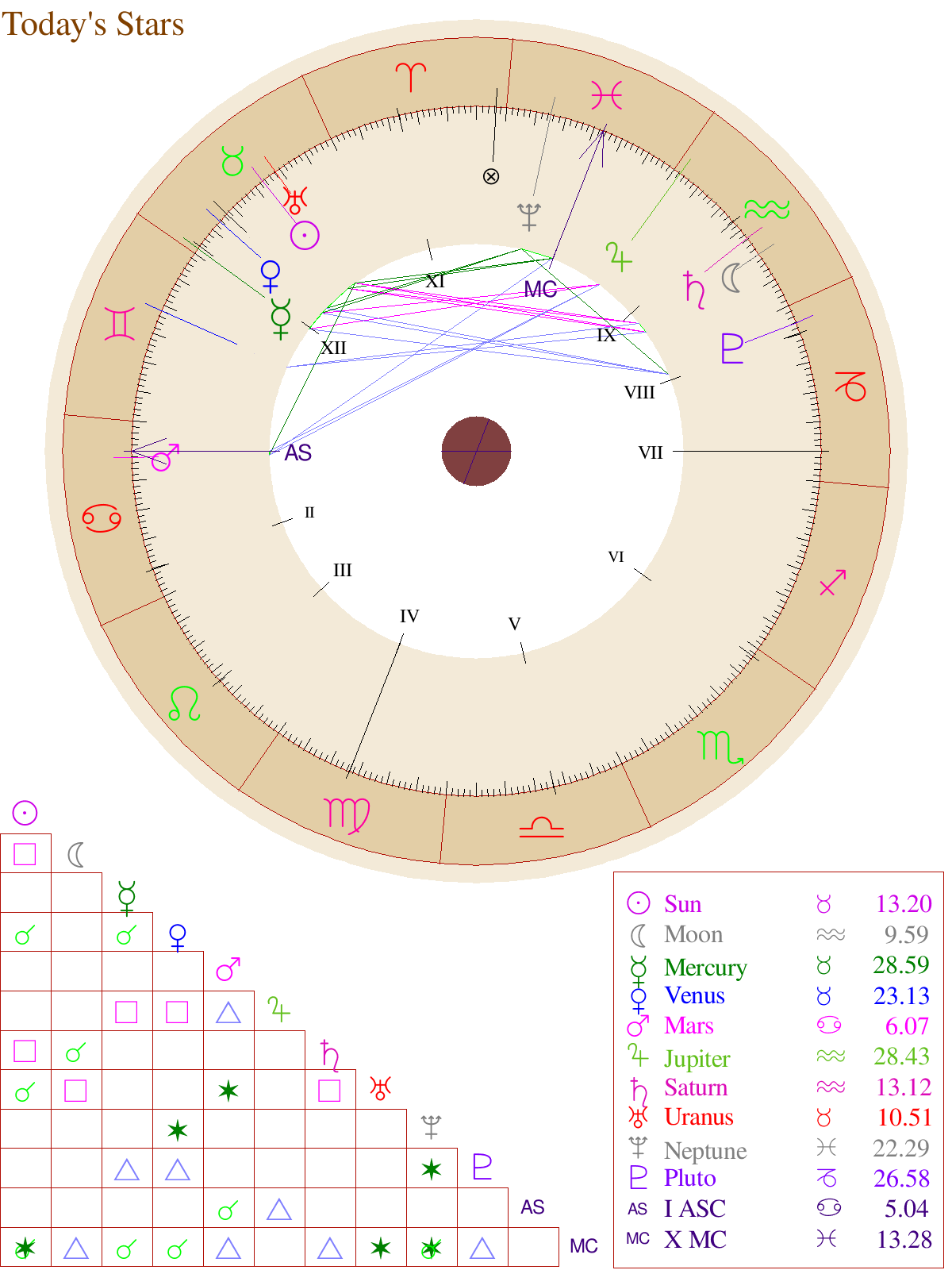
First, the Heavens. Here is an astrological chart taken for my current location at the time that I'm writing this blog:


If you don't know how to read charts like these, now is a good time to learn. The main event, dominating the Heavens, is currently the square between Saturn and Uranus, representing (broadly) the conflict between Order and Chaos. At this moment, the Sun is conjunct Uranus, while the Moon is conjunct Saturn. This is not an especially good day for activities involving any of those planets-- or much else, for that matter. On the other hand, Jupiter and Mercury are both about to move into signs which they rule, which will lend considerable strength to both planets.  

More important than the details of this specific chart itself are the ways that it relates to your own natal chart-- and if you don't have a copy of that, now is a good time to get one. You can find any number of astrological programs online that will give you your chart if you input your time, date, and location of birth. Most will come with interpretations of your planets. I do NOT recommend paying much attention to these; just get the image of your chart. Then look at how it relates to the chart above. If Uranus or Saturn is impacting any planet in your chart by an opposition, square, or conjunction, that means trouble for activities related to that planet and to whatever house that planet rules in your chart. If, for example, your natal Venus is placed at 11 degree of Taurus and is the ruler of your 10th House, you can expect serious challenges to both your love life and your career over the next year or so. (And they probably began some time last year.)

And then there's Earth, which I defined above as the astral reflection of the physical environment.

Astral reflection? The simplest way to understand that is that the astral reflection of a place literally is the way that it feels to be in a place. Have you ever walked into a church or a deep forest and felt a sense of abiding peace that stayed with you after you left? That was an astral experience. Have you ever driven past a graveyard and felt a sense of creepiness and nausea? That was a different kind of astral experience. 

Learning to open up and then rely on the astral senses is a key component and fruit of every system of magical training. Many people are born with strong astral senses, too, and there are other things, from drugs to yoga, that can open them. There's also a bit of a danger, because to be able to sense astral phenomena is to be affected by them-- it's very hard for a lot of sensitive people to both detect the presence of astral filth and to remain unaffected by it. This is why traditional magical systems teach protective rituals right away--  when you start becoming sensitive to the astral environment, you need to be able transform it and stop it from impacting you in a negative way. 

If you aren't able to see or feel what's going on in the astral, it can and will still affect you. Learning to read physical terrain is very helpful. I've been using the term "astral reflection" to describe the astral environment, but that isn't really correct. It's really the physical that's the reflection of the astral environment. We can therefore read the astral environment to a certain by paying attention to the physical. A broken down dive bar reeking of cigarettes and old booze is the reflection of a particular type of astral environment-- even if you can't see the spirits that hang around there, you can know what they are just by looking at the place, and avoid it, as Sun Tzu's army avoids an ambush in tall grass. 


Sorry for the light posting lately-- I've been struggling with the text, and with some things in my personal life. But as I said to someone the other day, you can have the best reason in the whole world for not watering in your garden, but your plants are still going to die. So let's continue.

Chapter 9 of the Art of War goes on to discuss the details of fighting in mountains, rivers, marshes and plains. The details are useful and necessary, if you are conducting an actual war with an army. But what does it mean for us, in our struggle to master our own souls?

For help in understanding, I want to turn again to Eliphas Levi.

In Chapter 4 of the second part of Doctrine and Ritual of High Magic, Levi discusses the elemental spirits-- the sylphs, salamanders, undines, and gnomes. These are the spirits, respectively, of Air, Fire, Water, and Earth. In the worldview of Levi and of classical occultism generally, these spirits are ever-present and in great numbers. Their influence of the elements extends well beyond the material substances that bear their names. The material earth, the air you breathe, the water you drink or bathe in and the fire on your hearth are only physical expressions of ideas that are present at every level of existence-- and that very much includes the internal environment of your own soul.

Now, each element has its characteristic vices-- these are the ways that the elements express themselves in the unawakened soul. But each has its characteristic virtues, as well. The true magician has complete mastery of the elements of his soul. Levi tells us that

 
To overcome and subjugate the elementary spirits, we must never yield to their characteristic defects. Thus, a shallow and capricious mind will never rule the Sylphs; an irresolute, cold and fickle nature will never master the Undines; passion irritates the Salamanders; and avaricious greed makes its slaves the sport of Gnomes. 

In order to overcome the vices of the elements, we must master their virtues. And so Levi continues: 

We must be prompt and active, like the Sylphs; flexible and attentive to images, like the Undines; energetic and strong like the Salamanders; laborious and patient, like the Gnomes: in a word, we must overcome them in their strength without ever being overcome by their weaknesses.

The elementals dwell within us, and rule the internal landscapes that correspond to Sun Tzu's mountains and marshes, deserts, plains and rivers. In order to master them, we must cultivate the virtues of the elements-- and in that way overcome their vices, and, in our own way, raise the entire elemental creation toward union with the Divine.
Sun Tzu continues to give us advice on military maneuvering: 


Camp in high places, do not climb heights to fight.

So much for mountain warfare.

After crossing a river, you should get faraway from it.

When an invading force crosses a river in its onward march, do not advance to meet it in mid-stream. It will be best to let half the army get across, and then deliver your attack. 

We discussed the meanings of "mountains" yesterday. To recap-- in military affairs, mountains are problems because they are void of sustenance for men and animals. If you get stuck on a mountain, your army will starve. On the other hand, as Sun Tzu says here, mountains have a certain value-- we should camp in high places, for defense.

So, as discussed yesterday, we need to not linger in places-- jobs, cities, lives and lifestyles-- in which there is no nourishment for our souls.

On the other hand, we can make use of undesirable places, the equivalent of mountains, in order to protect ourselves.

How do we do this?

Two different ideas come to mind. 

First, it's a very useful thing to avoid whatever is popular. Especially in moments like these, in which the collective mind of the fashionable classes is insane and the spirit of the times is a ravening, two-headed demon, every place that's fashionable is likely to be psychically toxic. I live in a more or less working class or lower middle class neighborhood in a small, rural town. There are no political signs in peoples lawns, nobody wears a mask on the trail in the woods, and kids play together, outside, on bicycles and skateboards, and the neighbors are relaxed and friendly. I spent a bit of time in a fashionable, higher end suburb of Washington, D.C. yesterday, and the contrast could not be more clear. There everyone is in a mask, no one talks to you, and they all have signs in their lawns going on about how tolerant they are. From my perspective, those neighborhoods are high, cold mountains, the sort of places where travelers get snowed in and resort to cannibalism. From their perspective, though, my neighborhood is the mountain-- the sort of place they wouldn't be caught dead in. And so I camp my army here.

But then there is also the issue of magical defense-- rendering your home and other places you spend your time defensible, like a mountain. This can dovetail nicely with the first approach-- a place that looks unfashionable on the outside, and so unappealing to the fashionable, but which is an astral paradise on the inside is a very nice place indeed!

I've gone on a bit longer than intended, so we'll see if we can come up with a meaning for "rivers" tomorrow. 

I plan on going quickly over the final chapters of the book, because I want to move on to something else. What's next? Either a detailed read-through of the Gospel of Matthew, analyzed as though it were a magical text in the tradition of Eliphas Levi, or else Iamblichus's canon of Platonic dialogs read in order. Or both. Stay tuned!
Let's move on to Chapter 9 of The Art of War. I'm going to take the rest of the book somewhat quickly. 

We come now to the question of encamping the army, and observing signs of the enemy.

Pass quickly over mountains, and keep in the neighborhood of valleys.
 

The heading of this chapter is The Army on the March. Sun Tzu gives us details specific to actual military maneuvering, here. But are there general principles that we can tease out and apply to our own lives?

Let's see.

The point of telling us to "pass quickly over mountains," our translator notes, is that we need to not "linger among barren uplands, but keep close to supplies of water and grass."

Water and grass are fuel for men and horses. We can say for the soul generally, keeping in mind Plato's image of the soul as a winged chariot, pulled by two horses. "Barren uplands," then, are all those places in which the soul can find no nourishment, no water for the men nor grass for the horses.

What is it that nourishes the soul?

This varies from person to person, of course, depending on our individual needs and desires. There are some constants, though. Every soul is nourished by vital energy: Real food, fresh air, sunlight, the presence of other living beings. Every soul is nourished by beauty: In music, art, architecture, and stories. Every soul is nourished by purpose: By fulfilling that charge or set of charges which is its own to dispatch upon the Earth. 

And every soul without exception is nourished by Love. Love for God; for one's parents or mentors, one's children or students, one's friends, one's lover; for one's town and country, for a forest or mountain range, for one's own animals and plants-- relationship is another way to say this. 

Let us recall Plato's words in the Phaedrus:


Ten thousand years must elapse before the soul of each one can return to the place from whence she came, for she cannot grow her wings in less; only the soul of a philosopher, guileless and true, or the soul of a lover, who is not devoid of philosophy, may acquire wings in the third of the recurring periods of a thousand years; he is distinguished from the ordinary good man who gains wings in three thousand years:-and they who choose this life three times in succession have wings given them, and go away at the end of three thousand years. But the others receive judgment when they have completed their first life, and after the judgment they go, some of them to the houses of correction which are under the earth, and are punished; others to some place in heaven whither they are lightly borne by justice, and there they live in a manner worthy of the life which they led here when in the form of men. And at the end of the first thousand years the good souls and also the evil souls both come to draw lots and choose their second life, and they may take any which they please. The soul of a man may pass into the life of a beast, or from the beast return again into the man. But the soul which has never seen the truth will not pass into the human form. For a man must have intelligence of universals, and be able to proceed from the many particulars of sense to one conception of reason;-this is the recollection of those things which our soul once saw while following God-when regardless of that which we now call being she raised her head up towards the true being. And therefore the mind of the philosopher alone has wings; and this is just, for he is always, according to the measure of his abilities, clinging in recollection to those things in which God abides, and in beholding which He is what He is. And he who employs aright these memories is ever being initiated into perfect mysteries and alone becomes truly perfect. But, as he forgets earthly interests and is rapt in the divine, the vulgar deem him mad, and rebuke him; they do not see that he is inspired.
 
Stay close to the air and the sunlight; don't linger in catacombs, even if they're well stocked with groceries. Find time every day to do the things that you are meant to do on this Earth. And abide not long in a life devoid of love!
 Here is a useful selection from Chapter 8 of The Art of War:

There are five dangerous faults which may affect a general:

1. Recklessness, which leads to destruction;

2. Cowardice, which leads to capture;

3. A hasty Temper, which can be provoked by insults;

4. A delicacy of Honor which is sensitive to shame;

5. Over-Solicitude for his men, which exposes him to worry and trouble.

Let's see if we can reframe these in terms of the inner struggle for control of one's own soul and destiny. Some will be the same, but others must necessarily differ. The five dangerous faults might be called:

1. Impulsiveness. This means acting from the internal passions and from outside impulses like TV or social media, without reflecting on consequences and without reference to principles or goals.

2. Cowardice. This specifically means living from fear, and is very common these days, to judge by the number of people I see wearing masks while driving their own cars. 

3. Irascibility. This also means what it does in Sun Tzu-- living from wrath, which can be easily provoked. Social media and TV news thrive by provoking both fear and wrath, leading the subject to lash out wildly, like a trapped animal. 

4. Conformity. This is the fourth of the major passions, along with lust, fear, and wrath, that are targeted for manipulation by news media, advertisers, politicians and other modern techno-magicians. All human beings are social animals. We want to be part of the group, and we don't want to be ostracized or spoken badly of. 

5. Laziness.  It's the case that many of us want to accomplish great things in our lives, but we don't want to have to endure the difficulties involved in doing so. If we want to achieve anything, we need to be willing to sacrifice our comfort for it, in the same way that a good general, even as he does his best to preserve his army, must be willing to sacrifice such men as are necessary to achieve victory. 

It was common in earlier times to oppose a saving virtue to every vice. In our case, we might overcome these five dangerous faults with the following list of virtues:

1. Reflection, which leads us to act only if it is right and in our long term benefit to do so;

2. Courage, which allows us to do what is right in spite of danger;

3. Patience, which allows us to endure provocation;

4. Independence, which allows us to do what we choose, regardless of the opinions of others; and 

5. Industriousness, which allows us to work to achieve our goals in spite of difficulty.
Chapter 8 of The Art of War continues:

Hence in the wise leader's plans, considerations of advantage and disadvantage will be blended together.

If our expectation of advantage be tempered in this way, we may succeed in accomplishing the essential part of our schemes.

If, on the other hand, in the midst of difficulties we are always ready to seize an advantage, we may extricate ourselves from misfortune.

Our translator points out that that the Chinese is rather precise here, indicating "to blend thoughts of advantage with disadvantage."

While keeping our goals in mind, we need to be able to adapt to circumstances and willing to roll with the punches. But it isn't enough simply to figure out how to get out of a difficult situation. We need to always be working to turn disadvantage into advantage.

A later commentator elaborates:

For instance, if I am surrounded by the enemy and only think of effecting an escape, the nervelessness of my policy will incite my adversary to pursue me and crush me; it would be far better to encourage my men to deliver a bold counter-attack, and use the advantage thus gained to free myself from the enemy's toils.

I've talked a lot here about how I view the current political situation in the United States as a spiritual conflict, with demonic powers on both sides. My advice up to this point has been to avoid the conflict as much as possible, lest being drawn into the fight against one demon we should find ourselves supporting the other, and still end up diabolists.

Lately, however, I have begun to rethink that approach. Assume that I'm right, that there are demonic elements both on the radical Social Justice Left and the far right that will eventually supplant it. Does that mean we should avoid the conflict? Maybe, but I wonder if, in attempting too much to avoid conflict, we don't end up surrendering ground to demons, and thereby losing anyway. I am starting to see our position as an encirclement-- in which case, we're obligated not just to escape from the enemy, but to effect a counter-attack. More on this as we go on. 
Sun Tzu says

The general who thoroughly understands the advantages that accompany variation of tactics knows how to handle his troops.

The general who does not understand these, may be well acquainted with the configuration of the country, yet he will not be able to turn his knowledge to practical account.  


In other words, we need to be flexible. Learn to roll with the punches, and change our tactics accordingly as circumstances change.

That sounds simple, but it's often quite difficult, because we very frequently confuse means with ends. You see this quite often in politics and in charity work of every kind. People believe that they are organizing to achieve a particular goal, but somehow the goal itself is never achieved, and the organization becomes an end in and of itself. And then you'll often find that if you criticize the organization, people accuse you of criticizing the goal-- even if the organization is the thing standing in between the goal and reality!

We can apply this lesson to our daily lives as well. If you want more money, you can try to get a different job and work longer hours. Or, you can cut your expenses-- now you have more money. Even better, you can ask yourself what you actually want. It's very often the case that you can enjoy a higher standard of living if you simply do things yourself. My favorite example is bread. A loaf of "artisan" bread at the store will set you back at least five dollars. I bake all of my family's bread at home. Every day we eat a loaf of "artisan" bread whose total cost, factoring all ingredients, is a little over a dollar. And it's only that much because I use King Arthur flour. If we were really low on money I'd spend $8 on a 25 pound bag of flour from Costco, and each loaf would cost around 35 cents. And it would still taste better than most stuff you can get at the store.

In any situation, ask yourself what end you really want to achieve, and don't become attached to any one set of means. Or, if you have become attached to the means, realize that they are, in fact, your real goal!
Sun Tzu tells us that

There are roads which must not be followed, armies which must not be attacked, cities which must not be besieged, positions which must not be contested, commands of the sovereign which must not be obeyed. 

This is along the same lines as what we said yesterday: Don't set yourself up for failure. Or, to put it another way: Pick your battles. 

One of the later commentators gives the example of a general who bypassed a major city that stood in his army's way, and doing so took much of the enemy's country. A later French general put it, "Don't take a city when you could have a province." And of course, that advice was put into practice by the Wehrmacht in 1939, with results that don't need to be repeated here.

If you take the province, the city will fall into your hands later, but the reverse is not necessarily true. Much of life is that way. If you have a habit or addiction you can't break, focus on building up your healthy habits and working on your goals in the time that's not dedicated to your addiction. You may find that as the rest of your life becomes better and better, the addictive behavior stops because it's simply no longer that interesting.
Sun Tzu continues to give us advice about terrain:

When in difficult country, do not encamp. In country where high roads intersect, join hands with your allies. Do not linger in dangerously isolated positions. In hemmed in positions, you must resort to stratagem. In a desperate position, you must fight. 

If you remember, way, way back in Chapter 1 we discussed terrain as a component of "Earth." For our purposes, terrain includes all those locations-- whether actual physical locations, mental locations, cultural locations, digital locations, astral locations or spiritual locations-- in which we must act to achieve any particular goal. 

The essence of the advice here is: Don't set yourself up for failure. If you have a problem with internet pornography, arrange your day so that you're not spending all your time alone with a computer-- that's the definition of a dangerously isolated position, for you. If you find yourself in that kind of position, don't encamp-- that is, find something else to do, don't just hang out. 

Joining hands with your allies is useful advice for anyone, provided that it's possible. Addicts very often find that it's much easier to get over their addiction if they join forces with others. This is true for addicts of every kind-- which includes many, perhaps most of us-- not just substance abusers. Alcoholics are better off at AA meetings than barrooms; home shopping addicts would often be better off getting together with their friends at a park than spending time on Etsy or Amazon.

Set yourself up for success, and you will succeed.
 Chapter 8 of The Art of War opens with a reminder:

In war, the general receives his commands from the sovereign, collects his army, and concentrates his forces. 

This is a point we keep returning to, and it's worth revisiting here.

We use our reason to set a goal; our reason directs our will, which unites all of our faculties. By uniting all of our faculties and focusing on a particular goal, we are able to achieve it. In the act of repeating this point, we practice remembering it; in practicing remembering it, we practice its advice. 

Here are some words from Eliphas Levi on the same topic: 

An idle man will never become a magician. Magic is an exercise of all hours and all moments. The operator of great works must be absolute master of himself; he must know how to repress the allurements of pleasure, appetite and sleep; he must be insensible to success and to indignity. His life must be that of a will directed by one thought and served by entire Nature, which he will have made subject to his mind and his own organs, and by sympathy in all the universal forces which are their correspondences. All faculties and senses should share in the work; nothing in the priest of Hermes has the right to remain idle; intelligence must be formulated by signs and summarized by characters or pentacles; will must be determined by words and must fulfill words by deeds. The magical idea must be turned into light for the eyes, harmony for the ears, perfumes for the sense of smell, savors for the palate, objects for the touch. The operator, in a word, must realize in his whole life that which he wishes to realize in the world without him; he must become a MAGNET to attract the desired thing; and when he shall be sufficiently magnetic, let him be assured that the thing will come of itself, and without thinking of it. 


Chapter 7 of The Art of War ends with the following words:

Do not interfere with an army that is returning home.

When you surround an army, leave an outlet free. Do not press a desperate foe too hard. 

Such is the art of warfare. 
 
The points here are not to give the enemy the courage and tenacity that desperation provides. Give them an out; don't attack them when they're retreating. 

In my view, a major part of the problem with American politics is that no one is willing to understand this. Let's consider the Social Justice movement for a moment. I personally see this as the worst poison in American public life today, and I see its major exponents as different from Hitler and Stalin only in degree, and not in kind. I expect that difference in degree to even out if the SJWs ever gain the total power that they crave.

That said, I would be more than happy to compromise with them on any number of areas. Do you want reparations for slavery? Fine-- as long as we can also get reparations for the opioid crisis, and as long as it's not being paid for by people who didn't benefit from and had nothing to do with slavery. Do you want to mandate ethnic studies in the schools? That's okay, but not if it fails to include discussion of any European ethnic groups. Do you want identity politics? Okay, I don't, but if we're going to have it, it's got to be identity politics for all, not our current regime of "identity for me, but not for thee." 

And I can think of any number of other areas where I'd be willing to compromise-- but this is never allowed. Are you descended from Irish Catholics? Pennsylvania Germans? Scots-Irish Appalachian coalminers? Italians who arrived in the early 20th century and faced lynching in the South and bigotry from the Irish-dominated Catholic Church in the North? It doesn't matter-- you're just as "white" as an old money family whose ancestors arrived at Jamestown in 1630, and just as culpable for anything that ever upset a black person. 

Under such circumstances, the only possible result, and one that I predict that we'll see before the decade is out, is going to be a massive resurgence in white self-identity, white solidarity, white pride and white power. And no, I don't like this result, at all. Like the great majority of ethnic-white Americans, I would have been perfectly happy to see "whiteness" eliminated as a form of collective identity. I'm proud of who I am, who my family is and who our ancestors are, and "white" has never been a part of that. But if you don't give me any way out, what do you expect to happen? And so I fully expect that by 2030, if I'm still writing this blog or something like it, I'm not going to be talking about how to avoid being attacked by SJWs, but how to avoid being co-opted by white identitarianism. 

What about our internal struggles, against our own addictions, bad habits, and unruly passions? Are there ways that we can allow them to retreat?

I think so. One great way to do this is simply not to focus on them. If you try to eliminate a habit-- watching television, say-- by getting rid of it, you're likely to fail. Instead, focus on doing something else with your time. If you usually watch TV from 7:00 until bed time, but you want to get in better shape, don't cut the TV out. Instead, find a workout to do from 7:00 to 7:30. You can watch TV after that. Eventually, you'll probably find that the amount of time you spend watching TV gets smaller and smaller, as the feeling of doing something you've chosen, rather than something that's been chosen for you, inspires you to do more of what you want. Once it's finally become irrelevant, you can eliminate it entirely. 

As our translator notes, the point of all of this 

does not mean that the enemy is allowed to escape. The object, as Tu Mu puts it, is "to make him believe that there is a road to safety, and thus prevent his fighting with the courage of despair." Tu Mu adds pleasantly: "After that, you may crush him."
 Some advice from Sun Tzu:

It is a military axiom not to advance uphill against the enemy, nor to oppose him when he comes downhill.

Do not pursue an enemy who simulates flight; do not attack soldiers whose temper is keen.

Do not swallow a bait offered by the enemy.

We've discussed these ideas in different form many times in these posts. Attack the enemy where he is weak and you are strong. Don't attack strong points, or oppose forces that you can't resist. 

As for baits, modern life is riddled with them. Social media is the worst, with Twitter probably the absolute worst-- every tweet ever made by someone you don't like is a bait held out by the enemy. And remember, because this is crucial-- the enemy is a demon with two heads. Get caught up in fighting with one, and you will very often find yourself fighting alongside the other: Now the demon is your friend, and you have become, for a time, a demoniac. 

Television and advertisements are also baits. I enjoy visual media and am not opposed to it on principle. My favorite TV show is the 90's sci fi series Babylon 5; my favorite movie is Groundhog Day. But visual media have a power like nothing else to simulate experience and, thus, to alter your memories, emotions, and your very sense of self. It's critical to retain self-possession when watching them-- or, rather, to choose what you watch based on what you want to create in yourself, rather than what's popular, or you may find yourself transformed into a very different sort of person from who you thought you were. 


More on the same note:

Disciplined and calm, to await the appearance of disorder and hubbub amongst the enemy: this is the art of retaining self-possession.

To be near the goal while the enemy is still far from it, to wait at ease while the enemy is toiling and struggling, to be well-fed while the enemy is famished-- this is the art of husbanding one's strength. 

It's unfortunately the case that in life, we have to deal with other people. Their whims, their moods, their traumas and circumstances-- these things affect us all the time. Someone cuts us off in traffic because they're in a hurry; a cashier at the grocery store is rude to us because we look like a villain from a TV show or the evening news; a romantic partner flies into a rage because of something that reminds them of a childhood trauma; a boss belittles us because he was bullied in middle school and now has the chance to do the same thing to someone else. 

In the end, self-possession is the only way we can make it mentally and emotionally intact through the storms of life.

But how do we find it?

We can't rely on other humans; they aren't reliable. And that means we can't rely on ourselves either because we are also human. 

We need, then, to reach beyond the human-- to the divine. That includes that small spark of divinity within that is our own higher self, of course. But above all, we need a relationship with God-- our God, whatever God is appropriate for us. At the end, only God does not fail, and it is only by standing always in the divine presence that we can remain unmoved at all times. This is why St. Paul says, "Rejoice always. Pray without ceasing. In all things give thanks."
Sun Tzu tells us

Disciplined and calm, to await the appearance of disorder and hubbub amongst the enemy: this is the art of retaining self-possession.

In order to develop self-possession, we need to gain self-knowledge.

In order to gain self-knowledge, we need to practice meditation.


Buddhist and other East Asian systems of meditation which work by stilling the mind have much to recommend them. They are not, in my view, sufficient; done in isolation, they can lead to mindlessness; done to excess, they can lead to insanity. 

That said, stillness is entirely necessary. It is only once we still our minds that we become capable of deliberate action, instead of unchosen reaction.

Western meditation is called discursive meditation. A discursive component to any meditation is also necessary. Discursive meditation builds the capacity to think new thoughts. 

So both of these are necessary. First we need to stop being moved. Then we need to learn how to move on our own.

The third component of self-possession is the capacity for pattern-recognition.

That sounds somewhat simple, but very few people seem to possess it. If you spend time studying politics you'll find people supporting positions which are identical to those they opposed two years ago because they're incapable of seeing the underlying pattern. If you spend time studying pathological behavior, you will find people repeating the same patterns over and over because they don't recognize them. If you start learning to observe and to change your own mind, you can learn to detect and change your own destructive patterns of thought and behavior. And that is the key to freedom. 

The only person I know who doesn't practice discursive meditation who has a very strong capacity for pattern recognition is a math teacher by profession. That's math, not science-- Scientists seem to be unusually stupid outside their own field (and, often enough, within it). Spending time studying religious texts is also extremely useful, if you approach them, not as works of journalism, but as tools for training the mind and elevating the spirit. 

 Let's back up a little bit, and discuss some of Sun Tzu's previous selections from The Book of Army Management.

A whole army may be robbed of its spirit; a commander in chief may be robbed of his presence of mind. 

To this the later commentator Chang Yu helpfully adds:

In war, if a spirit of anger can be made to pervade all ranks of an army at one and the same time, its onset will be irresistible. Now the spirit of the enemy's soldiers will be keenest when they have newly arrived on the scene, and it is therefore our cue not to fight at once, but to wait until their ardor and enthusiasm have worn off, and then strike. It is in this way that they may be robbed of their keen spirit. 

I've been focusing my commentaries on personal development and habits for the last little while. Today I want to shift attention back to the Spiritual Warfare. 

I've recently learned, via JMG's blog, that the latest absurdity in the world of the demoniac Social Justice movement is an attempt to prevent white people from using tarot cards, because they're "cultural appropriation."

Now, reading that, I had the following reactions:

The first was anger.

The second was a mental debate.

The third was an attempt to figure out why the hell anyone would think anything like that, which led me to a pagan site on Reddit where some very concerned 22 year old was explaining the ways that white people can appropriately use tarot cards.

The fourth was a lengthy comment about the whole matter on JMG's blog, which comment was promptly devoured by the Internet when the site went down for a half hour.

Now, the thing is-- all of this was a waste of time. 

There is no reason whatsoever to debate the Social Justice movement. The essence of that movement is racialized socialism enforced by surveillance, censorship, indoctrination and mob violence. We don't need to talk about whether or not that works or what outcome it produces. We have the whole history of the Twentieth Century to look at if we want to know. If you are driving in a car and your passenger tells you to drive into oncoming traffic, you don't argue about the reasons why you shouldn't do that, and you don't consider their point of view. You just don't drive into oncoming traffic. If they grow increasingly shrill and start shrieking about how you have to drive into oncoming traffic because they are an epileptic and don't have their medicine available, you still don't drive into oncoming traffic. You drive to a psychiatric hospital and have them committed. Later on, once their psychosis is under control, you can find out if they are actually epileptic and if you can help them get access to treatment. 

To engage with insanity is to allow yourself to be robbed of your presence of mind. To engage with a public insanity, such as the Social Justice movement, while it is still at the peak of its enthusiasm is to engage the enemy's soldiers while their spirit is at its keenest. Only do it if you can get something out of it besides rage at the insanity of it all and a sense of powerless at being unable to stop it. Most of the time you can't-- so don't follow my example. It's best to avoid learning the news of the latest outrage, if all it will do is outrage you; if you are unable to avoid learning about it, it is still best to ignore it and do something constructive. Only engage with it if the force of the outrage will be sufficient to rally yourself or your own side to actually achieve something
A short one today. Quoting from "The Book of Army Management," Sun Tzu tells us, 

Now a soldier's spirit is keenest in the morning. A clever general, therefore, avoids an army when its spirit is keen, but attacks it when it is sluggish and inclined to return. This is the art of studying moods. 

We can apply this idea to our lives directly and in reverse.

In reverse: All of us have times when our own spirit is at its keenest. For me, it's the morning, with late night also being okay. I do my best writing and thinking either right after morning coffee or else very late at night. Evenings are harder; I can get work done, but not a lot of mind work. Right now I'm writing at 1:30 in the afternoon, and it's a struggle-- I honestly hate afternoons. I feel like I have no energy, and my brain is like a pile of mush. 

We can use all of this, by scheduling our lives so that we get to our most constructive habits when we have the most energy for them. For me, like I said, that's morning and late night-- but I can use afternoons, provided I do so effectively. Specifically, I can do any kind of drudging grunt work during this time of day, provided I have a podcast or audiobook to distract me. So this is usually when I fold the laundry, do the dishes, clean the kitchen and so on.

Of course, this all works in reverse, as I said. We can look at our bad habits and see what particular times, settings, and events trigger them. That's when we want to be on guard, as these are the times when our enemy's spirit is keenest, and this is when we must be on guard. 

Well, anyway, I've really got to go get to the dishes now. See you tomorrow!


Profile

readoldthings

December 2024

S M T W T F S
1234567
891011121314
1516 17 18192021
22232425262728
293031    

Syndicate

RSS Atom

Most Popular Tags

Style Credit

Expand Cut Tags

No cut tags
Page generated Feb. 3rd, 2026 04:09 am
Powered by Dreamwidth Studios