Sun Tzu tells us to  

Ponder and deliberate before you make a move

This harkens back to Sun Tzu's words way back in Chapter 1:

Now the general who wins a battle makes many calculations in his temple ere the battle is fought. The general who loses a battle makes but few calculations beforehand. 

It's occurred to me lately that I talk a lot about self-knowledge. And that's appropriate, given that my main focus in these reflections is on what I've been calling the battle within or the conquest of the soul. But even when we are working solely to change ourselves from within, we often encounter resistance from without. Sometimes this is direct and obvious, as in the case of friends or family who don't wish us to change. Other times, it occurs without any apparent cause. A woman of my acquaintance recently informed me of her desire to lose weight. The very next day, a coworker came to her office and offered her McDonald's for lunch. The coworker had never done that before. This, of course, is why I always say that we shouldn't talk about our plans. Regardless, it's very often the case that as soon as we announce an intention, even to ourselves, some form of resistance appears. 

We should undertake all of our goals with the awareness that we're going to encounter resistance. Resistance isn't a bad thing-- it's by the resistance of heavy weights that we strengthen our muscles; it's by the resistance of beams and pillars that buildings are erected. Let's be aware of it and be prepared to use it to accomplish our goals. 

But whenever we encounter deliberate resistance, in the form of another person blocking us from our goals or attempting to turn us toward some other goal of their own-- whether this person is acting intentionally or not-- we need, to the extent that we can, to understand what the person wants. It's only by doing that that we can "know our enemy," which, along with knowing ourselves-- that is, defining our own goals-- allows us to achieve victory. 
 Sun Tzu says,

When you plunder a countryside, let the spoil be divided among your men; when you capture new territory, cut it up into allotments for the benefit of the soldiery.

There are a few different possible applications of this idea to our purposes. 

Rewarding yourself is the first thing that comes to mind. If you have a huge task to undertake, first break it up into small pieces-- these are the small territories and allotments-- and then give yourself a reward whenever you complete each step. 

I've recently gotten into home brewing. Brewing a 5 gallon batch of beer can be a pretty big undertaking, requiring a number of steps. First you brew the thing; then a few weeks later you have the option of siphoning it into a secondary container to continue fermentation; then you bottle it; then, finally, after it's been conditioned in the bottles, you open it up and drink it.

If you spend any time watching videos about home brewing, as I do, you'll find that the guys that make these videos nearly always have a beer in hand during each step of the process. This is the sort of thing I'm talking about-- You're going to spend anywhere from 3 to 6 hours on each of these steps, so how do you make it interesting? Reward yourself with a tall glass of beer, of course! 

Rewarding yourself is a way to help develop any habit. I remember many years ago I was trying to quit smoking. I found that there were episodes of my favorite TV show available on Amazon for $2 apiece-- this was completely new at the time. $2 was much less than the $5 I was spending every day on cigarettes (and that should tell you how long ago this was), so I decided that any day I didn't buy a pack of cigarettes, I could buy an episode of my show. 

Another application comes to mind, though, that's sort of the reverse of this one. Let's segue into it by talking about beer again. Once you finish brewing a 5 gallon batch of beer, you have a whole lot of beer. 45-50 bottles-- that's 2 cases. Now, unless you're drinking much more than you should, it's going to take you a while to go through all that. 

So why not give it away?

Not all of it of course. And, well, not even most of it. But if it is true that we reap as we sew, then sew generosity-- and watch it return to you!

This principle of giving is widely applicable. Another idea, and one that you find in a lot of support and recovery groups, is that if you find yourself stuck in your own mind and your own misery, get out of it by finding something good to do for others. I've applied this on occasion-- It's an easy one for me to forget, and my head is a place I'm fond of getting stuck-- but when I remember I've found it's very effective. If you find yourself turning inward and spiraling on some unpleasant set of thoughts, emotions or behavior patterns, stop and do some charitable act for someone. It's best if you can move and actually physically do something, but saying a prayer and making a donation works, too. In the battle within, this is the equivalent of taking the enemy's territory and dividing the spoils among your men, and it works quite well.

Give freely, never grudgingly but always in a spirit of gratitude for the opportunity of giving, and  you'll find it returns to you. 
Since I missed yesterday, let's have a Saturday Post.

Sun Tzu says:


Let your rapidity be that of the wind, your compactness that of the forest.

In raiding and plundering be like fire, in immovability like a mountain.

Let your plans be dark and impenetrable as night, and when you move, fall like a thunderbolt.


An army that followed Sun Tzu's injunctions here would have the following qualities.

It would move quickly, covering great distances. But it would move together as a unit, not strung out across many, many miles, so that if an enemy appeared, it would be able to turn and fight. It would appear suddenly in the enemy's territory, raiding supplies and plundering farms and cities. Its intentions would be unknown and unknowable to its enemy. When it did act, it would act very suddenly, with great preparation leading to overwhelming and immediate success: Its coming would be like lightning from the heavens.

Let's leave aside warfare now, and consider what such a person would be like. If I were such a person, I would have the following qualities:

I would be able to make decisions and act upon them very quickly when I needed to, not hemming and hawing. In order to do this, of course, I would need knowledge of my own purposes and intentions. 

I would not be taken off-guard by sudden eventualities like a global pandemic, my place of employment closing, or a sudden shortage of toilet paper. Instead, I would respond quickly in such a way that turned the situation to my advantage. This would require self-knowledge, plus a great deal of self-possession, and a level of preparation and adaptability. 

When I saw something that would help me in attaining my goals, I would reach out and take it. This would require self-knowledge, plus vigilance in pursuit of opportunities.

When I created something that I wanted in my life-- a good habit, a relationship, a career-path-- I would let nothing move me from it. This would require self-knowledge, plus knowledge of those quirks of human psychology that fool us into seeing a temporary mood of resistance, temptation, or lack of motivation as a permanent condition. 

I would not spend my time talking and bragging about what I wanted to do. Instead, I would keep my plans to myself, and let their achievement be their announcement. 

I was going to say "I'll let you know when I get there." But that just shows you that I'm not there yet. Instead, let me say that when I get there... you'll know.
 Sun Tzu tells us:

In war practice dissimulation, and you will succeed. Move only if there is a real advantage to be gained. 

This recalls an idea that we've discussed quite a bit on this blog, which is the magical virtue of Silence. Or, to say it another way, 

Don't tell the Devil your plans.

As a brief reminder, the point here is that if your intention is to change in a particular way-- don't tell anyone about it. Especially not people who are used to you being the way you are, and are comfortable seeing you that way. They will try to sabotage you-- even if they love you, even if they want what's best for you, even if they don't mean to. 

And don't tell yourself either. The slogan "one day at a time," common in recovery groups, is relevant here. If you're trying not to drink anymore, don't set about not drinking for the rest of your life. Just don't drink today. You can figure out tomorrow tomorrow. 

I wrote a while back that those of us pursuing a spiritual path in the modern world very often have to live our lives like undercover agents. Most of the people we encounter are asleep; they don't understand where we're coming from. These days, they aren't just asleep; they're dreaming nightmares, and the demons that haunt their nightmares are very real. In a time of intense astral chaos, learning how to live inconspicuously becomes ever more important. 

So I spent some time yesterday watching old army training videos from World War II. If you have an hour to spare, this is a training video for undercover agents, made in 1944:
A couple of the takeaways from the video that are relevant to us:

The most important thing for a secret agent is to be inconspicuous. Standing out is the best way to draw attention. Times were, it was common among  people in the occult and pagan communities to dress in as countercultural a fashion as possible. I advise against this. The purpose of countercultural dress is to shock; the purpose of shocking is to gain attention for shocking. Devotion the old gods, spiritual growth, practical magic-- these are goals entirely unrelated to the goal of shocking bourgeois society. If anything, in a time of social destabilization, we should be trying to prop up bourgeois society. 

There is a scene around the 51 minute mark where one of the undercover agents spots an enemy police officer. His first instinct is to turn around and run away. The voiceover narrator tells him, "If something frightens you, don't run away from it. Turn and meet it." This is excellent advice for life in general. It's not just "Don't give in to your fears." It's "If something frightens you, actively go towards it." This is how we keep from being controlled by fears that restrict our growth and development. 

To the line about dissimulation Sun Tzu added, "Only move if there is a real advantage to be gained."

In our context, we could say, "Only talk about your practices if talking will really help them in some way." Often we talk about things either just to fill time, or else to earn social approval. If you're learning to meditate, play music, practice martial arts, or anything else, only talk about these things if talking will help improve them. Otherwise, be Silent. 

Sun Tzu next tells us that

We are not fit to lead an army on the march unless we are familiar with the face of the country-- its mountains and forests, its pitfalls and precipices, its marshes and swamps.
 
In the Great Work of the conquest of our own souls, we need to be familiar with the face of the country we intend to conquer. While we are all unique individuals, different in our own ways, we are all human beings having a human experience. To gain mastery over a human soul, we will be greatly aided if we start with a map.

It happens that maps of the soul are quite common. The world of the mind is much wider and more various than the physical world, and so many, many different types of maps exist. All describe the same territory, but they do so in different ways. In just the same way, a map of a physical country might be a road map, a topographical map, or a detailed ecological map. Each is useful in its own way, but it's very important to understand what type of map you are using. A topographical map won't help you find an intersection, nor will a road map help you avoid a hill.

Here are several maps of the human psyche.


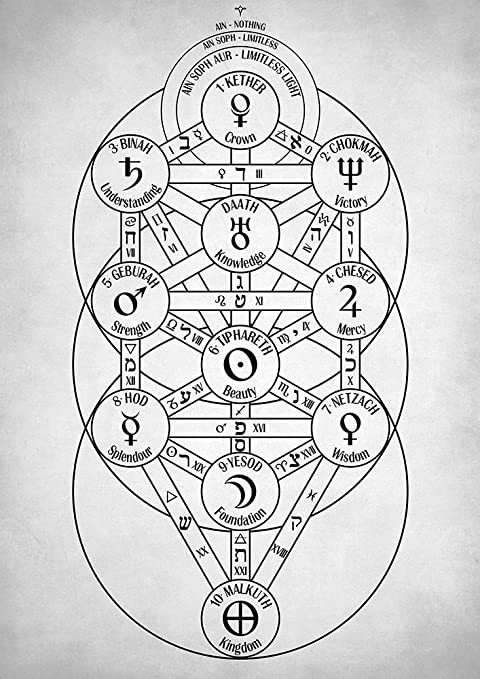
The Tree of Life was originally developed by the Gnostics, and was later appropriated by Jewish Cabalists. Christian occultists picked it up from the Jews during the Renaissance, and it has seen further development since then. The Tree of Life is a map of reality, conceived as ten spheres, which are centers of constructive power, united by 22 paths. There is also a hidden semi-sphere (that's the one without a number on this version of the Tree), two barriers, called the Abyss and the Veil, and an unmanifested background from which the first sphere emanates. In order from ten back to one, the spheres represent the individual's capacity for 10 embodiment, 9 relation, 8 perception, 7 emotion, 6 thought, 5 intention, 4 intuition, 3 intellection, 2 will, and 1 existence.

The exploration and integration of the spheres of the Tree of Life is often the central initiatiatory work in schools of ceremonial magic.

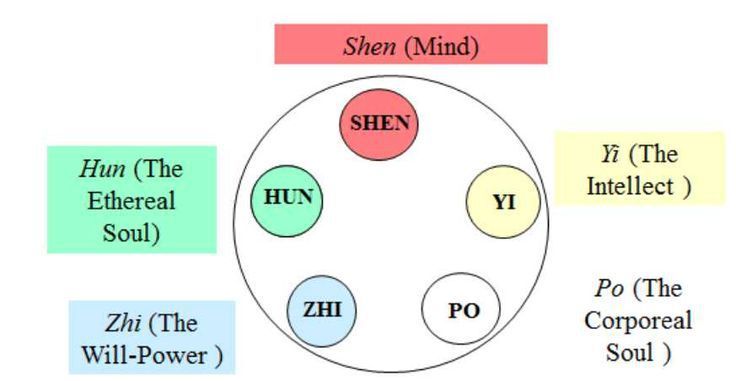
It isn't the only possible map. Here is a very different one from the Chinese Taoist tradition:


This view sees the soul divided into five parts, which also correspond to the Chinese five elements and to the five major organs. A major aim of traditional Chinese spiritual practice is the integration of the five souls, each of which has their own necessary function.

The five soul model is quite effective on its own terms, but it is not the same as the Tree of Life, and trying to use them at the same time doesn't work. It's like trying to use a road map and a topographical map at the same time; you get confused and you don't get anywhere.

Or, to say it a different way, every spiritual path involves three components, which can be called View, Method, and Fruition.

View is the path's understanding of the spiritual world and the human soul.

Method is the path's specific set of practices and disciplines.

Fruition is the results that one can expect from doing the practices and discipline's and keeping to the particular view. The stuff you've heard about "different paths to the same mountaintop" is simply not true; different spiritual paths lead to different mountaintops-- that is to say, they have different results.

That's not to say that they can't be blended and can't inform one another. In fact, different traditions blend and move into and through each other all the time. The Tree of Life is a perfect example. Its origin is probably in the Tetractys, an ancient diagram used by the Neoplatonists:


Take those ten dots and rearrange them, and you have the Tree of Life.

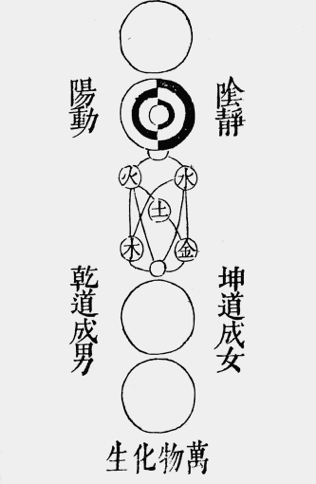
Take the Tree of Life-- or, more likely, some precursor to it-- and rearrange it with Chinese symbology in mind, and you come up with this:


That's the Taijitu. It's functionally identical to the Tree of Life, and it appears in Taoist sources a century before the earliest versions of the Tree appear in Jewish sources.

So some blending of maps is possible-- in the same way that, if you are exploring a city like Pittsburgh or San Francisco for the very first time, a road map combined with a topographical map could actually be extremely useful. The point is not to try to blend two maps until you fully understand them and know what you're doing with them. To give a personal example, the Tree of Life is traditionally blended with astrology, so that the spheres correspond to the planets. I've had this in my mind for a number of years, but I've only just realized that it's prevented me from fully understanding the Tree on its own terms. The key issue was the Eighth sphere, called Hod in the Jewish version of the Tree. Its astrological correspondence is Mercury, but it is not Mercury, and if you try to understand Hod simply as Mercury you miss something important. 

Probably the simplest Soul Map of all is the one given by Plato in the Republic. The soul is like a city, Plato tells us, with three classes of people. There are the rulers, the warriors, and the workers. The rulers correspond to our reason; the warriors to our strength of will; and the workers to our desires. If we subordinate our will to our desires, our reason is overwhelmed. If, on the other hand, we make our will the servant of our reason, we can master our desires and our destiny. 

The point of all of this, though, is that we need to pick a map to work with. And, to shift the metaphor a little bit, from warfare to travel, we need to have a destination in mind. A topographical map won't help you find Fifth Avenue, nor will a road map lead you to a mountaintop. 

One day I will write out a detailed Map of my own, which will probably treat the soul as an old growth forest, with trees and meadows and animals and rivers and soil. Ultimately, I think, that is all of our purpose. While all of us are human and must start with a map of the human soul, all of us are individuals, and must conclude by making a map of our own soul. 
Sun Tzu tells us that,

We cannot enter alliances until we are acquainted with the designs of our neighbors.

In the spiritual life, this can have a number of meanings.

The most obvious is the joining of spiritual organizations. These include formal religious organizations like churches, temples, and Buddhist sanghas and alternative groups like occult lodges and magical orders. But it can also include martial arts organizations, music groups or bands, and even knitting circles.

Any such organization can potentially help us in our development by teaching us things that we didn't previously know and helping us to connect with others who are on the same path. But organizations can very easily go toxic, and that's especially true in the current age of universal psychic toxicity. It's apparently the case that women's knitting circles in recent years became infected with Social Justice ideology, so that groups ostensibly dedicated to knitting sweaters became instead dedicated to left-wing indoctrination. If it can happen in a group as innocuous as a knitting circle, it can happen anywhere. On the complete opposite end of the spectrum, traditionalist Roman Catholic groups are notorious for descending into what's called "Toxic Traddism." As the link here describes it, Toxic Traddism is

manifest in arrogance, busy-bodying, LARPing, finger-pointing, paranoia, gossip, over-protection of children, spousal abuse, mistaking "modern" for "modernist," prudery, raising of personal opinions to the level of dogma, hyper-vigilance against perceived evils and "enemies," making the perfect the enemy of the good, cancel-culturing, lack of humor, lack of empathy and charity for certain types of sinners (you know, the ones whose sins are different from yours), baseless conspiracy-mongering (which is not to say that some conspiracies are true), and other such unpleasant behaviors.

Whether the focus of your life is knitting, prayer, or both, the Great Work can be very lonely, and it's natural to want to connect with others who are on the path. But how do you avoid toxic groups, and how do you dissever yourself from a group gone toxic?

The answer is not to be dependent on a group in the first place. Learn to pray, do magic, play music, knit sweaters, bake bread, and everything else all on your own. Yes, some activities are dependent on others-- you can't learn martial arts on your own. But you can do a great deal of training by yourself, through forms, visualizations and heavy bag workouts, and only get together with others on your own terms. Once you have established yourself in your practice, then you can go looking for a group to join or people to partner with.

But how do you tell the good groups from the bad?

As Sun Tzu says, we can't enter into alliances until we are acquainted with the designs of our neighbors. And how do you discover those?

For any given group of people, the test to apply is this: Do I want what they have? The more time you spend around any person, and especially any group of people, the more like them you will become. Before you commit to a group, spend some time getting to know the people involved. If they seem to be emotionally balanced, pleasant to be around, as well as knowledgeable in your particular field of study, stick with them. If it feels weird to be in the same room as them, or if the group is periodically disrupted by over-the-top drama, internal politics, gossip or witch-hunting-- stay away. Even if they have knowledge and skills that you want. You're better off continuing to work on your own until you can find another group that won't subject you to emotional chaos.

At the end of the day, the only ally you need is the God that dwells within you.
A blessed Alban Eilir to one and all. 

Today, some heavy lifting from Sun Tzu. Or at least, it was heavy lifting for me:


Maneuvering with an army is advantageous; with an undisciplined multitude, most dangerous.

If you set a fully equipped army in march in order to snatch an advantage, the chances are that you will be too late. On the other hand, to detach a flying column for the purpose involves the sacrifice of its baggage and stores.

Thus, if you order your men to roll up their buff coats and make forced marches without halting day or night, covering double the usual distance at a stretch, doing a hundred li in order to wrest an advantage, the leaders of all your three divisions will fall into the hands of the enemy.

The stronger men will be in front, the jaded ones will fall behind, and on this plan only one tenth of your army will reach its destination.

Sun Tzu is concerned here with forced marches; he adds a few other verses about how many of our men we will lose if we force-march 50 li or 30 li. (One li is about a third of a mile.)

What are we to make of this in terms of our own work, the overcoming of our inner enemies and the conquest of our own souls?

Maybe I'm slow, but it took me a few days to figure out what to do with this one. Then the following occurred to me.

Anyone who has done any type of spiritual teaching-- or teaching in anything that requires daily discipline, I imagine-- knows that there are two types of problem students. The first type, by far the more common, is the student who will do no training at all outside of class. If you have class three days a week, this sort of student can still make progress; if one day a week, they may progress, but very slowly; if you have class once a month, they will get nowhere and will drag everybody else down with them. 

And then there's the second type of problem student. This type doesn't do too little work-- they do too much. Way too much. In some fields, the only danger is that this person will neglect the rest of their life. Someone who spends 14 hours practicing the guitar won't hurt themselves very badly, but their diet, health, hygiene, friends, and family are will suffer. Someone who spends as many hours training in martial arts is risking serious injury. And someone who spends that many hours doing spiritual practices-- especially practices which involve the movement of internal energies-- is risking their sanity and even their life.

I know this from experience; I am Problem Student Type 2. 

Some years ago, I got involved in a group dedicated to qigong and Taoist internal alchemy. We would meet every day at 5am at a local park-- a very bad choice of location, as the park also served as an open-air motel for the city's heroin addicts-- and spend an hour practicing meditation, an hour doing qigong, and an hour doing tai chi. This was already too much-- serious Taoist teachers will tell you that 1.5 hours of practice per day is the maximum that anyone not on retreat or living in a monastery should be doing. But I took it even further, because that's my nature. I had a 9 to 5 job then, with the standard 2 fifteen minute breaks and an hour lunch, and I would spend all that time doing more qigong and internal alchemy (neidan 內丹) practices, and then still more after work.

Now, this sort of routine can work-- if you're on retreat, or living as a monk, in a temple, with the special diets and spiritual protections appropriate to the tradition. If you're living an ordinary life in a city, it does not work. An army can make a forced march; an undisciplined multitude cannot. I kept up my routine for several months, and then things started to get really weird. I began to experience "sleep paralysis"-style spirits attack once a week like clockwork, every Wednesday or Thursday. The attacks spread to my girlfriend, every time she would sleep next to me. I became afraid to go to sleep at all, because I kept having nightmares that I was being attacked by ghosts, and I would always wake up in excruciating pain. 

It went on like this for months. My qigong teacher was no help at all; he blamed my Celtic magical practices, insisting that the Druid gods are actually demons. I developed an explosive temper and started lashing out at everything. Then in the middle of all of this, my qigong teacher's own instructor in Chinese medicine, a prominent local acupuncturist known to all of us, was murdered in a grizzly fashion which I won't relate here. Was it a coincidence? Was it related? I didn't know then and I don't know now, but I knew that I was more than a little freaked out. It was around that point that I decided to stop all Taoist energetic practices, and focus only on Western magical work, done in the usual fashion-- about 30 minutes of practice a day. 

And things calmed down. 

Learn a lesson from my mistakes, and don't make them yourself. The battle for our souls is the most important work that we can do in our lives-- that's why Levi called it the Great Work. But we cannot do more than we're ready to do, and spiritual development in particular cannot, must not be forced. 
Happy St. Patrick's Day!

Sun Tzu tells us that

Thus, to take a long and circuitous route, after enticing the enemy out of the way, and though starting after him, to contrive to reach the goal before him, shows the knowledge of the artifice of deviation. 
 
I've spent much of the day trying to figure out what I could say on this subject that isn't something I've said already. 

 A moment ago, the following came to me.

John Michael Greer's blog post this week is about the now largely forgotten traditional American mode of invention. I've seen polls which show that "inventiveness" is a quality that people around the world associate with Americans, and justifiably so. These days, we aren't so inventive. What happened?

In JMG's telling, the American tradition largely consisted of lone weirdos or small groups of individuals, tinkering on their own without much in the way of oversight, regulation, or funding. From this, a whole lot of cranks, crackpots and nuttery emerged-- and, along with the nuttery, telephones, airplanes, space travel, and the whole panoply of American technological achievements.

These days the universities, the government, and the big corporations, backed up by their sycophants in the media, have a lockdown on science, medicine, and technology, and tend to treat crackpots very unkindly. JMG suggests that we would do well to return to our traditional crackpottery; I agree with him.

It occurs to me that this idea is a  kind of application of Sun Tzu's principles. The big institutions which govern our society act as enemy armies, blocking the way to creation and innovation. Fortunately, we have the advantage of being dispersed and few in number; in order to create new things, we simply have to do so, and to avoid official channels to exchange with one another.

But is that really feasible?

Yes indeed.

I've recently gotten into homebrewing and found it to be a very enjoyable hobby. As recently as 1977, it's not something I could have done. At that time, homebrewing was still illegal in America. At that time also there was next to nothing in the way of American craft beer. Sierra Nevada existed; Sam Adams did not. American beer meant Budweiser, Miller, or Coors. The microbreweries that dot every town of more than a few thousand people were still decades away. 

And look what's happened since then. Now everyone with a few hundred dollars to spare can brew beer in their basement-- and, what's more, a uniquely American tradition of beer making has emerged (or re-emerged), every bit as good as anything you'd find in countries with unbroken traditions of brewing dating back centuries.

Consider also the revolution in publishing that we're currently living through. When I was a kid, I read Orson Scott Card's guide to fiction publishing, How to Write Science Fiction and Fantasy. Written in 1990, it contained detailed instructions for submitting a manuscript to one of the three or four big name publishers-- the only real way to publish a work of fiction at that time. Between then and now-- and roughly simultaneously with the revolution in brewing, I might note-- everything has changed. Countless small publishers, print-on-demand operations and expanded self-publishing has completely revolutionized the publishing world. If you want to write a book that someone will read, you don't need to beg Tor or Orbit. You can just write your book and publish it. 

Bureaucracies, corporations, gatekeepers of all kinds stand between us and our goals-- externally, but internally too. The art of maneuver as Sun Tzu has it is the practice of circumventing all these obstacles that stand in our path, whether it's a government agency, a corporate monopoly, or a belief in our own inadequacy. The rule is: Do it anyway!
Sun Tzu continues

After that [that is, after harmonizing the elements of the army], comes tactical maneuvering, than which there is nothing more difficult. The difficulty of tactical maneuvering consists in turning the devious into direct, and misfortune into gain.

It's tempting to repeat the points I've been making over the last couple of months at this point. Know your enemy and know yourself, attack where the enemy is weak, the most important battle is within, and so on. Today, though, I'm going to assume that if you've been following along, you already know all that. 

How do we turn the devious into the direct, and how do we turn misfortune into gain?

Here are two very different examples which, I believe, together illustrate the point. 

***

In June of 2014, 1500 members of the Islamic State organization attacked the city of Mosul, in Northern Iraq. Mosul was defended by 30,000 Iraqi soldiers and another 30,000 police. Despite being vastly outnumbered, the Islamic State forces took the city within 4 days

A question was raised here recently: Do I always favor an indirect approach to situations? No, not at all. I followed the news of the Islamic State's offensive closely at the time, and their extraordinary success has always stuck with me. We've discussed Pickett's Charge during the Battle of Gettysburg and the fictional battle of Minas Tirith in The Lord of the Rings as examples of frontal assaults not working. Well, the Battle of Mosul is an example of how a frontal assault on a vastly superior force can work very well indeed. 

In order to understand its relevance, we need to remember two things:

First, while Sun Tzu has repeatedly enjoined us to attack the enemy's weak points, he has also counseled us, "When strong, feign weakness; when weak, feign strength." 

Second, there are different types of strength. Physically, the Iraqi Army was much stronger than the Islamic State; but the latter was clearly possessed of strength of will, and spiritual strength. Regarding the latter, "spiritual" doesn't always mean "good." It just means "nonphysical." Whatever desert demon the IS forces were worshipping under the name of "Allah" clearly gave them the strength to overcome their enemies. (You can tell it was a demon by the way it received human sacrifices and abandoned its worshipers to American and Russian bombs and special forces.)

In addition to "If weak, feign strength," then, we should add, "If physically weak, seek spiritual strength."

***

The second example is personal. 

Now, the trouble with using personal examples is that, unless it's an example of failure, it can sound like bragging. So I want to be clear that that's not what I intend here; I've made more mistakes than I can count in my life. But the following is not one of them.

It's now one year since the Covid lockdowns began. Like a lot of people, I lost my job, and my wife did too. We both worked in a field that requires direct contact with other human beings and that was deemed "non-essential" by those whose job it is to determine these things. 

At the time we lived in a very expensive city in California. Neither of us is from there and we never really adapted; we wanted to move back to the East Coast. 

So we decided to take advantage of the situation. In April-- or was it May? Can you remember that long ago time?-- of 2020, we received our government stimulus checks. Between both of us we could have covered a single month's rent in California. Instead, we decided to give our landlord 30 days notice and use the money to rent an RV. We packed our kids and cats into the RV and spent 2 weeks driving across the country. Now we live on the East Coast, as we intended. We pay significantly less rent for much more space; we're closer to our families; and we're able to experience all 4 seasons, instead of just one unending summer. Life is much better, according to our standards-- but it couldn't have happened if not for the disaster of the Covid lockdown. 

Every misfortune can be turned into a gain, if we have the will to look for the opportunity and the courage to pursue it. This includes the ultimate misfortunes, our own deaths and the deaths of those we love. It's not that, as people will sometimes (and rather obnoxiously) say, "Something good comes from everything." It's that, if we are willing, we can find the good in anything. As my favorite passage from Epictetus has it, even at the very last, we can choose not to die screaming, or full of fear, or cursing God. Even the worst catastrophes can be sources of inner strength, if we're willing to accept it as such. 
 For Monday, let's begin a new chapter of The Art of War. Chapter 7: Maneuvering opens with the following verses:

Sun Tzu said: In war, the general receives his commands from the sovereign.

Having collected an army and concentrated his forces, he must blend and harmonize the different elements thereof before pitching his camp. 

Thinking about this with regard to the soul, we come upon the familiar idea that our wills must be unified. If we struggle within ourselves and against ourselves, we will achieve nothing.

That seems obvious, and yet it's much harder than it sounds. 

Have you ever noticed that people have one area of their lives which is totally incongruous with the rest? Very often it's either their political views, or their religious beliefs, or their sexuality, and it's somehow 180 degrees off the rest of their personality. So you get very selfish people who fervently believe that the government ought to confiscate their wealth and redistribute it to the poor, or technology addicts who spend all days indoors but think of themselves as pagans or druids, or very aggressive and dominant people who can only get off by paying someone to tie them up and beat them with a riding crop. 

There are also cases where the person seems more or less integrated, but their children are their exact opposites. These are the Pastor's Kids who live like hellions, the effeminate gay sons of hard-nosed police officers, the Wall Street day traders whose parents are hippies. 

In each case, what's happening is that the Shadow-- that is, all the repressed parts of the personality-- is coming out either in the person's political or religious beliefs, or their sexuality, or in their children. 

Now, we all have a Shadow, and this can't be escaped. It's not a bad thing that a selfish person becomes a socialist, a narcissist becomes a Buddhist, or a CEO pays a dominatrix. It is a bad thing when this is done when this is done unconsciously. In this case, the Shadow can come out in ways that cause serious harm to the personality, ending in self-destruction. Or it can be projected unconsciously-- or telephatically-- onto the children, leading to serious conflict in the family, and to children who have to deal with, not just their own, but their parents' Shadows. In these cases, the various elements of the internal army-- the Psyche-- have not been harmonized. 

How do we integrate our Shadows?

Now, that's the work of a lifetime. And it's another way of saying "the conquest of our own faculties and future." 
Today, a very important couple of verses from Sun Tzu:

So in war, the way is to avoid what is strong and to strike at what is weak.

Water shapes is course according to the nature of the ground over which it flows; the soldier works out his victory in relation to the foe whom he is facing.

Therefore, just as water retains no constant shape, so in warfare there are no constant conditions. He who can modify his tactics in relation to his opponent and thereby succeed in winning ,may be called a heaven-born captain.

In actual conflict, the commonest thing in the world is for armies to "fight the last war." This is why the United States military is equipped to kick the crap out of Nazi Germany, but has spent 20 years failing to defeat a tiny force of Aghan tribesmen.

More generally, there is a concept in the social sciences called path dependence. The entry at brittanica.com is good enough for our purposes:

Path dependence, the tendency of institutions or technologies to become committed to develop in certain ways as a result of their structural properties or their beliefs and values.
 
One of the better known examples of path dependence is the QWERTY keyboard. I've heard different versions of the reason for the QWERTY keyboard layout. One has it that jamming was a problem with the first typewriters, and so the QWERTY layout was developed in order to deliberately slow down typists. Another has it that QWERTY was chosen because a traveling salesman can spell the word "TYPEWRITER" using just the type row of keys. In any case, QWERTY is not the most efficient keyboard layout, but it persists because we're used to it. 

Many things are like this.

What Sun Tzu is telling us is to avoid path dependency by not getting locked into a particular way of doing things. Instead, he gives us a general principle: avoid what is strong and attack what is weak. That principle can then be applied to multiple situations. 

In the Great Work of the conquest of our own souls as in warfare, we will succeed if we hold fast to principles but remain as flexible as possible in regard to situations

To which principles do we hold fast, though? That's up to each of us to discover for ourselves.
Sun Tzu tells us:

Do not repeat the tactics which have gained you one victory, but let your methods be regulated by the infinite variety of circumstances. 
  
One of my occasional bad habits is playing strategy video games. I'm not much of a gamer and I don't play regularly. Instead, I go through a phase of a few weeks or months where I play a lot of games, and then I don't play any at all for months or years after that. So I don't have a wide variety of games I play-- just a few, and all of them old. My favorite is called Mount and Blade: Warband. This is a medieval-type of game in which you start out as an errant warrior and you can slowly rise to become a king or a general or a merchant prince, depending on how you want to play. I like these sorts of games especially because they're almost unbelievably boring and don't require very much attention, except during big battles and the like. So I use them when I want to do something else, like listening to a lecture series on a subject which I couldn't concentrate on if I didn't also have a distraction. 

I'm getting to a point, and it isn't just how nerdy I am. The point is, in a game like Mount and Blade-- or my other favorite, Civilization 4-- note that both of these titles are old enough to have been replaced twice over by sequels; one of the advantages to not playing a game until it's 10-15 years old is that it's still new to you but it's either cheap or free--

Anyway. What I was going to say is, in a video game like Mount and Blade, you can win by doing the exact same thing every single time

And this is true of videogames generally.

Of course, this exactly contradicts what Sun Tzu is saying here. 

When you're dealing with human beings, if you do the same thing every time, you will eventually lose. This is true whether you're trying to win a war or a fistfight, or a political campaign or a marketing war. Human beings adapt. 

On the other hand, when you're dealing with your own internal Enemy, with your own passions, addictions, and habits of thought and behavior, here again the advice is: Do the same thing. Every time. The cultivation of good habits is the cultivation of good habits; meditation is meditation; prayer is prayer; these things will always work in the overcoming of vice. 

And they also always work in the overcoming of those vices, passions, and bad habits which seem to have an external cause-- that is, which originate in evil spirits. Demons, in other words, are more like opponents in a videogame than like human beings. 


Knowing this, don't we also learn something about the difference between God and the Devil?


 Though the Enemy be stronger in numbers, we may prevent him from fighting. Scheme so as to discover his plans and the likelihood of their success. Rouse him, and learn the principle of his activity or inactivity. Force him to reveal himself, so as to find out his vulnerable spots. /

Carefully compare the opposing army with your own, so that you may know where strength is superabundant and where it is deficient. 

Today, Sun Tzu's talking about something we've heard quite a bit of-- the need for knowledge. We need to know our enemy, and we need to compare his strength with our own. As always, our primary battle is with the Enemy Within, that is, the sum total of our own passions, bad habits, thought-chains and addictions that keep us from accomplishing our goals. This is the Enemy that we need to know, and his the strengths to understand. 

So far, so familiar; we've said the same thing many times since beginning this series. Today I'd like to talk a bit about how I use these ideas to understand and overcome some of my own internal enemies.

Careful examination of my life reveals the following:

I really like being out of power. 

That doesn't sound very good, does it? 

It's true, though. Something about my mind is very comfortable when it's part of a small and despised minority, struggling against an overwhelming power. When I was a child, my favorite movie was Star Wars (the original one; I was born in 1983) and my favorite book was Lord of the Rings. In Star Wars, of course, a tiny band of rebels struggles against the all-powerful Galactic Empire; in The Lord of the Rings, a tiny band of heroes struggles against the might of the Dark Lord Sauron. Did my fascination with these stories cause my mental disposition, or is it a mere reflection of it? Who knows. Either way, the result is the same. My favorite place to be is in the heroic band of rebels struggling against the empire, and if I should happen to find myself on the imperial side, I will move Heaven and Earth to get back to the rebellion.

I've watched myself repeat this pattern over and over again. I grew up in a rural, very conservative area that is basically run by the Catholic Church. And so by the time I was 18, I was a radical leftist and a pagan. Eventually I moved to California, where everyone I knew was a Democrat and a Buddhist or New Ager or "spiritual but not religious" essential oil yogini. At that point, right on schedule, my political views began to shift hard toward Conservatism, and Catholicism became far more appealing.

These days I live in a more or less red area, but it's easy to maintain my conservative views because of the deranged Woke Left hegemony currently running the country. Once the backlash against Wokesterism propels a new generation of Far Right leaders to power in politics, academia and entertainment-- I expect this to happen by 2030 at the latest-- I guarantee I'll start sounding more and more like the Boomer '60s radicals I currently abhor. 

I know this about myself, and I don't regard it as an especially good quality. It does seem to be a fairly fixed condition, though.

So what do I do about it?

I have a number of different approaches. I was going to write about three of them, but my daughter interrupted me as I began the third paragraph after this one and I honestly have no idea what I was going to tell you; maybe it will come back tomorrow. In the meantime, here are two:

First, when it comes to my beliefs and views, I try to figure out which ones are actually mine, and which ones are reactions against the enthusiasms of the day. The way to do this is to figure out what endures from one of my personal incarnations to the next. A surprising number do. For example, on a religious level, the changing of the seasons is very meaningful to me; there is something about the awakening of life in the Springtime, its climax in Summer, maturity in Autumn and death in the Winter that moves me like very little else does. Religiously, then, I need a cycle of seasonal celebrations. Modern paganism, the Druid Revival, and traditional Roman Catholicism can all meet that need. I love the natural world and need to interact with it spiritually, and it doesn't particularly matter whether the spirit of a forest is called its god or its guardian angel On a personal level, I like making as much of my own stuff at home as I can. I bake bread, brew beer, make medicine, grow herbs, and do most of my cooking from scratch. This is true of me whether I'm justifying it by way of anarchism (Liberate the means of production!) or Conservatism (Burkean "little platoons" and subsidiarity!); therefore it needs no justification. Yesterday I brewed an herbal beer inspired by Stephen Buhner's Sacred and Herbal Healing Beer; it uses molasses as its sugar and is flavored with fir needles from our Christmas tree. It will be excellent regardless of its justification. 

Second, I try to give myself outlets that aren't harmful. At one time, I expressed my love for being in a secret rebel band by living an anarchist lifestyle in an actual secret rebel band. The result was that I didn't have any money, I was frequently in danger, and I was angry all the time. It turns out, though, that I can meet a lot of the same needs that I met through anarchism by simply taking in fictional stories about rebels, bandits, and people facing overwhelming odds. Reading Mario Puzzo's The Godfather puts one in much the same mental frame as spending hours on radical message boards. Even better, I can put some effort into figuring out what I want to be, and use the opposition of some large body to push me in that direction. I am attempting to do this with my spiritual life above all else.

Think about your own recurring life patterns. How can you use them to push yourself in the direction you want to go, rather than being pushed by them in directions you don't want to go?
Sun Tzu tells us:

The spot where we intend to fight must not be made known; for then the Enemy will have to prepare against a possible attack at several different points; and his forces being thus distributed in many directions, the numbers we shall have to face at any given point will be proportionately few.
 
To this our translator appends the note,

Sheridan once explained the reason of General Grant's victories by saying that "While his opponents were kept fully employed wondering what he was going to do, he was thinking most of all of what he was going to do himself."

This brings up a point which I don't think that we've discussed here. About ten years back I was doing a wilderness first responder certification, and the instructor made the point that while we need to be aware of the obstacles in our path, our focus needs to be on what we want to achieve. He gave the example of mountain biking. If a cyclist stares at a rock, they will hit it; if they look at a drop off, they'll go down it; but if they keep their eyes on the trail, they'll stay on the trail.

In a similar way, General Sheridan tells us that General Grant's opponents were focused on Grant himself, with the result that they were unable to accomplish their own goals. 

And Sun Tzu tells us that the key to maintaining this advantage is secrecy.

Now we're back on familiar territory. The advice remains: Don't tell people your goals. Not your enemies, certainly, but also not your family members and close friends. Very often, no matter how much they love you, they're so used to a certain version of you that they can't bear the thought of you changing. (It might mean that they'd have to change.) So don't tell them; let them find out afterward. 

And to the extent that you can, don't tell yourself your goals either. This is why recovery groups use the slogan "one day at a time." You're not quitting booze or heroin for the rest of your life. Just for today. You're not meditating or running or writing or practicing your guitar every day for the rest of your life. You're just doing it today, or just right now. Tomorrow will take care of itself. 

But while you're at it, don't spend your time focusing on the way that you could fail or how things could go wrong. You need to know these things, of course-- and that's part of knowing your Enemy. But if you make failure the central focus of your consciousness, you'll only accomplish bringing it about. 
 Sun Tzu elaborates on the uses of secrecy in the following verses

You may advance and be absolutely irresistible, if you make for the Enemy's weak points; you may retire and be safe from pursuit if your movements are more rapid than those of the Enemy.

If we wish to fight, the Enemy can be forced to an engagement even though he be sheltered behind a high rampart and a deep ditch. All we need to do is to attack some other place that he will be obliged to relieve.

If we do not wish to fight, we can prevent the Enemy from engaging us even though the lines of our encampment be merely traced out upon the ground.

All we need do is to throw something odd and unaccountable in his way. By discovering the Enemy's dispositions and remaining invisible ourselves, we can keep our forces concentrated, while the Enemy's must be divided. 

All these dicta can be boiled down into two:

Be where the Enemy is not.

Force the Enemy to be where you want him to be. 

When we think about actual warfare, it's very easy to see how to apply these ideas, both in imaginary and in historical examples. Robert E. Lee's invasion of the North in 1863 was an attempt to force the Union to withdraw their armies from Virginia and defend Harrisburg and Philadelphia. It worked. Union armies followed Lee into Pennsylvania, where they met at Gettysburg. There, the tables were turned. On the third day of the battle, Lee ordered a massive infantry assault on the strongly defended Union position at Cemetery Ridge. This was Pickett's Charge, and its results are well known. The attackers were repulsed with heavy losses, and the North was victorious at Gettysburg.

Invading the North is a good idea; Pickett's Charge is not. 

In ordinary life, this means that we will be more likely to succeed in any given task or goal if we can figure out beforehand where and how we are most likely to meet resistance, and avoiding this. To pick a fairly well known example, if you want a career in education, you will have a much easier time finding a job if you can teach Math or Chemistry than if all you can teach is English. 

We've discussed this sort of thing before, though. What new ideas can we glean from this passage?


In relation to defensive warfare, Sun Tzu discusses "throwing something odd an unaccountable" in the Enemy's way. In a military setting, this can mean bluffs, tricks, or diversions. But what might it mean in daily life? 

For many people, the conquest of their own souls means the overcoming of an addiction. Habitual and involuntary use of porn, alcohol, TV, social media, video games, caffeine, tobacco, gambling, shopping, sugar or hard drugs all stand between the individual and the "total conquest of his faculties and his future." Some people-- those with strongly trained wills-- are able to attack addictions head on, and simply choose to quit them. I knew someone who smoked every day until he was 40, decided to quit, and never had another cigarette. Most of us aren't like that, though. So what can we do?

Here's where the use of diversions comes in. For most people, an addictive behaviors are provoked by fairly specific and regular triggers. You might be used to having a cigarette after lunch, or with your morning coffee. If you want to stop smoking-- that's if, by the way; smoking may be the least fashionable of vices these days, but that doesn't mean it can't be your favorite one-- but as I said, if you want to stop smoking you're going to need to recognize these triggers. They're like forces of the enemy, overcoming your defenses and getting a cigarette into your mouth. Once you see them, though, you can do something about them. Sometimes, all it takes is to create a little time delay. If you feel a craving for a cigarette, don't fight it. Just tell yourself that you can have a cigarette if you still want one in 15 minutes. A lot of the time, you're going to find that you don't anymore. The triggering event has passed, and so has the craving that went with it. 

Of course, you can simply pass your 15 minutes waiting for the moment when you're allowed your cigarette (or your cell phone, your whiskey or whatever it is). Do that and you're probably going to fail. Find something else to do instead, and-- this is critical-- make sure it's something you enjoy. Instead of smoking, spend 15 minutes playing the guitar, reading a book, walking in the woods or enjoying a really cool daydream. Once your time is up-- if you even notice it-- you'll probably find you'd rather keep doing whatever you're doing. 


Sun Tzu says:
 
O divine art of subtlety and secrecy! Through you we learn to be invisible, through you inaudible; and hence we can hold the Enemy's fate in our hands. 

If you have a goal-- any goal-- the more energy you spend talking about it, the less you'll spend actually doing it. 

This is true for a number of reasons, and we've discussed many of them. One very important reason that we haven't discussed yet is this:

The largest part of our minds is not capable of distinguishing fantasy from realty

This is why you're able to enjoy watching movies or tv shows, or reading novels. You feel fear when the characters are in danger, joy when they triumph, sorrow when they die.

Notice-- You don't feel facsimiles of these emotions. You feel the emotions themselves.

Think of a good horror movie-- my favorites are The Exorcist and The Shining. The fear you feel during these movies is the same fear that you feel when walking through the wrong neighborhood at night or contemplating the future of The United States. And it's the same fear you feel during a nightmare. All four of these circumstances are different. In one case, the fear is provoked by a dream; in another, by anticipation of possible future events; in the third, by the actual presence of danger, and in the fourth, by a work of fiction. But it's the same fear, because the part of you that fears doesn't distinguish between the real and non-real

In the exact same way, when you tell people all about the novel you're writing or the workout routine you've started or the new meditation you're practicing, a part of you treats the discussion of these things as though it was the things themselves. You confuse talking about it with doing it. And there's another factor, too, which is that, whether we like it or not, we're social animals, and all of us are motivated to one degree or another by social approval. If we receive the social approval for an action in advance of doing it, it removes one of the incentives for actually doing it.

Funny enough, this is also true if you spend too much time thinking about your plans. If you spend your time daydreaming about receiving a reward for your novel or being interviewed about your hit song on the radio, you run the risk of tricking the greater part of you into thinking you've already done it.

Remember that the primary battle is the conquest of our own souls, defined always as the sum totals of our actions and mental representations. And we learned way way back in Chapter 1 that we must understand the terrain on which our battle taking place. In the battle within, then, we must be aware that most of the terrain-- all that which is made up of instincts, passions, and emotions-- is unable to distinguish between the real and the unreal. Knowing this, we need to be exercise great caution when choosing which unreal experiences we allow ourselves to have!
More Sun Tzu:

Hence that general is skillful in attack whose opponent does not know what to defend; and he is skillful in defense whose opponent does not know what to attack.  

I've let the discussion of Spiritual Warfare be for a little while now, but I want to return to it today. 

Most of the readers here also follow John Michael Greer's work, and his most recent blog post is very worth reading in light of everything we've been discussing so far. Without using the same language, JMG is talking directly about the Spiritual Warfare that I've spent a great deal of time discussing, and his approach is similar to mine. Among other things, he counsels disconnecting from electronic media, avoiding people who are obvious vectors for demonic attack, spending more time in nature, and dedicating more time to spiritual pursuits. 

Of course, I agree, and recommend all these approaches. Remember that, in the Spiritual War, our goal is "to live in peace," defined as a life lived under the rule of the Divine and our own higher selves, and free of the influence of the demonic and the lower passions. Following Sun Tzu, we need to create a situation where our opponent-- the demonic influences ravaging the collective American psyche-- does not know where to attack us, and unable to defend against our own movements.

How do we do that?

By disconnecting from the collective, as JMG writes, and by not broadcasting our actions or our movements. There's no reason to start arguments about politics on social media, even if you're really mad about the latest absurdity (today, it's the banning of 6 childrens books by Dr. Seuss. Remember when the Left was against book banning?). The only thing that will happen is that you'll be drawn into the cycle of rage and conflict.

It's critical to remember-- and very easy to forget-- that the Enemy is a two-headed demon. When you strike at one head (the one on the Left, say) you risk falling under the spell of the other head (say, the one on the Right with the letter Q tattooed on its forehead). Focus, instead, on building up the divine presence in your own soul, your home, and your life generally. 

Or as an old martial arts instructor of mine used to say, "The best block is Don't be there." 


Sun Tzu tells us:

By holding out advantages to him, he can cause the enemy to approach of his own accord; or, by inflicting damage, he can make it impossible for the enemy to draw near.

If the enemy is taking his ease, he can harass him; if well supplied with food, he can starve him out; if quietly encamped, he can force him to move.

Appear at points which the enemy must hasten to defend; march swiftly to places where you are not expected.

An army may march great distances without distress, if it marches through country where the enemy is not. 

You can be sure of succeeding in your attacks if you only attack places which are undefended. You can ensure the safety of your defense if you only hold positions that cannot be attacked. 

Some of this is material that we've seen before, and I don't want to be repetitive. All of this advice boils down to: Attack the enemy where he is weak, and make him attack you where you are strong. 

One thing I discussed a while back that I want to bring up again is the 80/20 rule. This is a rule, applicable to many human affairs, that suggests that things will break down into an 80% and a 20%. My favorite example comes from the publishing world. Apparently 80% of books published in a given year are nonfiction, but 80% of aspiring writers want to be fiction writers. That means that 80% of writers are, at any given time, chasing 20% of the book contracts. If your goal is to write, then, it's very worth considering becoming part of the 20% of writers chasing the 80% of the book contracts.

This same rule can be found in so many areas it's best simply to assume that it's the case. What this means in Sun Tzu's terms is that the 20% that everyone is after is the enemy's strong point. In order to attack the Enemy's weak point, what you want is to be part of the 20% who are chasing the 80%.

...Or maybe you don't. This is where self-knowledge comes in. If 80% of the men are chasing 20% of the women, do you want to be part of that 80%? If so, why? Is it just because that's what your culture taught you? Maybe that's the case, and if so, maybe you can let it go.

But what if it's not? What if you really do want what the rest of the 80% wants? Can you achieve it?

Of course. The best job, the best girl, and the best house all go to somebody. But how?

In order to attain a seemingly difficult goal, we can still rely on all of our rules here in Chapter 6, what Sun Tzu calls "the science of weak points and strong."

For any given goal, we can look at Sun Tzu's tactics, given above, and ask how we might employ them. If you want a job or a date, how can you hold out baits so that your target comes to you? In dating, this often looks like playing "hard to get," which may be unethical, but it's been around forever because it works. And it works because people want someone who is part of the 20%, not the 80%: if that's not you, think about coming up with ways to give the impression that it is. Before long it will be. 

The same tactics are used in marketing. Have you ever been part of a class or program that had a wait list with openings only once every 3 months or so? It may have been a great class, but that was a marketing strategy. I used to send out marketing emails for a school of massage and bodywork. Whenever we had a clinic with a lot of open spaces that we needed to fill, I would send out an email to our list that read something like "We have JUST TWO REMAINING SLOTS in our clinic tonight!" It always worked. 

The great question, though, is: How can we apply these ideas to the battle within? 
Sun Tzu tells us that

Therefore the clever combatant imposes his will on the enemy, but does not allow the enemy's will to be imposed on him.

In order to achieve this, we need to know something about our own will and our own capabilities, and something about the enemy's. Remember Sun Tzu's most famous saying, that we encountered in Chapter 3:

If you know your enemy and know yourself, you need not fear the result of a hundred battles.

The difficulty is that our enemy, be it the rebellious parts of our own soul; our rivals in work or war or love; our Great Spiritual Enemy, must always remain, to a certain extent, unknown to us. 

So how do you plan for the unknowable? 

Well, by definition, you don't. Above all else, though, flexibility is the key to dealing with unknown situations. 

Imagine two nations go to war with one another. Call them Phlogistonia and Etherland, for some reason. Phlogistonia is one large, open steppe. The Phlogistonians have the best cavalry in the whole world, and their horse simply can't be beaten either by another cavalry force or by infantry in the field. Etherland, on the other hand, is a pathwork land of open fields, lakes, and forested mountains in the east. Etherland have a solid cavalry force, usually sufficient for the border wars they fight with their neighbors, but no match for the Phlogistonians. When the Phlogistonians invade Etherland, the Ethermen don't engage them directly. Instead they evacuate their villages in the lowlands, burn their crops, and head for forested hills in the east. In that country the Phlogistonians are unable to mass their cavalry for an open battle. They're worn down by relentless attacks by Etherland hill tribes. After months of guerrilla warfare, they withdraw their depleted forces to the Ether lowlands, where the Ethermen are able to engage them in a decisive battle.

In this example, the Etherland folk were able to win and win completely because they were able to engage in more than one type of warfare, while the Phlogistonians were not. They may not have known the Phlogistonians were going to invade, and they may not have known how effective Phlogistonian cavalry are, but their flexibility allowed them to adapt to the situation, and impose their will on the enemy.

In our lives, the area where this is most relevant is probably our careers. Having both a range of skill-sets and a range of income streams allows you to adapt to circumstances where being locked into a single field does not. Of course, I'm speaking from experience: the fact that my partner and I both had rather varied work histories is what has allowed us to survive, and really to thrive, even when we both lost our jobs due to the pandemic. 

There is another issue I want to discuss in regard to control of the battlefield, but it will have to wait until tomorrow. See you then! 
Chapter 6 of The Art of War begins as follows.

Sun Tzu said: Whoever is first in the field and awaits the coming of the enemy, will be fresh for the fight; whoever is second in the field and has to hasten to battle, will arrive exhausted. 

Readers familiar with the American Civil War may remember another version of this dictum, from Confederate General Nathan Bedford Forrest. When asked how he won so many battles, General Forrest simply replied,

I get there first with the most.

Let's consider how this dictum can be applied to the Great Work-- the conquest of our own souls-- and all of its subdivisions, including our daily goals and tasks, the conquest of our habits, thoughts and emotions, and the work of spiritual warfare.

What does it mean to arrive first with the most?

Let me give an example or two from my daily life.

I know that I do my best work in the mornings. But I also know that things become very difficult for me without a cup of coffee to start my day. But if I have too much coffee and no food, it affects my mood very badly. I start getting irritated, and then mentally scattered. If I let things keep going, I'll soon fall into a kind of pit of craving and emotion. I could have a list of tasks 3 pages long for the day, but if you come back at noon you'll find me with 20 browser tabs open to mostly political news of the sort that irritates me but feeds my dopamine craving, and at that point I'll be so incoherent and low-energy from lack of food I'll barely be able to explain to you what I'm doing or why.

In order to combat this, I prepare the battlefield beforehand. In the evening I set the coffee so that all I have to do is push a button when I go downstairs. I also pay more for coffee that I genuinely like, rather than buying Maxwell House or something similar. This all helps me to feel excited to get out of bed, because I know something is waiting for me other than the misery of being awake at 5am. 

The other thing that I do at night is to set out bread to rise. By the way, If you don't know how to bake bread, I strongly suggest you learn. It's not just that it's extremely easy, though it is. It's also much, much cheaper to bake bread yourself than to buy it in the store, and I promise it also tastes much better. I buy the higher end King Arthur flour rather than store brand all purpose flour, and it still only costs me about a dollar for a tasty loaf of bread that's also free of chemical additives and allergens like soy and dairy. The point, though, is that it's already prepared beforehand. The result is that I simply have to stick the thing in the oven and wait 40 minutes, and I'll have sufficient food to keep me going for the rest of the day.

This example may seem a bit mundane. And it is exactly that, in the sense that "mundane" refers to the mundus or material world. Another way to say that is "Malkuth," the 10th sphere of the Tree of Life:

<img src='https://readoldthings.dreamwidth.org/file/370.jpg' alt='' title='Tree of Life' />

The Tree of Life begins in the absolute unity of Kether, the First Sphere, and descends all the way down into material manifestation at Malkuth, the Tenth Sphere. As above, so below; our souls descend from the highest heaven into the material world, and it's from the material world that we must begin our return journey. By properly caring for the physical body, we make it easier to control our emotions and thoughts, which in turn allows us to maintain our contact with higher realities and divinity. 

Getting there first with the most can apply to all of our goals. In job-hunting, it looks like getting the application in on time with the best resume. In dating, it looks like being the first available with the most to offer. In actual fighting, it looks like throwing the first punch-- or, really, like landing the first punch, as many great fighters are great counter-punchers. In mental health and addiction recovery it looks like anticipating triggers and having coping strategies and support networks in place. 

And of course, all of this presupposes that we have a set goal in mind, and some knowledge of the steps required to get there and the obstacles we might encounter on the way. This is true whether we're talking about the Great Work of spiritual development; intermediate life goals like getting a job or a house; or just making it through the day. 

Profile

readoldthings

December 2024

S M T W T F S
1234567
891011121314
1516 17 18192021
22232425262728
293031    

Syndicate

RSS Atom

Most Popular Tags

Style Credit

Expand Cut Tags

No cut tags
Page generated Feb. 3rd, 2026 09:50 am
Powered by Dreamwidth Studios