In the beginning, God created the Heavens and the Earth.

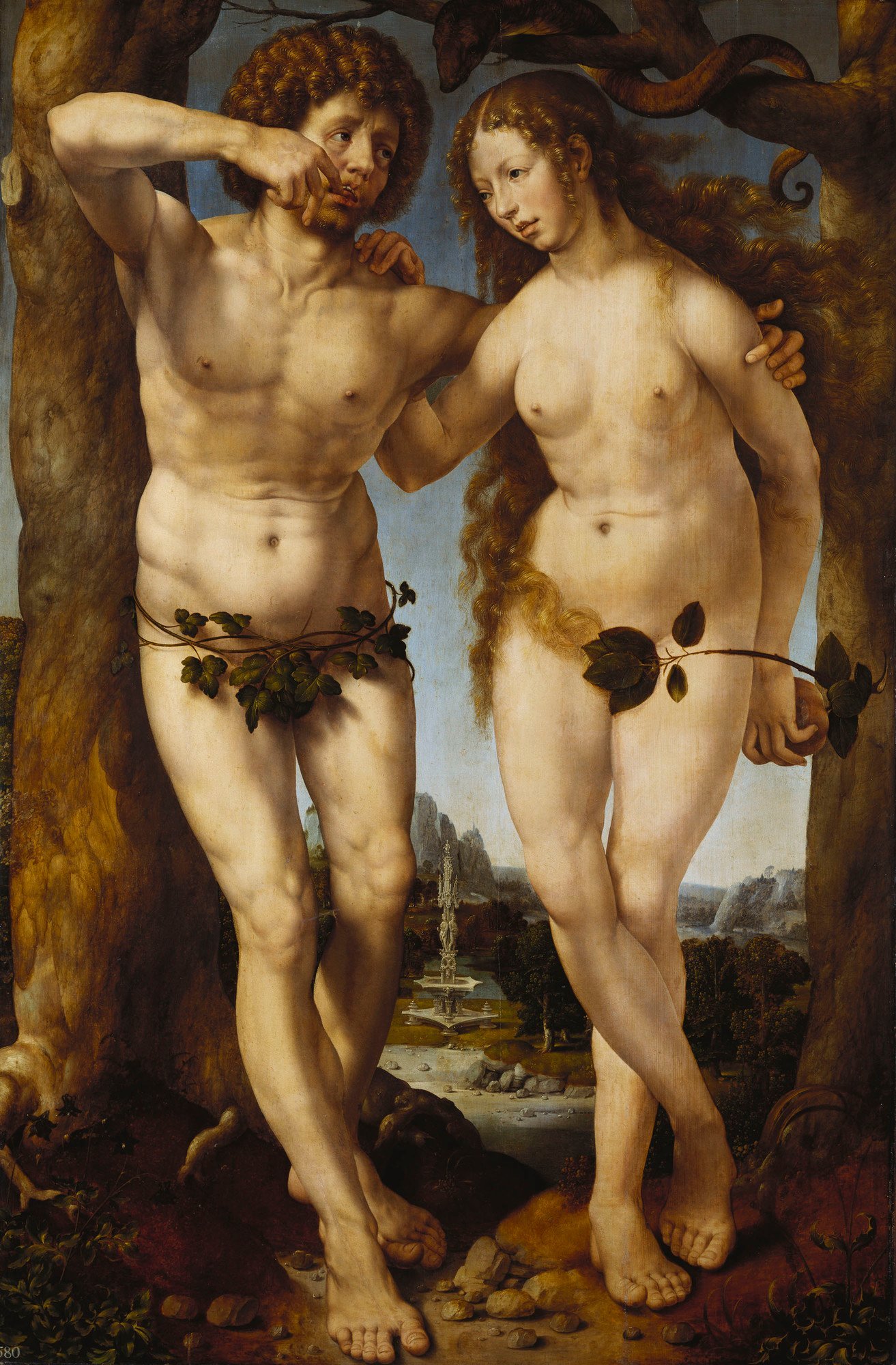
On the Fifth Day, he created Man. Male and female created He them, in His Own Image created He them.

Or, after another way: the Lord God formed man of dust from the ground, and breathed into his nostrils the breath of life; and man became a living being. And later, the Lord God caused a deep sleep to fall upon the man, and while he slept took one of his ribs and closed up its place with flesh; and the rib which the Lord God had taken from the man he made into a woman and brought her to the man.

***

Now, as we know, all visible and sensible things are shaped and governed by the invisible and eternal Ideas. In the Book of Genesis we learn of the creation of the Idea of Man. Now by the male is signified the Nous, and by the Female, the Psyche. By the image of God, the presence within Man of the Divine Monad.

The Man and the Woman are not two individuals, but one, the archetypal Human Being. Each person has within him Adam, and Eve, and the Image of God.

***

Now the serpent was more subtle than any other wild creature that the Lord God had made. He said to the woman, “Did God say, ‘You shall not eat of any tree of the garden’?” And the woman said to the serpent, “We may eat of the fruit of the trees of the garden; but God said, ‘You shall not eat of the fruit of the tree which is in the midst of the garden, neither shall you touch it, lest you die.’” But the serpent said to the woman, “You will not die. For God knows that when you eat of it your eyes will be opened, and you will be like God, knowing good and evil.” So when the woman saw that the tree was good for food, and that it was a delight to the eyes, and that the tree was to be desired to make one wise, she took of its fruit and ate; and she also gave some to her husband, and he ate. Then the eyes of both were opened, and they knew that they were naked; and they sewed fig leaves together and made themselves aprons.

***

The serpent is the desiring part or appetite, and it now turns toward the material creation. This is why it is said that the tree is "good for food" and a "delight to the eyes." And the serpent which sheds its skin and goes through the Earth is the image of the life lived according to generation. Thus the soul turns toward its lower parts, the appetites, which border on materiality. It then draws after it the nous. Every part is now drawn into material creation. The Human Being, formerly altogether spiritual, now "makes itself an apron," which is to say, it clothes itself in a material body. Soon, God himself will create for them garments of skins. This completes the process of the descent into Matter.

And the fruit of the Tree will indeed make one wise. But that comes later.


***

Then the Lord God said, “Behold, the man has become like one of us, knowing good and evil; and now, lest he put forth his hand and take also of the tree of life, and eat, and live for ever”— therefore the Lord God sent him forth from the garden of Eden, to till the ground from which he was taken. He drove out the man; and at the east of the garden of Eden he placed the cherubim, and a flaming sword which turned every way, to guard the way to the tree of life.

***

It is said that, at this time, Sin and Death entered the world. In ancient writing and iconography these are proper nouns, names. It could as well be said that the Human Being, Adam-Eve, enters the World of Sin and Death. By sin is signified karma, actions which bind us to matter. By Death is signified death as we commonly understand it, but two other things. The first is Death Himself, or Hades. The second is the underworld over which Hades presides, which is also called Hades. In early Christian writings and to this day in the Eastern Church, "Hell" and "Hades" are distinct, and so are Death and Lucifer. Entering into the world of Sin, mankind is subject unto Hades, the ruler of the world of the Dead.

Here is the secret teaching, which was at the heart of the Mysteries of Eleusis:

We are all, already in the world of the Dead.

The descent into Hades is also the descent into the material body. The soil wherein the dead are buried is the Mineral Kingdom, the kingdom of raw matter, whose ruler is Death. When we depart our bodies at Death our spirits abide for a time as ghosts in the Underworld, and then return to material bodies, again and again and again. Soma is sema: The body itself is the tomb. This will go on until we can become free. But how? Let us return to our story.

***
On Earth, ages pass, and many generations are begotten. Abraham was the father of Isaac, and Isaac the father of Jacob, and Jacob the father of Judah and his brothers, and Judah the father of Perez and Zerah by Tamar, and Perez the father of Hezron, and Hezron the father of Ram, and Ram the father of Ammin′adab, and Ammin′adab the father of Nahshon, and Nahshon the father of Salmon, and Salmon the father of Bo′az by Rahab, and Bo′az the father of Obed by Ruth, and Obed the father of Jesse, and Jesse the father of David the king.
And David was the father of Solomon by the wife of Uri′ah and Solomon the father of Rehobo′am, and Rehobo′am the father of Abi′jah, and Abi′jah the father of Asa, and Asa the father of Jehosh′aphat, and Jehosh′aphat the father of Joram, and Joram the father of Uzzi′ah, 9 and Uzzi′ah the father of Jotham, and Jotham the father of Ahaz, and Ahaz the father of Hezeki′ah, and Hezeki′ah the father of Manas′seh, and Manas′seh the father of Amos, and Amos the father of Josi′ah, and Josi′ah the father of Jechoni′ah and his brothers, at the time of the deportation to Babylon.
And after the deportation to Babylon: Jechoni′ah was the father of She-al′ti-el, and She-al′ti-el the father of Zerub′babel, and Zerub′babel the father of Abi′ud, and Abi′ud the father of Eli′akim, and Eli′akim the father of Azor, and Azor the father of Zadok, and Zadok the father of Achim, and Achim the father of Eli′ud, and Eli′ud the father of Elea′zar, and Elea′zar the father of Matthan, and Matthan the father of Jacob, and Jacob the father of Joseph the husband of Mary, of whom Jesus was born, who is called Christ.

***

In the genealogy is, perhaps, signified a literal genealogy, or perhaps not. Its inner meaning is the cycle of reincarnation. Abraham begins the process by assent to Divine Commandment. In his willingness to give Isaac to God is signified the turning of the soul toward spiritual things; in God's freeing of Isaac, the beginning of the end of subjection to the rule of Death. In the genealogy that follows we see the long cycle of reincarnation that continues from the beginning of a spiritual journey to its culmination. Abraham is Adam, or a participant in the Human Idea which is called Adam-Eve and sometimes, in Cabbalistic writings, Adam Cadmon.

***

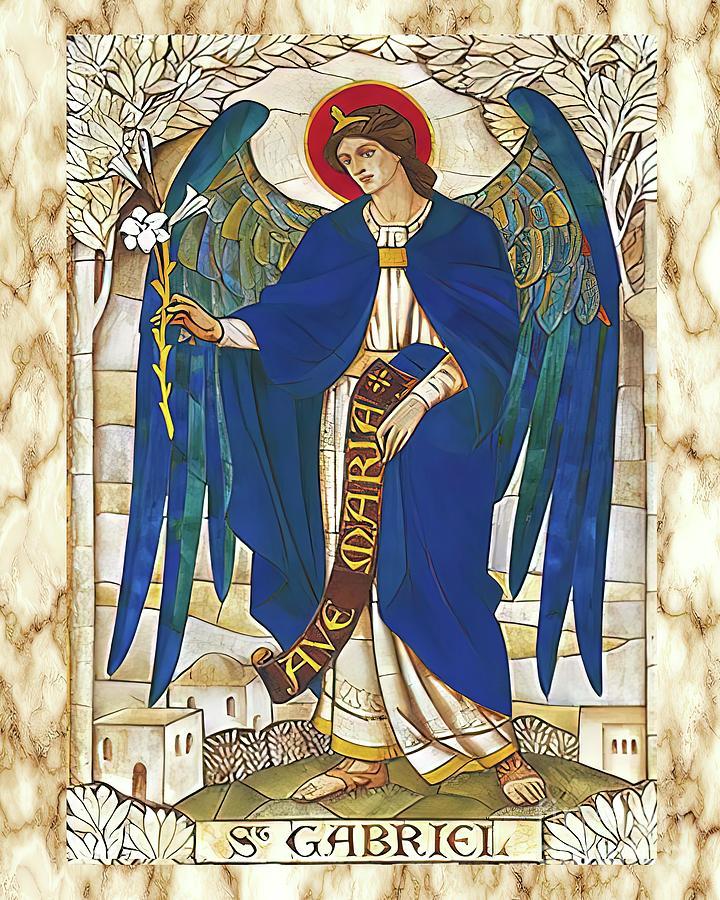
And in the sixth month, the angel Gabriel was sent from God into a city of Galilee, called Nazareth,
To a virgin espoused to a man whose name was Joseph, of the house of David; and the virgin's name was Mary.
And the angel being come in, said unto her: Hail, full of grace, the Lord is with thee: blessed art thou among women.
Who having heard, was troubled at his saying, and thought with herself what manner of salutation this should be.
And the angel said to her: Fear not, Mary, for thou hast found grace with God.
Behold thou shalt conceive in thy womb, and shalt bring forth a son; and thou shalt call his name Jesus.

He shall be great, and shall be called the Son of the most High; and the Lord God shall give unto him the throne of David his father; and he shall reign in the house of Jacob for ever.
And of his kingdom there shall be no end.
And Mary said to the angel: How shall this be done, because I know not man?
And the angel answering, said to her: The Holy Ghost shall come upon thee, and the power of the most High shall overshadow thee. And therefore also the Holy which shall be born of thee shall be called the Son of God.

***


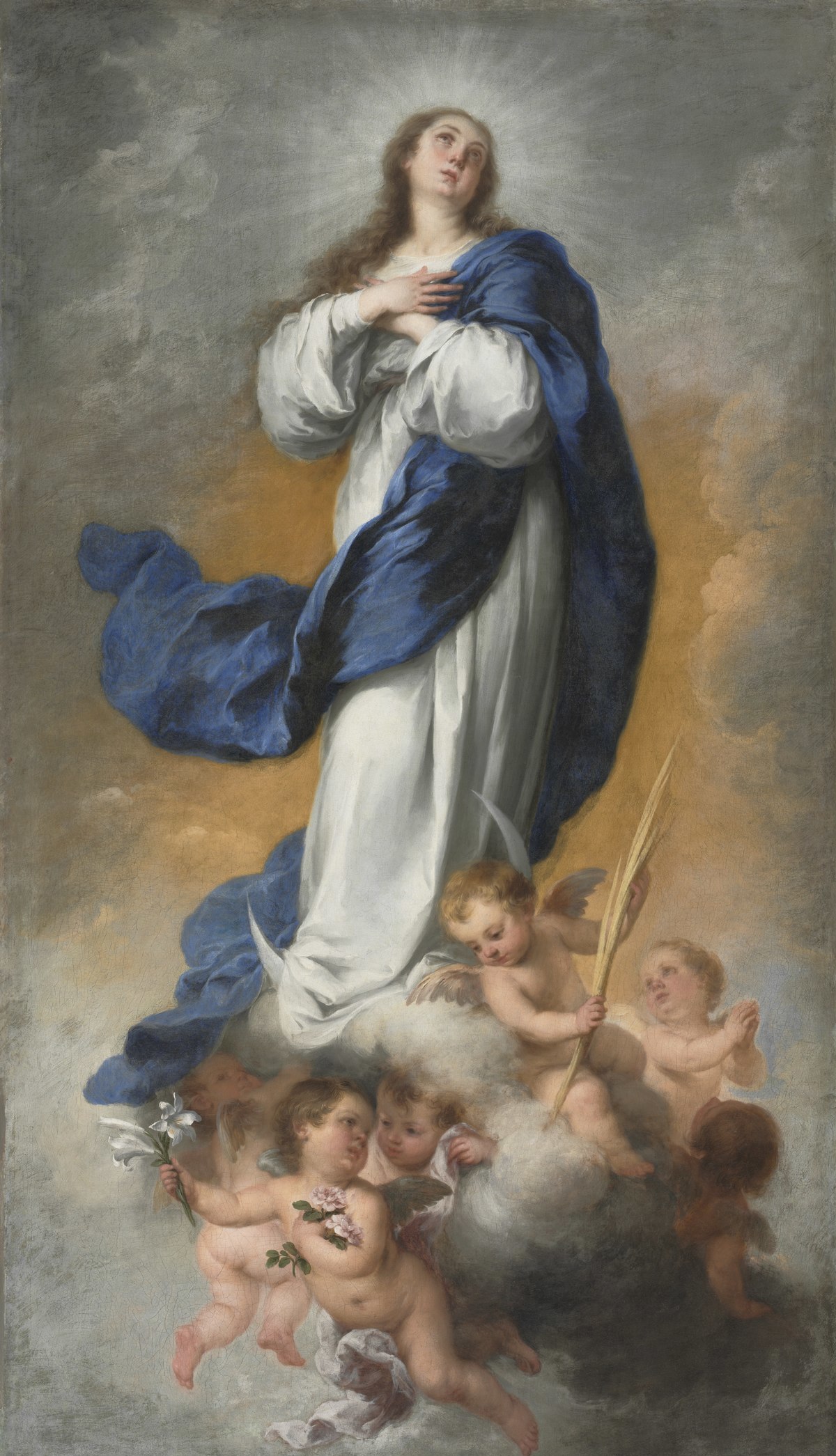
Mary is called: Immaculate Conception, Model for Christians, Virgin Pure, Mother of God, the New Eve.

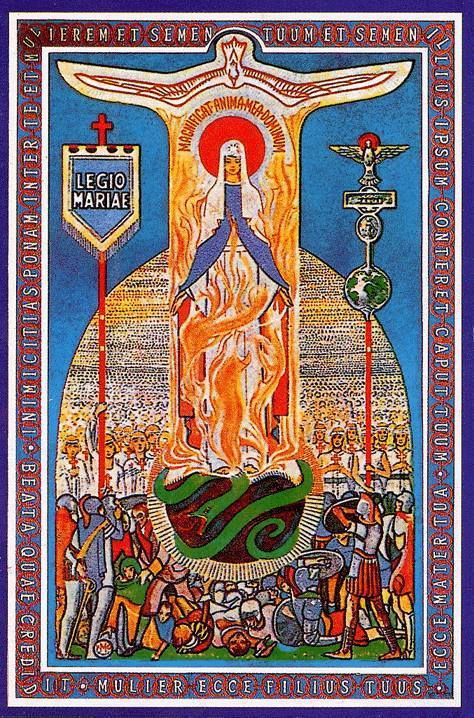
By the New Eve we understand that Mary is Eve, and the complete Human Being is called Adam-Eve, and is also called Mary-Jesus. The journey from Adam-Eve to Mary-Jesus through the stories of kingship, exile, conquest and redemption found in the Old Testament is the archetype of the journey of the human soul. This is why she is "model for Christians." Turning toward matter, it descends into matter. Assenting to Divine Command, it begins its conquest of matter. Purified and divinized, it is born free of karma. It now "gives birth" to the Christ, which is to the Nous, the higher part of the spirit which is above soul. This is why she is called "virgin," because she signifies the soul which has turned its gaze away from the things of generation in the material creation and toward the eternal things of the noetic and divine realms.

As Mary is the New Eve, Jesus is the New Adam. As Eve is born of Adam's rib, Jesus is born of Mary's womb. Neither has a second parent. Eve is called "Wife of Adam" to signify that Adam-Eve represents the soul in its downward journey into materiality. But Jesus is called "Son of Mary" to signify that here the soul is on its upward journey, away from generation.

***

Now Jesus is born. He is born in a manger, with animals; and this is also called a cave. By the cave is signified the material order, and his birth there signifies the beginning of the return journey from the material creation to the spiritual order. By the animals it is signified that the soul which descends into matter descends at least as far as the level of the beasts, though some say lower. In ancient times, it was said that animals could speak at midnight on Christmas; this is to signify that the noetic power is present in the animal creation as well, and the animals are also on the Journey of Return.

Later, Jesus, which is to say, the awakened Nous in the Human Being, will return to the Garden, which is now called Gethsemene. And he will ascend the Tree of Life, which is the Cross. Descending, he will break open the doors of Hades, which is to say, he will model and become the Journey of Return, so that all who follow after Him may no longer die. But that isn't for a little while yet.


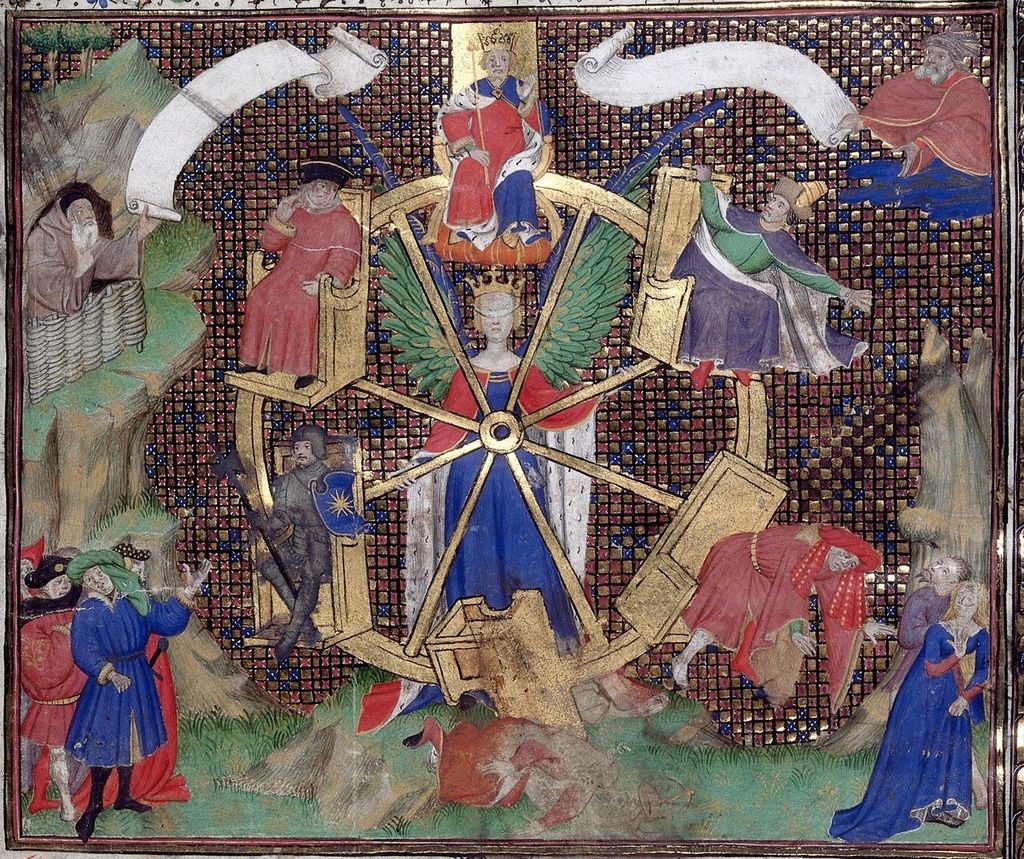
Fortune's Wheel

I've been avoiding discussing astrology for a while, because I found that I was often skipping over charts, like that for Summer 2022, that basically said "Things will be fine for a little while" but focusing on negative charts, such as that for the Fall Equinox just past. In fact that's why I didn't do a post for that particular Equinox; I find that sort of astrological ambulance-chasing unseemly and was annoyed with myself for engaging in it.

That's a preface by way of saying: The subject of this post is tomorrow's Lunar Eclipse. All eclipses are negative indicators in mundane astrology, and this one's a doozy.

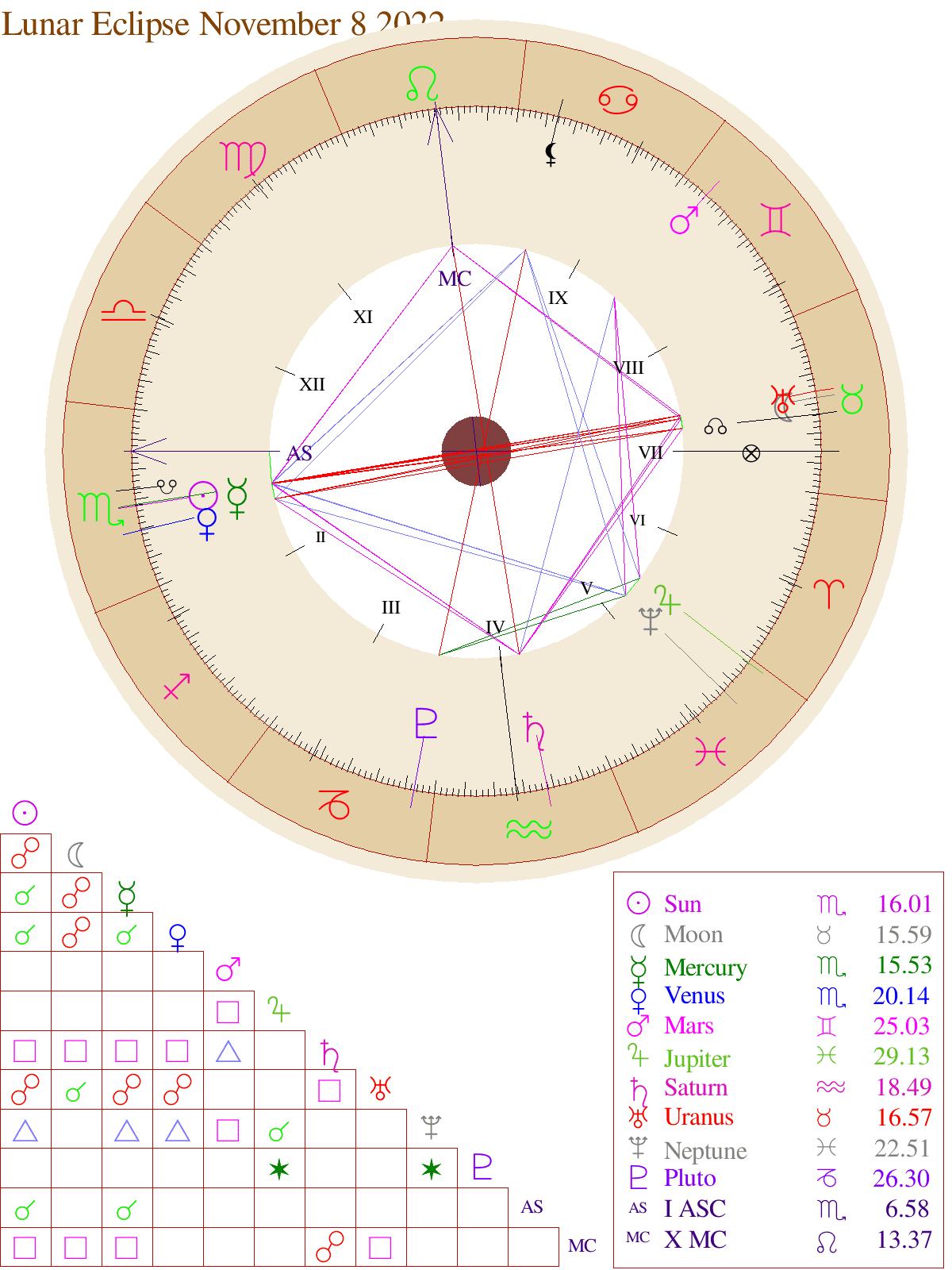
What I'd like to do in this post is share the Eclipse chart and an interpretation of it, and then talk about what I think it means and what we can do about it.


The Eclipse

Every eclipse is a malefic indicator, the equivalent of a curse being pronounced in the Heavens. Its effects are most prominently felt in those areas in which the eclipse is visible; in this case that includes North America. (That eclipses occur so regularly may be taken as a commentary on the nature of life on Earth.)

The primary subject of an Eclipse Chart is, naturally enough, the luminary which is being eclipsed-- the Moon, in this case. We therefore begin by looking at the Moon's placement, dignities and aspects; this will tell us much of the information the chart has to convey.

We find the Moon in the Seventh House, in the sign of Taurus. The Seventh House rules foreign nations, foreign affairs, and war, and an eclipse in this House indicates trouble in all of these areas. Issues related to foreign conflict will come to the foreground. The sign of Taurus relates to Earth and its produce and to the economy and material goods. 

Right off the bat, we have an indication of trouble in foreign affairs affecting the economy and, quite possibly, food supplies, especially grain. In my way of looking at astrology, Taurus is especially the sign of Ceres, the agricultural goddess who rules wheat fields. When I said that, did you think "Ukrainian grain exports?" So did I. Whether it's that or some other area, the war in Ukraine is likely to cause serious trouble to the material well-being of the United States, moreso than it already has.

The Eclipse is conjunct Uranus. Uranus is a malefic planet, ruling chaos, revolution, and explosive change. Taurus is the sign of Uranus's Fall; in this sign he is at his most destructive. The suggestion is that whatever economic trouble comes out of this eclipse may be precipitated by a sudden, explosive event. Did you think "Retaliation for the sabotage of the Nordstream pipelines?" So did I. Did you think "Chinese invasion of Taiwan?" I thought that too. 

The conjunction to Uranus is just one of the Moon's aspects; let's discuss the others.

The T-Square

When two planets oppose one another, and both also make a square aspect (that is, a right angle) to some third planet, a larger aspect called a T-Square is formed. The opposition and the square are both aspects of conflict. In a T-Square, a 3-sided conflict is calling out for a forth side to create balance, but the forth side is unavailable. The whole thing collapses, like a table with one of the legs removed. In our T-Square, all of the following planets are involved:

The Sun
Mercury
Venus
Saturn
The Moon
Uranus
Mars

Yes, that's most of the sky. Or, to say it another way, most of the Visible Mundane Gods whose activities govern life below the sphere of the Moon. Let's take them one group at a time.

The Sun is in the First House, in the sign of Scorpio. Scorpio is the sign of Mars, the god of war. The First House represents the people as a whole; Scorpio is a sign of conflict, disease, and death. The Sun in the First House, afflicted by square to Saturn and opposition to Uranus and the Moon, suggests open conflict between the people and their leaders, and their head of state in particular. The Sun is conjunct Mercury and Venus, which is harmful for those planets, though the Sun benefits. Mercury represents the news media and the "chattering classes" generally; Venus represents the arts and entertainment industries. Together with the Sun, they suggest the coalition of entertainment, academic and media industries that have marched in lockstep behind the Biden administration. As I said, the conjunction to the Sun is a harmful aspect called "combustion"; a planet afflicted by combustion functions as though it were blinded by the Sun's rays. The Administration attempts to dominate its lackeys in the various TV, internet, and education related sectors; these go along, as they're unable to see clearly. 

Rotating the chart 90 degrees, we come to the second pole of the T-Square. This is a single planet: Saturn. Saturn was traditionally known as the Great Malefic. He rules restriction, limitation, conservatism and tradition, poverty, time, and death. In this chart he is in the Fourth House, in Aquarius. The Fourth House is particularly important as it rules the party currently out of power-- as of this writing, the Republican Party. It also rules agriculture, mining, and the rural areas of the country generally-- or to say it another way, "flyover country." Saturn is retrograde, suggesting a Return movement. He is in conflict with the coalition represented by the Sun, Venus, and Mercury. Saturn clearly represents the Republican Party and, in particular, its populist wing, attempting a return to power. 

It's worth noting that Saturn is in Aquarius. In modern Astrology, Aquarius is Uranus's sign; it shares Uranus's symbols of individualism and going one's own way. Here we have the interesting paradox that the power which represents conservatism also represents rebellion and individual freedom; more on this in a moment. 

The third pole of the T-Square we've already had a chance to consider. By itself, the Moon represents the people, and, specifically, that part of the people with the ability to participate in politics. This class-- call them the political class-- are represented here by the conjunction of the Moon and Uranus. It's worth noting that Uranus also rules sexual minorities, and the Moon represents women and women's issues; Uranus conjunct Moon suggests both the Feminist movement and the Rainbow coalition. 

Mars is also involved in the T-Square, in two ways. First and obviously, he is trine Uranus. Mars is the planet of war and conflict, and here he is lending his fiery energy to Saturn, representing the rising conservative movement in conflict with the Establishment. 

Mars also is in mutual reception with Mercury. "Mutual reception" is a condition in which two planets occupy each other's signs. In this case, Mercury is in Mars's sign of Scorpio, while Mars is in Mercury's sign of Gemini. The suggestion is that there is a hidden link between the two planets. In effect, they can be said to occupy one another's positions and possess one another's dignities. Saturn-- the conservative Populist movement-- can also be seen to be aided by a Mercury-- that is, a coalition of academics and media personalities-- of his own, though this is still smaller and "underground" compared to the visible Mercury, which is loyal to Biden. Biden, meanwhile, also has a Mars on his side, and a hidden Mars at that. Of the two signs that Mars governs, Scorpio is the more subtle, deceptive, and cruel; Aries represents open and honorable conflict, Scorpio hidden, secretive and destructive conflict. 

It should be noted that Mercury also rules thieves and liars; each side has these as well. Moreover, in my own experience Gemini and Scorpio are the two most difficult signs in the Zodiac. 

The Saturn-Uranus Square

Another critical thing to note about this Eclipse is the direct involvement of the Saturn-Uranus square. This aspect has been the primary astrological indicator and symbol of the chaos of the last few years. 

Saturn represents: Stability, conservatism, restriction, limitation, order, patience, wisdom

Uranus represents: Chaos, radicalism, sudden change, revolution, expansive growth, technology

The square aspect between these planets represents the conflict between these two archetypes, which we've seen play out over and over again in the last few years. It's interesting to note that Saturn is in Aquarius, which is, in modern Astrology, the sign Uranus rules; Saturn is acting Uranian, in a certain sense. Meanwhile, though Uranus is not in a sign of Saturn, it is in Taurus, which shares much of Saturn's symbolism as it also relates to Earth and to fixed conditions. Thus we have these odd reversals that have also dominated public life during this time, with liberals demanding censorship, quarantines, and restrictions on movement, and conservatives demanding liberty and flouting authority. 

The Saturn-Uranus conflict, and the weird reversed symbols that come with it, is also represented by the conflict between the United States and Russia. Russia is conservative and naturally collectivistic, not to mention cold; these are Saturnian symbols. But we see Russia acting as a Uranian force, pushing the breakdown of a world order which has grown rigid and inflexible. America, meanwhile, is the world's great Uranian power; a revolutionary society whose best-known characteristics include individualism and technological innovation. And yet America now stands in a Saturnian role viz-a-viz Russia and the world as a whole, as it pours endless billions of dollars into maintaining an old and probably outworn system of global power. 

The First House

It remains to take note of the First House-- which is usually also the first thing we consider when looking at a mundane chart, but this is a special circumstance. The First House and its ruling planet rule the chart as a whole. 

Here, as we have seen, the First House is in Scorpio, which is ruled by Mars. 

Mars, in this chart, is in Gemini, in the Eighth House. But in another sense he is here in his own sign of Scorpio, gaining power by his presence in his own sign and in the First House, but afflicted by all the trouble that comes with the T-Square. Mars in the First House represents-- here I quote H.S. Greene-- "a martial and aggressive spirit both in home and foreign affairs, with rumors of war or actual war, strikes, riots, murders, fires, assaults, ill-health and death from martial diseases." Mars in the Eighth House, meanwhile, represents death by violence, and the deaths of those ruled by Mars-- especially soldiers. Either one or both are possible. 

Mars makes two other aspects, squares to both Jupiter and Neptune. Jupiter and Neptune are conjunct one another and retrograde in Pisces in the Fifth House. Pisces as a sign is ruled by Neptune in modern Astrology, but was Jupiter's traditionally. Both Neptune and Jupiter relate to religion, and Pisces is the especial sign of Christianity; the Fifth House relates to children, child-rearing and early education. Jupiter is also the natural ruler of the economy, and doubly so as in this chart he rules the Second House of natural wealth, while Neptune rules the mass political movements of the modern world, especially socialism and its variants, but potentially also Populism. Neptune also rules delusion, illusion, and insanity. 

Expect serious fights to continue over transgender and other Rainbow issues, as well as Critical Race Theory, in the classroom. Church and religious motives will be involved-- as we already know. Jupiter and Neptune are both retrograde, which is a debility suggesting backward movement. In Economic turns, that probably means re-cession. In education, the news may be better-- although Neptune is afflicted by Mars, it is the only planet in this chart that has much dignity, being in the sign that it rules, conjunct benefic Jupiter, and trine the Sun, Mercury, and Venus. A re-turn of sanity to the classroom is very possible.  

Duration

It remains to note the duration of the Eclipse. Raphael has it that the effects of a lunar eclipse will endure for as many months as the Eclipse is visible; in this case, that means around five months, taking us through April of next year. Surprises can come at any time during this period. The location of the Eclipse in a fixed sign (Taurus) tells us that the consequences will endure long after this period, and the element (Earth) tells us that these effects will make themselves known in a big way in daily life and economic affairs. 

In Summary

At the end of the day, is this anything you didn't know? The United States is sliding toward a major crisis. The election is the beginning. Trouble will manifest both in foreign and domestic affairs; each will reflect the other. My hope is that we won't see a return of the rioting and violence of 2020 after the upcoming election, but we very well might, if we see a "red wave." Abortion and, er, "gender affirming care" seem to be the hills that the Democratic Party wants to die on, and it's looking like they're going to get their wish; more particularly, it's looking like these may be the excuses for the next round of "riots, murders, fires and assaults," as H.S. Greene put it, or "mostly peaceful protests" as CNN would say. 

Moreover, we can expect internal conflicts to be mirrored by conflicts abroad. What that will mean is uncertain, but only because there are so many things that could go wrong. It's already looking like China might move against Taiwan this year, and a US even more split internally might give it the opportunity; Russia may pull off a decisive winter offensive in Ukraine; US and Russian forces might engage in direct combat, with consequences I shudder to even consider; all of these may occur against a backdrop of rioting and civil conflict. The details are unknown and unknowable until we meet them; the pattern is one of strife at home and abroad, each feeding into the other.  

The House of Atreus

Have you ever read the trilogy of plays by the Aeschylus, that goes under the name Oresteia, or House of Atreus? In case you haven't, here is a quick summary. 

In Episode 1, Agamemnon, leader of the Greek armies, returns home from Troy triumphant, but his victory is tainted by his having sacrificed his daughter to Artemis to ensure victory. He is immediately murdered by his wife, who rules the land as a vicious tyrant with her lover Aegisthus at her side. 

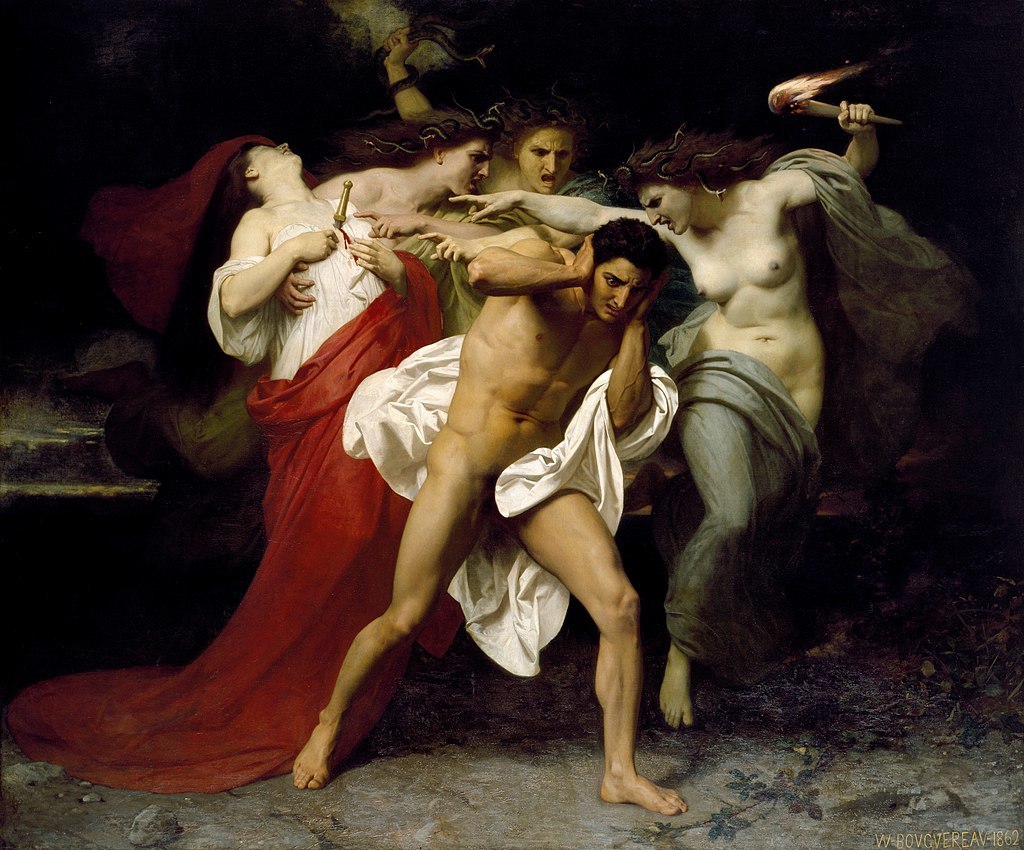
In Episode 2, Orestes, the son of Agamemnon, returns home and kills his father's murderers, including his own mother-- but with the immediate consequence that the gates of Hell burst open and the Furies descend upon him. "See, they swarm and throng-- black blood of hatred dripping from their eyes!"

In Episode 3, Orestes has been hounded throughout the land by the Furies, in payment for his matricide. He finally finds his way to Athens, and takes refuge at the shrine of Athena. With Apollo at his side, Orestes and the Furies each plead their case before the goddess, and judgment is given by a jury of twelve Athenians, with Athena herself as tie-breaker. Echoing an earlier statement by the Furies themselves, Athena instructs the jury to act according to this standard:

"Let no man live uncurbed by law nor curbed by tyranny."

In the end, Orestes is acquitted. With Apollo, he returns to Argos, pledging peace between his nation and Athens.

It's my view that we in the United States are in a situation similar to that recounted by Aeschylus-- who was himself an initiate of the Mysteries, it's worth remembering. One party, itself already tainted by sin, and another takes power, only to reap the reward of its own misdeeds. Back and forth it goes.

I believe that, for Agamemnon, we may read the old Republican coalition, which included most of rural white America. Like Agamemnon, these are the people who reaped the karmic whirlwind for their support of the evils of the old guard, especially the Bush Administration. Notice that the "opioid crisis," anti-white racism in the schools, forced masking and so on especially target and apply to the people who were most likely to have said "Strongly Support" when asked the question "How do you feel about President Bush's invasion of Iraq?" in 2004.

For Clytemnestra, we have the Democratic Party, with its tyrannical female and feminized leaders, who govern now uncurbed by law. In Clytemnestra you see an embodiment of what's been called the "Devouring Mother" archetype-- the form of female leadership that rules by restriction and surveillance, fear and guilt, and above all, refusal to allow its charges to grow.

But who is Orestes, and where are we in the cycle? Was it Trump's slaying of Hillary Clinton that unleashed the Furies-- those hideous female demons-- from Hell, who now hound Trump and his supporters throughout the land? Or is it the case-- and this is what I suspect-- that Trump is, in effect, our Agamemnon, and we are still under the rule of Clytemnestra (Kamalytemnestra), waiting for an Orestes to take the guilt of matricide and the horror of Hell upon himself in order to free the nation from the curse? 
 
If you return to the chart above, you'll see that the resolution of the T-Square is found in the Tenth House, in the Sign of Leo. The Tenth House is the House of the Executive Branch of government; this shows us that resolution to the crisis isn't coming until we have a new leader in the White House-- and so, not until 2024 at the very earliest. Leo is the especial sign of kingship. Moreover, Leo represents charismatic authority, the kind of powerful individual that gathers others around him and bends them to his will. (It's worth noting that the time that Plato assigns to the era of Atlantis, when he says that human kingdoms were ruled directly by divine spirits, corresponds to the Age of Leo astrologically.) We are, in other words, awaiting our next American King-- we get these roughly once every 80-90 year, you know; they have names like "Roosevelt," "Lincoln," and "Washington." The work of the American King is to destroy the previous order and set the new one in place, and then to step aside or, more often, die. The new order then endures for another 4 generations or so, before it become corrupt and stale and must be overthrown in its turn. 

So here is my prophecy: When a leader emerges who can, like Orestes, slay the Devouring Mother, face the Furies, and plead his case before the people, then we will see the end of this period of crisis and restoration of a new American justice. Who will it be? Donald Trump? It's possible. But it may well be a complete unknown. In the meantime, we must be prepared to face a time of crisis.
Rushing to work today to make an 11:30 appointment, I looked down at my phone to make sure I had the time correct and discovered that the appointment had been canceled sometime between the time I left the house and that moment. And, looking at my phone, I managed to miss my exit, and drove some 20 more minutes into the mountains of Western Virginia before realizing what I had done. I now find myself sitting at a coffeeshop in a place called Purcellville, with several hours to kill, or to use.

And so I'd like to take the opportunity to discuss something that's frequently on my mind, which is the question of how we ought to read Plato's political writings, and what relevance they have to our modern politics. 

Plato and Politics

Modern treatments of Plato very often take him as some sort of weird old politician. In College I was forced to read the Crito in a Political Philosophy class, and told nothing of its author except that he was very old and very dead, but that we ought to know something about what he had thought on political topics merely as a way of saying "People have been talking about these matters for some time now."

Plato does indeed discuss politics-- or, rather, law-- in the Crito, but he treats of political matters much more fully in the Republic, the Statesman, and the Laws, three dialogues which come out to nearly 700 pages between them. As my own copy of the Complete Works of Plato comes out to around 1700 pages, these 3 dialogues between them make up some 40% of the entire body of Plato's work. Since Platonism has become so central to my thinking and to what I'm trying to do with this blog and my work in general, I thought it was worth spending some time on this issue. 

In this post, I'd like to give an overview of Plato's political views, discuss how we ought to approach Plato's politics and what relevance they have to our approach to Platonism as a spiritual discipline, and, finally, to see whether Platonic politics has any relevance to our modern world. 

Before we do that, though, it is critical that we understand what "politics" means in Plato's world.

The Polis

The word "politics," as you probably know, is derived from "polis," which is the ancient Greek word for a city. And, as you probably also know, the Greek world was composed of city-states, which were countries so small they were limited to a single city. This is what I was taught, at any rate, and if you know any better than this you're further along than I was just a short while ago. 

It is true that the political unit Plato was discussing was the polis and it is true that the polis is a city and that the reach of a particular government in ancient Greece did not extend beyond the reach of a particular polis. But matters are not as simple as that. The polis, you see, is not simply a smaller version of one of our modern states, nor is the government of a polis the equivalent to the US Congress on a smaller scale, or to the government of the town in which you live. The polis is not merely a smaller thing than the things that we have, it is a different kind of thing altogether.

The best book on this subject is The Ancient City, by a Frenchman named Fustel Coulanges; you ought to read the whole thing when you have a moment. In The Ancient City, Coulanges shows that, in the "cities" of the ancient world, the categories of human life that we currently separate under the headings "family" "religion" and "government" were not separate, but were a single category of experience called "the city" or "politics." 

To illustrate how such a thing is possible, let's think about it in reverse. In our society, the life-categories "marriage" "child-rearing" and "residence" are combined under the single heading, "family." A "family" consists, ideally, of a married couple, sharing a home, and raising their children. To us, nothing in the world could be more natural; even where this system breaks down, it is still there in the background as something which is missed. 

Imagine if we separated these things. Imagine a society in which husbands and wives don't live together-- the men live together with their friends and brothers in a dormitory or fraternity house, while the women have their own sorority, along with the youngest children. It's not that they don't get married-- they do. Husbands and wives go on dates and spend time together and sneak off into out of the way corners of town when they need some adult time. But they don't share a bed, and they don't share a house. And they don't raise children together-- the babies and young girls live with their mothers, yes, but men don't even raise their own sons. Instead, they raise their sisters' sons. When boys come of age, they are sent to live in their uncle's fraternity house, which is invariably in another city, since women move to a sorority house attached to their husband's fraternity, and it's considered somewhat incestuous to marry a girl from your home town. If a boy lacks an uncle, a suitable male relative is found for him, back in the mother's hometown-- but never his father.

Does that sound odd, or impossible? In fact, it's a very common social arrangement among certain tribes of the New Guinea highlands. So yes, it's very possible. 

Now let us suppose that a similar living arrangement is found among our own descendants living right here in America sometime around the year 4500. Categories of life that seem to us to be obviously connected seem to them to be completely separate. Moreover, just as we pride ourselves on having separated the categories of "religion" and "government"-- and both from "family"-- much of their identity as a people and a culture revolves around their having had the wisdom to separate residence from marriage and marriage from child-rearing.

Given such a set of circumstances, what would our descendants make of a modern philosopher who wrote at length about spiritual issues, but regularly connected them with the family-- an institution which they either no longer had, or no longer had in the same form? If a modern philosopher-- I give no examples as I don't know that there is one-- wrote several books of detailed advice on household-management, describing the proper roles of father, mother, and children, but also filled them with detailed discussions and hints and allegories of a grand and universal spiritual system, what could these descendants of ours do with it? Dismiss it out of hand? If so they would lose an enormous contribution to human wisdom and human excellence, as well as (let us imagine) the root of many of their own ideas. But if they attempted to adopt our philosopher's recommendations as far as household management whole-cloth, they would need to burn their own civilization to the ground and start again from scratch. And even if they managed it-- as they probably wouldn't-- it would be at the cost of an enormous amount of suffering and death. And they probably wouldn't manage it; they'd probably just get a lot of people killed. 

This, I argue, is precisely the position that we are in with regard to Plato's political writings. The polis that he wrote of does not exist, and the concepts that applied to it cannot be applied to our modern governments, as modern government-- this is critical-- is not the heir to the polis

The Fire, the House, and the King

Let's go back and discuss ancient society, drawing, again, on Coulanges.

The basic unit of that society is the fireplace

The fireplace? How is that possible?

In the ancient world the fire was-- as it still is today in India-- the living body of a god, or-- in the West-- a goddess, named Vesta at Rome and Hestia in Greece. Fire is a living being, and the fireplace-- the sacred hearth-- is a sacred altar. Every home has its fire, and lacking its fire, it is no home at all. The father, as head of the family, is also the high-priest of the religion of the hearth-fire. At the fire-- tended by his wife, the priestess-- the sacrifices are made every day to the spirits of the ancestors, the land on which the family lives, and the home in which they dwell. Sacrifices are made, too, to be sure, to the high gods and heroic ancestors that the family shares with its neighbors and its community as a whole, but at the microscopic level, each household is essentially a church and each family has its own, independent religion. 

And each family is also a kind of political unit, with the father as its king. 

In The Statesman, Plato discusses the nature of what he calls the True King, which is a leader who possesses the Science of Rulership. It's worth noting that, in the school of Iamblichus, The Statesman was read after The Sophist but before Philebus. In The Sophist, Plato discusses the nature of charlatan-philosophers called sophists, but the later Platonists understood him to also be discussing a being called the "Sublunar Demiurge," who is the trickster-god that creates the world that we experience with our senses, the exact equivalent of the Hindu Maya. The Philebus, meanwhile, is a discussion of the nature of the Good, which is the First God and Highest Principle. The Statesman must, therefore, also be understood as a dialogue about the nature of God Himself-- that is, the God that creates and governs the cosmos as a whole. 

In the Statesman, Plato is explicit about the relationship between rulership of a city and rule of a household:


Stranger: Are we, then, to regard the statesman, the king, the slavemaster, and the master of a household as essentially one though we use all these names for them, or shall we say that four distinct sciences exist, each of them corresponding to one of the four titles?

....

Stranger: The science possessed by the True King is the Science of Kingship?

Socrates: Yes.

Stranger: The possessor of this science, then, whether he is in fact in power or has only the status of a private citizen, will properly be called a "statesman" since his knowledge of the art qualifies him for the title whatever his circumstances. 

Socrates: Yes, he is undoubtedly entitled to that name.

Stranger: Then consider a further point. The slavemaster and the master of a household are identical.

Socrates: YEs.

Stranger: Furthermore is there much difference between a large household organization and a small-sized city, so far as the exercise of authority over it is concerned?

Socrates: None. 

Stranger: Well, then, our point is clearly made. Once science covers all these several spheres and we will not quarrel with a man who prefers any one of the particular names for it; he can call it royal science, political science, or science of household management. 

Layers of Meaning

All of Plato's dialogues were understood to have multiple layers of meaning. The Statesman is about the Science of political leadership, but it is also about how God rules the universe. The Republic, meanwhile, is supposedly a discussion of the ideal city, but Plato is explicit at the beginning of the dialogue that the city in quetsion is intended as an allegory of the soul:

 
Suppose [Here Socrates is speaking] that a short-sighted person had been asked by some one to read small letters from a distance; and it occurred to some one else that they might be found in another place which was larger and in which the letters were larger --if they were the same and he could read the larger letters first, and then proceed to the lesser --this would have been thought a rare piece of good fortune.
 
Very true, said Adeimantus; but how does the illustration apply to our enquiry?
 
I will tell you, I replied; justice, which is the subject of our enquiry, is, as you know, sometimes spoken of as the virtue of an individual, and sometimes as the virtue of a State.
 
True, he replied.
 
And is not a State larger than an individual?

It is.

Then in the larger the quantity of justice is likely to be larger and more easily discernible. I propose therefore that we enquire into the nature of justice and injustice, first as they appear in the State, and secondly in the individual, proceeding from the greater to the lesser and comparing them.

Summarizing

Let's summarize our argument before we proceed. Two major issues have emerged:

1. The polis of Plato is not a smaller form of a modern state. It is, rather, a different form of social organization, in which the categories of life that we currently separate under the headings "family," "religion," and "government" are combined. Plato's political arguments, therefore, cannot be applied to our current forms of government on a one to one basis.

2. Plato's political writings, like all of his writings, admit of more than one reading. What appears to be a discussion of an ideal ruler of a city can also be understood either as a description of God in his government of the universe, or as advice to the individual concerning the care of his own soul, which is regularly likened to a state with workers, soldiers, and leaders.

The Heir to the Polis

Let's consider the first issue. 

Given the foregoing, the questions become: Do Plato's political theories have any applicability to our modern world as political theories? And, if so, can they be understood as applying to government, or are there other structures or organizations which might better be understood as heirs to the ancient polis?

Now, to a real extent, this is where we leave the domain of Truth and enter into the realm of Opinion. There are no fixed answers to these questions, and certainly Plato himself could not have anticipated them and gives no explicit guidance concerning them. So the following can only be my own view of hte topic. 

That said, it's my view that Plato's writings on politics-- especially the three dialogues mentioned-- are very important, and very worth reading. But in a modern context, and perhaps especially in an American context, they have only minimal applicability to government as such. They work far better when applied to the lives of other heirs to the polis, including individuals and families, but also what are often called "civil society" organizations-- which can include anything from a church to a charity to a bowling league.

To illustrate what I mean, let's take another example from the Statesman, since it's currently open in front of me.

Toward the end of the dialogue, Plato describes the ways in which different virtues can be opposed to one another. Courage and Moderation, in particular, frequently come into conflict. Moreover, particular individuals often exhibit one personality type or the other, and these individuals then come into conflict. This leads to the ruin of hte state if individuals of either one type or hte other predominate. A state overrun by individuals of hte courageous type will be forever looking for conflicts with its neighbors, until it eventually antagonizes a larger power or a coalition of smaller powers and is overrun. A state dominated by the moderate type, meanwhile, will not fight even when it is necessary, and will soon find itself enslaved by its enemies. The wise statesman weaves together both types of individuals, so that they strengthen one another, allowing the state to fight or to make peace as necessary.

So far, this actually does seem like rather good advice as far as modern statecraft goes, even up to the level of global powers like the US and Russia. 

But in the next part, Plato strays well beyond what is possible for any modern government. Having described the sort of education that unites the moderate and courageous types as the "divine link" between them, he now sets out to describe how to link them on the human level:

Socrates: But what are these links and how can they be forged?

Stranger: They are forged by establishing intermarriage between the two types so that the children of the mixed marriages are so to speak shared between them and by restricting private arrangements for marrying off daughters. Most men make unsuitable matches from the point of view of the betting of children of the best type of character.

...

Stranger: The moderate natures look for a partner like themselves, and so far as they can, they choose their wives from women of the quiet type. When they have daughters to bestow in marriage, once again they look for this type of character in the prospective husband. The courageous class does just the same thing and looks for others of the same type. All this goes on, though both types should be doing exactly the opposite. 

Yes, he's arguing for exactly what we in the modern world call "eugenics," and which we know is a disaster in the hands of a government. 

But does that mean that it's bad advice?

Consider that what Plato is saying here is "Marry someone whose strengths balance your weaknesses." The exact same idea is found in Carl Jung under the heading "Animus and Anima." And note that Plato very explicitly does not say something like "Men are aggressive and should therefore look for passive women to find balance," as one might expect from some of our modern "conservatives." No-- he says "Any person can be of the more active or more passive type, and both are necessary for a society. In a good marriage, an active woman is balanced by a passive man, or an active man by a passive woman." To my mind, that's exceedingly good advice-- to individuals. From a spiritual perspective, it can also be described as balancing fire and water or yin and yang energies. 

As far as the Science of Kingship itself, this can be applied to any situation, from a political ruler to a church to a corporate boardroom. Anyone who has authority over any group of people, whether a nation or simply their own children, is a king, and can and should acquire and use the Science of Kingship. 

Concluding: Who Is Above The Law?

After all this, I have to tell you that the best way to come to understand Plato's political writings is simply to read them. The Republic, Statesman and Laws are fun to read and, if you practice it, great sources of themes for discursive meditation. While you read them, ask yourself: How can I apply these ideas to my own life? Not to the ancient world which no longer exists, much less to (God help us) reforming society according to some ideal image, but to becoming a True King over yourself above all, and in all those situations which call for the exercise of leadership, wisdom, justice, courage and self-mastery. 

Let me give one example before we go. 

The Laws is-- you may have guessed this-- an entire book of laws for a hypothetical colony. Early on in the dialogue, Plato tells us that the very best society doesn't need laws-- its people hold all things in common-- including wives-- and live together as one. Is he arguing for Communism? No-- Such a society cannot be found on this earth, but is suitable only for gods or demigods (Compare Jesus: "In Heaven there is no marrying or giving in marriage.) On this Earth the best we can do is to imitate the ideal, the heavenly society; and so the laws he gives are only the second-best form of society. And then he tells us, "But you're probably only going to end up with the third best." He promises to tell us what the third best form of society might look like... and then never gets around to it. 

Meanwhile, in the Statesman, Plato also discusses the nature of law. Here, he says that the worst sorts of societies are lawless. Does that mean that societies governed by law are best? No, not at all. Law is only an imitation of the statesmanship of the True King. In real life-- as you know and as I know-- the actual situations we encounter and the people we encounter in them are far too variable to be covered under any code of laws, no matter how extensive. The True King does not rule by laws, but by Science: That is, a True Knowledge of what is good and evil. Rather than legal codes of the "Thou shalt not" variety, he governs by applying unchanging, eternal principles, to everchanging, particular situations

Now, is it possible for our nations to be governed in this way? 

Of course not. Plato is literally saying that the True King is above the law, and he means it. When our leaders set themselves above the law, they merely cast themselves below it. At the political level, we must have laws and be governed by laws, and no one must be above them. 

But what about the other levels? How do Plato's insights apply to those other inheritors of the fragments of the polis-- that is, the family, and the church?

Are we really to suppose, for example, that God Himself governs according to a mere petty legalist, checking our good and bad deeds and, above all, our opinions against a written set of rules that decide whether we get into Heaven or get tossed into the fire? Or do we suppose that he is a True King, applying eternal principles which He knows best of all to the everchanging situations of our material universe? 

And, if we suppose that God is a True King-- as I believe He is-- how can we imitate him in our daily affairs, especially those under our own authority? Can we become better parents by rising above our own laws? Better managers? Better priests, teachers, ministers, spouses, friends? 

I think so. What do you think? 


The Christian Wheel of the Year: Autumn Ember Days

(What was that you said? "You've realy let this series go, Steve?" Well yes, I have a bit; I'll discuss the reason for that in an upcoming post. In the meantime, let's all talk about)
 

Autumn Ember Days
 

The Ember Days of Autumn fall on September 21st, 23rd, and 24th this th, and 11th this year.
 
If you aren't familiar with Ember Days or don't remember the details, refer back to my post on the topic back during the Winter Embertide.
 

Autumn Ember Days: The Element of Water
 

In Esoteric thought-- and in the ordinary way of thinking, for people on earlier eras-- Autumn is linked to the element of Water. (Actually, in many earlier ways of looking at things, Autumn relates to Earth, and Winter to Water. This is also a valid way of looking at things, but it's different from the system that I personally learned and practiced. One of these days, I'm going to do a set of rituals based on the older elemental symbolism, but for now, let's treat Autumn as Water and Winter as Earth). Water is understood as the qualities of cold and moisture. Water also has the following associations:
Among times, Evening; maturity in a lifetime; the emotions in man; the Moon and all substance, fluid, and connection in nature; among herbs, all those cold and moist by temperament; among animals, fish and all those that dwell in the sea or the water; among professions, those related to Water, from sailors and fishermen to brewers, and all those who work with the emotions, such as counselors and therapists, and all who work with pregnancy and childbirth; in society, it is the cultural traditions that are handed down among ordinary people, and the social bonds that unite people, especially ties of kinship; among planets, it is the Moon, though the modern planet Neptune may be watery in nature; among numbers, the triad; among solids, the icosahedron.
 

Every element is ruled by an archangel. It's worth taking a moment to consider the meaning of the word "angel." The word means "messenger." Augustine tells us that "angels" is their title; their nature is spirit. In the Christian tradition, mainstream as well as esoteric, they are given the government of the physical world and human society. At the same times, they are called "messengers." This is a bit of a paradox-- you wouldn't give the president of a country the title of "chief mailman." So what is going on here?
 

The resolution of the paradox is this: The angels govern the elements of the material world and the universe as a whole as an expression of the divine will. In earlier times, it was said that the whole of Nature was one of two books written by the Holy Ghost; as such, all of creation is a kind of message from God. And the angels that govern creation are the message-bearers.
 

The Archangel of Water is Gabriel, who is also the angel who announces the birth of the Christ-child.

The Ember Fast
 

This week, extend whatever fasting commitment you've made to Wednesday, Friday, and Saturday. In addition, make at least one additional effort towards lightening your impact on the Earth. You might make an effort to reduce your own contribution to air pollution. As Air rules the system of economic exchange in society, you might keep a closer watch on your spending this week, and try to support local businesses and those which follow sound environmental practices. On at least one of these days, spend some additional time in Nature. Allow yourself to be aware of the Air element as it manifests in the wind and the atmosphere and in everything that is in motion, as well as those creatures that are specifically governed by it. You might also consider donating to an Air-oriented charity, such as an organization dedicated to helping children learn to read or speak, or any organization dedicated to bird conservation.
 

Prayer and Meditation
 

At least once, and preferably during all three days, practice a meditation like the following:
 

1. Make the Sign of the Cross
 

2. Say the Our Father, 3 Hail Marys, and Glory Be.
 

2. Perform the asperges with holy water and the censing with incense, using the prayers previously given. In a pinch, you can use ordinary water into which a little bit of salt has been added. Before using it, make the sign of the cross over it and ask God for his blessing.
 

3. Pray the prayer of the Holy Spirit:
 

Come, Holy Spirit, fill the hearts of Thy faithful and enkindle in them the fire of Thy love.
 

Send forth Thy Spirit and they shall be created, and Thou shalt renew the face of the earth.
 

Let us pray.
 

O God, Who didst instruct the hearts of the faithful by the light of the Holy Spirit,
grant us in the same Spirit to be truly wise, and ever to rejoice in His consolation,
through Christ, our Lord. Amen.
 

4. Kneeling or seated, take a few moments to relax your body and clear your mind with rhythmic breathing. Then call to mind the Fire element and the Summer season, and everything pertaining to them. Offer a prayer, such as the following:
 
Oh God, I thank thee for all the gifts of the element of Water. For connection and emotion, the cool breezes and the rains of Autumn, and all the gifts of the element of Water and the Astral world. And I pray that thou wilt send thy holy archangel Gabriel, who governs the element of Water, to be with us at this time. Holy Saint Gabriel, archangel who governs the element of Water, grant that the gifts and virtues of Water, wisdom, mercy and compassion, humility and generosity of spirit, may be manifest in our lives. And grant, too, that the unbalanced manifestations of Water, including sloth and glutony, may be kept far from us. Through Jesus Christ our Lord, Amen.
 

5. Take a moment to visualize the gifts and virtues of Air manifesting in your life. Then close your meditation with more rhythmic breathing.
 

6. If you like, you can repeat the asperges and the censing.
 

7. Close with a suitable prayer or prayers, followed by the sign of the cross. The Fatima Prayer is a good option:
 

O my Jesus, forgive us our sins, save us from the fires of Hell. Lead all souls to Heaven, especially those in most need of thy mercy. Amen.
 
Click here to support this blog.


Click here to support this blog.


I had intended to cover a number of subjects related to Platonic Christianity, but it turns out I have a great deal to say on that topic, and I'd rather not attempt to pack it all into one post.  Instead, today we're going to discuss some of the possible ways of thinking about God that result when you combine the separate ideas of the Three Primary Hypostases in Plotinus with the Christian Holy Trinity, and then discuss how that then affects the role in the Divine economy of the greatest of Christian saints, the Virgin Mary. 

Now, before we begin, I need to say that all of this is at the level of Wild Speculation. I intend nothing I say here as a statement of dogma and certainly not as an attempt to change anyone's views. I enjoy playing with ideas, combining important or powerful thoughts from different traditions, and seeing what results. If that sort of thing appeals to you, welcome aboard! If not, well-- you probably aren't reading this anyway. 

The Hypostases, Horizontally and Vertically 
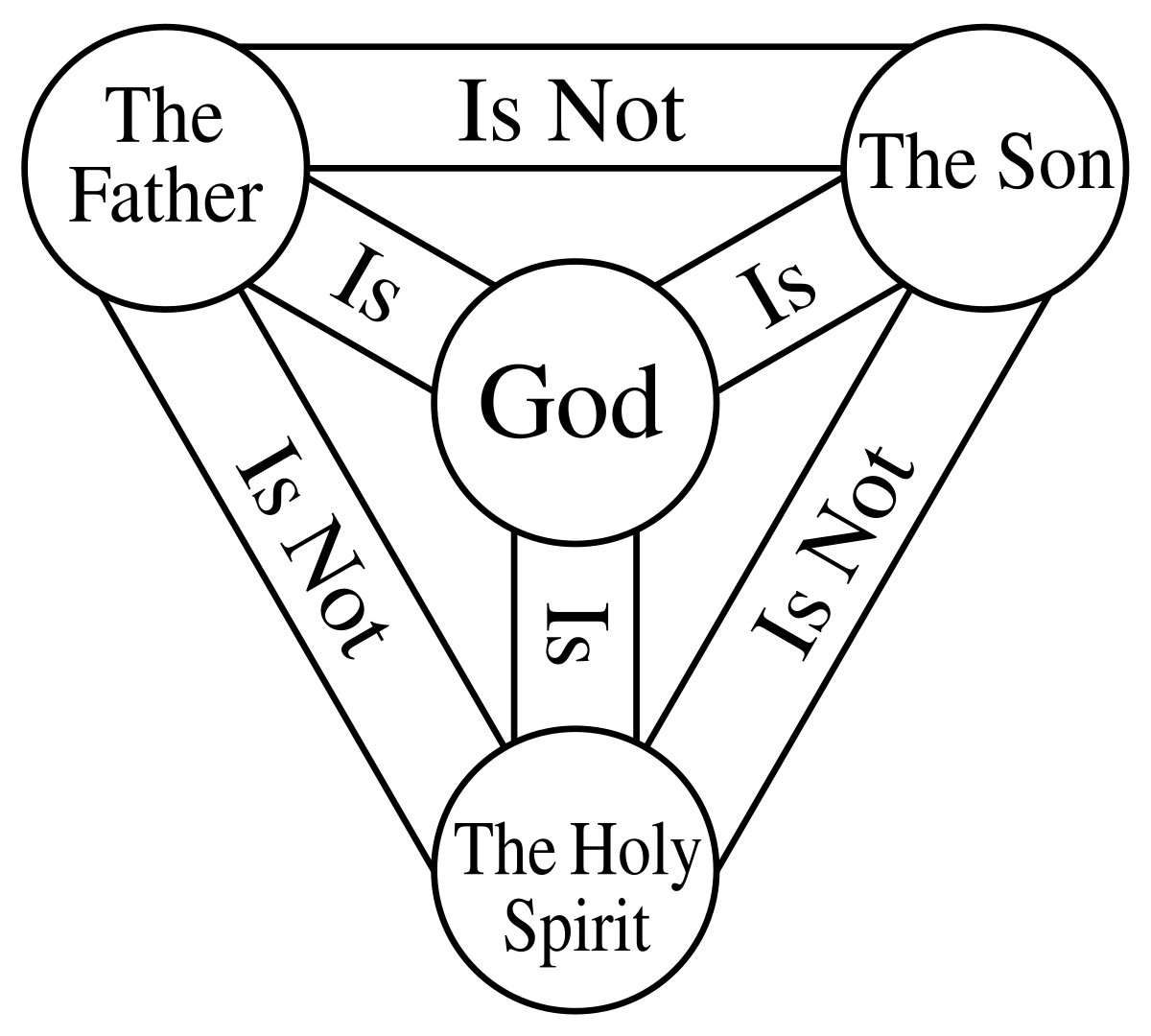
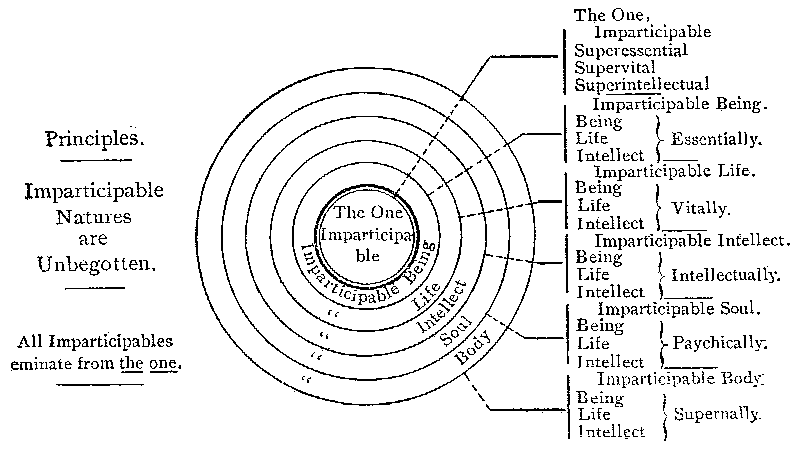
As we’ve already seen, the Intelligible Triad of Being, Life, and Intellect (Nous) was borrowed by many of the Church Fathers in order to describe the relationship between the Father, Son, and Holy Ghost. In the Christianized Triad, the Father is Being; the Son is Intellect; and the Holy Ghost is Life. Among the pagan Platonists, starting with Porphyry, each term in the Intelligible Triad is a hypostasis represented by a particular God, just as they are for Christians (the Christians also use the term “hypostasis,” though they’d say “three hypostases of One God” rather than “three hypostases, each of which is a God.” I’ll leave it to you to decide how important this difference is). Earlier on, this isn’t the case; Porphyry’s teacher, Plotinus, did not see them as hypostases, but as qualities possessed by the First Principle. For Plotinus, the three Primary Hypostases are Being Itself, Intellect (Nous) Itself, and Soul Itself. 
 
I wonder if it isn’t possible to combine Porphyry’s view with Plotinus’s, and Christianize both. In this case, the First Principle, Being Itself, is the One, or God the Father. Within the One Itself are three terms, Being, Life, and Intellect. The Being of the Father is the Father, within the Father; the Life within the Father is the Holy Spirit, within the Father; the Intellect within the Father is the Son, within the Father.

It's worth noting, by the way, that at least some of the late Platonists wouldn't like that notion very much at all. For Proclus, the One must be preserved exempt from all qualities and all multitude; in the Second Book of his Platonic Theology he calls it  "the cause of the Gods," and emphasizes that it is "not the leader of a Triad." Fortunately, we don't have to do what Proclus tells us!
 
The Second Hypostasis, Intellect Itself, is the Son. Please remember that “Intellect” is not thoughts, but the Ideas which make thought and existence possible; Intellect isn’t a particular Idea or even the sum total of Ideas, but that by virtue of which Ideas come to be. At every level, the First Triad is re-capitulated, so that the Father is the Being of the Son, the Holy Ghost is the Life of the Son, and the Son is the Intellect of the Son. 
 
The Third Hypostasis, Soul Itself, is the Holy Ghost. Remember, here, that Soul Itself is not the same as the World Soul. The World Soul or Anima Mundi is a powerful being-- a God-- but it is still one soul, even if it is the one soul that contains all souls. Soul Itself is that by virtue of which there are any souls at all, including the World Soul. Within Soul Itself, the Holy Spirit, the Father is the Being of the Holy Spirit, the Holy Spirit is the Life of the Holy Spirit, and the Son is the Intellect of the Holy Spirit.
 
Mary and the Hypostases
 
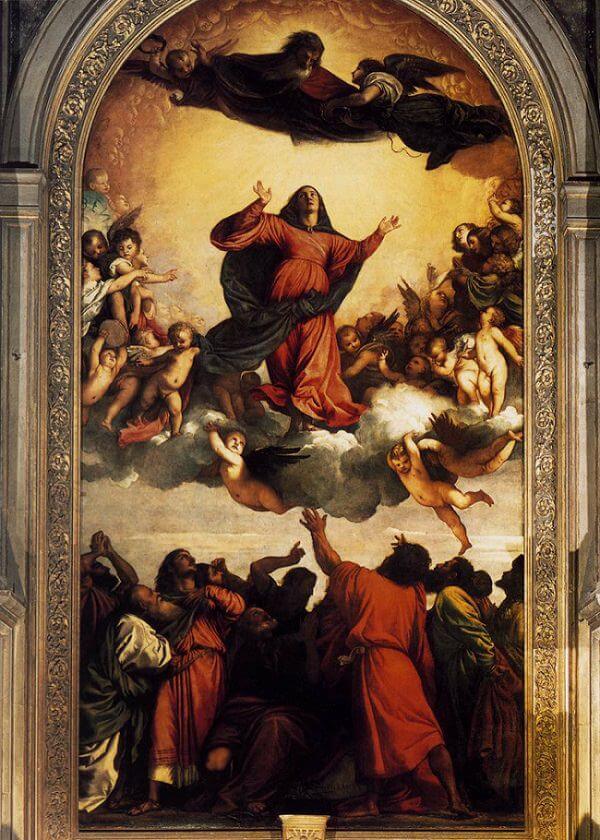
Mary has a unique role to play in this formulation of the Trinity. She is a creature, but a creature which was able to contain the Second Hypostasis, and thus to contain the First Principle. She is thus the mediating principle between the Primary Hypostases and creatures. In traditional Theology, she is the Daughter of God the Father, the Mother of God the Son, and the Spouse of God the Holy Ghost. As such, she plays a different role with respect to each of the Primary Hypostases. 
 
Here are some of the roles and titles Mary is given in traditional Christianity: 1. Queen of Heaven and Earth; 2. Exalted beyond compare above the Seraphim and Cherubim, the highest of the angels; 3. Mother of God; 4. Her womb contained the universe; 5. Mediatrix of All Graces; 6. Recipient of "hyperdulia," the highest veneration possible for a creature; 7. A creature, that is to say, a being with a definite beginning, and so not eternal; 8. Yet, somehow, able to contain the Eternal.
 
Picture the arrangement suggested above, in which the three persons of the Holy Trinity each occur at all three levels of being; in a sense the Triad becomes an Ennead. 
 
On this arrangement, Mary would have a different relationship to each of the terms (or Persons) of the Ennead at each of the three different levels.
 
 At the First Level, she is the Daughter of the Father; this means that she receives her Being from the Father (with the Son, his Intellect, and the Spirit, his Life). It might be that although, in Time, her birth comes rather late in human history, because there is no Time for God, the Idea of her, and thus the fundamental spark of her Being, always existed with him. In that case, as she will become the First of Beings, this was always the core of her being, and thus she was always the First; we can thus justifiably call her the First Creature, even if it doesn't appear so to us who live with Time and History. She is the Mother Secret and Hidden
 
At the second level, she is the Mother of the Son; this means that, having received Being from the Father (which includes Life and Intellect), she acts as the Kora in Plato's Timaeus, the Formless-Form which brings forth all the Forms; thus she is Mother of the Word, who is the Logos, the Form of Forms. At this level, too, she is Queen of Angels, as these are the Ideas or Noetic Beings (gods, in an earlier way of thinking) that exist at this level. 
 
At the Third Level, she is Spouse of God the Holy Ghost; this means that, in partnership with Soul Itself (the Holy Ghost), she becomes Mother to all particular souls. Would that make her the same as the Soul of the World (Anima Mundi), or would the Soul of the World be one of the particular souls to whom she is Mother? I don't know; what do you think?
 
The Holy Family and the Divinization of Matter
 
In the thought of Plotinus, Matter is not and can never be a Fourth Hypostasis; Matter is the source of evil and the prison from which we must escape. 
 
I wonder if the logic of the Incarnation doesn’t change this perspective. 
 
By her birth in time, Mary, the first Creature, becomes incarnate in matter. She then bears the Christ-child, who is the Second (or Third) Hypostasis, become incarnate in matter. The two are cared for by Saint Joseph, an ordinary man who rises to an extraordinary occasion. As a living human family, these three become a material model of the Trinity: Christ, the eternal spiritual power who descends into Matter; Joseph, the mortal man who rises to the occasion and thus rises above mere mortality; and Mary, who has elements of both, at once representing an immortal Idea incarnate in material form and also a perfectly ordinary woman who raises herself to universal heights by submitting absolutely to the Will of God: Be it done unto me according to Thy Word
 
If all of this is the case, it suggests that part of the work of the Incarnation of Christ is the Divinization of Matter Itself, the creation, in effect of a Fourth Hypostasis-- an adopted Hypostasis, to be sure, but another One which will share in the Life of the Blessed Trinity. The Way is shown by the Holy Family. This is the true meaning of the Gnostic idea of the Fallen Sophia, for whose rescue Christ descends into matter. 

But again, this is all speculation. What do you think?


I know I promised to continue the discussion of Christian Platonism this time, but the Muse speaks as she will, and just now she's led me to write a long discussion of Druidry and Platonism, while the next post on Christianity is only half finished. So we're going to shift gears a bit, and return to Christianity next time. It may be worth mentioning that this is the longest post by far that I have ever written for this blog.

Platonic Druidry, Druid Platonism

 
I should start by saying that to say “Druid Platonism” is a bit redundant. The modern Druid Revival-- which is the sort of Druidry I’ll be discussing here-- was heavily influenced by Platonism from the beginning, and for a very good reason. No one really knows what exactly the ancient Druids believed in. All we have are a few fragmentary records, largely written down by their enemies, and some hints in the archaeological record. When the Druid Revival began in the 18th Century in Wales and England, its proponents were forced to look around for sources to fill in the patchwork of legends with which they’d been left.
 
 
A century prior, an influential group of Anglican theologians and philosophers at Cambridge had drawn on Plato and Platonism to combat the rising tides of materialism and Calvinism in English academic circles and the English Church. The work of the Cambridge Platonists is almost certainly part of the hidden backdrop of the Druid Revival, though I’ve never heard anyone discuss it directly. Meanwhile, contemporary with the Druid Revival, there was a more direct revival of Platonic philosophy in the work and the person of Thomas Taylor.
 
 
Taylor-- pour out a glass of beer to his Genius-- is the first author to have translated the works of Plato into English, as well as those of Aristotle, Proclus, Plotinus, Porphyry and Iamblichus. Taylor’s translations were read by William Blake, one of the founding fathers of the Romantic movement and-- critically-- one of the chiefs of the Order of Bards, Ovates, and Druids. They were also read by Ralph Waldo Emerson, G.R.S. Meade, and later by the founders of the Golden Dawn. Since then, even as his works have gone out of print, the fingerprints of Thomas Taylor are all over the alternative and nature-oriented spiritual traditions of Britain and North America.
 
 
But did I say alternative? Is it really so? Emerson is one of the founding fathers not only of American letters but of American culture. The movement that Blake inspired produced many of the greatest works of poetry in the English language. His influence, Taylor’s influence and, above all, the influence of Plato and the later philosophers in the Platonic tradition is all over American and English literature and art, and all of the best of it. Wordsworth and Coleridge, Shelley, Keats, Emerson, Tennyson, Yeats-- we have them all thanks to Plato and the late Platonists, and we have the Platonists thanks to Taylor.
 
 
Well, that was a big digression to make a small point-- Platonism has been part of contemporary Druidry since it’s beginnings, and so it doesn’t require any sort of radical change to draw upon it. What I want to do here, though, is to go into detail about some of the ways that we can use Platonic ideas to think about the concepts, practices, and gods of the Druid Revival.
 
 
Not Dogma

 
Before we proceed, I want to emphasize that nothing that follows should be taken as a statement of doctrine or “belief.” I’m not trying to present a set of opinions that you have to “believe in” to be a Druid, or to present the One True Druidry, or anything similar.
Moving right along. Let’s ask the question: If Druidry is already Platonic, why call it Druidry at all? Why not just call it “Platonism” or “Celtic Platonism” and be done with it?
 
 
A Difference of Emphasis

 
Inscribed over the entrance to the Academy at Athens were the words “Let No One Enter Here Who Does Not Know Geometry.” Following his predecessors, the Pythagoreans-- you didn’t think Plato came out of nowhere, did you?-- Plato used mathematics as a bridge between the sensible and the Intelligible worlds.
 
 
We discussed how this works in the first post in this series. There, I gave the example of the Pythagorean Theorem: Though the perfect Right Triangle it describes exists nowhere in sensible reality, it shapes and determines hte geometries of all the imperfect triangles of our material world.
 
 
Numbers themselves function in the same way. Consider one. No, not The One-- not yet, at any rate. Just stick with 1 itself, the first number you learned when you first started to count. (My daughter learned it when she was only one years old; “One” was one of her first words.) One is a number, but it is more than that: It is the basis for all number. How many numbers 2 are there? Just one. How many 3s? Just one. And so on. Thus 1 provides being and unity to every number which follows it; the One Itself is the same principle applied to all things.
 
 
In the world of Druidry, all of the foregoing holds good. Indeed, many Druids are very familiar with number symbolism, sacred geometry, and so on-- and I encourage those that don’t know these things to get to know them!
 
 
But the focus of Druidry is not the world of Number, but the world of Nature. Numbers and mathematical formulae are examples of Ideas, the Intellectual Powers that shape the succeeding worlds of Psyche and Matter.
 
 
There are other Ideas. If A:B::C:D, then A:C::B:D. This is an example of a logical formula. It can be applied to mathematics in the form 2:4::6:12 therefore 2:6::4:12. But it can also be applied to human society in a form like If the King is to the City as the Nous is to the Soul, then the King is to the Nous as the People are to the Soul. This analogy, in fact, is one of those that undergird Plato’s political writings.
 
And Ideas can also be found in the world of Nature.
 
 
The most fundamental tenet of a Platonic Druidry, then, is the encounter with the Ideas as they manifest in the world of Nature.
 
 
The Idea in Nature

 
What does this look like in practice? Well, one of the really fun things about Druidry is that, while its roots are ancient, it’s a young tradition. And the sciences that strongly relate to it-- that would be ecology and systems theory-- are also very young. So there is a lot of work still to be done-- and we get to do it all!
 
But here is an example, drawn from my time spent working in the wilderness in Oregon. There lands west of the Cascade Mountains are covered by temperate rainforests, and the dominant trees in these forests are huge conifers-- Douglas Firs, Grand Firs, Western Red Cedar and Western Hemlock. The trees grow to enormous size, and provide a home in their massive canopies for countless birds, mammals and insects. But they also block the sun completely, so that only a few shade tolerant understory plants (mainly salal, swordfern, and Oregon graperoot) grow in the understory.
 
And then they die.
 
Now, when the old trees die, they die standing up. For months, years, or longer, a tree will rot from the inside out, becoming a gigantic snag standing in the middle of the forest. Eventually it falls. Sometimes it falls in the wind, but in this case, let’s say it’s something more violent. Let’s zoom in on one single tree-- an ancient, majestic Douglas Fir, grown brittle and dry with age.
 
And watch, as a blast of lightning pours down from Heaven and strikes the tree. There is a terrible roar as the trunk of the great tree is shattered by the strike. It crashes to the Earth and instantly great walls of flame pour forth in every direction.
 
A moment ago, there was a mature and beautiful but static and unchanging old forest. Now there is heat, fire, and chaos, and death and terror for the creatures who live in this place. Birds fly in every direction, deer and elk scramble to keep ahead of the blaze. Tree after tree is consumed with flames like a gigantic bonfire.
 
And when you come back, a few days or a week later, where there once was a forest, there is now a smoking ruin of ash and soot and blackened branches.
 
Sounds terrible, doesn’t it?
 
Keep watching.
 
The first plants to make their appearance are weeds. In this part of hte world, that often means hardy blackberry and Scotch broom; government scientists call them “invasive” because they grew somewhere else before Europeans arrived here (from somewhere else) and spend enormous amounts of money to try to remove them, but fail. To the plants it doesn’t matter. The lightning and the fire have released enormous amounts of organic fertilizer that had been locked up the giant trees, and now they’re growing like your lawn would if you covered it in fertilizer and ignored it for a month.
 
The weeds provide food for insects, which themselves feed birds and mammals. The thicker clumps of weeds provide homes for rodents, racoons, foxes and feral cats (some of these are government approved; others are not.) Shrubs appear, and provide nesting places for birds.
 
Year by year, the weeds die, and their bodies, mixed with the manure provided by the animals, becomes part of the soil, which is also enriched by the wood char lying everywhere. The soil thickens, and taller shrubs and small trees begin to grow. Ash and alder in low lying areas, oaks on open grounds and slopes. Where the fir trees had grown as nearly a monoculture, now many different types of plants and animals thrive here.
 

Over time, the landscape will stabilize into an oak woodland, with clusters of oak trees broken up by open areas, grazed by elk and black tail deer. Predators which are capable of hunting these will follow in due course.
 
 
And eventually, the oaks themselves will give way to the seedlings of fir trees and other conifers. They will grow tall, overshadow the oak, and, after a long time, the old forest will be restored. And the conifers will grow old, dry up, and die, and then with a new blast of fire from the heavens the cycle will start again.
 
 
The terms change, but the relations remain constant.
 
 
Imagine the forest. It grows old and brittle and unchanging. Fire comes and chaos and pain-- but out of chaos, new life. See this as a pattern, just like the Pythagorean Theorem or the logical formula given above. Have you ever seen it manifested in your own life? I know I have. What about the life of a people or a nation, or an entire civilization?
 
 
The One



As we’ve discussed, the First Term in Platonism is the One; it is from the One that everything which exists has its being. The One is also called the Good, because the highest term is identical to Goodness Itself.
 
 
In Druidry, we have an equivalent to the One in the term Awen, and the idea of the Three Rays of Light.
 
 
Awen is a Welsh word meaning “muse” or “inspiration;” a poet can be called “awenydd,” “one who has Awen.” In contemporary Druidic thought, Awen is the highest principle; we can thus understand it as another name for the One. Indeed, it is helpful to see that this highest term can be given different names in different traditions. In the Chinese philosophical tradition, “Tao” expresses the same idea. Neither One, nor Tao, nor Awen entirely characterizes the First Principle, as this is impossible for the human mind. Rather, each name we give to it allows us to understand it in a different way. In the poetic mode of thought common to all the Celtic peoples, Awen or inspiration is a perfect name for it. It teaches us to see, in the beauty of works of art and literature, something akin to the same power that produces the entire cosmos, that expresses itself in Nature, and that is also to be seen any time a human being lives according to his or her full potential.
 
 
Although we each have our own Awen, at the beginning of our lives it isn’t very clear; our souls are muddled and their parts disconnected, and we are weighed down with countless accretions from our culture or our personal karma, or elsewhere. The work of discovering and living one’s Awen is the work of encountering one’s true being and true purpose, and uniting ourselves to it. In just the same way, the task of the philosopher in the Platonic tradition is the gradual withdrawal from the world of sensibles, opinions and created things, to union with the Divine.
 

The Three Rays of Light

 
Awen is symbolized by the image of Three Rays of Light. These are named Gwron, Plenydd, and Alawn in Welsh, and their names are said to signify Knowledge, Power, and Peace. These three express the same idea as the Intelligible Triad that we discussed last time. Peace, Alawn, is Being Itself, the still and absolute center. Power, Plenydd, is Life, the activity of being. Knowledge, Gwron, is Nous, the awareness of being. These three together are Awen, which is also known by the name OIW, the highest expression of the Divine which can be understood by the human mind.
 
 
The third term in every Platonic Triad has two powers: It both returns to the first, and also recapitulates the first at a lower level. Thus from the third term in one triad, succeeding triads arise. From these triads are the unfolding of all the many Gods which bring the world of experience into being.
 
 
Succeeding Triads

 
Imagine the relationship of the Sun to the Earth. First there is the Sun, abiding in itself. Next, there is the light that shines forth from the Sun. Third, the light is received by the Earth. Now the process of creation begins, as the light is received by the Earth and turned into energy for living beings and the bodies of plants. From the interaction of Light and Earth, life emerges.
 
 
In Druidic terms, the Sun Itself is the OIW. The light which emerges is Hu the Mighty, the Great Druid God who drives forth darkness. The Earth is Ced the Earth Mother, who brings forth all living things.
 
 
These Three are another articulation of the Intelligible Triad. They also reveal another Platonic Triad, that of abiding, processing, and reversing. The Sun abides; the light goes forth; receiving the light, the Earth reflects it back to the Sun. If you were able to stand on the surface of the Sun, you could see the Earth, and what you were seeing would be the Sun’s light reflected back to you. In just the same way, our souls descend from the Eternal Unity of Spirit into material incarnation, and rise back up again to Spirit. (Is there a part of our soul which abides eternally, as the Sun stays where it is and shines its life forth? That’s a fine debate; Plotinus thought so, Iamblichus disagreed. What do you think?)
 
Here is another Triad, drawn from Plato’s Timaeus.
 
 
First there is the Form. The form is received by something which is at once form-like and yet altogether formless and without quality. The Formless provides the substance to the Form, and from these the Formed emerges. This triad of the Form, the Formless, and the Formed can also be called Father (Form), Mother (Formless), and Son (Formed). In Druidry, these are the Triad of Hu, the light; Ced, the substance, and their progeny, Hesus, Chief of Tree Spirits.
 
 
Hesus is an interesting figure. His name is a variation on the old Gaulish deity Esus, with the H added to emphasize the presence within his being of the power of Hu the Mighty, his progenitor. In the Druid traditions that I follow, he is the Power that dwells in the heart of the Sacred Oak, the guide of Druids, patron of healers, and teacher of wisdom. As the master of the trees, Hesus is the master of all forests and all plant-life. As the master of plant life, he is the master of the basis of Life Itself, as this is made possible only by the plants which absorb the light of the Sun and form it into food for succeeding orders of creatures. As we approach the forest, we can turn our minds toward Hesus and ask him to guide us to wisdom.
 
 
Ones and the One
 
Little is known of the ancient Celts and their religious practices, as I said above. We do know one very interesting thing about their religion, and that is their method of naming the Gods. Many divine names, it seems, were not so much names as titles. “Cernunnos,” for example, is one old Celtic God; his name means “he of the horns.” And, appropriately, Cernunnos was a Horned God. “Belenos” was another god; his name appears to have meant “the shining one” or the bright one”; in Roman Gaul he was seen as a form of Apollo. “Epona” is a goddess; her name means “she of the horses.”


Cernunnos


Belenos


Epona
 
 
And so here we have the convention: the suffix “unos” is added to a quality to give the name of a God; the suffix “ona” is added to give the name of a goddess. “Unos” and “ona,” meanwhile, are derived from the word for One.
 
 
In the thought of the late Platonic philosopher Proclus, the Gods are those beings which have their being in the One Itself. They can also be called “henads,” which means “unities;” the Gods particularize the One, bringing forth succeeding series of beings. A Goddess of Horses is absolute divinity manifesting as the power which brings into being horses and everything which relates to them. “Epona,” then, is a perfect name for this being “The One of the Horses.”
 
 
One of the issues that modern Druids who want a more polytheistic approach to their spirituality face is the paucity of available deities. Anyone who wants to work with the gods of Greece and Rome has an abundance of sources, the names and stories of hundreds of gods, spirits, and heroes. But those looking for a more Celtic “flavor” to their spiritual life are in a bind.
 
Knowledge of the old naming formula allows us to overcome this issue. Assume all the following to be true:
 

1. Awen is also called the One, and is the power which underlies all being.
2. Gods are beings which are most closely united to the One.
3. Everything in the world of our experience has its source in a God.
4. It’s much easier for a human mind to interact with a God if we have a name and a gender to assign to it.
 

We can use the old Celtic naming convention to designate Gods, which can then become the objects of prayer and contemplation.
 
 
How does this work? It’s simple. If you want to interact with a deity, and don’t have a name for it, look up the word for whatever it governs in Welsh or another Brythonic Celtic language. Then tack on “Unos” or “Ona.” Which one? That’s sort of up to you. The gods are designated masculine or feminine to show that, in addition to having unity, they have the power to generate: Generation is accomplished through gender. Masculinity can be defined as the sort of creativity which generates new forms by going outside of itself and mingling with other things. Femininity is the sort of creativity which generates new forms by drawing things into itself and mingling them with its own substance and power. If you’re want to bless your garden, and if gardens seem feminine to you, you might pray to “Garddona”-- that’s the Welsh word “gardd” for garden, with “ona” added on. If you’re out walking through the woods on a winter’s day and you find yourself moved by the beauty of the snow falling, you might give thanks to “Gwyntonos,” the “one of the snow.”
 
 
Now, it needs to be said that the words that will result from this process will almost always be complete nonsense. That’s okay. In fact, it’s important. By being unintelligible, the foreign word allows us to rise above the thinking mind. That’s also a reason to use words in a language you yourself don’t know, by the way-- saying “The One of the Snows” in English could work, but it doesn’t have the same power to kick your thinking above the level of dianoia. In magic, these sorts of half-comprehensible names for gods and spirits are called “the barbarous names of evocation,” and the old books include severe injunctions never to change them.
 
 
Since there are still people who speak the modern Welsh tongue-- and since getting offended about other people using languages is a popular past-time these days-- it would be even better to use an extinct language. A dictionary of Old Gaulish would be particularly useful, as there are no old Gauls around either to understand what you’re saying or get offended about your saying it. But, of course, you can always decide that you don’t care those sorts of things, and use whatever words you can come up with on Google Translate.
 

Beauty
 
 
Beauty is one of the most important parts of Platonic philosophy, and one about which we haven’t much to say. But Platonic philosophy isn’t all reading and math homework. Plato had a sense of humor, and also a sense of raunchiness, though both of these are often lost in the later commentators. Beauty and erotic love are central concerns for Plato.
 
 
Now Beauty, in this tradition, is not any kind of mere prettiness, and it isn’t a matter of “taste” or “in the eye of the beholder.” Beauty in an object is the living presence of Beauty Itself, which is the presence of the Divine. Oh, and Beauty isn’t just physical beauty. This is something that is often very hard for modern people to understand, but in the Platonic tradition, “beauty” can be found both in physical objects, like a beautiful forest or a beautiful face, and in beautiful actions. Beautiful actions, of course, are those which arise from the virtues.
 
 
Nor is the practice of Platonic philosophy all reading and thinking about stuff. Techniques both of contemplative meditation and ritual magic (theurgy) were taught in the Platonic schools. Different branches of the tradition emphasized one or the other-- Plotinus emphasized meditation, Iamblichus theurgy, and so on. But both are important. Just now, though, I’d like to talk about a particular technique of meditation which focuses on the contemplation of Beauty. This practice allows us to approach a particular object of beauty and to raise our consciousness by progressive degrees to the Divine.
 

Plato tells us how this works in the Symposium, a dialog which is especially concerned with the nature of Love, or Eros. In the dialog, Socrates relates how he was initiated into the nature of love by his teacher, a priestess named Diotima. Diotima teaches Socrates to move from the contemplation of a single beautiful image-- or person-- to beauty itself. “Starting with individual beauties, the quest for the universal beauty must find him ever mounting the heavenly ladder, stepping from rung to rung-- that is, from one to two, and from two to every lovely body, form bodily beauty to the beauty of institutions and laws, from institutions to learning, and from learning in general to the special lore that pertains to nothing but the beautiful itself-- until at last he comes to know what beauty is.”
 
Whoever has been initiated so far in the mysteries of Love and has viewed all these aspects of the beautiful in due succession, is at last drawing near the final revelation. ANd now, Socrates, there bursts upon him that wondrous vision which is the very soul of the beauty he has toiled so long for. It is an everlasting loveliness which neither comes nor goes, which neither flowers nor fades, for such beauty is the same on every hand, the same then as now, here as there, this way as that way, the same to every worshiper as it is to every other.
 

Nor will his vision of the beautiful take the form of a face, or of hands, or of anything that is of the flesh. It will be neither words, nor knowledge, nor a something that exists in something else, such as a living creature, or the Earth, or the Heavens, or anything that is-- but subsisting of itself and by itself in an Eternal Oneness, while every lovely thing partakes of it in such sort that, however much the parts may wax and wane, it will be neither more nor less, but still the same inviolable whole.
 

In the Symposium, Plato is talking about erotic love, and so the contemplation he discusses begins with the beauty of another person. Contemplating that person, the lover then considers what makes them beautiful, and then contemplates how that same beauty is manifest in others. In this way, he comes to realize how that beauty goes beyond any one individual. He then proceeds to contemplate what qualities that produce the sort of physical beauty he is contemplating are also manifest in human society at its best, in laws and the institutions of culture, in just actions and virtuous behavior. At this point, he attempts to realize a unified principle which underlies the beauty in question. Finally, he progresses, if he can, from a particular unifying principle, to unity itself, by seeing how the particular principle of beauty he has discovered is found in every form of beauty, and participates in what Diotima calls “the open sea of beauty.”
 
 
All this is very abstract, and we would do better to explain it by example. But now, as befits our purpose, let’s turn to the special emphasis of the Druid tradition: The Natural World.
 
 
A Druid Meditation on Natural Beauty
 
This practice takes the contemplation of beauty described in the Symposium and applies it to that most Druidly of actions: Taking a walk in the woods.
 

Step 1. Before you begin, either before you step out your door or before you step onto the path into the woods, say a prayer such as the following:
 

Oh Hesus, Chief of Tree Spirits, guide of Druids and teacher of wisdom, I pray that, as I venture into the Green World which is your kingdom, you will guide my soul to such wisdom as it is able to attain.
 
I like to then make a small offering at the beginning of any forest path before I enter. This can be as simple as pouring out a bit of water from your bottle. I say something like “In the name of Hesus, Chief of Tree Spirits, I pour out this water in offering to the spirits of this place. As you receive this offering, may I receive your wisdom.”
 

Step 2. Just walk. As you do, try to clear your mind of any stray thoughts, and focus your attention on the world around you. Keep an eye out for birds and animals, smell the air, touch the trees and the ground.
 
 
Step 3. Eventually, you will come across something particularly beautiful, on which you want to focus your attention and which you want to make the subject of your meditation. It may be the entire scene, or it may be some detail of it, like orange leaves in late Autumn or the scent of blackberries on the air in Summer, or it may be some particular object, like a bird’s nest in an ancient oak tree or a sunlight rippling on the surface of a stream.
 

Step 4. Focus your attention on the object of your contemplation. Experience it, enter into it, let yourself be totally enraptured with the beauty of it. Do this for as long as you like. You don’t have to be in any particular posture, by the way-- if it’s a static object, like a tree, you can stand or sit in a suitable meditation pose, but if it’s a larger scene, you can continue walking, slowly and reverently. Just make sure your body is poised but comfortable enough to not get in your way, and focus your attention on the object, filling your entire awareness in this way.
 

Ask yourself, what is it that makes this object beautiful?
 
 
If you’re focusing on a bird’s nest in a tree, it may be that you found yourself moved by the way that something as ancient as a centuries-old tree provides a home for the newborn life of the baby birds. It may be the interplay of solidity, represented by the tree, and fluidity, represented by the nest and its inhabitants; or it may be the interplay of the straight lines of hte branches with the circular lines of the nest. Any answer is correct.
 

Step 5.
Consider where else in the natural world the same sort of beauty can be found. It might be that, in the same way that an ancient tree provides shelter for birds, a different and far more fleeting form of life, a tidal pool provides a home for molluscs and crustaceans, and your own gut is home to countless micro-organisms which aid you in the work of digestion. Or it could be that the interplay of solidity and stability seen in the birds and their tree can also be seen in a stream making its way through a stone channel or in fish spanning underneath a fallen log in a pool. Or it could be that the same relationship of straight and circular is also found in a lake overflowing into a stream or winds gathering into a vortex.
 
 
Step 6. From this contemplation, see if you can derive a general principle. “The ancient, abiding life which creates the home for the new and transient life.” “The creative power of the union of stability and change.” “The spiral as union of the circular and the straight.”
 
 
Step 7. Move in your mind from the realm of nature to the realm of human society and culture. Where can the same principles be found in humanity at its best? Perhaps the same care of the ancient and abiding for the young, different and fleeting can be seen in the way that the best constitutions are framed with the care of many generations in mind, far past those the framers themselves will ever see. And this same principle can be seen in wise parents that lay up savings for their children, their grandchildren, and beyond-- or in family stories and traditions, passed down from generation to generation. The interplay of stability and change can be seen in this way also, as laws that permit change but limit its pace and its direction, and the same laws as household rules laid down by parents for their children. The union of line and circle can be seen in a well-designed farmer’s market, which leads you on a straight path to circle through the stalls of the many vendors, or in the best forms of cultural practice, which allow periods of movement and change to alternate with periods of circling back toward old ways.
 

Step 8. Consider the foregoing, and add in a contemplation of how you can best make use of the same principle in your individual life. Maybe you could do some work toward making your own lawn or garden more like the tree, providing a stable home for those fleeting forms of life, butterflies and pollinators. Or maybe you could do a better job of providing a stable example for the young and changeable people you know. Or maybe it’s time to circle back to something you once knew and did well-- or to move forward in a line toward the next circle.
 
 
Step 9. Let us suppose that all of the ideas which you have experienced so far emanate from a single principle. We can give it a name, and here we can draw on the Celtic Naming Conventions given previously. “Hengoedenona” would mean something like “The One of the Old Tree” or, more poeticly, the Old Lady of the Trees. Solethylifunos is a combination of the words that (according to Google Translate) mean “Solid” and “Fluid” with the -unos suffix; it could be said to mean “The One Who Moves and Abides.” “Cylchalinnelona” is the Lady of Line and Circle.
 
 
Address yourself to this power and thank it, in your own words, for its wisdom. Try to reach out with your mind, letting go of all the details and particularities previously encountered, and stand only in the presence of this power, which is a God. Ask that you may manifest its light and its wisdom in your own life and bring its blessings with you back to the world of experience. If you want, you can create an image of the God in your mind; whatever seems appropriate, let it be filled and overflowing with light. As you speak to it, slowly allow everything but the Light to melt away, and imagine that Light spilling over from the ineffable One, through teh God that bears it, to you and to the entire world.
 

Step 10. Close with a suitable prayer. The Gorsedd or Universal Druid’s Prayer may be particularly appropriate:
 

Grant, oh God (Goddess, Gods, etc),
Thy Protection,
And in Protection, Strength,
And in Strength, Understanding,
And in Understanding, Knowledge,
And in Knowledge, the Knowledge of Justice,
And in the Knowledge of Justice, the Love of it,
And in the Love of Justice, the Love of All Existences,
And in the Love of All Existences, love of hte Gods, and the Earth, and all Goodness.
AWEN.
 
 
You may find it helpful, when you return to your home or your car or wherever you started, to write down any insights that came to you during this practice.


Platonism and Early Christianity


The influence of late Platonic thought on early Christianity is very strong. Some contemporary thinkers-- almost always Anglophone converts to Eastern Orthodoxy-- try to deny this, but in doing so they make fools of themselves; the ideas of Plato and his successors are all over the early Church. The idea of the Intelligible Triad, in particular, was borrowed by the Church Fathers, in order to explain the relationship between the three members of the Holy Trinity.


Let's take a minute to recall what we said last time. The "Intelligible Triad" refers to three qualities which characterize beings, and which particularly apply to the Primary Hypostases. These qualities are: Being; Life; and Intelligence. We could also call these the capacity to Be, the capacity to Act, and the capacity to Know. (If this reminds you of
someone, you're not far off.)

The Three Primary Hypostases, meanwhile, are the One, Intellect, and Soul. These are the three primary Beings, which bring all other beings into existence. The One is first; Intellect proceeds from the One; Soul, from Intellect (and the One). Now, the terms of the Intelligible Triad, as we said, are different from the Three Primary Hypostases. The terms of the Intelligible Triad are arranged horizontally, not vertically.

Now, one of the things that makes later Platonic philosophy difficult to access is that the ideas are not static; the doctrines evolved with time, and the thinkers involved often disagreed among themselves. For Plotinus, the terms of the Intelligible Triad are qualities possessed by the One, or by the One as it emanates into Intellect and returns to Itself. But Plotinus's student Porphyry turned the terms of the triad into hypostases themselves, calling them "three Gods." This was-- probably-- part of the process of transforming the pagan Chaldaean Oracles into sacred texts which could form the basis for a Platonic pagan theology; in the Oracles, the primary Gods are referred to as "Father -- Power -- Intellect."

It isn't certain, because many of Porphyry's writings are lost, but it's likely that he actually spoke of three Triads emanating one from the next, to form an Enneagram of deities. 

The Triad Christianized

Remember the terms of our Triad-- Being, Life, and Intellect. And remember that the Three Primary Hypostases, for Plotinus, are the One, Intellect, and Soul-- in that order. Now, let's turn to
Saint Augustine, the most important of the Western fathers of the Christian Church:
 
Porphyry... speaks of God the Father and God the Son, whom he calls (writing in Greek) the Intellect or mind of the Father; but of the Holy Spirit he says either nothing, or nothing plainly, for I do not understand what other he speaks of as holding the middle place between these two. For if, like Plotinus in his discussion regarding the three principal substances, he wished us to understand by this third the soul of nature, he would certainly not have given it the middle place between these two, that is, between the Father and the Son. For Plotinus places the soul of nature after the intellect of the Father, while Porphyry, making it the mean, does not place it after, but between the others.

That is all to say: For Augustine, Porphyry's Triad is the Christian Holy Trinity

Being is the Father.

Life is the Holy Spirit.

Intellect is the Son.

It's worth noting that Augustine isn't quite right about Plotinus (as far as I know). Soul Itself is not the same as the "soul of nature" or the World Soul. The latter, while immensely greater than any human being and properly honored as a god, is still one soul among many, and so not the same as the hypostasis Soul Itself.

Augustine was not alone among Church Fathers in his use of the Intelligible Triad. The anonymous author who wrote under the name "Dionysius the Areopagite"
 
used it explicitly:
The divine name of Good revealing all the processions of the universal Cause, extends both to the things which exist, and to the things which do not exist, and is beyond both existent and non-existent things. And the title of Existent extends to all existent things and is beyond them. And the title Life extends to all living things and is beyond them. And the title of Wisdom extends to all intellectual and rational and sensible things and is beyond them all.
 
Notice that in Dionysius, the terms of the Triad are not hypostasized, unlike in Porphyry or Augustine. Saint Maximus the Confessor also used the Intelligible Triad as a description of the Trinity: 

Furthermore, having noticed that through sophisticated investigation connected with reasoning, the Cause could be variously contemplated in its effects, they [that is, saints of prior generations] piously under-stood that it exists, and is wise, and is living . And from this they have learned divine and salutary doctrine about the Father, the Son and the Holy Spirit, so that they both have been mysteriously enlightened about the principle of being of the Cause and have been initiated into the mode of its existence 
 

Christian Platonisms

A straightforward, more or less Orthodox and in fact quite traditional Christian Platonic theology, then, simply borrows the terms of the Intelligible Triad and applies them to the Father, Son, and Holy Ghost. The One Itself, which stands above Being, Life, and Thought, can be understood as the Godhead which all three share, as in the diagram that heads this page. The realm of Intellect is the proper habitation of the Angels, and Intellect is, as I wrote before, called Angelic Mind in the work of Marsilio Ficino. Soul comes next, just as in the pagan Platonic thinkers, and imparts the capacity for life and motion to beings. In this way of looking at things, Plotinus's First Hypostasis, the One, becomes the Three Hypostases of the Holy Trinity. His second two hypostases are levels of being, but are no longer hypostases in the same sense. 

Ficino describes the levels of reality this way: Above mobile soul is motionless Angel. Above Angel is God; for just as Soul is mobile plurality and Angel motionless plurality, so God is motionless Unity." For Ficino, as for Plotinus, the World Soul exists and is also one soul among many. Stars, planets, and elements are ensouled-- as they were for many medieval and early Renaissance thinkers. For readers who are interested, Ficino wrote
a six volume treatise of Platonic Christian Theology
, and if the Catholic Church had preferred it to Aquinas's Summa Theologica we would all be much better off. 

Ficino represents one possibility for Christian Platonism. I would like to suggest another, which draws upon him and other thinkers, including Dionysius and Iamblichus, but goes further than they did. But that will have to wait for next time!


The One


In Platonic thought, the First Principle is called the One; it is also known as the Good. The One is not one being among many; the One, rather is Being Itself, or that by virtue of which everything anything has existence. In one sense, the One does not even exist-- not because it is nothing, but because it precedes existence and allows for the possibility of existence. In another sense, the One is everything that exists.


Intellect


The Second Principle is Intellect, or, in Greek, "Nous." It is sometimes named "Divine Mind" in English translations of Platonic writing, or "Angelic Mind" in the work of Christian Platonists like Ficino. It is better not to think of it as mind in the ordinary sense. Intellect consists, not of ordinary thoughts, but of Ideas. Note the capital I-- the word in Greek means something like "showings." In the 19th century, it was translated into English as "Form," and that is the word under which most people know it. Intellect consists of the Ideas or Forms, the fundamental patterns which create, shape, and sustain existence at lower levels of reality. It is important to note that Intellect isn't static; the Ideas aren't like blueprints sitting on a table somewhere. They are alive, constantly shaping our experience of reality.


The easiest way to understand the Ideas is to consider mathematical formulae, and, of these, the most traditional is the Pythagorean Theorem:


a²+b²=c²


The Pythagorean Theorem describes the geometry of a perfect right triangle. The trouble is, no perfect right triangle exists in the material world-- every physical triangle is off by at least some tiny fraction of a percent. The perfect right triangle of the Pythagorean Theorem, then, does not have material existence-- but it has a higher existence, which shapes and determines conditions in the material world. And notice: We can understand the perfect right triangle with our minds, even though we can never encounter it with our senses.


Now imagine the Pythagorean Theorem is alive. That's an Idea.


Intellect is not one idea among many, just as the One isn't one being among many; it is Idea Itself, as the One is Being Itself.


Soul


The Third Principle is Soul. In the same way that Intellect isn't what we commonly think of as the thinking mind, the word "soul" also means something a little different from its common English usage. Specifically, it isn't something that you "believe in," and it isn't some kind of weird, invisible bag of gas (perhaps weighing 27 grams?) which floats away from the body at the time of death in order to go live up in space or something. It's easier to understand what it is if you consider that the Greek word for soul is psyche; the definition is roughly the same as psyche. Soul includes all of our thoughts and emotions, our energy, desires, and sense-impressions.


Soul Itself-- you already saw this coming-- is not one individual Soul among many, but that by virtue of which everything which is ensouled has soul.


These three-- the One, Intellect, and Soul are called the Three Primary Hypostases. Hypostasis means a kind of Being or Substance, and so the Three Hypostases are also called the Three Primary Beings.


The Intelligible Triad

Everything which exists can be understood as possessing three basic properties:
Existence, Life, and Thought (In Greek: On, Zoe, Nous.) Being is mere existence; Life is activity; Intellect is the capacity for awareness. It's very important to note that the Intelligible Triad is not the same as the Three Primary Hypostases-- rather, each hypostasis possesses Being and Life and Intellect. And so do you! 

Also note that Intellect or Nous, in reference to the Intelligible Triad, is not the same as Intellect or Nous, the hypostasis-- though they mean something similar.

The Three Primary Hypostases, the worlds which they produce, and the lower world of Matter are all arranged hierarchically to one another. The One comes first, and with it, those Beings which are eternally united to the One-- yes, those would be the Gods. Intellect comes next, with its inhabitants, the Ideas. Soul is next, and with it the souls. Matter comes last, and material objects with it; matter is not a Fourth Hypostasis, as it has no causal power. But the terms of the Intelligible Triad are arranged horizontally to one another-- they occur on the same plane, at every level.

Pagan Platonism, Christian Platonism, Platonic Druidry


In the thought of late antiquity, the identities Primary Hypostases were assigned to the classical gods. There are various ways of doing this, depending on who you are reading, and sometimes individual thinkers contradict themselves-- Plotinus usually identifies Intellect as Saturn, but sometimes Intellect is Juno, who he also identifies with Aphrodite. Aphrodite, meanwhile, he elsewhere identifies with Soul! One older translator wrote that, in Plotinus's thought, the classical gods are basically vestigial. I think that's too much of a stretch-- Plotinus wrote at length of the importance of honoring the Gods, but he also made it clear that, in his view, they are subordinate to the One Itself, which he also refers to as God or the First God.

Proclus, on the other hand, was far more concerned with finding the old gods their proper places in the hierarchy of being-- so much so that he stretches the basic system I've described here nearly to its breaking point. Proclus divides Intellect into two levels, connected by various overlapping Triads and Heptads. His whole system is complex, baroque, fascinating and sometimes a bit ridiculous. It would require turning this blog post into a book to really get into the details of Proclus's thought here. 

In the next post, I want to discuss another possible Platonic theology, based on traditional Christianity. After that, I want to look at a third possibility, based on the Druid Revival. Finally, I'll close this series with some thoughts on an ecumenical Platonism through which any spiritual tradition can be understood. 
The Gospel of Matthew, Chapter 12, verses 38-50 reads:

38 Then certain of the scribes and of the Pharisees answered, saying, Master, we would see a sign from thee.

39 But he answered and said unto them, An evil and adulterous generation seeketh after a sign; and there shall no sign be given to it, but the sign of the prophet Jonas:

40 For as Jonas was three days and three nights in the whale's belly; so shall the Son of man be three days and three nights in the heart of the earth.

41 The men of Nineveh shall rise in judgment with this generation, and shall condemn it: because they repented at the preaching of Jonas; and, behold, a greater than Jonas is here.

42 The queen of the south shall rise up in the judgment with this generation, and shall condemn it: for she came from the uttermost parts of the earth to hear the wisdom of Solomon; and, behold, a greater than Solomon is here.

43 When the unclean spirit is gone out of a man, he walketh through dry places, seeking rest, and findeth none.

44 Then he saith, I will return into my house from whence I came out; and when he is come, he findeth it empty, swept, and garnished.

45 Then goeth he, and taketh with himself seven other spirits more wicked than himself, and they enter in and dwell there: and the last state of that man is worse than the first. Even so shall it be also unto this wicked generation.

46 While he yet talked to the people, behold, his mother and his brethren stood without, desiring to speak with him.

47 Then one said unto him, Behold, thy mother and thy brethren stand without, desiring to speak with thee.

48 But he answered and said unto him that told him, Who is my mother? and who are my brethren?

49 And he stretched forth his hand toward his disciples, and said, Behold my mother and my brethren!

50 For whosoever shall do the will of my Father which is in Heaven, the same is my brother, and sister, and mother.
 

Prophecies

Jesus is asked for a sign, and responds with prophetic language. This passage is much discussed and much interpreted, and I'm not going to go into detail on it here. If you've never read the Book of Jonah, by the way, it's worth taking the time. 

Exorcism

Jesus then gives us a very important spiritual teaching, in the discussion of the evil spirit driven out of a man. For demons, we can read self-perpetuating, destructive habits. In the modern world, we usually refer to these as "addictions" and ignore or deny the idea that they may have a personal identity analogous to that of a human being. This doesn't matter, though, the teaching still applies-- if a destructive power has taken root in your soul (psyche), and you want to change this condition, it is not enough to rid yourself of the behaviors or habits that the destructive power causes. The soul must be purged, but it cannot only be purged; it must be filled. 

This is precisely what is done in 12-step programs when the recovering addict starts by "admitting that he is powerless over" his addiction, and then continues by "coming to believe that a power greater than himself can restore him to sanity" and "making a decision to turn his will and his life over to the care of God as he understands God." The destructive behavior must end, but the void in the soul must be filled.

In a letter to Bill Wilson, the founder of Alcoholics Anonymous, Carl Jung wrote of an alcoholic that both knew that

His craving for alcohol was the equivalent, on a low level, of the spiritual thirst of our being for wholeness, expressed in medieval language: the union with God.

A demon is a spirit; a low-level spirit. If Jung is right then in addictive behavior, the encounter with the evil spirit acts as a stand-in for the encounter with God, who the addict is not able to reach. It's an interesting exercise to consider the various addictions to which people succumb in our world and match them with various aspects of the Divine. What is the alcoholic seeking? The porn addict? The shopping addict? The guy that can't turn off cable news? 

Who Is My Mother? Who Are My Brethren?

The next passage is often used by Protestants in an attempt to attack traditional Christianity's veneration for the Mother of God, but it has little to do with this. Instead Jesus is reminding us of something we've encountered already: The Kingdom of God is the Noetic Realm, and human social categories do not apply here. To "do the will of my Father in Heaven" is to unfold one's life-purpose in harmony with the Divine, and those who are able to do this transcend separation, which is a condition of the material world. Those who have attained this state have also long since outgrown the ordinary human social structures that we have inherited from our primate ancestors. 


The Assumption of Mary

August 15th is the Feast of hte Assumption of the Blessed Virgin Mary. On this day, Christians celebrate the end of the earthly life of the Mother of Our Lord, and her assumption, soul and body, into heaven. Note the ambiguity in the first clause-- Orthodox Christians believe that Mary died a natural death, that her soul was received into heaven and her body resurrected. Catholics, while they are required to believe in the assumption of Mary's body as well as her soul, are more open as to whether she died or not. Pope Piux XII defined the dogma in the following words:

We proclaim and define it to be a dogma revealed by God that the immaculate Mother of God, Mary ever virgin, when the course of her earthly life was finished, was taken up body and soul into the glory of heaven.
 
East or West, August 15th is a major Marian feast, and we should talk about what it means from the perspective that we're using here.

Divinization

Mary is the highest of the saints and the queen of the angels, surpassing all other creatures in power and majesty. As she is the first of the saints-- not chronologically, but in dignity-- she is thus meant to be the model for all saints and, therefore, the model for all Christians. By imitating her, we seek to become like her and so to share in the glory that is hers. On this we agree entirely with our more orthodox and Orthodox siblings.

But how are we to understand the dogma of the Assumption?

As a historical event, it is not without its parallels. Great saints and mystics from many traditions, when they leave this world, either leave no corpse behind, or else leave behind a body which remains incorrupt. It has always seemed to me that these two possibilities represent two different forms of ascension, and it's interesting to note that, in the Christian tradition, the vast majority of saints are incorrupt. Mary is the first great exception-- or the second, if you count Jesus Himself. But what this might mean is beyond the scope of this brief essay. For now, it is enough to point out that the doctrine of the Assumption-- belief in which goes back far into antiquity-- is not at all unprecedented, and should be seen as evidence that the historical Mary was a spiritual Master of a very high level of attainment.

As a mythical event it is even more interesting. Mary's story begins with the words "Behold the handmaiden of the Lord; be it done unto me according to Thy Word." It continues with the words, "My soul doth magnify the Lord and my spirit hath rejoiced in God my Savior; because he hath regarded the humility of his handmaiden, from henceforth all generations shall call me blessed." And the words: "A sword shall pierce your soul." And then, "Behold thy mother; woman, behold thy son. (And from that hour that disciple took her to his own home.)" It continues with her dying-- or perhaps not-- and with her tomb found empty, even as was the tomb of her son. And after that, this:

A great portent appeared in Heaven: a woman clothed with the Sun, with the Moon under her feet, and on her head a crown of twelve stars.
...
Who is she that comes forth as the morning rising, fair as the Moon, bright as the Sun, terrible as an army set in battle array?


And so we see the pattern as follows:

A human woman is offered the chance to empty herself of ego and submit entirely to the Will of God. Doing so, she receives God in his entirety. God not only acts through her, but through her God's power is revealed and even magnified, as under a glass. She experiences trial, pain and sorrow in this life, in the service of God. At the end she is with Jesus at the crucifixion, coming as close as any other being possibly could to fully experiencing the crucifixion itself. She is then appointed the mother of all Christians to follow, symbolized by John, who are themselves charged with bringing her to dwell in their own home. And at the end every part of her, even her body, is divinized and comes to dwell eternally in Heaven.

In her story as a myth, the divine plan of salvation is revealed. God is always calling out to his creatures-- all of them-- as he did to Mary, extending the invitation. All creatures can, in proportion to their own nature, receive God, submit to the Divine Will, and magnify the Lord. All creatures can then return to divinity, coming to dwell eternally in God. And, moreover, this same divine power is extended to all creation, including the material world-- as Mary is assumed bodily into Heaven, so all of creation will return to its Source. This is the entire story of the soul's descent into Matter; initiation through trial, suffering, death, and resurrection; and reascent into Spirit, revealed in one divine human being.

Prayer and Practice

I have personally found meditating on the Assumption very moving and powerful. It is covered by the Fourth and Fifth Glorious Mysteries of the Rosary. If you've never prayed the entire Rosary in a single sitting-- referring, of course, to the 15 traditional Mysteries of the Rosary, and not to the recent innovations-- this is a very good day to do it. Prayed together in order, the three sets of Mysteries become an Initiation into the highest mysteries of the Christian life.

Saint Michael's Lent

It was a custom at one time to observe a fast from the Feast of the Assumption until Michaelmas-- that is, the Feast of Saint Michael and All Angels. This was known as "Saint Michael's Lent." I plan on following it this year. If you'd like to join me, you might find the earlier articles on fasting during Advent and fasting from technology helpful.

Click here to support this blog.
The Gospel of Matthew, Chapter 12, Verses 33-37 reads:
 

33 Either make the tree good, and his fruit good; or else make the tree corrupt, and his fruit corrupt: for the tree is known by his fruit.
 

34 O generation of vipers, how can ye, being evil, speak good things? for out of the abundance of the heart the mouth speaketh.
 

35 A good man out of the good treasure of the heart bringeth forth good things: and an evil man out of the evil treasure bringeth forth evil things.
 

36 But I say unto you, That every idle word that men shall speak, they shall give account thereof in the day of judgment.
 

37 For by thy words thou shalt be justified, and by thy words thou shalt be condemned.


Re-Tread

Notice that I'm repeating some of the verses from last time; that's because these selections together form one coherent thought. In many Bibles they are grouped together.

It's worth noting that the original text is divided neither into chapter, nor verse; this came much later, and is seen as a serious problem by some. Why? Well, when was the last time you heard someone quote a Bible passage-- those in this particular chapter are very commonly used for this purpose-- without any context, in order to prove a point? It's much easier when your Bible itself is divided into little sections which can be pulled out and re-arranged in more or less any order you like.

Karma

That said, what are we really being taught in this section? The lesson is not, I believe, that God is a kind of intergalactic Stalinist, who sends his angelic goons to write down everything you say so that he can use it against you later on. This is the lesson that I picked up in my Catholic childhood, and which led me to run as far away from Christianity as I could for many years.

No, what I believe Jesus is teaching is very simple: All of your actions have consequences. And that includes your words, which arise from your thoughts. We have already discussed the way that mental events are as real as events in the material world. Jesus reiterates that point here, and also points out that the mental or psychic world exists in a causal relationship to the material world. Purify your heart and good words will flow from it. Make the tree of your soul good and pure, and the fruit of your actions will be good and pure. No, God isn't going to literally sit you down and say, "You called your sister a brat when you were 12, and you stole a Snickers bar from the 7-11 when you were 16, and you've spent the last 20 years staring at the backside of every woman that walks past you, so I'm just going to go ahead and set you on fire until forever now."

What really happens is simply this: You will eat the fruit of your own tree.

Click here to support this blog.


In honor of the Summer Solstice, and as a way of saying thank you to the readers here who have supported this blog for the last couple of years, I am going to offer $1 geomancy readings over at my Etsy shop from now until August 1st.

Geomancy is the most straightforward and effective, system of divination that I have ever used. Geomancy gives simple yes or no answers to any kind of question you can imagine. But it also gives you the details, so you know just why it is telling you yes or no, and how things will work out if you take a yes for a green light. 

Come give it a try
The Gospel of Matthew, Chapter 12, Verses 31-35 reads: 
 
31 Wherefore I say unto you, All manner of sin and blasphemy shall be forgiven unto men: but the blasphemy against the Holy Ghost shall not be forgiven unto men.
 
32 And whosoever speaketh a word against the Son of man, it shall be forgiven him: but whosoever speaketh against the Holy Ghost, it shall not be forgiven him, neither in this world, neither in the world to come.
 
33 Either make the tree good, and his fruit good; or else make the tree corrupt, and his fruit corrupt: for the tree is known by his fruit.
 
34 O generation of vipers, how can ye, being evil, speak good things? for out of the abundance of the heart the mouth speaketh.
 
35 A good man out of the good treasure of the heart bringeth forth good things: and an evil man out of the evil treasure bringeth forth evil things.

It Shall Not Be Forgiven

Here we encounter the hardest and the darkest words to be encountered anywhere in the Scripture. Jesus tells us that there are sins-- or, rather, one sin-- which cannot be forgiven, either in this world, or in the next world.

At least, that's what he appears to be saying. The word translated as world is "aoni," which actually means "age." Of course, the English word "world" originally refers also to an age, and has the connotation of both a duration of time and a human culture. We will go wrong if we understand Jesus to be using the word "aoni" to mean the same thing we do when we say "planet." 

That said, He is certainly telling us that a particular sin will either never be forgiven, or not forgiven until long ages have passed. What is that sin?

Blasphemy Against the Holy Ghost


On the surface, we are simply told that anyone who speaks ill of Jesus (the words used mean "speak against") will be forgiven, but no one who says anything bad about the Holy Ghost will be forgiven. Now, this is another case where if we take the surface meaning literally, we end up with a cosmic absurdity. It simply cannot be the case that if someone says "That Jesus guy sure is a big stupid jerk" he'll be forgiven, but if he then says "And the Holy Ghost is a big jerk too!" he goes to Hell forever. Not if we also want to have a God with a level of maturity exceeding that of the average 10 year old, anyway!

Here-- you saw this coming, didn't you?-- I'd like to turn to Plato for a bit of guidance. In both the Republic and the Phaedo, Plato suggests that there are some among the dead who are not permitted to return to the Earth, but must remain in the Underworld forever. 

Discussing the fate of the Dead in the Phaedo, Plato writes:


...when the Dead arrive at the place to which the genius of each severally guides them, first of all, they have sentence passed upon them, as they have lived well and piously or not. And those who appear to have lived neither well nor ill, go to the river Acheron, and embarking in any vessels which they may find, are carried in them to the lake, and there they dwell and are purified of their evil deeds, and having suffered the penalty of the wrongs which they have done to others, they are absolved, and receive the rewards of their good deeds, each of them according to his deserts. But those who appear to be incurable by reason of the greatness of their crimes—who have committed many and terrible deeds of sacrilege, murders foul and violent, or the like—such are hurled into Tartarus which is their suitable destiny, and they never come out.
 
Note the two crimes which he specifies as condemning a soul permanently. Put simply, they are massacres and desecrations of holy places. 

The punishment for souls who commit such crimes is to be hurled into Tartarus, forever. Tartarus, note, is not the same as the kingdom of Hades, which is the proper abode of the Dead. In pagan Greek religious thought, Tartarus is a dark realm in which the Giants and titans that rebelled against the Gods are imprisoned. In the Iliad Homer tells us that it lies "far, far away, where is the deepest gulf beneath the earth, the gates whereof are of iron and the threshold of bronze, as far beneath Hades as Heaven is above Earth." This is where the souls of those beings that have rebelled against the divine order of the Cosmos are imprisoned. Bear that in mind. 

The Lemurian Deviation

Now let's take another detour, into one of the weirder and more interesting theories to come out of the Occult schools of the late 19th and early 20th centuries.

Yes, I'm going to talk about the Lemurian Deviation. According to this theory, at one time in the dim past a human civilization existed on a continent called Lemuria, now sunk beneath the Pacific Ocean. Now, this civilization may have been technologically primitive-- or not, we don't know-- but they were magically quite advanced, a fact which proved their undoing. At some point, the magicians of this civilization discovered what may, to them, appeared to have been a source of power in the form of beings hidden away from our universe. Chances are, these beings lied and claimed to be very powerful; such is their nature. In any case, the Lemurian magicians broke into the prison and let its inhabitants loose. Of course, the result was not more magical power, but the destruction of their civilization. The oceans rose, the landmass on which they dwelt sunk beneath the waves, and-- what is far worse-- demons gained access to human consciousness.

Why do I think this relates to the unforgivable crimes described in Matthew 12 and in the Phaedo?

Two Forms of Evil

If you pay attention, you'll notice that human beings are capable of two kinds of evil. Even our worst crime-- that is, murder-- comes in two different forms. There are some murders which are sudden outbursts, crimes of passion-- a street fight goes wrong, a man finds his wife in bed with another man, and so on. These are evil deeds, and Plato is clear that those who commit them are punished in the next world. But they can be forgiven after a time.

Those again who have committed crimes, which, although great, are not irremediable—who in a moment of anger, for example, have done violence to a father or a mother, and have repented for the remainder of their lives, or, who have taken the life of another under the like extenuating circumstances—these are plunged into Tartarus, the pains of which they are compelled to undergo for a year, but at the end of the year the wave casts them forth—mere homicides by way of Cocytus, parricides and matricides by Pyriphlegethon—and they are borne to the Acherusian lake, and there they lift up their voices and call upon the victims whom they have slain or wronged, to have pity on them, and to be kind to them, and let them come out into the lake. And if they prevail, then they come forth and cease from their troubles; but if not, they are carried back again into Tartarus and from thence into the rivers unceasingly, until they obtain mercy from those whom they have wronged: for that is the sentence inflicted upon them by their judges.
 
I personally find it both very interesting and very intellectually satisfying-- whether or not it is literally true-- that it is their victims' forgiveness that a murderer must obtain in order to be free of punishment in the next world. In any case, the thing about these sorts of crimes is that, whatever else we can say about them, we can understand them

Certain crimes we cannot understand.

I'm not going to ennumerate them here. Frankly, these topics creep me out, and in order to describe them to you I'd have to read about them, which I greatly prefer not to. Let us, for now, suggest a difference between murders that fall under the heading "crime of passion" and those that fall under the heading "serial killer"; and between great slaughters which are necessary in order to enter into a war justifiably entered into and the sort of horrific massacres of innocents which characterized 20th century regimes like those of the Bolsheviks or Khmer Rouge.

It's my view that the first sort of evil is natural to human beings and the human experience -- We make foolish decisions by letting ourselves succumb to wrath or lust or jealousy, passions we share with the other animals. The purpose of this stage of our journey is to overcome such things, and so it is natural that they are still with us. The second sort of evil is not natural; it is worse than animal, and it only became possible when we made contact with the demonic plane.

In the case of the first sort of evil, one can imagine a soul, suitably purified, able to re-join the ordinary order of the Cosmos. This, I believe, is the meaning of Jesus's blasphemy against the Son of Man. 

In the other case, the soul has quite clearly aligned itself with those beings with whom we were never meant to have contact; the demons, the Giants, call them what you will. It is no longer fit for any association with ordinary existence, and must be locked away in Tartarus through the ending of this Age and the Age to come, for the safety of all Creation. What becomes of it in the fulness of time is a mystery. 

The Nature of the Holy Ghost

Finally, it's worth considering what it says about the nature of the Holy Ghost. If I'm right, then the Holy Ghost literally is the divine order of creation, the Life of the Cosmos itself. Or at least, this is one of the images under which we can comprehend the Holy Ghost-- His true nature, as experienced by Himself and by the Son and the Father, is another mystery.


Alban Hefin


Tuesday at 5:30 AM Eastern Daylight Time was the Summer Solstice. As less than 48 hours have passed since then, the energies of the Solstice are still active, so let's have a post on it!

The name Alban Hefin, commonly used for the Spring Equinox by modern Druids, comes from the work of Iolo Morganwg. In the Barddas, his collection of Ancient Celtic Lore which emerged largely from his own extraordinary mind, Iolo writes about the "free days" associated with the Sun:

 
There are two calculations of years: one is the year of the Sun, consisting of 365 days; the other is the year of the moon, having 354 days. The days which are over and above the number of the lunar year are called days of days, and they are thus distributed among the Albans, that is to say;--two days of days to Alban Arthan, three to Alban Eilir, three to Alban Hevin, and three to Alban Elved. They are free days, and let any one come from any place he may, he will be free, and exposed to no weapon or stroke, since there can be no court and law of country on those days.

Qi Nodes

In Chinese philosophy and traditional medical practice, the pattern of shifting energies through the seasons is called jia qi or "Calendar Energy." Moments when the energy shifts in a big way are called Qi Nodes. Traditional acupuncturists, qigong teachers, and the like, have an elaborate system of practices designed to attune the energy of the individual to that of the season. This includes particular foods which are especially beneficial, qigong and meditation exercises, and modes of conduct. In the West, a similar system existed, but it's in fragments now, and part of our work is to reconstruct it; we can look to the intact energetic systems to provide some clues as to how to do that, as well as to the fragments of our own holistic system.

The Ember Fast is one of the most survivals of the Western system of energetic medicine, as it relates to the jia qi. The purpose of the fast is to re-set our energetic system. The foods of Winter are purged from our bodies, and we experience a kind of stillness and freedom from movement, from which we can begin to move again, in harmony now with the Spring Energy, rather than the Winter Energy which is passed.

Additional associations of Summer include: The element of Fire; the Zodiac sign of Cancer; culmination, intensity, and the first seed of decline; the sin of Wrath; light, joy, labor, and above all, activity. Above all, Summer is associated with activity. Fire, in the Western as well as the Chinese system of thinking, is the most yang, hot, active and masculine element. The Summer solstice is the triumph of light over darkness and of life over death; from here onward begins the long, slow, steady decline toward Winter. Human culture, reflecting the natural world, makes the Summer a time both of labor and of celebration. This is the time of life.

The primary Christian festival associated with Mid-Summer is Saint John's Day, celebrating the birth of Saint John the Baptist, which we'll discuss shortly. Recall what is said of John in the Gospel: He must diminish, that Christ may increase; notice that John, born at the Summer Solstice, is thus tied to the increase of Yin and of the Winter Power, Christ, born at the Winter Solstice, to the increase of Yang and the Summer Power.

Suggestions for Practice

If you're reading this, there is a good chance that you already have a way of celebrating the Summer Solstice, and I'd like to encourage you to stick with it! For everyone else, as with the Winter Solstice, I'm just going to make a few suggestions for practices now. Eventually, we'll have a more elaborate ritual for each point on the calendar, but it's best not to rush these things; the energies moving at this time of year are powerful and shouldn't be treated lightly.

1. Continue the invocation of St. Michael from the Spring Ember Days; we can even make the Equinox a kind of culmination of that practice, with the slog of Embertide as preparation. In meditation, you can imagine the Archangel extending a blessing which attunes you to the energy of the season.

2. A free day. As in the selection from the Barddas above, we can make this a kind of free day in our own homes. Children can be given lighter chores and freedom from other responsibilities. The idea of the "Free Day" can be tied in with the Ember Fast to create a kind of general Energetic Reset for Spring.

3. Bonfires! 

Summer conduct in general should be vigorous. The natural world is overbrimming with activity; our natural inclination is to mirror it, and we should allow this. Cook outside, eat full meals, allow yourself to work and to play. At the same time, there is a danger in excess Summer energy. In areas in which the Sun is particularly intense, this spoke of the Wheel is immediately followed by a general dying; the grass turns brown, all the Spring greenery dies away. If we overdo it at this time, we will experience the same dying within our energetic body as we exhaust ourselves. And if we greatly overdo it, the depletion that results will follow us throughout the whole year.

I haven't found a discussion of it in the Chinese material, but in my experience the power of the Sun and of the Summer Energy to harm varies according both to your constitution and to the energy of the area in which you live. While the Sun is at his most intense at this time of year everywhere in the Northern hemisphere, the further North you go, the milder that intensity becomes. I personally could not bear to be in the direct Sun for more than a few minutes at a time when I lived in Southern California; now that I live in a more Northerly (and considerably more humid) region, I can endure much more Sunlight and have come to enjoy it again. General prescriptions are models; look to your own body, energy and spirit and that of the land on which you live as an exact guide to your own conduct. 

Happy Alban Hefin, everybody!


The Gospel of Matthew, Chapter 12, Verses 22-30 reads:

22 Then was brought unto him one possessed with a devil, blind, and dumb: and he healed him, insomuch that the blind and dumb both spake and saw.
 
23 And all the people were amazed, and said, Is not this the son of David?
 
24 But when the Pharisees heard it, they said, This fellow doth not cast out devils, but by Beelzebub the prince of the devils.
 
25 And Jesus knew their thoughts, and said unto them, Every kingdom divided against itself is brought to desolation; and every city or house divided against itself shall not stand:
 
26 And if Satan cast out Satan, he is divided against himself; how shall then his kingdom stand?
 
27 And if I by Beelzebub cast out devils, by whom do your children cast them out? therefore they shall be your judges.
 
28 But if I cast out devils by the Spirit of God, then the kingdom of God is come unto you.
 
29 Or else how can one enter into a strong man's house, and spoil his goods, except he first bind the strong man? and then he will spoil his house. 

30 He that is not with me is against me; and he that gathereth not with me scattereth abroad.

A Time of Devils

This passage concerns exorcism, so it's worth taking a moment to make an observation: In Jesus's time, exorcism was extremely common, and evil spirits seemed to be everywhere. It's popular in contemporary thinking to view the triumph of Christianity over the pagan religions of the late Classical period-- and, later, over other pagan religions through the Middle Ages-- as simply an act of violence, or cultural imperialism, or genocide. And to be fair, there was a fair bit of that. But the truth is that one of the single most important reasons for Christianity's success was its effectiveness as a system of practical magic and spirituality. And in a time like that of late Classical antiquity-- that is to say, a time burdened by demons-- that very much meant its effectiveness at performing exorcisms.  

Now, that said, there is another issue that this section immediately raises:

Can Satan Cast Out Satan?

Here are our old friends the Pharisees again. They see Jesus healing the people, which they cannot or will not do; they see him cast out demons, which they are unable or unwilling to do. And what is their claim? It is by the power of the Devil Himself that he casts the demons out!

Jesus very quickly and very characteristically tears apart this bit of idiocy. He gives us a parable, an image on which to think, which contains a straightforward bit of practical wisdom. 

You see, it is possible to know whether he is casting out demons by the power of the Devil. You don't have to guess or wonder; you can put it to the test, and the test is this:

Is the soul healed?

If so, it is not and cannot be the work of evil spirits. God is One; God is Absolute Unity. The coming of the Kingdom of God is the healing of division, especially that division within the soul that is caused by the Devil-- his name, diabolos, literally means the divider

Now, the implications of this should be obvious, though many Christians have gone out of their way to avoid noticing them for the past, oh, one thousand nine-hundred eighty-nine years or so. 

God Heals

Any spiritual path which heals the soul and brings it toward unity with the Divine, regardless of the particular Names and Images by which it invokes the Divine, necessarily and by definition is Divine and is the work of God. It's not that names and images don't matter-- they do matter, a great deal. But it is the case that whether a particular spiritual path is the work of God or the Devil is very easy to determine. Simply look at the behavior of those who follow it. If they act like they are possessed by devils, it is the work of the Devil; if they act like saints, it is the work of God; if a particular path heals the souls of those who are afflicted by demons, then it is and can only be the work of God.

And this is absolutely critical for our own time, because we, like Jesus himself, live in a time and a place in which the demonic is rampant. Here are two pieces of evidence for that claim. First, the number of drug and alcohol related deaths in the United States per year is between 180,000 and 250,000. Addiction has a physical aspect, but its cause is spiritual in nature, as anyone who has ever worked with recovering addicts can tell you The cure for addiction is a life dedicated to an appropriate spiritual practice, which is one of the ways you can tell it is a spiritual illness, because spiritual solutions don't typically help purely physical problems; it's far easier to pray your way out of alcoholism than colon cancer (though the latter does happen, of course). 

The second piece of evidence is simply that exorcisms and requests for exorcisms are at record highs.  

And, what is more, we also live in a time and place where our traditional religions-- while still very effective for many, have also failed many, and become actively harmful. Please don't misunderstand: I write and share the traditional practices of Roman Catholicism, my birth religion, because I believe in and have seen their power and their efficacy, and I want to get them into the hands of as many people as possible. But there are people out there, good people, who simply cannot read the posts I do on Christian magical practice or the Bible itself. It's not because they consciously reject God-- it's because they've suffered such severe abuse by clergy or zealous parents or others acting in the name of the Church and of Jesus that even to encounter these words produces PTSD symptoms. 

And this sort of thing isn't new, either. 

The Fall of the Gods

Publius Ovidius Naso-- known today as Ovid in English speaking countries-- was a contemporary of Jesus who died while the latter was a teenager. Ovid is today remembered as one of the great poets of Roman antiquity, and justly so. His greatest and most ambitious work is the Metamorphoses, which re-tells a great many Classical myths in what was then the contemporary style.

Here's the thing about the Metamorphoses which interests me right now: In it, the Gods appear as absolute monsters. If you read earlier works of mythology, like the works of Homer or Hesiod, or the Homeric hymns or the Orphic hymns, the Gods can be very difficult, to be sure; they're sometimes petty, sometimes jealous, sometimes tyrannical. But there is always a sense of majesty and grandeur that accompanies their actions, and always a sense-- this is critical-- that what seems capricious or arbitrary to mortals is driven by a higher moral law. That higher law is sometimes harsh, by our standards; it can sometimes be understood only by a great effort of the mind, and sometimes not at all. The fact that it can be hard to understand the goodness of the Gods is one of the reasons that Plato suggested in the Republic that the traditional poets, with their episodes of Divine cruelty or deception, should not be read at all, except in very special, ritualized circumstances. But the goodness was there, even when hard to see.

Not so in Ovid. In the Metamorphoses, the Gods are spiteful, petty, jealous horrors. In such a situation, it is hard to imagine why anyone would want to worship the Gods, and it is very easy to see how people would turn en masse to a system which offered them liberation from the spiritual tyranny to which they were subjected. 

Can we not see the same pattern in our own time? Isn't it very easy for us now to look at great Mysteries like the Fall from Paradise or Noah's Flood or the destruction of Sodom and Gomorrah and simply see the petty cruelty of a cosmic tyrant? How easy is it for us to look at the episodes of seeming cruelty in the Bible, set them alongside the behavior of the contemporary Church, and see the same kind of spiritual tyranny that people like Ovid lived under? Are we not awaiting the coming of a new savior, who will be to us as Jesus was to the pagan world? I think so. But it is my hope that the best in Christianity will survive, and survived in a more intact fashion than ancient Paganism did. That is a major part of the reason that I'm doing this work here. 


Summer Ember Days

The Ember Days of Summer fall on June 8th, 10th, and 11th this year.

If you aren't familiar with Ember Days or don't remember the details, refer back to my post on the topic back during the Winter Embertide.

Summer Ember Days: The Element of Fire

In Esoteric thought-- and in the ordinary way of thinking, for people on earlier eras-- the Springtime is linked to the element of Fire. Fire is understood as heat and dryness. Fire also has the following associations:

Among times, Noon; youth in a lifetime; the will in man; the Sun, heat, and energy in nature; among herbs, all those hot and dry by temperament; among animals, mammals and all those that dwell on the land, and all animals that live in hot countries, or in the fire; among professions, those related to Fire, from firefighters to cooks, and all those who do violence, such as soldiers and police officers, and those who have power or attention and whose work involves the exercise of power; in society, it is the leadership, the government, and the political system, and also the religious hierarchy;; among planets, it is Mars, though the Sun has a part in Fire as well; among numbers, the monad; among solids, the tetrahedron.

Every element is ruled by an archangel. It's worth taking a moment to consider the meaning of the word "angel." The word means "messenger." Augustine tells us that "angels" is their title; their nature is spirit. In the Christian tradition, mainstream as well as esoteric, they are given the government of the physical world and human society. At the same times, they are called "messengers." This is a bit of a paradox-- you wouldn't give the president of a country the title of "chief mailman." So what is going on here?

The resolution of the paradox is this: The angels govern the elements of the material world and the universe as a whole as an expression of the divine will. In earlier times, it was said that the whole of Nature was one of two books written by the Holy Ghost; as such, all of creation is a kind of message from God. And the angels that govern creation are the message-bearers.

The Ember Fast

This week, extend whatever fasting commitment you've made to Wednesday, Friday, and Saturday. In addition, make at least one additional effort towards lightening your impact on the Earth. You might make an effort to reduce your own contribution to air pollution. As Air rules the system of economic exchange in society, you might keep a closer watch on your spending this week, and try to support local businesses and those which follow sound environmental practices. On at least one of these days, spend some additional time in Nature. Allow yourself to be aware of the Air element as it manifests in the wind and the atmosphere and in everything that is in motion, as well as those creatures that are specifically governed by it. You might also consider donating to an Air-oriented charity, such as an organization dedicated to helping children learn to read or speak, or any organization dedicated to bird conservation.

Prayer and Meditation

At least once, and preferably during all three days, practice a meditation like the following:

1. Make the Sign of the Cross

2. Say the Our Father, 3 Hail Marys, and Glory Be.

2. Perform the asperges with holy water and the censing with incense, using the prayers previously given. In a pinch, you can use ordinary water into which a little bit of salt has been added. Before using it, make the sign of the cross over it and ask God for his blessing.

3. Pray the prayer of the Holy Spirit:

Come, Holy Spirit, fill the hearts of Thy faithful and enkindle in them the fire of Thy love.

Send forth Thy Spirit and they shall be created, and Thou shalt renew the face of the earth.

Let us pray.

O God, Who didst instruct the hearts of the faithful by the light of the Holy Spirit,
grant us in the same Spirit to be truly wise, and ever to rejoice in His consolation,
through Christ, our Lord. Amen.

4. Kneeling or seated, take a few moments to relax your body and clear your mind with rhythmic breathing. Then call to mind the Fire element and the Summer season, and everything pertaining to them. Offer a prayer, such as the following:

Oh God, I thank thee for all the gifts of the element of Fire. For power and energy, the long days and the heat of the Sun, and all the gifts of the fire and the divine world. And I pray that thou wilt send thy holy archangel Michael, who governs the element of Fire, to be with us at this time. Holy Saint Michael, archangel who governs the element of Fire, grant that the gifts and virtues of Air, justice and self-mastery, integrity and order, may be manifest in our lives. And grant, too, that the unbalanced manifestations of Fire, including wrath and violence and impulsivity, may be kept far from us. Through Jesus Christ our Lord, amen.

5. Take a moment to visualize the gifts and virtues of Air manifesting in your life. Then close your meditation with more rhythmic breathing.

6. If you like, you can repeat the asperges and the censing.

7. Close with a suitable prayer or prayers, followed by the sign of the cross. The Fatima Prayer is a good option:

O my Jesus, forgive us our sins, save us from the fires of hell. Lead all souls to Heaven, especially those in most need of thy mercy. Amen.

Click here to support this blog.


My wife and I started dating 4 years ago last Wednesday. We spent about two awkward months referring to each other as "my girlfriend" and "my boyfriend," terms which never fit or really came out right. Then we suddenly found ourselves pregnant (oops!) (also, don't you love it when men say "we're pregnant) and had to spend another month frantically scrambling for a place to live. Once we found it, we also found that other people automatically referred to us as "your wife" or "your husband." That fit much better, I think because we had already been married in a prior incarnation, and so we simply adopted the habit.

Of course you know what happened after that. A colicky baby, 2020, the pandemic, the riots, the unemployment, and the sudden desperate need to get out of California as quickly as possible. Another frantic scramble, this time to move across the country; another, to find a place to live; and a third, when the landlord called me up out of nowhere last January and said, "I'm selling the house, do you want to buy it?"

Well, having settled all that, and Venus having made a nice trine from Taurus to both of our natal Venuses (trine one another in the other two Earth signs), this Friday past we finally made the time to get married for real-- in this incarnation.

I want to thank everyone for bearing with me during the last few, very busy, months. I still have a number of other projects underway, which will be of more interest to the general readers here-- Project 2 is still rolling, as is Project 3 and a tentative Project 4, but now that I can relax a little more, we'll be able to return to something more like our regular blog schedule. 


Hi Everyone,

I haven't been able to post much lately and I wanted to share a few quick updates. 

The blog is still rolling; I have a post on Matthew 12 written up in my head that just needs time to get onto the page, plus more on the Christian Wheel of the Year. The issue, of course, is time, a resource which is rather scarce right now. I'm currently in the middle of two huge projects, which are eating up the great majority of my free time. Things should calm down after the first week of June, and I'll be back to posting with more regularity.

I used to make a habit of doing very short posts here, with only a minimum of commentary; I may go back to that for right now.

In the meantime-- since this is a blog about books, after all-- here are a few things I've been reading lately and can strongly recommend:

The Ancient City, by Fustel de Coulanges

This is a 19th century study of the history and institution of the city-states of the ancient world. Some of its assumptions are dated and it certainly reflects the culture in which it was written, but it's an excellent work over all. Moreover, its insights are critical to understanding one of the oddest things, for a modern, about Plato: How is it that he appears to be both a spiritual philosopher whose insights are on par with those of a Patanjali or Gautama Buddha, and also a political philosopher whose views are often repellant, or at least very confusing, to the modern reader? The key lies in the structure of the cities of the ancient world, in which were wrapped up all of the ideas that we now separate under the headings "church," "family," "community," and "residence." 

The Life of Apollonius of Tyana, by Flavius Philostratus

This is a record of the life of a wandering sage and miracle worker who lived in the First Century A.D. For some reason, modern atheists have attached themselves to Apollonius because they think that his history proves the non-existence of Jesus. This is more or less equivalent to thinking that the writings of Hunter S. Thompson prove that Jack Kerouac never existed. Apollonius is the same sort of figure as Jesus, but his teachings and his practices are very different in a number of important ways. 

The Cave of the Nymphs, by Porphyry

This is a meditation by Porphyry, a leading Classical Platonist and student of Plotinus, on a brief passage in Homer. Read it because it's fascinating, but also read it to learn how to use the techniques of discursive meditation and Platonic philosophy to unpack any myth-- or, rather, to unfold it into light, as Porphyry would say.  


I Introduction

The traditional Christian fast involves abstention from meat and meat-products, and very often also alcohol, for an extended period of time. The traditional fasts have multiple purposes and consequences, some of which are publicly acknowledged, others esoteric, secret, or officially denied.

In the first case, the fast is a method of training the Will and restraining the appetites. Now, the word "appetite" needs a bit of unpacking. In traditional usage, it doesn't refer merely to the desire for food. Appetite is, rather, one of the three parts of the soul; its Greek name is Epithymia. (The other two are Thymos, the spirit or energy, and Nous, which includes the thinking mind and the parts of the mind that extend above thought, into the heavenly realm.) Appetite or Epithymia includes all of the desires that arise from our bodily nature, whether for food, water, sleep or sex, or for less tangible goods such as power or social inclusion. These latter appetites are often ignored but are extremely important; just as the desire for food arises from the body, so the desire for inclusion in a group arises from being in a body, specifically, of a social primate.

Epithymia is not wrong or evil in and of itself, but it has its proper role and its proper purpose. Moreover, its tendency is to overwhelm the higher parts of our soul, including the reason, to control our behavior and drive us to actions that we do not choose and which are often harmful to us. Mastering our appetites is, therefore, the key to spiritual development; to be ruled by Epithymia is to be a beast in the form of a man. This insight is at the foundation of Western philosophy in all of its classical forms, whether Christian, Jewish, or Pagan.

The traditional fast has other purposes as well. The human body is made of meat, and it is the case that abstinence from meat can aid the mind in withdrawing from the body. This is why veganism is so strictly prescribed in those spiritual traditions which are particularly concerned with leaving the physical world by the fastest possible means, such as Chan Buddhism. In Christian thought, the world is not inherently bad or evil, only Fallen. The Christian, therefore, abstains from meat during particular seasons, in order to withdraw his gaze for a time from the material world, toward the Divine.

Abstinence from alcohol has a similarly practical purpose. The higher part of the mind, as we have said, is called the Nous, and at its summit it extends beyond the ordinary human soul and into the divine realm. The nous is sometimes, by Orthodox Christians, called the "eye of the soul," because its role is to perceive spiritual realities. The more the nous is clear, the more the soul is able to perceive the presence of God, the angels and saints, and the spiritual world generally.

Now, alcohol taken in even small amounts has a clouding effect upon the nous. This was well understood in ancient times, when it was very common for diviners to interpret messages from the gods by looking to dreams. The interpreters of dreams knew that those that occur under the influence of alcohol are unreliable. As Apollonius of Tyana explained to the King of India,

as a faculty of divination by means of dreams, which is the divinest and most godlike of human faculties, the soul detects the truth all the more easily when it is not muddied by wine, but accepts the message unstained and scans it carefully. Anyhow, the explainers of dreams and visions, those whom the poets call interpreters of dreams, will never undertake to explain any vision to anyone without having first asked the time when it was seen. For if it was at dawn and in the sleep of morning tide, they calculate its meaning on the assumption that the soul is then in a condition to divine soundly and healthily, because by then it has cleansed itself of the stains of wine. But if the vision was seen in the first sleep or at midnight, when the soul is still immersed in the lees of wine and muddied thereby, they decline to make any suggestions, and they are wise.
 
And so we see that in the traditional fast, the Christian takes steps both to withdraw his mind from the physical world and open it to the Spiritual. 

It is critical to note that fasting never takes place all on its own, or for its own sake. An Orthodox friend of mind shared on social media a meme that went, "Remember that if your Fast doesn't include prayer and almsgiving, it's just a diet." As fasting is to Epithymia, so almsgiving is to Thymos and prayer to Nous. Almsgiving purifies the Thymos, and directs its energy toward healing, rather than conflict. In the traditional way of looking at things, the strength of the Thymos ought to assist the Nous in governing the appetites, as the knights assist the king in governing the kingdom. Almsgiving at once mollifies the Thymos and divinizes it, by imitating the work of God Himself, who gives freely of Himself to all. Prayer, of course, is direct contact with spiritual reality. And so we see that the traditional Fasts are deliberate, regular spiritual operations, carefully designed to bring about contact with God, His angels and saints, and the spiritual world generally. 

II Fasting and Feasting

Every action has an equal and opposite reaction; this is as true in the life of the mind and in society as it is in physics. Traditionally, every fast, without exception, was followed (and usually preceded) by a Feast. Just as the fast lasted for many days, so did the Feast, and the joy of the Feast was enhanced by the rigors of the Fast. 

From a spiritual perspective, we can see that the purpose of the fast was not simply to enhance the feast in the form of having an even more enjoyable party. No-- the Fast is a withdrawal from the world into Heaven, and the Feast is a re-descent into the world. But one doesn't simply give up the glories of Heaven. If so, the Feast is an occasion of sin, and that would be a rather terrible way to celebrate the holiest days of the year! It must be the case, rather, that the Feast represents a kind of divinization of the physical world. It's as though we gather the treasures of Heaven during the Fast, and bring them down to Earth during the Feast. 

III A Second Fall and the Need for a New Fast

The traditional Fast is good, and it is a complete practice all by itself; if you find yourself willing and able to undertake it, you don't need anything else. Traditional Christian literature, particularly that of the Orthodox but also of the pre-Desecration Latin Church, is as much a guide as you need. 

It is, however, my view that many of us today would benefit from a new and different form of fasting. This is-- rather emphatically-- not because of a preference for new things for their own sake or any belief in the superiority of contemporary over traditional thinking. Far from it! One only has to spend time reading books written before the Twentieth Century to see how utterly degraded the modern mind has become. That said, there are at least two good reasons for working with the new fast I'm describing, either instead of or in addition to the traditional. 

The first reason is simply that many people are unable to fast in the traditional manner. This isn't a new or a modern notion, either-- in those traditions which still carry on the most rigorous forms of fasting, no one, even among clergy, is actually permitted to follow the full fast without the guidance and supervision of a competent spiritual director. On the one hand, the extreme form of fasting can be an occasion for spiritual Pride, which is always to be avoided; on the other, many people simply cannot handle the rigors of a vegan diet or restricted food portions for very long. Even in traditional Catholic societies in which the Lenten Fast consisted of one 8-ounce meal per day, men like coal miners, farmers and construction workers were given dispensation to eat more, lest they pass out and injure or kill themselves on the job! 

The second reason is more complicated.

The following is a myth, and should not be taken as a description of real events.

When Adam and Eve ate from the apple, they knew that they were naked, and they therefore weaved clothing for themselves; for this, they were expelled from Eden.

Now, prior to this event, Adam and Eve, and humanity as a whole, for which they stand in-- were pure spirits. Now, the apple is contact with the material world; the clothing they made are bodies made of flesh; and the expulsion from Paradise is the descent of the soul into matter. The process of salvation is the re-ascent into heaven and the release from bondage to the material world. 

Starting in the 18th Century with the rise of Industrialism, proceeding apace through the Nineteenth and the Twentieth Centuries with the advent of authoritarian high modernism, Corbusian urban planning and brutalist architecture, and finally culminating in the Twenty-First with the advent of entire virtual realities, humanity has undergone a Second Fall. In the old Occult writings, there is discussion of a sub-plane of being below the material plane, sometimes called the Sub-Natural; this plane is to nature as Hell is to the surface of the Earth; it is, thus, the natural habitation of demons. What has happened since the Industrial Revolution, and especially since the Digital Revolution, has been the descent of humanity from the Natural world down one plane further, into the Sub-Natural.

The Industrial Revolution began in Britain in the 18th century. Simultaneous with this event and in the same part of the world, the Druid Revival began. The Druid Revival was and remains a spiritual tradition focused on Nature, and it's critical to note how new this was at the time. Our older traditions do not deny the beauty of the natural world. In the Middle Ages, the world of Nature was believed to be the first of the two books authored by the Holy Spirit, the second being the Bible; in the thought of Plotinus, the beauty of the natural world is an image of the Perfect Beauty of the Eternal Realm. That said, a nature-oriented spirituality per se did not really exist in the Western world until the Industrial Revolution made it necessary. It is my view that it is, today, even more necessary, and this is the purpose of the new fast, which is a fast from digital technology. As the traditional fast aims to withdraw the consciousness from the Natural world to the Supernatural by abstinence from meat, so the new fast aims to withdraw the consciousness from the Subnatural to the Natural by abstinence from technology. 

IV The New Fast: Preliminaries

The nature of the new fast will vary for every person, as everyone's engagement with technology differs, as does their ability to abstain from it. A computer programmer will both have more need and more difficulty in fasting from technology than a professional wilderness guide! And so I'm going to discuss my own experience here, being aware that it may not have universal applicability.

On Ash Wednesday this year, I began my technology fast. It included total abstinence from any form of social media or blogs, and absolutely any news or politics of any kind, excepting only weather reports. 

I chose to emphasize news and politics for a very simple reason: I am addicted to them. There is no better way of saying it than that. Alcoholics Anonymous has a list of 12 questions they ask potential alcoholics to consider. They suggest that if you answer "Yes" to four or more questions, you may have a problem with drinking. If you swap out the words "drinking" or "alcohol" for "politics," "news," or "Twitter," and modify the questions just a bit, I could easily answer "Yes" to 10 of them!

Now, the literature on addiction and recovery from substances is very worth reading, even if you don't have a problem yourself. You very quickly learn that part of the definition of "addiction" is "an obsession of the mind." That word, "obsession," is a very interesting one. Today we think of it as simply being an inability to stop thinking about something. But in earlier times it was understood to be the inability to stop thinking about something, because of constant attacks upon the mind by demons! It is my experience, having worked with people in recovery from alcohol and drugs, that substance addiction is very, very often demonic in nature. One of the ways that you can tell that this is the case is that, very often, addiction has a spiritual cure. The planes are discrete, and not continuous; a spiritual cause has spiritual effects, and not material ones. It's my view that in those cases where an addict is unable to recover by sincerely working with AA or a similar program, such as the Buddhist-oriented Refuge Recovery, the addiction itself is rooted in a physical cause, such as a genetic abnormality. Such unfortunates are better off seeking medical intervention, or confinement, than a meeting. 

In any case, my personal addiction was and is to news and politics. I can tell you when and where this started. It was 1999, and President Bill Clinton had just announced an American air war in Yugoslavia. I was 16 years old, a loyal Democrat of the old ethnic-white Catholic sort, devoted to President Clinton and naively patriotic. What is more, I had been raised by movies like Top Gun and Star Wars to believe that an air war was about the coolest thing that could ever happen. The news media were about as delighted as I was to have something interesting to talk about, after a decade of boring economic growth and relative peace, and so CNN and Fox News both filled their time with round-the-clock coverage of every NATO bombing run and sortie. When TV reports got old, one could supplement them with then still quite new news websites. And so I spent hours a day, every day, reading and watching everything related to the war that I could get my hands on. 

It's probably worth noting that my views of the conflict itself changed over time, so that by the Serbs' surrender on Day 78 I was a newly-minted radical Leftist, opposed to the war, to Clinton, and to, well, whatever else I could find to oppose. But this hardly matters, because the point of all of this was never the content of the news, or the political ideas it was reading, or my supposed opinions about them. I do not live in Yugoslavia; I didn't then, and I don't now. I lived in a small town in Pennsylvania. While the events of the Kosovo War were technically "real," in the sense that they were happening, somewhere, to someone, they were not in any real sense happening to me, and so the "news" had nothing to do with my actual life. It functioned instead, to distract me from my life. The thoughts that it provided me, and that the thousands and thousands of pages of political books and websites and tweets and memes I have read since then provided me, were not and are not my thoughts, and have nothing to do with the actual world of my lived experience. 

What were my actual thoughts, about my actual life? Since-- with some important exceptions, that I'll get to-- I spent hours a day, every day, reading politics and news, from 1999 until now, I really had no idea.

V The New Fast: A Report

I began the fast, as I said, on Ash Wednesday, which was March 2nd of this year. 

The first thing I noticed was an immense sense of relief. Both the hysteria of the media and the intensity of their subject matter have massively increased since the late 90s, as you well know. To neither know nor to be able to find out what was happening in the Ukraine War, the economy, or any of the other ten thousand things that the media shriek about felt like setting down an enormous burden that I didn't know I was carrying. And so the first effect of the fast was to greatly decrease my stress level and increase my happiness. It would not surprise me to find out that my blood pressure decreased as well.

The second thing that happened were several rather enormous improvements in my material circumstances. On March 2nd I began the fast. On March 4th we completed the process of buying the house we've been renting. On March 27th I started a new job-- my first full-time job since the Pandemic began two years ago-- and doubled our household income. Of course, both of these were culminations of processes which had been underway for some time, but it's been my consistent experience that, when you clear the mind and raise the mental state, life in general becomes easier. That was certainly the case this time around. We managed to buy the house despite circumstances massively arrayed against us, and we pushed it through before the recent raising of interest rates. The job I took was one of four I was offered; I interviewed for them all and accepted the one I liked best. While I can't say for certain that the news fast contributed to any of this, it certainly didn't hurt things. 

The third consequence was simply that I was able to get a lot more done, especially in the areas of reading and study, as you might expect. During Lent, I made my way through the first half of the Divine Comedy (reading a canto per day, starting at Septuagessima), Ficino's Book of the Sun and the third of his Three Books on Life, the whole of the Corpus Hermeticum, Porphyry's Cave of the Nymphs and Life of Pythagoras, and much of Cicero's De Natura Deorum. I brewed about 15 gallons of beer. I also completed certain spiritual workings I had undertaken years earlier, and had an unexpected, and rather massive, blessing come to me in this area-- the culmination of something I've been working toward for a decade, though I'm not able to talk about it in detail just yet. And, what is worth more than all of this, I had more time to focus on my family, though this, too, is a private matter. 

Above all else, the quality of my thoughts changed. Instead of thinking stressful and angry thoughts about Ukraine, corporate wokesterism, inflation, high gas prices, or any of the other news items that often dominate my consciousness, I thought about spiritual matters, the nature of the gods and of God, and how magic works. Please remember that thought is a phenomenon of the Astral Plane. Patterns of thought are, to the Astral Plane, what places or ecosystems are to the Physical Plane. To think about gods is to spend time among them, while to think about war is to to be at war. Now, to switch metaphors, thoughts are grown from books as trees are grown from seeds; sow your mind with books about God and reap a divine harvest; sow it with angry tirades about the blacks and the Left and the whites and the Republicans, and you will reap mental poison.

Now, I want to note that I didn't spend all this time feeling good, or thinking happy thoughts. Sometimes I was angry, and in fact, on those occasions, I was actually very angry indeed. I don't regard this as a bad thing-- I believe that forcing myself to stay away from media-based distractions meant that I had to encounter my actual feelings in these circumstances. I'm far, far from sainthood, nor is my life perfect. There are things that apparently bother me a great deal, from which I was using the news to distract myself, without even realizing it. It's a lot easier to be angry at Joe Biden, who you'll never meet and can't affect in any way, than a neighbor or family member, who you see every day and have to learn to get along with!

On the other hand, I did have a few encounters with modern political ideas that I simply couldn't avoid, and these were far more upsetting than usual, I think precisely because the fact that I couldn't avoid them means that they are actually affecting my life. It's one thing to hear in the abstract about corporate virtue signaling. It's quite another when your 10 year old picks out Disney's latest for our Friday Night Movie, and it turns out to be an anti-white propaganda film. 

VI Conclusion and Notes for Future Practice

Considered simply as an experiment, with myself as subject, the New Fast succeeded beyond all expectations. One of my chief concerns was that, following Easter, the rebound effect would propel me back into full-time news-addiction, but this has not happened-- not yet, at any rate. I have read a bit of news and listened to one political debate (between Patrick Deneen and Michael Anton, who are about as far apart as two different shades of chartreuse), and I can feel even this limited engagement lowering the quality of my thoughts. The full-scale addiction has not returned, but we will see if it does. In any case, I'm certainly going to follow either this or an even more rigorous fast during Saint Michael's Lent (Aug 15-Sept 29) and Advent.  

Of course, I invite everyone reading this to participate in a Technology Fast of their own devising, though, again, it needs to be said that the nature of the fast will vary from person to person. Someone who rarely watches the news but spends 5 hours a day playing Minecraft will not not benefit from abstaining from CNN. If you're the sort of person who doesn't touch the computer (in which case, how are you reading this?) but can't function without a radio or TV blaring in the background, it's time to turn it off and learn to engage with silence. 

The great, remaining question, to my mind, is how to feast. One of the discoveries I made while fasting is that not all of my internet use is toxic or destructive. There are certain spiritual groups on Facebook that I genuinely missed and which I'm glad to re-engage with now, and there are certain blogs which enhance my life by the reading. I am currently trying to let the recoil effect from fasting push me to engage with these groups in a healthier manner than before, but as these are early days yet, there is still much data to be gathered. 


The Resurrection of Our Lord, According to Saint Mark

At that time, Mary Magdalen and Mary the mother of James and Salome bought sweet spices, that coming, they might anoint Jesus. And very early in the morning, the first day of the week, they come to the sepulchre, the sun being now risen. And they said one to another: "Who shall roll us back the stone from the door of the sepulchre?" And looking, they saw the stone rolled back. For it was very great. And entering into the sepulchre, they saw a young man sitting on the right side, clothed with a white robe: and they were astonished. Who saith to them: "Be not affrighted. you seek Jesus of Nazareth, who was crucified. He is risen: he is not here. Behold the place where they laid him. But go, tell his disciples and Peter that he goeth before you into Galilee. There you shall see him, as he told you."


A Meditation on Easter

Our story began on Christmas Eve with a census. "In those days, Caesar Augustus ordered a census of the entire world."

A census, let us recall, had a very specific meaning in ancient times; it was no mere bureaucratic exercise. At the census, which took place every year, or every four or seven years, every member of a given city would gather outside its walls to be counted by the censor. They would then make attonement to the God who ruled that city for the sins of its members.

At Christmas, we have a census of the entire world: Thus we see that the story that begins is a story of atonement to a god, and that God is the god of the entire world-- what the ancient Platonists called the "proximate Demiurgus of the Cosmos." That is to say, the creator.

Our story continues with Jesus's baptism, which is to say, his initiation into the ancient current of power carried by John the Baptist, who tells us "Repent, for the kingdom of Heaven is at hand." Or, to say it more currently: Change your nous, for the kingdom of God is within you.

Jesus, revealed as the living incarnation of the Second Person of the Holy Trinity, then begins his ministry, teaching the people of Israel the Great Way of changing the nous.

On Holy Thursday, we come to the Paschal Supper. Here several things happen. A meal is shared. The meal commemorates the passover meal, in which the door of every Jewish household is marked by the blood of a sacrificial lamb. Thus we know that we are about to encounter a sacrifice, and this will be the reverse of the previous passover: Now, the Firstborn will be sacrificed, and will be the lamb, and his blood will stain the door.

"This is my flesh," he tells his disciples, "and this is my blood," distributing bread and wine among them. "It will be poured out for you and for many for forgiveness of sins. Do this in memory of me."

In a garden, he prays. He knows what is to come. Can it be averted? If it were possible, he asks, let this cup pass from me: "But Thy will, not mine, be done."

The cup does not pass. He is arrested. Beaten, scourged, crowned with thorns. And he is sentenced to be crucified at Golgotha, the Place of the Skull.

Now, let us remember what in earlier and wiser times was known to all. The cross on which he was crucified was made from the wood of the Tree of Life itself. And the Place of the Skull is the resting place of our first parents; the skull is Adam's skull.

Now, of the three members of the soul, the nous is the highest, and its place in the subtle anatomy is in the skull. Here at the Place of the Skull, He dies upon the Tree of Life.

He descends into Hell. And there he comes in triumph; the Gate of Hell is broken, and its inmates are released.

"Take up your cross and follow me," He tells us. By sacrifice, bind yourself to the Tree of Life. Descend from the Nous in your head to the Passions burning in the hellfire of your belly, and release the energy and the will that you have bound up there in the following of earthly things. Do this, die to this world, and you will be reborn, even as He is reborn.

Thank you to everyone who has followed this blog over the last few years, and a blessed Easter to one and all!


Profile

readoldthings

December 2024

S M T W T F S
1234567
891011121314
1516 17 18192021
22232425262728
293031    

Syndicate

RSS Atom

Most Popular Tags

Style Credit

Expand Cut Tags

No cut tags
Page generated Jan. 2nd, 2026 08:37 pm
Powered by Dreamwidth Studios