The Passion of Our Lord Jesus Christ According to Saint John

18 When Jesus had said these things, he went forth with his disciples over the brook Cedron, where there was a garden, into which he entered with his disciples.
 
2 And Judas also, who betrayed him, knew the place; because Jesus had often resorted thither together with his disciples.
 
3 Judas therefore having received a band of soldiers and servants from the chief priests and the Pharisees, cometh thither with lanterns and torches and weapons.
 
4 Jesus therefore, knowing all things that should come upon him, went forth, and said to them: Whom seek ye?
 
5 They answered him: Jesus of Nazareth. Jesus saith to them: I am he. And Judas also, who betrayed him, stood with them.
 
6 As soon therefore as he had said to them: I am he; they went backward, and fell to the ground.
 
7 Again therefore he asked them: Whom seek ye? And they said, Jesus of Nazareth.
 
8 Jesus answered, I have told you that I am he. If therefore you seek me, let these go their way.
 
9 That the word might be fulfilled which he said: Of them whom thou hast given me, I have not lost any one.
 
10 Then Simon Peter, having a sword, drew it, and struck the servant of the high priest, and cut off his right ear. And the name of the servant was Malchus.
 
11 Jesus therefore said to Peter: Put up thy sword into the scabbard. The chalice which my Father hath given me, shall I not drink it?
 
12 Then the band and the tribune, and the servants of the Jews, took Jesus, and bound him:
 
13 And they led him away to Annas first, for he was father in law to Caiphas, who was the high priest of that year.
 
14 Now Caiphas was he who had given the counsel to the Jews: That it was expedient that one man should die for the people.
 
15 And Simon Peter followed Jesus, and so did another disciple. And that disciple was known to the high priest, and went in with Jesus into the court of the high priest.
 
16 But Peter stood at the door without. The other disciple therefore, who was known to the high priest, went out, and spoke to the portress, and brought in Peter.
 
17 The maid therefore that was portress, saith to Peter: Art not thou also one of this man's disciples? He saith: I am not.
 
18 Now the servants and ministers stood at a fire of coals, because it was cold, and warmed themselves. And with them was Peter also, standing, and warming himself.
 
19 The high priest therefore asked Jesus of his disciples, and of his doctrine.
 
20 Jesus answered him: I have spoken openly to the world: I have always taught in the synagogue, and in the temple, whither all the Jews resort; and in secret I have spoken nothing.
 
21 Why asketh thou me? ask them who have heard what I have spoken unto them: behold they know what things I have said.
 
22 And when he had said these things, one of the servants standing by, gave Jesus a blow, saying: Answerest thou the high priest so?
 
23 Jesus answered him: If I have spoken evil, give testimony of the evil; but if well, why strikest thou me?
 
24 And Annas sent him bound to Caiphas the high priest.
 
25 And Simon Peter was standing, and warming himself. They said therefore to him: Art not thou also one of his disciples? He denied it, and said: I am not.
 
26 One of the servants of the high priest (a kinsman to him whose ear Peter cut off) saith to him: Did I not see thee in the garden with him?
 
27 Again therefore Peter denied; and immediately the cock crew.
 
28 Then they led Jesus from Caiphas to the governor's hall. And it was morning; and they went not into the hall, that they might not be defiled, but that they might eat the pasch.
 
29 Pilate therefore went out to them, and said: What accusation bring you against this man?
 
30 They answered, and said to him: If he were not a malefactor, we would not have delivered him up to thee.
 
31 Pilate therefore said to them: Take him you, and judge him according to your law. The Jews therefore said to him: It is not lawful for us to put any man to death;
 
32 That the word of Jesus might be fulfilled, which he said, signifying what death he should die.
 
33 Pilate therefore went into the hall again, and called Jesus, and said to him: Art thou the king of the Jews?
 
34 Jesus answered: Sayest thou this thing of thyself, or have others told it thee of me?
 
35 Pilate answered: Am I a Jew? Thy own nation, and the chief priests, have delivered thee up to me: what hast thou done?
 
36 Jesus answered: My kingdom is not of this world. If my kingdom were of this world, my servants would certainly strive that I should not be delivered to the Jews: but now my kingdom is not from hence.
 
37 Pilate therefore said to him: Art thou a king then? Jesus answered: Thou sayest that I am a king. For this was I born, and for this came I into the world; that I should give testimony to the truth. Every one that is of the truth, heareth my voice.
 
38 Pilate saith to him: What is truth? And when he said this, he went out again to the Jews, and saith to them: I find no cause in him.
 
39 But you have a custom that I should release one unto you at the pasch: will you, therefore, that I release unto you the king of the Jews?
 
40 Then cried they all again, saying: Not this man, but Barabbas. Now Barabbas was a robber.


19 Then therefore, Pilate took Jesus, and scourged him.
 
2 And the soldiers platting a crown of thorns, put it upon his head; and they put on him a purple garment.
 
3 And they came to him, and said: Hail, king of the Jews; and they gave him blows.
 
4 Pilate therefore went forth again, and saith to them: Behold, I bring him forth unto you, that you may know that I find no cause in him.
 
5 (Jesus therefore came forth, bearing the crown of thorns and the purple garment.) And he saith to them: Behold the Man.
 
6 When the chief priests, therefore, and the servants, had seen him, they cried out, saying: Crucify him, crucify him. Pilate saith to them: Take him you, and crucify him: for I find no cause in him.
 
7 The Jews answered him: We have a law; and according to the law he ought to die, because he made himself the Son of God.
 
8 When Pilate therefore had heard this saying, he feared the more.
 
9 And he entered into the hall again, and he said to Jesus: Whence art thou? But Jesus gave him no answer.
 
10 Pilate therefore saith to him: Speakest thou not to me? knowest thou not that I have power to crucify thee, and I have power to release thee?
 
11 Jesus answered: Thou shouldst not have any power against me, unless it were given thee from above. Therefore, he that hath delivered me to thee, hath the greater sin.
 
12 And from henceforth Pilate sought to release him. But the Jews cried out, saying: If thou release this man, thou art not Caesar's friend. For whosoever maketh himself a king, speaketh against Caesar.
 
13 Now when Pilate had heard these words, he brought Jesus forth, and sat down in the judgment seat, in the place that is called Lithostrotos, and in Hebrew Gabbatha.
 
14 And it was the parasceve of the pasch, about the sixth hour, and he saith to the Jews: Behold your king.
 
15 But they cried out: Away with him; away with him; crucify him. Pilate saith to them: Shall I crucify your king? The chief priests answered: We have no king but Caesar.
 
16 Then therefore he delivered him to them to be crucified. And they took Jesus, and led him forth.
 
17 And bearing his own cross, he went forth to that place which is called Calvary, but in Hebrew Golgotha.
 
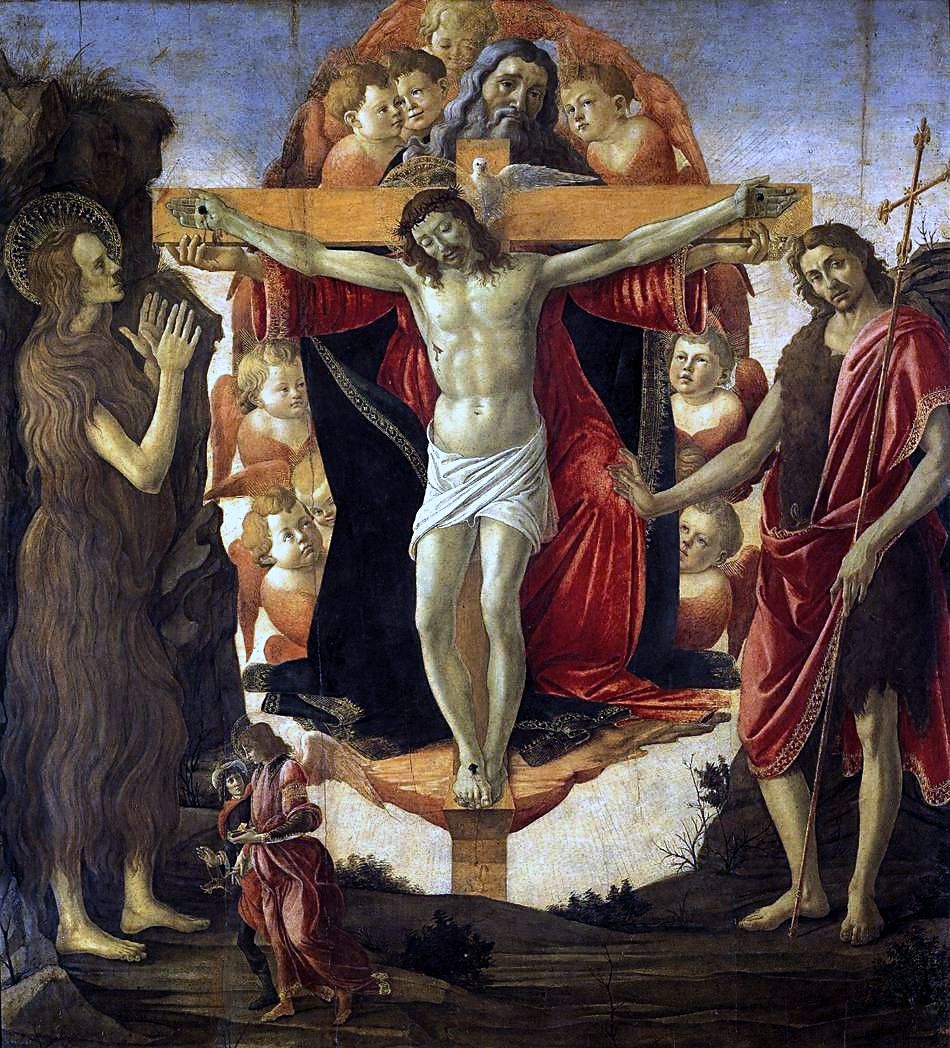
18 Where they crucified him, and with him two others, one on each side, and Jesus in the midst.
 
19 And Pilate wrote a title also, and he put it upon the cross. And the writing was: JESUS OF NAZARETH, THE KING OF THE JEWS.
 
20 This title therefore many of the Jews did read: because the place where Jesus was crucified was nigh to the city: and it was written in Hebrew, in Greek, and in Latin.
 
21 Then the chief priests of the Jews said to Pilate: Write not, The King of the Jews; but that he said, I am the King of the Jews.
 
22 Pilate answered: What I have written, I have written.
 
23 The soldiers therefore, when they had crucified him, took his garments, (and they made four parts, to every soldier a part,) and also his coat. Now the coat was without seam, woven from the top throughout.
 
24 They said then one to another: Let us not cut it, but let us cast lots for it, whose it shall be; that the scripture might be fulfilled, saying: They have parted my garments among them, and upon my vesture they have cast lots. And the soldiers indeed did these things.
 
25 Now there stood by the cross of Jesus, his mother, and his mother's sister, Mary of Cleophas, and Mary Magdalen.
 
26 When Jesus therefore had seen his mother and the disciple standing whom he loved, he saith to his mother: Woman, behold thy son.
 
27 After that, he saith to the disciple: Behold thy mother. And from that hour, the disciple took her to his own.
 
28 Afterwards, Jesus knowing that all things were now accomplished, that the scripture might be fulfilled, said: I thirst.
 
29 Now there was a vessel set there full of vinegar. And they, putting a sponge full of vinegar and hyssop, put it to his mouth.
 
30 Jesus therefore, when he had taken the vinegar, said: It is consummated. And bowing his head, he gave up the ghost.
 
31 Then the Jews, (because it was the parasceve,) that the bodies might not remain on the cross on the sabbath day, (for that was a great sabbath day,) besought Pilate that their legs might be broken, and that they might be taken away.
 
32 The soldiers therefore came; and they broke the legs of the first, and of the other that was crucified with him.
 
33 But after they were come to Jesus, when they saw that he was already dead, they did not break his legs.
 
34 But one of the soldiers with a spear opened his side, and immediately there came out blood and water.
 
35 And he that saw it, hath given testimony, and his testimony is true. And he knoweth that he saith true; that you also may believe.
 
36 For these things were done, that the scripture might be fulfilled: You shall not break a bone of him.
 
37 And again another scripture saith: They shall look on him whom they pierced.
 
38 And after these things, Joseph of Arimathea (because he was a disciple of Jesus, but secretly for fear of the Jews) besought Pilate that he might take away the body of Jesus. And Pilate gave leave. He came therefore, and took the body of Jesus.
 
39 And Nicodemus also came, (he who at the first came to Jesus by night,) bringing a mixture of myrrh and aloes, about an hundred pound weight.
 
40 They took therefore the body of Jesus, and bound it in linen cloths, with the spices, as the manner of the Jews is to bury.
 
41 Now there was in the place where he was crucified, a garden; and in the garden a new sepulchre, wherein no man yet had been laid.
 
42 There, therefore, because of the parasceve of the Jews, they laid Jesus, because the sepulchre was nigh at hand.
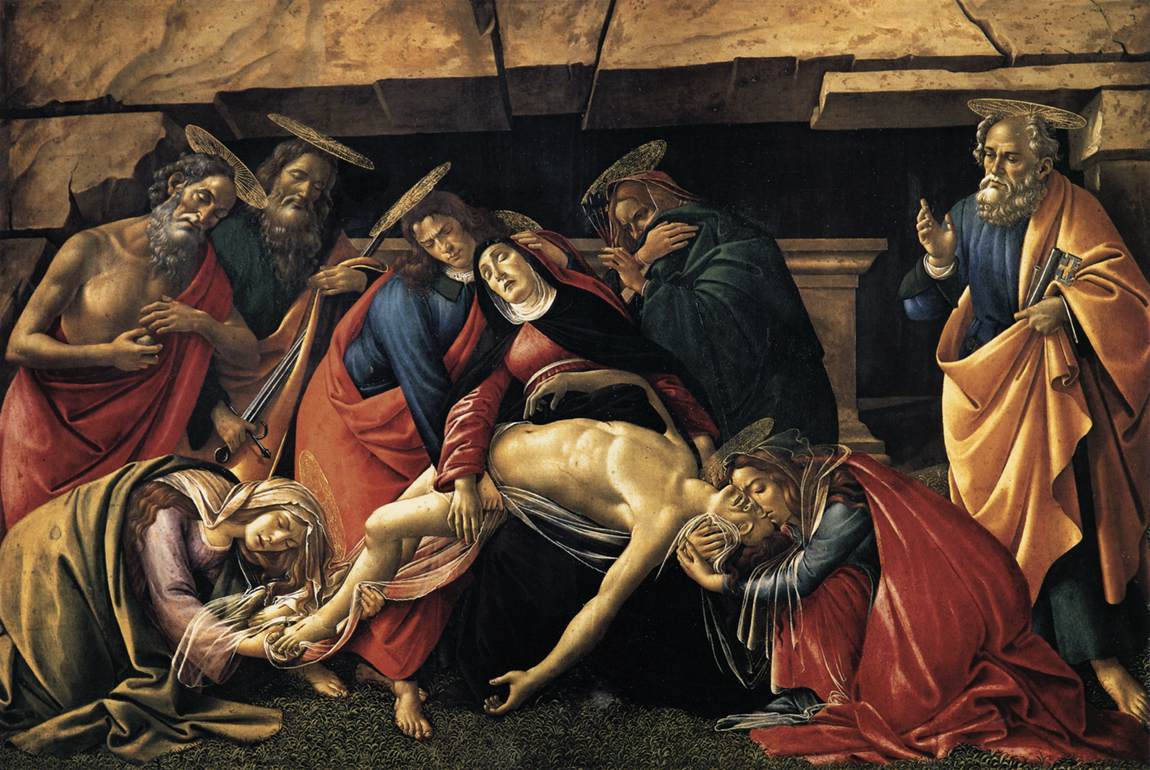


Maundy Thursday

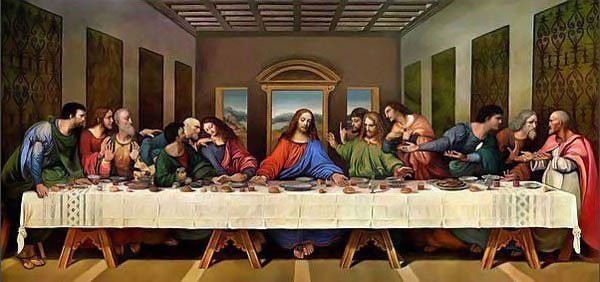
We have now come to the holiest time of the year. On Holy Thursday, or Maundy Thursday to give it its English name, we come finally to the Last Supper, and thus to the First Communion and the institution of the priesthood.

Many customs associated with this day. In some countries it was common for the king or queen to wash the feet of the poor, in remembrance of the same action by Christ commemorated in today's Gospel (as we'll see.) In many churches, the washing of the feet is performed by the priest, or by the faithful for one another. Very often bells are rung this day, and then silenced, and will not be heard again until Easter. In many countries, children would run through the street announcing the time for mass, in lieu of bells; the bells themselves having, it was said, gone to Rome to be absolved of their sins. Of course this often led to Trick-or-Treating, after the usual fashion, sending children door to door to ask for candy having been the usual way our ancestors had for celebrating holidays of any kind.

Practice

The days that follow are the most solemn and the most holy of the year. It is my view at this time that the Easter season should not be used for practical magic, but only for works of meditation, devotion, almsgiving and repentance. If the mass is available to you in whatever form, you should at least attend on Easter Sunday, but daily mass going during Holy Week is a fine idea. Tomorrow's Good Friday service is very long and emotionally challenging, as it ought to be, but it will reward everything you put into it.

These days it is both our blessing and our curse to have livestreamed masses available on the internet, so that you can participate to a certain degree in the ceremony of any denomination you choose, including the more obscure, Esoteric or Esoteric-friendly ones that I personally prefer. Used properly, these can be a blessing, but you also run the risk of further entangling yourself in technology.

Missa Sicca

If a mass is unavailable, an option that I would like to see more widely practiced is the missa sicca, or "dry mass." This was a form of liturgy that was practiced in the Middle Ages when a priest did not have access to bread and wine. As such, it consists of every part of the mass-- except for the Eucharist. The disadvantage is obvious, but the advantage is that it may be practiced with good effect by any person, whether ordained or otherwise, and it makes for an excellent form of private meditation.

In order to perform the missa sicca, you need the text for the day's mass. Begin with the Sign of the Cross, as usual, and make use of every tool to expand that practice that we've discussed here. Then move onto the readings.

Down the road I'm going to do a longer post on the missa sicca as a magical practice unto itself. In the meantime, you can find a good how-to for personal use here, and a set of readings for every day of the year here.

The Stripping of the Altars
 
At the close of the mass on Maundy Thursday the altars are stripped, the host removed to an altar of repose, as no hosts are consecrated during the masses on Good Friday and Holy Saturday. During this time, the 21st Psalm is sung. Whatever form your devotion takes today, you should definitely consider closing with its words:

They have divided my garments among them, and for my vesture they have cast lots.

Psalm 21: O God my God, look upon me: why hast thou forsaken me? Far from my salvation are the words of my sins.

O my God, I shall cry by day, and thou wilt not hear: and by night, and it shall not be reputed as folly in me.

But thou dwellest in the holy place, the praise of Israel.

In thee have our fathers hoped: they have hoped, and thou hast delivered them.

They cried to thee, and they were saved: they trusted in thee, and were not confounded.

But I am a worm, and no man: the reproach of men, and the outcast of the people.

All they that saw me have laughed me to scorn: they have spoken with the lips, and wagged the head.

“He hoped in the Lord, let him deliver him: let him save him, seeing he delighteth in him.”

For thou art he that hast drawn me out of the womb: my hope from the breasts of my mother.

I was cast upon thee from the womb. From my mother's womb thou art my God,

Depart not from me. For tribulation is very near: for there is none to help me.

Many calves have surrounded me: fat bulls have besieged me.

They have opened their mouths against me, as a lion ravening and roaring.

I am poured out like water; and all my bones are scattered. My heart is become like wax melting in the midst of my bowels.

My strength is dried up like a potsherd, and my tongue hath cleaved to my jaws: and thou hast brought me down into the dust of death.

For many dogs have encompassed me: the council of the malignant hath besieged me. They have dug my hands and feet.

They have numbered all my bones. And they have looked and stared upon me.

They parted my garments amongst them; and upon my vesture they cast lots.

But thou, O Lord, remove not thy help to a distance from me; look towards my defense.

Deliver, O God, my soul from the sword: my only one from the hand of the dog.

Save me from the lion's mouth; and my lowness from the horns of the unicorns.

I will declare thy name to my brethren: in the midst of the church will I praise thee.

Ye that fear the Lord, praise him: all ye the seed of Jacob, glorify him.

Let all the seed of Israel fear him: because he hath not slighted nor despised the supplication of the poor man. Neither hath he turned away his face form me: and when I cried to him he heard me.

With thee is my praise in a great church: I will pay my vows in the sight of them that fear him.

The poor shall eat and shall be filled: and they shall praise the Lord that seek him: their hearts shall live for ever and ever.

All the ends of the earth shall remember, and shall be converted to the Lord: And all the kindreds of the Gentiles shall adore in his sight.

For the kingdom is the Lord's; and he shall have dominion over the nations.

All the fat ones of the earth have eaten and have adored: all they that go down to the earth shall fall before him.

And to him my soul shall live: and my seed shall serve him.

There shall be declared to the Lord a generation to come: and the heavens shall shew forth his justice to a people that shall be born, which the Lord hath made.

They have divided my garments among them, and for my vesture they have cast lots


Palm Sunday

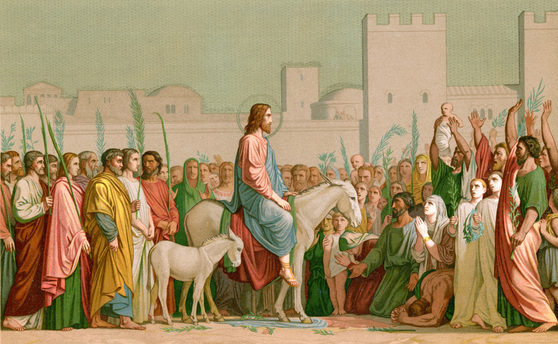
Today is Palm Sunday, and the beginning of Holy Week. This is the day of Christ's entry in triumph into Jerusalem.

 
21 And when they drew near to Jerusalem and came to Beth′phage, to the Mount of Olives, then Jesus sent two disciples, 2 saying to them, “Go into the village opposite you, and immediately you will find an ass tied, and a colt with her; untie them and bring them to me. 3 If any one says anything to you, you shall say, ‘The Lord has need of them,’ and he will send them immediately.” 4 This took place to fulfil what was spoken by the prophet, saying,
 
5 “Tell the daughter of Zion,
Behold, your king is coming to you,
humble, and mounted on an ass,
and on a colt, the foal of an ass.”
 
6 The disciples went and did as Jesus had directed them; 7 they brought the ass and the colt, and put their garments on them, and he sat thereon. 8 Most of the crowd spread their garments on the road, and others cut branches from the trees and spread them on the road. 9 And the crowds that went before him and that followed him shouted, “Hosanna to the Son of David! Blessed is he who comes in the name of the Lord! Hosanna in the highest!” 10 And when he entered Jerusalem, all the city was stirred, saying, “Who is this?” 11 And the crowds said, “This is the prophet Jesus from Nazareth of Galilee.”

Matthew 21:1-11
The Blessing of Palms

The best-known tradition associated with Palm Sunday is, of course, the blessing of palms. In many a Catholic household one can see palm branches, distributed during today's mass, twined behind the crucifix. The palm branches commemorate the branches which were laid before Our Lord by the crowd.

Now, this custom originated in the Middle East, where palm or olive branches are widely available. As it spread to northern parts of the world, it became common to use local trees. In this age of global trade networks, palm branches are widely used, but we should consider the opportunity provided by the older custom. The palm branches, once consecrated, become magical talismans which are able to ward off evil spirits and devices of hostile magicians. At one time it was common to burn the consecrated palm fronds in order to ward off natural, and in fact this use was wisespread enough that the Modernist church felt the need to condemn it; we may therefore be assured of its usefulness. Many trees have natural magical properties which can strengthen the protective effect of the blessing, and some are far better than the palm. Most evergreens are good, and cedar and juniper in particular have been used throughout the world to clear negative energy and repel hostile magic, I strongly recommend them.

A Ceremony for the Blessing of Branches

By this point in our journey, you know how this goes. Set up your altar in the usual way, and place the branches you intend to consecrate upon it. After the usual preparatory work, call down the energy of the Holy Spirit, and say the following words of consecration over the branches:


O Lord, bless + these branches of palm [or whatever tree you've chosen]. Grant that the sincere devotion of Your people may make them victorious over their enemy and zealous in works of mercy, and thus spiritually complete the ceremony which they outwardly perform this day in Your honor. Through Christ our Lord, Amen.

They are now a consecrated sacramental, and you may use them for whatever purpose you like. Traditionally, they are interlaced behind the corpus on your home crucifix, and they may be burned throughout the year for purposes of spiritual protection and energetic purification.

Devotional Practice for Palm Sunday

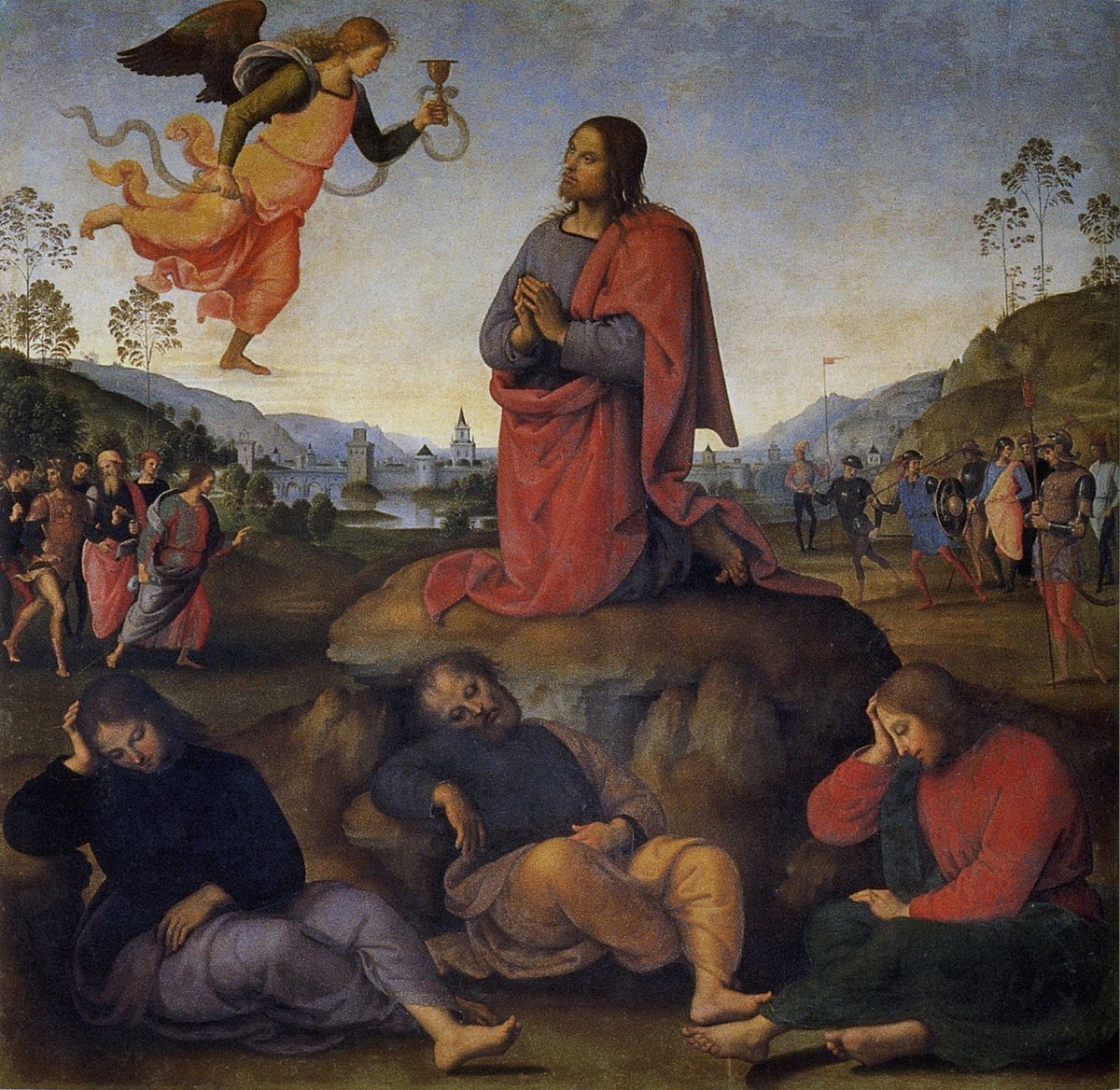
Palm Sunday is a day at once joyful and sorrowful. A century ago, the liturgy consisted of two parts: In the first, palms were blessed and distributed to the faithful in a ceremony that more-or-less exactly mirrored the sacrament of Communion, and this fact shows us something about the nature of the Communion rite and its inner structure. The second part was the mass itself. In the first ceremony, the Gospel reading commemorated Christ's triumphant entry into Jerusalem. The Gospel reading for the mass was the Agony in the Garden:

36 Then Jesus went with them to a place called Gethsem′ane, and he said to his disciples, “Sit here, while I go yonder and pray.” 37 And taking with him Peter and the two sons of Zeb′edee, he began to be sorrowful and troubled. 38 Then he said to them, “My soul is very sorrowful, even to death; remain here, and watch with me.” 39 And going a little farther he fell on his face and prayed, “My Father, if it be possible, let this cup pass from me; nevertheless, not as I will, but as thou wilt.” 40 And he came to the disciples and found them sleeping; and he said to Peter, “So, could you not watch with me one hour? 41 Watch and pray that you may not enter into temptation; the spirit indeed is willing, but the flesh is weak.” 42 Again, for the second time, he went away and prayed, “My Father, if this cannot pass unless I drink it, thy will be done.” 43 And again he came and found them sleeping, for their eyes were heavy. 44 So, leaving them again, he went away and prayed for the third time, saying the same words. 45 Then he came to the disciples and said to them, “Are you still sleeping and taking your rest? Behold, the hour is at hand, and the Son of man is betrayed into the hands of sinners. 46 Rise, let us be going; see, my betrayer is at hand.”
A good devotional practice for today might begin with the blessing of the Palms, and continue with a deep meditation on the Gospel passage above. We have, here, two parts of the three-part journey which recurs again and again in the spiritual life. First the Joy of the entrance into Jerusalem; then the Sorrow of Christ's betrayal. In Sorrow we must now abide for a time, but in a week, that Sorrow gives way to a Glory surpassing all earthly Joy.

Click here to support this blog.


Today, a brief passage from The Gospel of Matthew, and a brief comment. The Gospel of Matthew, Chapter 12, verses 15-21 reads: 

15 But when Jesus knew it, he withdrew himself from thence: and great multitudes followed him, and he healed them all;
 
16 And charged them that they should not make him known:
 
17 That it might be fulfilled which was spoken by Esaias the prophet, saying,
 
18 Behold my servant, whom I have chosen; my beloved, in whom my soul is well pleased: I will put my spirit upon him, and he shall shew judgment to the Gentiles.
 
19 He shall not strive, nor cry; neither shall any man hear his voice in the streets.
 
20 A bruised reed shall he not break, and smoking flax shall he not quench, till he send forth judgment unto victory.
 
21 And in his name shall the Gentiles trust.
 
Prophecy

Matthew is connecting the Old and New Testaments, and presenting Christ as the fulfillment of Old Testament prophecy. The question, of course, is whether he is right to do so. Modern Biblical "scholars" tend to say No-- they read each Gospel as simply presenting the agenda of its particular author. Matthew is trying to convert Jews, Luke is making a political argument, John is arguing at once against the Jews and against proto-Gnostic followers of Thomas, and so on. 

Of course, the orthodox position is that the incidents wherein Jesus fulfills Old Testament prophecy are exactly what they claim to be. When I was much younger, a Christian evangelist presented this to me as a reason I ought to attend his church. I thought it was nonsense. "So the Bible is right because the Bible said so?" I scoffed as only a 20 year old can scoff and departed the scene. But of course what we call "the Bible" is not a book but a collection of books, collected precisely because of their relationship to one another. 

Now, of course, the perspective I've been using in these commentaries is neither the false skepticism of the modern "critic" nor the naive acceptance of the orthodox believer. But it is far closer to the latter than the former, and I'm inclined to take Matthew at his word here. If it looked like Jesus was fulfilling a prophecy, that's very likely because he was fulfilling a prophecy, and the Gospel authors recorded it as such for the obvious reason.  

Fulfilled Prophecies

I want to say two more things on this topic.

The first is that in a fulfilled prophecy we have one of the best tests of religious truth you can find. The fulfilled prophecy is the religious equivalent of the accurate prediction which proves the scientific hypothesis. 

On June 17, 1917, the Virgin Mary gave the following message to three children at Fatima, in Portugal:

I shall come to ask for the Consecration of Russia to my Immaculate Heart. If people attend to my requests, Russia will be converted and the world will have peace.

In a later appearance that July she was more specific:

God wishes to establish in the world devotion to my Immaculate Heart. If what I say to you is done, many souls will be saved and there will be peace. The [First World] war is going to end; if people do not cease offending God, a worse one will break out during the pontificate of Pius XI. When you see a night illumined by an unknown light, know that this is the great sign given you by God that He is about to punish the world for its crimes, by means of war, famine, and persecutions of the Church and of the Holy Father. To prevent this, I shall come to ask for the consecration of Russia to my Immaculate Heart.... If my requests are heeded, Russia will be converted, and there will be peace. If not, she will spread her errors throughout the world, causing wars and persecutions of the Church. The good will be martyred, the Holy Father will have much to suffer, and various nations will be annihilated. In the end, my Immaculate Heart will triumph. The Holy Father will consecrate Russia to me, and she will be converted, and a period of peace will be granted to the world
 
Now the consecration of Russia took place in 1984, as part of a consecration of the entire world. A miracle promptly followed. Within five years, the Warsaw Pact began to fall apart. By 1991 the Communist Party had fallen in Russia, the Soviet Union was dissolved, and the Russian Church began a resurgence which continues to this day. 

In another world, this would be sufficient proof of the power of the Immaculate Heart of Mary. And also of the fact that the schism that divides the Russian and the Roman Churches means little or nothing in Heaven. Humans being humans, neither of these is an acceptable option, and so the most astonishing spiritual event of the 20th century goes largely ignored. 

Two thousand years ago, the famous Roman statesman Cicero presented a dialog about the existence of the gods in his work, De Natura Deorum (On the Nature of the Gods). Part of it runs as as follows:

The augur's office is one of high dignity; surely the soothsayer's art also is divinely inspired. Is not one who considers these and countless similar facts compelled to admit that the gods exist? If there be persons who interpret the will of certain beings, it follows that those beings must themselves exist; but there are persons who interpret the will of the gods; therefore we must admit that the gods exist. But perhaps it may be argued that not all prophecies come true. Nor do all sick persons get well, but that does not prove that there is no art of medicine. 
 
Nothing is really new, and humanity runs in the same circles over and over again.
 The Gospel of Matthew, Chapter 12, Verses 1-14 reads: 
 
 
1 At that time Jesus went on the sabbath day through the corn; and his disciples were an hungred, and began to pluck the ears of corn and to eat.
 
2 But when the Pharisees saw it, they said unto him, Behold, thy disciples do that which is not lawful to do upon the sabbath day.
 
3 But he said unto them, Have ye not read what David did, when he was an hungred, and they that were with him;
 
4 How he entered into the house of God, and did eat the shewbread, which was not lawful for him to eat, neither for them which were with him, but only for the priests?
 
5 Or have ye not read in the law, how that on the sabbath days the priests in the temple profane the sabbath, and are blameless?
 
6 But I say unto you, That in this place is one greater than the temple.
 
7 But if ye had known what this meaneth, I will have mercy, and not sacrifice, ye would not have condemned the guiltless.
 
8 For the Son of man is Lord even of the sabbath day.
 
9 And when he was departed thence, he went into their synagogue:
 
10 And, behold, there was a man which had his hand withered. And they asked him, saying, Is it lawful to heal on the sabbath days? that they might accuse him.
 
11 And he said unto them, What man shall there be among you, that shall have one sheep, and if it fall into a pit on the sabbath day, will he not lay hold on it, and lift it out?
 
12 How much then is a man better than a sheep? Wherefore it is lawful to do well on the sabbath days.
 
13 Then saith he to the man, Stretch forth thine hand. And he stretched it forth; and it was restored whole, like as the other.
 
14 Then the Pharisees went out, and held a council against him, how they might destroy him.


The Machine Stopped, But No One Noticed

Imagine a town built around a nuclear power plant. Every household has at least one family member employed at the plant. At work, the employees wear personal protective equipment: hard hats, safety goggles, gloves, steel-toed boots. Over time, the culture of this community becomes thoroughly built around the power plant-- weddings, birthdays, even funerals, all take place at the plant. Everyone wants to work at the nuclear plant, and so even those who don't work at the plant go about in hardhats and safety goggles and so on.  

After a while, the plant itself ceases to function. Funny enough, though, no one realizes this. After long centuries, the cultural activities centered around the plant have become the point. Engineers go to work and oversee machines that no longer function. Welders and machinists repair pipes through which nothing passes. Reactor operators press buttons in prescribed sequences handed down from long ago, totally unaware that nothing at all is happening. And everyone dresses in hardhats and safety gloves and goggles and steel-toed boots, despite the lack of anything very much to be protected from. Indeed, the dress code is enforced all the more rigidly, now that it is an end unto itself, rather than a means. 

This is what superstition is: the continued use of spiritual practice-- or, far more commonly, fragments of spiritual practices-- whose meaning and purpose is no longer understood. Very often, the practices are in fact useless, because the Power which animated them has departed. 

In Jesus's time, many of the practices of the Jews have degenerated into superstition. Moreover, it's quite likely that the Power of YHVH had indeed departed Jerusalem, as demonstrated by the temple's destruction just a few decades later. 

The Man Came Around

Let's go back to the defunct nuclear power plant.

Suppose that, one day, a man turns up who claims to be the plant's owner. Along with a trusted crew of engineers and workmen, he manages to restore power here and there and get parts of the plant up and working again. 

He quickly becomes quite popular. One day, he and his engineers are sitting around the plant's cafeteria, eating lunch. Because they're in the cafeteria, they have their gloves and hardhats off, and they don't bother with goggles. 

The Board of Safety that runs the plant are upset. They're used to screaming at people to put their hat and gloves on, even if they're at lunch, or in the bathroom, or outside smoking a cigarette. And here's this jerk that claims to be the plant owner, sitting around eating a sandwich with his bare hands! When they ask him just what he thinks he's up to, he calmly replies that gloves were made for man, and not man for gloves, and in any case this is his plant and he'll do whatever he darn well pleases. 

The Board of Safety are not pleased.

The Trouble With Abraham

If I didn't have a deep and abiding love for the Christian religion, I wouldn't be writing these posts. That much should be obvious. That said, Christianity has a problem, and it's one that it shares with the other Abrahamic faiths, for the most part. To understand that problem, let's go back to the nuclear power plant. 

Suppose that when the plant was built, the Board of Safety demanded that the town use it as its only source of energy. When some people refused, the employees went out and destroyed every coal-fired power plant, every hydroelectric plant, every windmill and solar panel they could get their hands on. After that, the Board of Safety insisted that nuclear was the only possible source of energy, that no other energy source existed, and that any claims by anyone to have produced energy from any source other than nuclear was a lie. Several other nuclear plants were built, but after a few centuries, rivalries grew up between the different Board of Safety. So that now, each Board of Safety insists not only that nuclear is the only possible source of energy, but that its own plant is the only possible source of nuclear energy. Other nuclear plants are schismatic frauds, which only seem to produce energy to the foolish or malicious. 

In such a situation, it would become impossible to determine whether a plant was working or not, because it could no longer be tested. If Plant B seemed to be producing enough energy that people in the surrounding territory could turn the lights on in their homes, what of it? We already know that Plant B is a schismatic power plant, and Plant A is the only true nuclear power plant. So the idea that nuclear power allows people to turn lights on is merely a superstition. In fact, it's probably pure paganism, since those wicked people who make use of coal-fired power plants make similar claims. No, the proper way to judge a nuclear power plant is whether it adheres to the same Manual of Safety Procedures yours does-- or whether it's obedient to your Board of Safety-- anything else is mere superstition. 

The Circle is Unbroken

Much of CHristianity, then, is in a similar state to the Judaism of Jesus's day, with the added difficulty that many churches not only cannot judge the efficacy of their practices, they have in fact prohibited themselves from doing so! Indeed, much of Christianity largely consists of people going to the defunct nuclear power plant every Sunday to share coffee and sandwiches in the old cafeteria. 

This is why I say that we can always judge the conditions of our own souls, as the soul is the sum total of our thoughts, emotions, and actions. If we fail to do so, we wind up like Pharisees, performing actions we don't understand for reasons we've never known, or else we wind up treating spiritual practices as if they didn't matter at all. 


Let's close out Matthew Chapter 11 today, with verses 25-30:

25 At that time Jesus answered and said, I thank thee, O Father, Lord of Heaven and Earth, because thou hast hid these things from the wise and prudent, and hast revealed them unto babes.

26 Even so, Father: for so it seemed good in thy sight.
 
27 All things are delivered unto me of my Father: and no man knoweth the Son, but the Father; neither knoweth any man the Father, save the Son, and he to whomsoever the Son will reveal him.
 
28 Come unto me, all ye that labour and are heavy laden, and I will give you rest.
 
29 Take my yoke upon you, and learn of me; for I am meek and lowly in heart: and ye shall find rest unto your souls.
 
30 For my yoke is easy, and my burden is light.
 
Yuan Shen

Yesterday, we talked a bit bout the nature of egregores, the collective minds in which all human beings participate during our sojourn here on Earth. Egregores, as we explained, are natural and unavoidable, but sometimes grow toxic. Even when they are not toxic, however, egregores are not human beings.

Every egregore includes patterns of thought, communication, emotion, interaction, and behavior. If you carefully watch people around you, you will find you see the same types of interactions over and over again. One person receives Great News, and everyone knows what to say to them. Another gets into a fight with her boyfriend, and it looks like every other fight between every other couple you've ever seen. One person overcomes adversity, and everyone knows just how to think and feel about it; another relapses into addictive behavior, with all the usual consequences. Two coworkers fall in love, and the affair plays out with the inevitability of a train wreck; two estranged siblings have to spend a family holiday together, and

It's not that the people in your life are faking it. Their emotions, their thoughts, and their actions are real, and they mean them. It's just that they aren't really their emotions, their thoughts, their actions. They are scripted patterns, which are themselves the components of a larger egregore-- that of a human culture.

Again, there's nothing wrong with this as such. As human beings, we can't live without culture. We are born more or less helpless into a world which is set up to kill us. The first few years especially, but really the entire first half of our lives, are spent learning the cultural patterns and scripted behaviors which allow us to live on the Earth and have a reasonable chance of not dying.

But the work of spiritual practice-- and really, the work of the second half of every human life-- is to un-learn all of these scripts and uncover the real person underneath. In this way our thoughts, our actions, and all of our choices become our own. We begin to resemble Divinity, which acts through choice, and not contingency. And we also begin to resemble newborn babes, who have not yet become entangled in the web of human culture.

In Taoist practice, the human nature that is revealed once the mind is disentangled from the web of human culture is called yuan shen, or original spirit. This is who we are before we put on the costumes of our culture, our nation, our time, and even our selves.

Know the Son

Jesus reminds us here that he is the visible image of the Father, who abides eternally in Heaven. Since he brought it up, let's talk about the Holy Trinity. What are the Three Persons of the Trinity, and what is their relationship to one another?

It's important not to misunderstand this, and given some of the sources that we are using here in interpreting these texts, it is easy to do so. In later Platonist thought, every God has three aspects, sometimes called the essence, power, and energy. The energy of the God is its activity, its power is the sphere in which it is active, and its essence is its absolute being. Now, the essence of a God is not knowable, but we knowGods through their power and their energy.

It is possible to interpret the Christian Trinity this way, so that the Father, Son, and Holy Ghost are different aspects of a single God. In Catholic terms, however, this is incorrect. Divinity is the property that the Father, Son, and Holy Ghost each shares; each of them is God in the same way that you and I are both human beings, and so share in the quality "human." Now, it is the nature of "human" that we are each separate individuals, but the nature of divinity is Oneness itself. If three persons share divinity, they are One, eternally united, all-powerful, all-knowing, and ever-present.

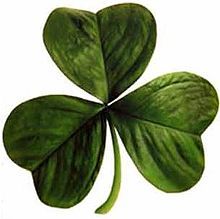
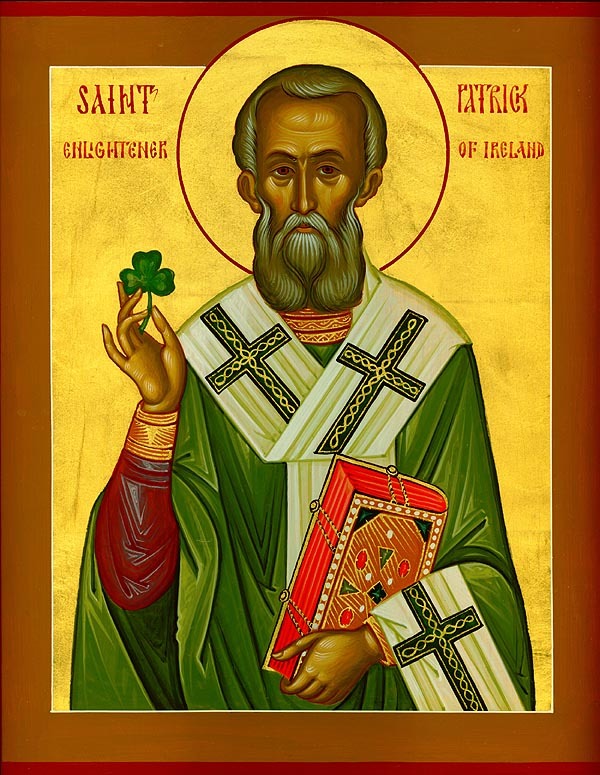
Saint Patrick famously explained the relationship between the three persons of the Trinity by way of the shamrock.


How many leaves are there on the shamrock? Three. But how many shamrocks are there? Just one. In the same way, the Holy Trinity are three persons, and only one God. Each person is a person, just as each leaf of the shamrock is a leaf; the shamrock really has three leaves, and not one leaf viewed from three perspectives, or one leaf doing three different things. 

In his commentary on Plato's Timaeus, Proclus tells us the following, about the nature of the gods:

Should we wish to examine what makes a god an intelligible god, or an intellective or supercelestial or encosmic one, we would find it is nothing other than the Good. For what makes each body ensouled other than... Soul? What makes the intellective souls such if not the intellect in them, which is an irradiation of Intellect as a whole? And what in that case is it that gives divinity to Intellect and intelligible being other than participation in the First and the radiation from it?

In other words: Souls are souls by the action of Soul Itself. Intellects (nous) are similarly formed by the action of Intellect Itself. And gods? Gods are gods because of their union with and in the Good. The Good, remember, is the same as the One; in Christianity as well as Platonism we refer to it as God. And so Gods have God in the same way that human beings have souls!

From this perspective, it becomes clear that, on Platonic terms, Christians worship not one God but three. I am more than aware of how controversial that statement is, which is why I qualified it. On Christian terms, the One is divinity itself, and the gods are the persons of the Trinity. This is often another source of confusion, as late Platonists used the term "personae" to refer to the aspects of a single divinity, as I described above-- but in Christian theology, seeing the persons of the Trinity as different aspects or activities of a single individual is a heresy known as modalism.

My Burden is Light

Jesus's final words in this chapter remind us that spiritual practice should-- ultimately-- make our lives better, not worse. I once read a blog by a Catholic traditionalist who had spent years as a New Ager. One of the things he mentioned was that, since committing himself to Traditional Catholicism, he had become more neurotic.

Now, the spiritual life is not easy and not for the faint of heart; "the way is narrow." At the same time, its ultimate fruit should be lightness of spirit and an easier way in the world-- "my burden is light." If you find that, after decades practicing a particular religion, you've become crazier, it would be better to find another one. 
The Gospel of Matthew, Chapter 11, Verses 20-24 reads:  

20 Then began he to upbraid the cities wherein most of his mighty works were done, because they repented not:
 
21 Woe unto thee, Chorazin! woe unto thee, Bethsaida! for if the mighty works, which were done in you, had been done in Tyre and Sidon, they would have repented long ago in sackcloth and ashes.
 
22 But I say unto you, It shall be more tolerable for Tyre and Sidon at the day of judgment, than for you.
 
23 And thou, Capernaum, which art exalted unto heaven, shalt be brought down to hell: for if the mighty works, which have been done in thee, had been done in Sodom, it would have remained until this day.
 
24 But I say unto you, That it shall be more tolerable for the land of Sodom in the day of judgment, than for thee.

Collective Punishment

In this passage, Jesus is directing his anger toward cities. To the modern ear, this is somewhat difficult to bear-- how can you condemn an entire population based on the actions of some of its members? Isn't that prejudicial, perhaps even a form of collective punishment?

To understand Jesus's words here, we need to understand two things. The first is the nature of cities in the ancient world. The second is the nature of the Astral Plane. These two concepts will lead us to understand this passage and ultimately lead us back to the Unity of God. 

The Ancient City

Many years ago, a French historian named Fustel de Coulanges explored the nature of cities in the ancient world in a fine volume entitled La Cite Antique (the Ancient City). You can read the entire text online here; it's also available on Audible, if, like me, you like audiobooks. If you want to understand the politics of the ancient world, Coulanges' work is the place to start. Now, this book was writing in 1864, and, as such, it shares prejudices, and odd obsessions of its era-- as contemporary works share the rather more egregious flaws and prejudices of our own era. But learning to read through the layers of bias that color every work of nonfiction without exception is a very useful skill to have, and so I strongly recommend you read-- or listen to-- the entire thing, cover to cover.

In Coulanges' telling, in the ancient world, the modes of life that we, today, classify under the headings "religion," and "politics" were not separate from one another, and neither was separate from "family." The basic unit of society was the household, organized-- and this is critical-- around a hearthfire. The hearthfire was not a mere instrument for heating and cooking, but was a living god, the guardian spirit of its particular household. Around the hearthfire were gathered various spirits of the home, including the spirits of dead ancestors. The father was at once head of the family and its chief priest-- and its representative in the larger extended family, in which the household was nested as the smallest node in a fractal that extended outward from there. Extended families were united into clans, clans into phratries, phratries into tribes, and tribes, finally, into cities. As each family had its sacred fire, its spirits and its ancestors, so the clan had its fires, its heroes and its gods, and so did the phratry, the tribe, and finally, the city as a whole. In the ancient world, the king of a city was at once also father and chief priest to the city as a whole. 

Collective Souls

As we've discussed many times before, none of our individual minds is an island to itself. It is, instead, a node in a larger network of minds-- or rather, many networks. Our souls themselves are parts of many larger, collective souls. We are part of the souls of our families, our towns, our states and our nations-- but also of all of the groups in which we participate. In Esoteric thought, these collective souls are called egregores. They form naturally whenever humans come together in a group. Relationships have egregores, and so do sports teams, subcultures, music fandoms, charitable organizations, occult societies and so on. There is nothing wrong with participating in an egregore and in fact you can't help but do so, many, many times over. 

The trouble is, an egregore can go toxic.

If you've ever seen a subculture destroy itself through in-fighting, purity spiraling, cultishness or abuse, you know what I'm talking about. Patterns of destructive behavior perpetuate themselves. Think of the viciousness, always internally directed, and the witch hunts that often consume left-wing internet forums. Similarly, in music scenes and youth subcultures that have gone toxic, it's common to hear established participants mourn for newcomers. "Somehow every new face, in every single case, in a year or two will be erased" went a popular punk song from my mis-spent youth. "Something breaks inside of you," another began, "The spectacle of all the shows, fifteen fights and your six bucks has gone up some promoter's nose." 

In my view, this is what Jesus is talking about here. The collective souls that animate the cities of Chorazin and Bethsaida and Capernaum have gone toxic. We know this, because they've rejected Jesus Himself, the visible image of the One God. 

The Day of Judgment

And so Jesus tells us in fairly plane words that these cities will be destroyed. "It shall be more tolerable for the land of Sodom in the day of judgment, than for thee." 

In the colorful language of the Gospels, we're led to picture God getting really mad and smashing these cities with His hand. This is metaphor. It would be more accurate to say that these cities have smashed themselves. 

God, always remember, is not one being among many. God is being itself, that by virtue of which anything at all exists. To reject God, therefore, is to reject existence. The more a soul-- any soul, be it of a person or a city-- turns away from God, the more it turns toward non-being, and dissipation until, finally, it ceases to be at all, and dissolves back into the primordial Chaos. 


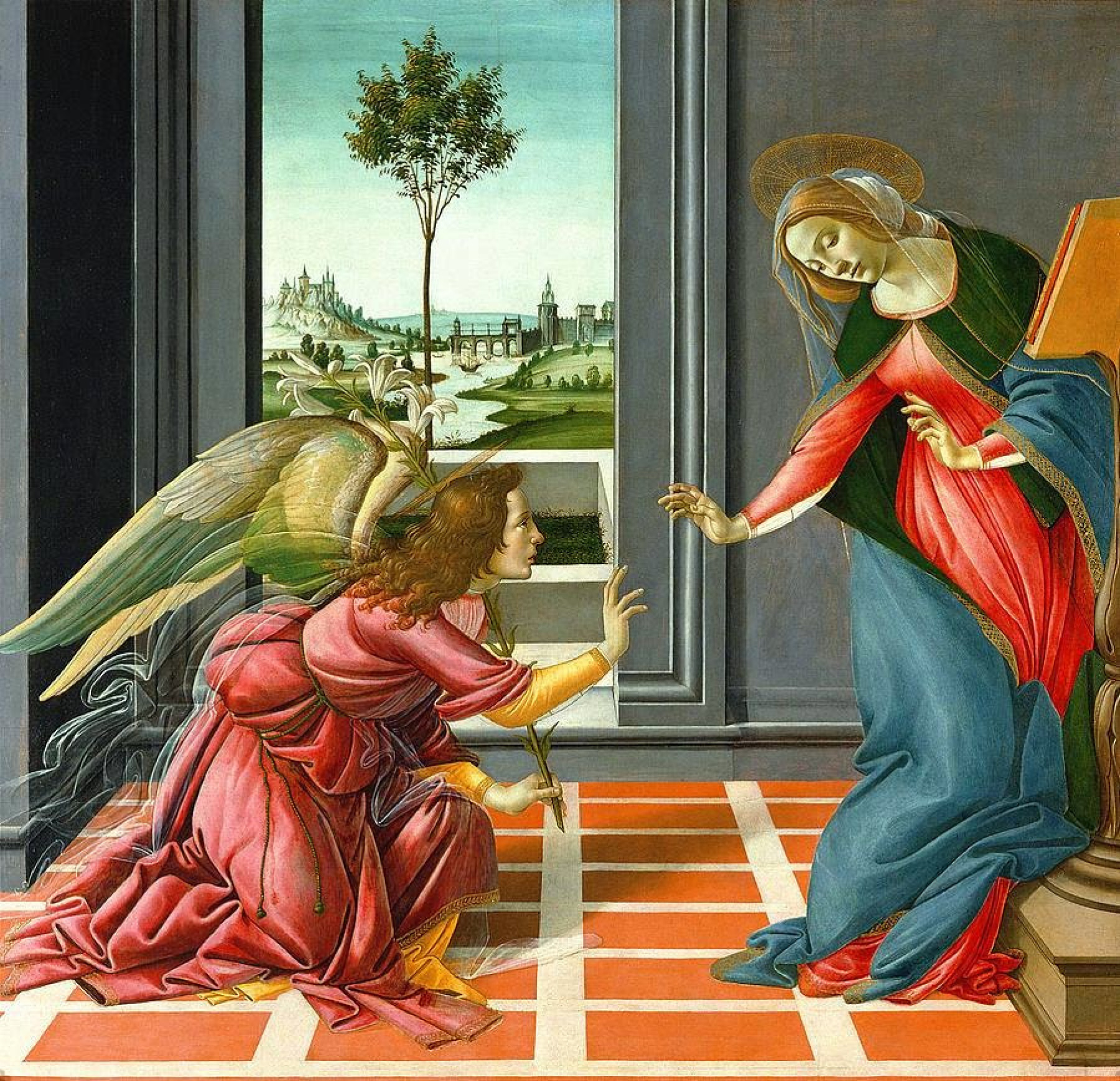
The Annunciation

March 25th is the Feast of the Annunciation, so called because on this day, the archangel Gabriel announces the birth of Christ to the Virgin Mary. Also called Lady Day in the English speaking world, this is one of the most important Marian feasts.

Origins

I could tell you where Lady Day comes from, but someone else has already done a much better job of explaining it than I could. So let's read together.
 

26 And in the sixth month, the angel Gabriel was sent from God into a city of Galilee, called Nazareth,
 
27 To a virgin espoused to a man whose name was Joseph, of the house of David; and the virgin's name was Mary.
 
28 And the angel being come in, said unto her: Hail, full of grace, the Lord is with thee: blessed art thou among women.
 
29 Who having heard, was troubled at his saying, and thought with herself what manner of salutation this should be.
 
30 And the angel said to her: Fear not, Mary, for thou hast found grace with God.
 
31 Behold thou shalt conceive in thy womb, and shalt bring forth a son; and thou shalt call his name Jesus.
 
32 He shall be great, and shall be called the Son of the most High; and the Lord God shall give unto him the throne of David his father; and he shall reign in the house of Jacob for ever.
 
33 And of his kingdom there shall be no end.
 
34 And Mary said to the angel: How shall this be done, because I know not man?
 
35 And the angel answering, said to her: The Holy Ghost shall come upon thee, and the power of the most High shall overshadow thee. And therefore also the Holy which shall be born of thee shall be called the Son of God.
 
36 And behold thy cousin Elizabeth, she also hath conceived a son in her old age; and this is the sixth month with her that is called barren:
 
37 Because no word shall be impossible with God.
 
38 And Mary said: Behold the handmaid of the Lord; be it done to me according to thy word. And the angel departed from her.

--The Gospel of Luke, Chapter 1, verses 26 through 38
 
The Meaning of the Annunciation

The passage from Luke's Gospel is also the first Joyous Mystery of the Rosary, which is the beginning of the Rosary as a whole. Its prominent place in Catholic devotional practice shows its importance. Like the rest of the Bible, this Gospel will reveal much to meditation. Still, we should talk a bit about the central idea here, which is contained in Mary's words:

Behold the handmaid of the Lord; be it done to me according to thy word.
 
Mary is the New Eve. The original Eve was tempted by a demon, and said Yes to power, and was, therefore, expelled from Paradise. The New Eve is tempted by an Angel, and says Yes to humility and, ultimately, suffering; for this, she is exalted above all creatures. This reversal is at the heart of Christianity and the heart of Christian mysticism. Lucifer is a mighty seraph, but that isn't enough for him; he wants to be God Himself. In his pride he rebels against the tyranny of Heaven, and is cast down. An ordinary angel refuses mighty Lucifer, asking "Who is like God?" He is raised up made prince of the Heavenly Host, and "Who Is Like God"-- in Hebrew, Micha-El-- becomes his name. Over and over we see this; as the Magnificat tells us,

He hath shewed might in His arm: He hath scattered the proud in the conceit of their heart.
He hath put down the mighty from their seat, and hath exalted the humble.

Now, Mary is the model for all Christians. We are all called to say "Behold the servant of the Lord." What this means is that we empty ourselves of attachment to worldly things, and in so doing open ourselves to Divine Grace. Mary herself is the fullness of grace, which is the meaning of Gabriel's opening words to her: Ave, gratia plena. By imitating her, we become like her, and share in the grace that is hers.

The Wheel of the Year

The Annunciation is coordinate with the Spring Equinox. Notice its 3 counterparts: Saint John's Day on June 24th; Saint Michael and All Angels on September 29th; and Christmas on December 25th. These are the four quarters of the year, and Christians have the option of celebrating them instead of the solstices and equinoxes as such, or of rolling the latter into the Christian holidays.

Notice the 4 figures that stand at the quarters of the year. We have Jesus himself at the Winter Solstice; Mary at Spring; John the Baptist at Summer; and St. Michael the Archangel at Autumn. Now, given that Jesus is not a saint, when we consider it from this point of view, it might be better to place St. John the Evangelist at the Winter quarter, opposite his counterpart, St. John the Baptist. The symbolism of these four figures-- Jesus (or John), Mary, John, Michael-- are linked in very interesting ways. Here again, I won't spoil it for you-- spend some time unlocking the symbolism in meditation.

Traditional Celebrations

In many parts of the Catholic world, the Annunciation marked the beginning of the year. In England it marked the start of the year until 1752, even after the Reformation had done away with as much that was good and interesting as possible.

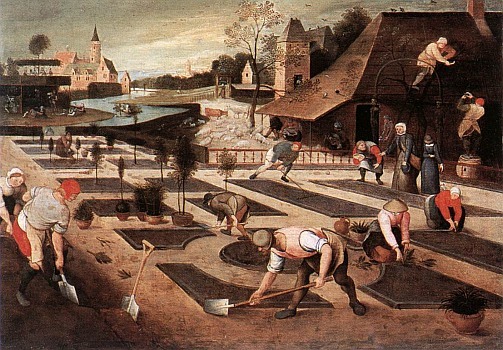
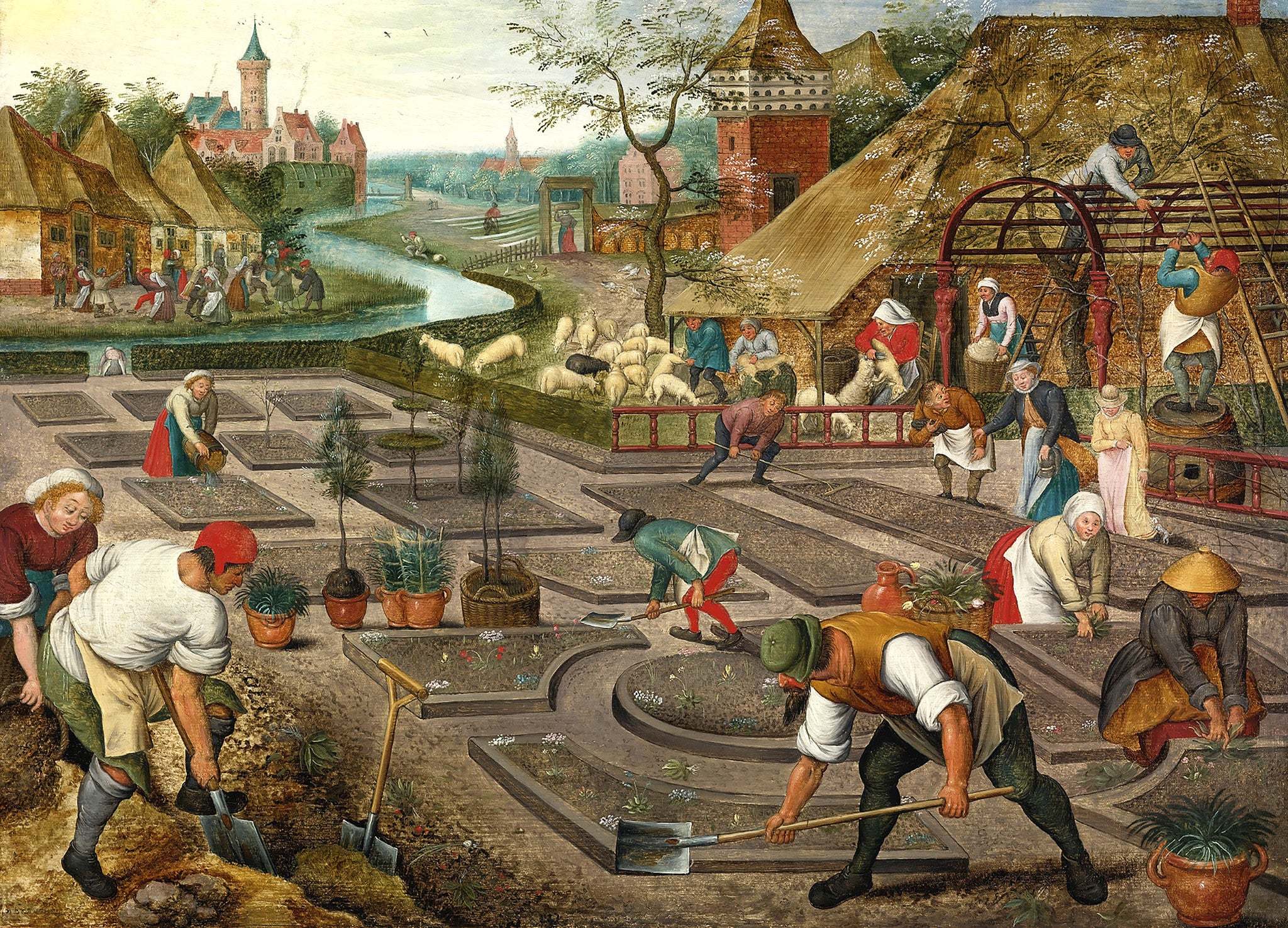
Annunciation customs are often associated with Spring and the sewing of the fields. In Russia, the priests would bless bread and give it to the people. Families would share their Annunciation Bread in silence, and then take the crumbs to the fields, where they were sprinkled as a protection against, blight, hail, and frost. Similar customs prevailed in Central Europe. Here, an icon of the annunciation was placed in a barrel of grain, and a suitable prayer said, such as this one:

O Mary, Mother, we pray to you; Your life today with fruit was blessed: Give us the happy promise, too, That our harvest will be of the best. If you protect and bless the field, A hundredfold each grain must yield.

After this, the grain could be sown in the fields.

Suggestions for Practice

Lady Day's symbols are the annunciation itself, Mary and her mission and nature, the beginning of Spring and the sowing of the fields.

Obviously, prayer directed toward Mary is particularly appropriate today. The Angelus is a great, simple prayer which is based on the Annunciation itself.

The Angelus

V. The Angel of the Lord declared unto Mary.
R. And she conceived by the Holy Spirit.

Hail Mary, Full of Grace, the Lord is with thee.
Blessed art thou among women, and blessed is the fruit of thy womb, Jesus.
Holy Mary, Mother of God, pray for us sinners, now and at the hour of our death.
Amen.
 
 
V. Behold the handmaid of the Lord.
R. Be it done unto me according to Thy word.

Hail Mary, Full of Grace, the Lord is with thee.
Blessed art thou among women, and blessed is the fruit of thy womb, Jesus.
Holy Mary, Mother of God, pray for us sinners, now and at the hour of our death.
Amen.
V. And the Word was made flesh.
R. And dwelt among us.

Hail Mary, Full of Grace, the Lord is with thee.
Blessed art thou among women, and blessed is the fruit of thy womb, Jesus.
Holy Mary, Mother of God, pray for us sinners, now and at the hour of our death.
Amen.
 
V. Pray for us, O Holy Mother of God.
R. That we may be made worthy of the promises of Christ.
 
 
LET US PRAY:
 
 
Pour forth, we beseech Thee, O Lord, Thy grace into our hearts;
that we to whom the Incarnation of Christ, Thy Son, was made known by the
message of an Angel, may by His Passion and Cross, be brought to the glory
of His Resurrection through the same Christ Our Lord. Amen.
 

A Feast of Grain

Most of us don't have grain to sow in the fields, but we can share in the symbolism of this aspect of the traditional celebration in other ways. If you bake bread, this is a good day for it. Once the loaf is ready, you can bless it, using the methods of blessing objects that I've previously given here, and share it with your family. A bit can be sit aside and placed in the yard or garden as a blessing.

Lady Day Bread

Ingredients:

3 Cups flour
12 ounces warm water
1 tsp salt
1 tsp Fleischmann's bread yeast*

*or whatever bread yeast you like. I prefer Fleischmann's because it's also good for making mead!

Step 1. Add yeast to water and let it set for a few minutes.
Step 2. Mix flour and salt in a bowl.
Step 3. Add water to flour. Mix thoroughly.

Now, every bread recipe will tell you to do things just a little bit differently at this point. I just use the wooden spoon I've been using the whole time to mix and knead the bread for a few minutes. Others will tell you to knead it by hand for seven minutes. Or you can just mix it lightly and let it set overnight. It's your call.

Step 4. Cover dough with a clean towel. and set it in a warm place to rise. Pro-tip: If it's summertime and you want your bread to rise quickly, set it in your car!
Step 5. After an hour or two, turn dough out onto a floured cutting board. Use your hands to form it into a ball, then flatten it, then ball it up again, 3 or 4 times. Then cover it.
Step 6. Cover bread and set oven to 450 degrees.
Step 7. When the oven hits 450, uncover your bread and place it on a floured pan. Yes, you can use a dutch oven or a cast iron or whathaveyou, but you can also use the same pan you use to bake cookies and your kid's chicken nuggets. (I'm telling you this because food blogs will try to make it sound complicated. It's not complicated. It's the easiest thing in the world.) Put it in the oven. Then turn the oven down to 375 degrees, and bake for 40-45 minutes.

Why do you turn the oven down? That's something I read about in John Michael Greer's book The Encyclopedia of Natural Magic. Apparently it helps form the crust. I thought that was cool, so it's how I always do it.

Step 8. Let the bread cool down for at least 30 minutes before you cut it. Then slice and eat.

A Prayer for Blessing Bread

Here is a simple prayer for the blessing of bread, from Catholic Online:
 
Holy Lord, almighty Father, eternal God, graciously deign to bless + this bread with Thy spiritual benediction that all who eat it may have health of body and soul and that they may be protected against all sickness and against all the snares of their enemies. Through Jesus Christ, Thy Son, the living bread that came down from heaven and giveth life and salvation to the world; who liveth and reigneth with Thee in the unity of the Holy Ghost, forever and ever. Amen.

A simple practice might be to say that prayer over your bread, then serve it at dinner along with a suitable discussion of the Feast of the Annunciation, perhaps reading the relevant passage from Luke.

Annunciation Prayer and Blessing of Bread, Full Form

1. Open with the Sign of the Cross, opening prayers, holy water and incense. Have your bread for blessing on your altar or prayer table, wrapped in a cloth.

2. Pray a suitable Confiteor. Take some time to visualize your sins. Imagine God's purifying fire descending from Heaven, scouring them from your soul.

3. Read the passage from the Gospel of Luke that I shared above. Enter into meditation for some time.

4. When you feel ready, unwrap the bread and pray the Angelus. At the words, "Pour forth, we beseech Thee, O Lord, Thy grace into our hearts," bow your head, raise your hands, and visualize a column of light descending from Heaven, pouring into your heart.

5. Then bless the bread using the prayer of blessing given above. While doing so, hold your hands over it, and imagine the same light pouring forth into the bread, filling it with Divine Fire.

6. Close with a suitable prayer. The Fatima prayer, Come Holy Spirit, or Prayer of Saint Francis are always good options, but today, the Magnificat might be the best option: 
 
My soul doth magnify the Lord,
And my spirit hath rejoiced in God my Saviour
Because He hath regarded the humility of his handmaid: for behold from henceforth all generations shall call me blessed.
Because He that is mighty hath done great things to me, and holy is His name.
And His mercy is from generation unto generations to them that fear Him.
 
He hath shewed might in His arm: He hath scattered the proud in the conceit of their heart.
He hath put down the mighty from their seat, and hath exalted the humble.
He hath filled the hungry with good things, and the rich He hath sent empty away.
He hath received Israel His servant, being mindful of His mercy.
As He spoke to our fathers; to Abraham and his seed forever.

Glory be to the Father, and to the Son, and to the Holy Ghost,
As it was in the beginning is now, and ever shall be, world without end. Amen.

Click here to support this blog.


Alban Eiler


Sunday at 11:33AM Eastern Daylight Time was the Spring Equinox. As less than 48 hours have passed since then, the energies of the Equinox are still active, so let's have a post on it!

The name Alban Eiler, commonly used for the Spring Equinox by modern Druids, comes from the work of Iolo Morganwg. In the Barddas, his collection of Ancient Celtic Lore which emerged largely from his own extraordinary mind, Iolo writes about the "free days" associated with the Sun:
  
 
There are two calculations of years: one is the year of the Sun, consisting of 365 days; the other is the year of the moon, having 354 days. The days which are over and above the number of the lunar year are called days of days, and they are thus distributed among the Albans, that is to say;--two days of days to Alban Arthan, three to Alban Eilir, three to Alban Hevin, and three to Alban Elved. They are free days, and let any one come from any place he may, he will be free, and exposed to no weapon or stroke, since there can be no court and law of country on those days.

Qi Nodes

In Chinese philosophy and traditional medical practice, the pattern of shifting energies through the seasons is called
jia qi or "Calendar Energy." Moments when the energy shifts in a big way are called Qi Nodes. Traditional acupuncturists, qigong teachers, and the like, have an elaborate system of practices designed to attune the energy of the individual to that of the season. This includes particular foods which are especially beneficial, qigong and meditation exercises, and modes of conduct. In the West, a similar system existed, but it's in fragments now, and part of our work is to reconstruct it; we can look to the intact energetic systems to provide some clues as to how to do that, as well as to the fragments of our own holistic system.

The Ember Fast is one of the most survivals of the Western system of energetic medicine, as it relates to the jia qi. The purpose of the fast is to re-set our energetic system. The foods of Winter are purged from our bodies, and we experience a kind of stillness and freedom from movement, from which we can begin to move again, in harmony now with the Spring Energy, rather than the Winter Energy which is passed.

Additional associations of Spring include: The element of Air; the Zodiac sign of Aries; regeneration, renewal, and rebirth; the sin of Pride; joy, gaiety, lust, and starvation. Notice that some of the images associated with Spring are pleasant, some are joyful, some are painful. The nature of the element of Air, which dominates this season, is strongly dualistic; it has its positive and negative qualities, and both are often active at the same time. In the world of nature, the long cold of Winter is done and light is beginning to return, but Winter food stores are largely depleted, and new crops have not yet begun to grow. Historically, this is the time of starvation.

The dualistic nature of Spring is also reflected in the two sides of the Liturgical Year that share in it. Spring begins with Lent, in which we attune ourselves with the rhythm of the natural world by sharing in its time of hunger and restraint. Lent is followed by Easter, in which we participate in the rebirth of Christ and of the Sun by a long season of joyous celebration.

Suggestions for Practice

If you're reading this, there is a good chance that you already have a way of celebrating the Spring Equinox, and I'd like to encourage you to stick with it! For everyone else, as with the Winter Solstice, I'm just going to make a few suggestions for practices now. Eventually, we'll have a more elaborate ritual for each point on the calendar, but it's best not to rush these things; the energies moving at this time of year are powerful and shouldn't be treated lightly.

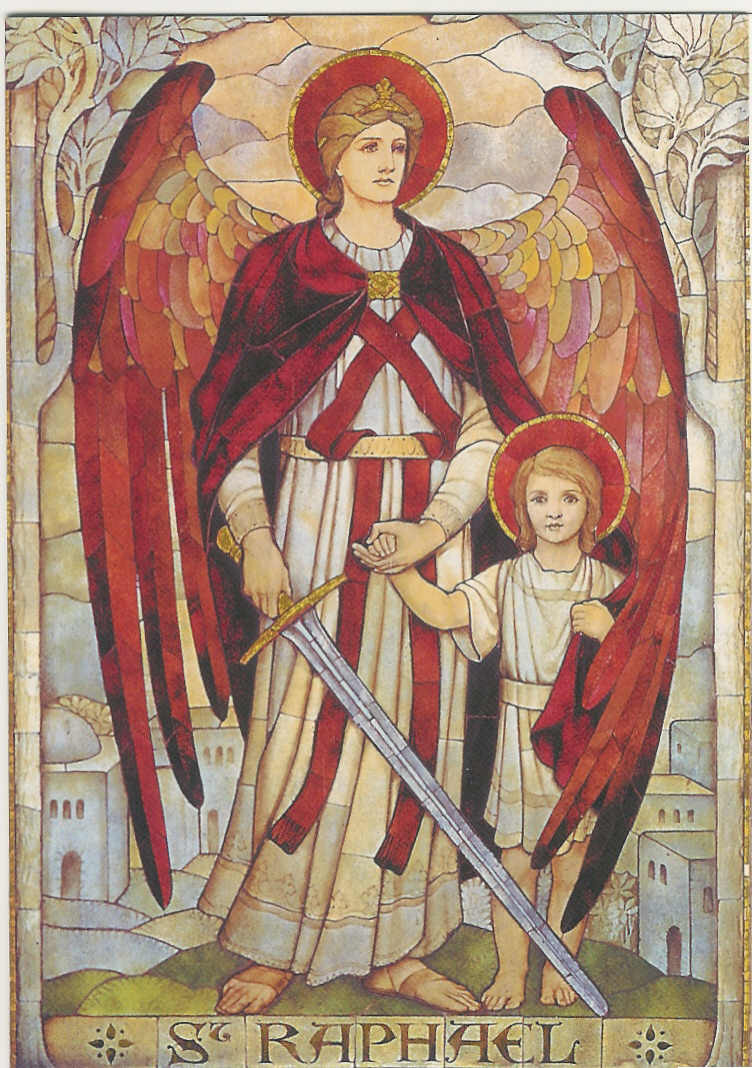
1. Continue the invocation of St. Raphael from the Spring Ember Days; we can even make the Equinox a kind of culmination of that practice, with the slog of Embertide as preparation. In meditation, you can imagine the Archangel extending a blessing which attunes you to the energy of the season.

2. A free day. As in the selection from the Barddas above, we can make this a kind of free day in our own homes. Children can be given lighter chores and freedom from other responsibilities. The idea of the "Free Day" can be tied in with the Ember Fast to create a kind of general Energetic Reset for Spring.
 

3. Spring Fires. If you saved your Christmas Tree, it's probably thoroughly dried out by this point. (Mine was! The Spring Equinox is a great time to burn it. The fire signifies the transformation of Earth to Air, as the incense of the needles rises into the sky. Let the kids roast marshmallows over the fire and make smores. Have fun.

Spring conduct in general should be light. Eat greens, herbs and sprouts; listen to music in the car, instead of lectures; read a novel. And you might even consider using the promo code PRIMAVERA to get 30% off any item at my Etsy shop over the next two weeks, if you were so inclined. 
 

Happy Alban Eiler, everybody!


Click here to support this blog.


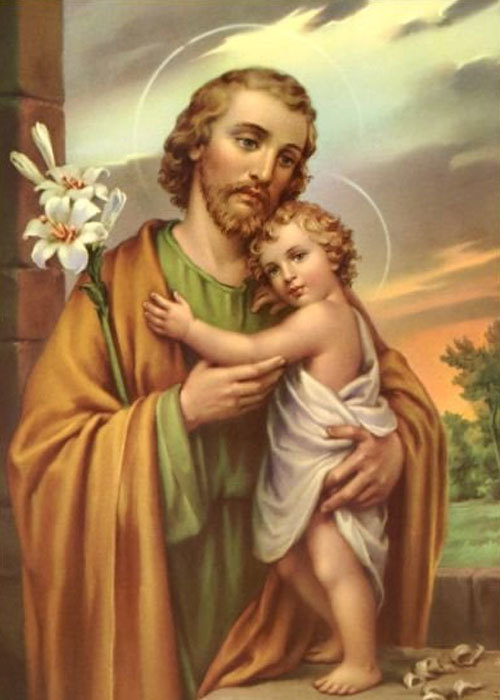
Saint Joseph's Day

March 19th is the Feast of Saint Joseph. (We're a day behind schedule, for which my apologies, I've been quite swamped lately.) 

Traditions


Saint Joseph is revered throughout the Western Christian world, and numerous customs are associated with his feast day. Probably the best known are those associated with Italian and Sicilian communities, both in their homeland and in the United States. Saint Joseph is the patron of Sicily, and Sicilians aren't known for doing things half-heartedly! In Sicily and in Sicilian/Italian immigrant communities around the world you'll find Saint Joseph altars heaped with food, parades and processions, and, of course, special meals and dishes. In many Catholic regions, Saint Joseph's Day is Father's Day, and that doesn't seem like a bad way to celebrate his Feast to me. 

Wearing red is traditional for Saint Joseph's Day. As his feast falls right after Saint Patrick's Day, which is associated with green, and as Saint Joseph is associated with Italians, it was at one time common to wear either red or green to demonstrate one's ethnic affiliation. The history of the rivalry between Italians and Irish in America is long, sometimes bloody and often amusing. These days, a great many ethnic-Catholic Americans are of mixed descent, love, after all, being not very different from war. 

The Patronage of Saint Joseph

As Saint Joseph was the foster-father of Christ, he is the patron of fathers everywhere, and of families, and everyone who works for a living. He is also the patron of the homeless and those who are seeking a home, and the poor. Since 1870, he has been regarded as the patron of the Unviersal Church. He is also the patron of the dying, and a powerful aid against demons and evil spirits. Indeed, Saint Joseph's patronage and power extend further than that of any other saint except for his spouse, the Blessed Virgin Mary. In Catholic theology, the honor due to a saint is called dulia, or reverence. The honor due to Mary is called hyperdulia; that due to Joseph is called protodulia. This reflects the fact that, in being given the charge of raising the Word Incarnate, these two were honored above all other human creatures. 
 
The Power of Saint Joseph

I'm writing this post late, on a day in which I have a whole pile of additional writing to do, and I'm finding that it's hard to bring the words forth. I usually write these posts in a formal style, as those they were entries in a book, rather than posts in a blog or journal. Just now, the formality is not coming, and attempting to affect an encyclopedic style feels stilted and awkward. So I'm going to try something different; I'm going to speak from the heart and tell you: 

Saint Joseph is an immensely powerful intercessor and protector. 

Two stories about him.

Some years ago I became a step-father to a (then) seven year old boy. This was entirely unintentional on my part. When I began dating his mother, I was delighted to discover that she had a son with whom she shared custody half time with her ex-husband. My assumption was that, since she'd need to spend half the week with her child, I'd have half the week off from the relationship, and be able to spend that time doing my own thing. "My own thing," in those days, mostly meant spending hours training at a local martial arts gym, laying on the beach, and playing videogames, while working just enough to afford food and rent. (Ah, California, ah, youth, ah, ignorance!) 

Well, as is so often the case, things didn't work out the way I intended. One thing led to another, and by "thing" I mean "pregnancy." And so I found myself living with my still rather new girlfriend and looking after her son, who was now, it seems, my stepson. And I had no idea what I was doing.

One day, I wondered to myself whether I might call upon Saint Joseph for assistance, as he had, after all, found himself in a similar position at one time. A few weeks later, I got a card in the mail. It was a Saint Joseph's Day card, from my mother, a natural psychic. Now, she'd never sent me a Saint Joseph's day card before, and I didn't really even know there were such cards. Inside, she'd written "I saw this while I was shopping for Saint Patrick's Day cards for you. I thought that, since Saint Joseph was Jesus's foster father, he could help you learn to be a step-dad."

Well, that answered that. 

I began a novena to Saint Joseph that day, and a devotion to him in which I've persisted. Step-fatherhood has expanded to include bio-fatherhood, but to my mind it's all the same

Another time, I found myself suddenly needing a place for my family to live. We had relocated across the country, and we'd managed to get my wife a job. The trouble was that the job was in Maryland, and we were staying with her family in New Jersey. And-- oh, yeah-- the job was starting nine days from now. 

I again went to Saint Joseph. In addition to prayer, I made a series of donations in his name to various churches under his patronage, while we filed one application after another for places to rent. At one point, with nothing coming in, I felt like giving up in despair. I found myself staring at Google Maps, looking at various broken down old mining towns in Pennsylvania where you can still buy a house for $50,000 cash and wishing we'd picked one of those places to live instead. I saw one town and, just for the heck of it, decided to look more closely with Google Street View. So I grabbed the little yellow guy and tossed him at random onto the map. And I found myself staring at Saint Joseph's Catholic Church of Somewheresville, PA. 

I immediately went online and set up a recurring donation to that church in particular. And the next day, we got a call saying we'd been approved to rent a house in a nice little town in central Maryland. We moved in two days later. Saint Joseph is a powerful patron. 

Further Study

Many fine books have been written on the topic of devotion to Saint Joseph. Here is one example, and here is another. Either would make a fine subject for meditation and lectio divina. 

I want to close with two prayers. One is an ancient prayer to Saint Joseph, which I have found very effective in calling upon his help; the other is his Litany. 

The Prayer to Saint Joseph

Oh St. Joseph whose protection is so great, so strong, so prompt before the throne of God, I place in you all my interests and desires.

Oh St. Joseph do assist me by your powerful intercession and obtain for me from your divine son all spiritual blessings through Jesus Christ, our Lord; so that having engaged here below your heavenly power I may offer my thanksgiving and homage to the most loving of fathers.

Oh St. Joseph, I never weary contemplating you and Jesus asleep in your arms. I dare not approach while he reposes near your heart. Press him in my name and kiss his fine head for me, and ask him to return the kiss when I draw my dying breath.

St. Joseph, patron of departing souls, pray for us.
 
Amen.

The Litany of Saint Joseph

Lord, have mercy. 
Christ, have mercy. 
Lord, have mercy. 
Christ, hear us. 
Christ, graciously hear us. 
 
God, the Father of Heaven, have mercy on us. 
God the Son, Redeemer of the world, have mercy on us. 
God the Holy Spirit, have mercy on us. 
Holy Trinity, One God, have mercy on us. 
 
Holy Mary, pray for us (after each line) 
Saint Joseph, 
Renowned offspring of David, 
Light of Patriarchs, 
Spouse of the Mother of God, 
Chaste guardian of the Virgin, 
Foster-father of the Son of God, 
Diligent protector of Christ, 
Head of the Holy Family, 
Joseph most just, 
Joseph most chaste, 
Joseph most prudent, 
Joseph most strong, 
Joseph most obedient, 
Joseph most faithful, 
Mirror of patience, 
Lover of poverty, 
Model of artisans, 
Glory of home life, 
Guardian of virgins, 
Pillar of families, 
Solace of the wretched, Hope of the sick, 
Patron of the dying, 
Terror of demons, 
Protector of Holy Church, 
 
Lamb of God, who take away the sins of the world, 
Spare us, O Lord. 
Lamb of God, who take away the sins of the world, 
Graciously hear us, O Lord. 
Lamb of God, who take away the sins of the world, 
Have mercy on us. 
 
V. He made him the lord of His house: 
R. And ruler of all His substance. 
 
Let us pray. 
 
O God, who in Thine unspeakable providence didst vouchsafe to choose blessed Joseph to be the spouse of Thine own most holy Mother: grant, we beseech Thee, that we may deserve to have him for our intercessor in heaven, whom we reverence as our defender on earth: who livest and reignest world without end.

Amen.


Saint Patrick's Day

Happy Saint Patrick's Day! Saint Patrick is one of the patrons of Ireland, as you probably already know.

History of Saint Patrick's Day

In 1780, George Washington gave his troops a day off. He had been encamped through the winter at Morristown, New Jersey. It was a long, bleak winter, and the army had been hit by no fewer than 28 snow storms and, well, no one was in a very good mood at this point. Now it happened that about a quarter of Washington's army was of Irish descent, despite the Irish composing less than a tenth of the American population at the time, and a dozen of his commanders had been either born in Ireland or born in America to Irish parents. And so it occurred to him that Saint Patrick's Day would make a fine occasion for a holiday. His order reads:

The general congratulates the army on the very interesting proceedings of the parliament of Ireland and the inhabitants of that country which have been lately communicated; not only as they appear calculated to remove those heavy and tyrannical oppressions on their trade but to restore to a brave and generous people their ancient rights and freedom and by their operations to promote the cause of America.

Desirous of impressing upon the minds of the army, transactions so important in their nature, the general directs that all fatigue and working parties cease for tomorrow the seventeenth, a day held in particular regard by the people of the nation. At the same time that he orders this, he persuades himself that the celebration of the day will not be attended with the least rioting or disorder, the officers to be at their quarters in camp and the troops of the state line to keep within their own encampment.

And so the first Saint Patrick's Day was celebrated without the least rioting, disorder, or mingling between officers and men.

That is the history of Saint Patrick's Day in America. His feast in Ireland is, of course, much, much older.

The Irish in America, The Power of Saint Patrick

In the United States, Saint Patrick's Day seems to grow in popularity every year. And this despite the fact that Americans of Irish descent are still less than 10% of the population. Moreover, the "Irish" of America include a very large percentage of Ulster Scots, whose forebears are rooted ultimately in the Scottish borderlands. These borderers were first expelled from Scotland to Northern Ireland as part of the British colonization of that country, and then from Ireland made their way to America. Today-- in America, at least-- they're usually just called "Irish," and that's how they see themselves. It's possible to be cynical or dismissive about the Irish-Americans, and this dismissiveness is quite popular in certain circles. Among the inhabitants of Ireland themselves, well, I've read that they see St. Patrick's Day as largely an occasion to evacuate their major cities, as these will be quickly overwhelmed by drunk Americans. Still, I think that something interesting is going on here.

The earliest Saint Patrick's Day celebration in the American colonies took place in 1737, in Boston. A group of Irish residents held a celebration in honor of Saint Patrick, and formed the Charitable Irish Society, in order to help their struggling co-ethnics in the city. Note that at this time nearly all of these "Irish" were Presbyterians who had emigrated from Northern Ireland, rather than Irish Catholics; more on that later.

On March 17, 1776, the Continental Army captured the city of Boston. Legend has it that the password for American soldiers entering the city that day was "Boston," to which the reply was, "Saint Patrick." Today, "Evacuation Day" is celebrated alongside Saint Patrick's Day in Boston. And Boston is the center of Irish culture in America.

Remember that two things are never connected by accident or happentance. If Boston was taken on Saint Patrick's Day, we should see this as the intervention by the saint on behalf of a city which was placed under his patronage 40 years earlier. If Boston has become the center of Irish or "Irish" culture in America, this is no accident either. There are no accidents, but the physical world is under the government of the spiritual world. On the magical worldview, cultural currents, fads, and enthusiasms are the outward manifestation of currents of force in the Astral Plane, and the Astral is under the government of higher planes still. If people around the world, especially but not only in America and other countries with a large Irish diaspora population, find themselves swept up in a notion of Irish identity on the feast of Saint Patrick, we should see this as the activity of the saint himself.

Saint Patrick was the patron saint of Ireland. Now, in addition, he is the patron saint of the Irish in America, and insists on including under that heading nearly anyone who is willing to wear green on March 17th.

Celtic Spirituality

Over the course of the last two centuries, the ideas both of Celtic identity and of a distinctly Celtic spirituality have spread throughout the world, wherever people of Celtic descent are found, and even where they are not. I think that you see the earliest version of it not in Ireland, in fact, but in Wales, with the Druid Revival and the work of Iolo Morganwg. Later, romanticized accounts of highland Scots history became very popular, starting with the work of Sir Walter Scott in the 1800s. And then there was William Butler Yeats, of which there is too much to say to be contained in a short blog post, except that, in more a more civilized era, sacrifices would be made to his spirit every year on the occasion of his Liberation from the flesh.

In any case, we've now had a fairly complete Celtic revival, which only grows in strength year by year. Celtic Spirituality takes Christian and Pagan forms, sometimes hostile toward one another, but often coexisting quite amicably. In either pagan or Christian form, Celtic spiritualities tend to share the following themes, among others:

  • Respect and reverence for the natural world and the cycles of nature
  • A focus on monasticism rather than a clerical hierarchy
  • A balanced relationship between men and women
  • A love of art, music, and poetry
  • An awareness of the nearness of the Otherworld, and of the beings which inhabit it
  • A celebration specifically of the landscapes, languages, and legends of the Celtic countries of Ireland, Scotland, Wales, Cornwall and Brittany

I'd like to suggest that Saint Patrick can be seen as one of the patron saints of Celtic spirituality and the Celtic revival generally. I'd also like to suggest that, to the list of traditional Celtic countries in Europe, we ought to add those regions of the United States and other countries which received large numbers of Irish, Scots and other Celtic immigrants, and in which Celtic culture has become rooted in the land. This would include much of the Northeast-- New England, of course, but Appalachia all the more so, as much of the region's culture was laid down by Scots immigrants, and large parts of New York, New Jersey, Pennsylvania, and Maryland. The Celts weren't always in Ireland, and they have been many other places besides. I'd like to think that historians in a thousand years will talk about "the traditional Celtic lands of Eastern North America."

How to Celebrate


The traditional American form of celebrating Sant Patrick's Day involves wearing green, drinking beer (preferably Guinness or a lager died green with food coloring), reminiscing about ancestors driven from Ireland by the machinations of one Englishman or another, and listening to Celtic music. (Here is a personal favorite of mine.) There's nothing wrong with any of this and you won't hear me speak a word against it.

But I think that we can, and should, incorporate the deeper aspects of Celtic spirituality into our Saint Patrick's Day celebrations. At minimum, this is a fine day to recite the Lorica of Saint Patrick:
 
I arise today
Through a mighty strength, the invocation of the Trinity,
Through a belief in the Threeness,
Through confession of the Oneness
Of the Creator of creation.
 
 
I arise today
Through the strength of Christ's birth and His baptism,
Through the strength of His crucifixion and His burial,
Through the strength of His resurrection and His ascension,
Through the strength of His descent for the judgment of doom.
 
 
I arise today
Through the strength of the love of cherubim,
In obedience of angels,
In service of archangels,
In the hope of resurrection to meet with reward,
In the prayers of patriarchs,
In preachings of the apostles,
In faiths of confessors,
In innocence of virgins,
In deeds of righteous men.
 
 
I arise today
Through the strength of heaven;
Light of the sun,
Splendor of fire,
Speed of lightning,
Swiftness of the wind,
Depth of the sea,
Stability of the earth,
Firmness of the rock.
 
 
I arise today
Through God's strength to pilot me;
God's might to uphold me,
God's wisdom to guide me,
God's eye to look before me,
God's ear to hear me,
God's word to speak for me,
God's hand to guard me,
God's way to lie before me,
God's shield to protect me,
God's hosts to save me
From snares of the devil,
From temptations of vices,
From every one who desires me ill,
Afar and anear,
Alone or in a multitude.
 
I summon today all these powers between me and evil,
Against every cruel merciless power that opposes my body and soul,
Against incantations of false prophets,
Against black laws of pagandom,
Against false laws of heretics,
Against craft of idolatry,
Against spells of women and smiths and wizards,
Against every knowledge that corrupts man's body and soul.
Christ shield me today
Against poison, against burning,
Against drowning, against wounding,
So that reward may come to me in abundance.
 
 
Christ be with me, Christ before me, Christ behind me,
Christ within me, Christ beneath me, Christ above me,
Christ on my right, Christ on my left,
Christ when I lie down, Christ when I sit down,
Christ in the heart of every man who thinks of me,
Christ in the mouth of every man who speaks of me,
Christ in the eye that sees me,
Christ in the ear that hears me.
 
 
I arise today
Through a mighty strength, the invocation of the Trinity,
Through a belief in the Threeness,
Through a confession of the Oneness
Of the Creator of creation

This is a powerful prayer of protection, as it invokes the entirety of God's creation, starting from the Trinity and extending downward through the ranks of angels and saints and into the elements of the material creation, and binds the one who prays to all of these. It can be recited in honor of Saint Patrick, with a prayer that his blessing be extended to all the peoples of the Celtic diasporas, everywhere in the world, and that the Celtic spirit continue to awaken, expand, and grow.

Happy Saint Patrick's Day!

Click here to support this blog.
I tried to do some work at the Astrology Blog yesterday, but Dreamwidth apparently didn't like it, and so every attempted post came out mangled in some way. So let's return our attention to The Gospel of Matthew, and deal with a passage I've been trying to avoid. Matthew 11:11-15 reads:
 
 
11 Verily I say unto you, Among them that are born of women there hath not risen a greater than John the Baptist: notwithstanding he that is least in the kingdom of heaven is greater than he.
 
12 And from the days of John the Baptist until now the kingdom of heaven suffereth violence, and the violent take it by force.
 
13 For all the prophets and the law prophesied until John.
 
14 And if ye will receive it, this is Elias, which was for to come.
 
15 He that hath ears to hear, let him hear.


The Least In the Kingdom of Heaven

The first, and most obvious question is: Why is John the least in the Kingdom of Heaven?

The answer seems to be provided by the rest of the sentence. "Among those born of women" there is no one greater than John. Among the immortal spirits created by God-- that is to say, the Bodiless Powers or Angels-- all are greater...

...At least for the time being. After he quits his earthly form, John will ascend to quite an exalted place in the Heavens, as demonstrated by his invocation in the Confiteor, or the traditional Confession, of the Tridentine Rite:

I confess to Almighty God, to Blessed Mary, ever Virgin, to Blessed Michael the Archangel, to Blessed John the Baptist, to the Holy Apostles Peter and Paul, and to all the Saints, that I have sinned exceedingly in thought, word and deed, through my fault, through my fault, through my most grievous fault.

To sojourn upon the material Earth is always to be less than those who have achieved the Higher Life, beyond the body. But by our deeds on Earth we can rise very far indeed. Note that John is named right after St. Michael the Archangel, Prince of the Heavenly Host himself!

This Is Elias

In the fourteenth verse, Jesus explicitly calls John Elias-- that is, Elijah. It's hard to misread this, and yet Christians of every denomination have done their best to do so over the course of two millennia. Most of the commentaries that I've found on it tell us that what Jesus means is that John is "like" Elijah. I prefer to take the Man at his word; John is Elijah, returned. 

Reincarnation

That the doctrine of the transmigration of the souls was taught by many in the early church is demonstrated by the fact that so many church fathers and later commenters felt the need to condemn it. Certainly it's taught in many other traditions as well. Plato discusses it explicitly in many of his dialogs, including Meno, Phaedo, Phaedrus, Republic and Timaeus, and later Platonists discussed it regularly. (For example, Sallust offers the very interesting suggestion that atheism may be a punishment for impiety in a prior lifetime. We all know people who cannot accept the existence of God or spirits, no matter how clearly the evidence is presented to them. Sallust's explanation accounts for that phenomenon nicely, as we're emerging from an era of grave impiety.) It's a central theme in Buddhist and Hindu texts, and discussed in Taoist writings as well. It's also found in certain esoteric and heretical Jewish and Muslim sects, and in tribal religions the world over. In more recent times Professor Ian Stevenson and his successors have compiled quite robust evidence for its reality. I've read that 51% of the world's population believes in reincarnation, including 25% of American Christians. 

It's my view that reincarnation completes the Christian religion-- indeed, that it saves it. Where it fits into the traditional afterlife scheme is fairly straightforward.

In Catholic tradition, the possible afterlives are these:

1. Heaven -- Needs no comment
2. Purgatory -- A place in which sinners are purified before entrance into Heaven
3. Limbo -- A middle world, whose inhabitants experience every possible natural joy while being deprived of the supreme and supernatural joy that is only possible in the presence of God
4. Hell -- Also needs no comment

In the Phaedo, Plato gives us the following possibilities:

1. Heaven -- Beyond the physical world; here the gods dwell truly in their temples. The jewels that one finds so rarely upon the earth are ordinary stones in the heavenly realm.
2. The Underworld --  A pleasant place, in which the souls of those who have done well in life are rewarded
3. Tartaros, Possibility 1 -- A place of torment and punishment for the wicked, especially murderers. However, the souls in this part of Tartaros can be freed from punishment once their victims forgive them
4. Tartaros, Possibility 2 -- For those who commit grave impieties or mass murder. This part of Tartaros is the habitation of demonic beings; you get here by becoming like them; there is no return.

Every person in categories 2 and 3 will return to life in the material world in an appropriate form. That isn't always human-- the violent will return in the form of hawks or wolves, the promiscuous as rabbits, and so on. 

It's worth noting that Plato gives different accounts of reincarnation in his other dialogs; we should look at the commonalities to extract a common principle, rather than seeing one or the other as a literal description of events in the after-death state. 

The traditional Christian account is enriched by the possibility of reincarnation, which allows those who have endured suffering in Hell or purgatory or the liminal state of Limbo to return and try again-- at least sometimes. Jesus tells us later in the Gospel of Matthew that for those who blaspheme the Holy Spirit, no forgiveness is possible; this agrees with Plato's account of impiety. It seems that there are degrees of impiety, as there are of murder-- some may be forgiven, as Jesus tells us. What of the others? These are, I think, those who have set their will totally and inexorably against the Divine; their proper place in the universe is the realm of the demons. No, it isn't pleasant to think about.

Evolutionary Reincarnation

As a final note, I want to briefly mention the doctrine, popular in Occult circles, of evolutionary reincarnation. This holds that every being without exception comes into incarnation on the material plane as a stone or material substance. By slow degrees, the stone takes on greater capacities on the etheric plane, becoming a crystal-- a substance capable of manifesting effects at the energetic level, not just the material level. The crystal moves on to become a plant: A being with a fully developed material body and a fully developed energetic body, but no life at the astral level. After long ages, the plant takes on life as a tree, which is a plant that has begun to awaken to life on the Astral Plane. The tree dies, and in time the tree is reborn as an animal: a being with fully developed material, etheric, and astral bodies. Again, long ages pass, and the animal souls proceeds through varying levels of complexity, dwelling for a time (perhaps) as an insect, and then a fish or reptile, before finally ascending to the higher life of a mammal or intelligent bird. At last the day comes when the animal graduates to life as a human being-- an animal which has begun to awaken to the life of the Noetic Plane of being. Again, many lifetimes pass. At last the human develops a fully-functional noetic body, and inarnates as a spirit like an angel.

I have to tell you, I don't personally believe this doctrine, and I don't like it very much.

I'm not willing to outright reject it, because there is certainly some truth here. But I have found that attempting to put it into practice by living it as a truth turns the world very dull. I discovered this a few years ago. I had just been reading something on this subject, and I went into the woods to harvest herbs. I came upon a patch of mugwort, and sat beside it, as I sometimes do, to get to know it. I found that if I tried to see it through this point of view, it stopped being a mugwort, and became just a kind of stunted tree. It was growing (as mugworts do) in the shade of a large sycamore tree. And now the sycamore tree was nothing but a young animal, somehow less than a kitten, or a baby rat. And the very gods themselves were nothing but old men and women, mere human beings. I find that idea, frankly, blasphemous. 

Now, I don't deny that something like evolutionary reincarnation actually is true. For whatever it's worth, I feel the same about the theory of biological evolution-- it's clearly untrue, but something like it is probably true. But I don't believe that the angels were once human beings; I think that they were always angels. I do believe that we, as human beings, are working our way back to a heavenly home from which we descended into matter. But how far did we descend? I don't know, but I don't believe that I was ever a plant. Moreover, I don't believe that a plant will ever become a human being, and-- this is critical-- if it did, I don't think that this would be any achievement, much less a reward! 

One of our cats died recently. He was a fine old cat, absolutely loyal, kind to the children. Years ago, when I was going through one of the hardest times of my life, he made sure to sleep next to my head on my pillow every night. The night before he died, he made sure to sleep next to me again. He hadn't done it in years, because our female cat had claimed that spot and the two of them never got along. But he came back on his last night. He also made sure to go outside, even though it was cold, and he demanded a cooked fish for his dinner, which I allowed. And then he died. To be reborn as a human being would be, in my view, a very poor reward for such a fine creature! Let him rather become to living cats as saints are to living men. 


Spring Ember Days

The Ember Days of Spring fall on March 9th, 11th, and 12th this year.

If you aren't familiar with her Days or don't remember the details, refer back to my post on the topic back during the Winter Embertide.

Spring Ember Days: The Element of Air

In Esoteric thought-- and in the ordinary way of thinking, for people on earlier eras-- the Springtime is linked to the element of Air. Air is understood as heat and moisture. Air also has the following associations:

Among times, the Dawn; infancy in a lifetime; the mind in man; atmosphere, weather and wind in nature; the flower in plants, and seeds born on the wind, and also all such plants as dwell in the air; among herbs, all those hot and moist by temperament; among animals, birds and all flying creatures; among professions, those related to the Air, including pilots, astronomers, meteorologists, and all those who work with their minds, or who make their living by communication; in society, it is the economy and all means of transportation, production, and exchange; among planets, it is Jupiter and Mercury, though others say the Sun; among numbers, the number 2 and all its permutations; among solids, the octahedron.

Every element is ruled by an archangel. It's worth taking a moment to consider the meaning of the word "angel." The word means "messenger." Augustine tells us that "angels" is their title; their nature is spirit. In the Christian tradition, mainstream as well as esoteric, they are given the government of the physical world and human society. At the same times, they are called "messengers." This is a bit of a paradox-- you wouldn't give the president of a country the title of "chief mailman." So what is going on here?

The resolution of the paradox is this: The angels govern the elements of the material world and the universe as a whole as an expression of the divine will. In earlier times, it was said that the whole of Nature was one of two books written by the Holy Ghost; as such, all of creation is a kind of message from God. And the angels that govern creation are the message-bearers.

The Ember Fast

This week, extend whatever fasting commitment you've made to Wednesday, Friday, and Saturday. In addition, make at least one additional effort towards lightening your impact on the Earth. You might make an effort to reduce your own contribution to air pollution. As Air rules the system of economic exchange in society, you might keep a closer watch on your spending this week, and try to support local businesses and those which follow sound environmental practices. On at least one of these days, spend some additional time in Nature. Allow yourself to be aware of the Air element as it manifests in the wind and the atmosphere and in everything that is in motion, as well as those creatures that are specifically governed by it. You might also consider donating to an Air-oriented charity, such as an organization dedicated to helping children learn to read or speak, or any organization dedicated to bird conservation.

Prayer and Meditation

At least once, and preferably during all three days, practice a meditation like the following:

1. Make the Sign of the Cross

2. Say the Our Father, 3 Hail Marys, and Glory Be.

2. Perform the asperges with holy water and the censing with incense, using the prayers previously given. In a pinch, you can use ordinary water into which a little bit of salt has been added. Before using it, make the sign of the cross over it and ask God for his blessing.

3. Pray the prayer of the Holy Spirit:

Come, Holy Spirit, fill the hearts of Thy faithful and enkindle in them the fire of Thy love.

Send forth Thy Spirit and they shall be created, and Thou shalt renew the face of the earth.

Let us pray.

O God, Who didst instruct the hearts of the faithful by the light of the Holy Spirit,
grant us in the same Spirit to be truly wise, and ever to rejoice in His consolation,
through Christ, our Lord. Amen.

4. Kneeling or seated, take a few moments to relax your body and clear your mind with rhythmic breathing. Then call to mind the Air element and the Spring season, and everything pertaining to them. Offer a prayer, such as the following:

Oh God, I thank thee for all the gifts of the element of Air. For movement and change, the lengthening days and the Spring rains, and all the gifts of the air and the mental world world. And I pray that thou wilt send thy holy archangel Raphael, who governs the element of Air, to be with us at this time. Holy Saint Raphael, archangel who governs the element of Air, grant that the gifts and virtues of Air, willingness and wisdom, honesty and lightness of spirit may be manifest in our lives. And grant, too, that the unbalanced manifestations of Air, including concupiscence, dishonesty and unreliability, may be kept far from us. Through Jesus Christ our Lord, amen.

5. Take a moment to visualize the gifts and virtues of Air manifesting in your life. Then close your meditation with more rhythmic breathing.

6. If you like, you can repeat the asperges and the censing.

7. Close with a suitable prayer or prayers, followed by the sign of the cross. The Fatima Prayer is a good option:

O my Jesus, forgive us our sins, save us from the fires of hell. Lead all souls to Heaven, especially those in most need of thy mercy. Amen.

Click here to support this blog.

 Spiritual reading is an important part of Lenten practice, so let's resume our journey through the Gospel of Matthew. When we left off, Jesus had given the major body of his teaching that fills the 5th through the 10th chapters of the Gospel. Matthew 11 begins thusly:

1 And it came to pass, when Jesus had made an end of commanding his twelve disciples, he departed thence to teach and to preach in their cities.
 
2 Now when John had heard in the prison the works of Christ, he sent two of his disciples,
 
3 And said unto him, Art thou he that should come, or do we look for another?
 
4 Jesus answered and said unto them, Go and shew John again those things which ye do hear and see:
 
5 The blind receive their sight, and the lame walk, the lepers are cleansed, and the deaf hear, the dead are raised up, and the poor have the gospel preached to them.
 
6 And blessed is he, whosoever shall not be offended in me.
 
7 And as they departed, Jesus began to say unto the multitudes concerning John, What went ye out into the wilderness to see? A reed shaken with the wind?
 
8 But what went ye out for to see? A man clothed in soft raiment? behold, they that wear soft clothing are in kings' houses.
 
9 But what went ye out for to see? A prophet? yea, I say unto you, and more than a prophet.
 
10 For this is he, of whom it is written, Behold, I send my messenger before thy face, which shall prepare thy way before thee.

 
John, Again

In this chapter we see the return of that very strange figure, John the Baptist. If you remember, John made his first appearance in Matthew 3. It's always seemed strange to me that whenever John turns up in the Gospels, he does so with relatively little introduction. Mathew 3 reads: 
 

1 In those days came John the Baptist, preaching in the wilderness of Judaea,
 
2 And saying, Repent ye: for the kingdom of heaven is at hand.

The Gospel of Mark opens with a discussion of John:
 
 
2 As it is written in Isaiah the prophet,
 
“Behold, I send my messenger before thy face,
who shall prepare thy way;
3 the voice of one crying in the wilderness:
Prepare the way of the Lord,
make his paths straight—”
 
4 John the baptizer appeared in the wilderness, preaching a baptism of repentance for the forgiveness of sins. 5 And there went out to him all the country of Judea, and all the people of Jerusalem; and they were baptized by him in the river Jordan, confessing their sins. 6 Now John was clothed with camel’s hair, and had a leather girdle around his waist, and ate locusts and wild honey. 7 And he preached, saying, “After me comes he who is mightier than I, the thong of whose sandals I am not worthy to stoop down and untie. 8 I have baptized you with water; but he will baptize you with the Holy Spirit.”

This is a longer discussion than you find in Matthew, but you still get the impression that John could have had a whole book all of his own. Matthew almost seems to assume you already know who John is; it's like reading a Superman comic book and someone references Batman. It's not Batman's story, so he only puts in a brief appearance, but you know that he has a whole series of his own. 

There is a link between John the Baptist and John the Evangelist, and Johannine sects revering either or both of the Johns have endured from ancient times down to the present day. Both Saints John are celebrated by freemasons; the Sethian Gnostic school revered Saint John the Evangelist, and attributed one of their most important books to him; a tradition of Johannine or Johannite Christianity has many modern expressions, of which the best known is probably the Apostolic Johannite Church; and the ancient Mandaean sect continues to exist to this day, seeing themselves as the true followers of John the Baptist. What the truth in all these traditions is, I don't claim to know. I think it's clear, though, that both Johns were possessed of Gnosis, the unique experiential knowledge of the Divine.

Signs of a Prophet

Notice what Jesus tells us about John-- he's not a reed shaken by the wind; he does not wear soft clothing like those who live in king's houses. John lived in the desert; he wore a shirt of camel's hair and ate that wild food that was most readily available. The type of John the Baptist in modern times is the mountain man or woodsman, of which the American tradition has been blessed with many examples-- far more so than the wealthy pastor, or bishop. 

A Story

Some years ago, I spent 5 weeks in the back country, working for a trail crew. Prior to this my life had reached a low ebb. I'd spent the previous year working as an AmeriCorps volunteer at a small nonprofit in Oregon, a job for which I was uniquely unqualified. Out of desperation, I'd googled "conservation corps pacific northwest" and discovered an organization in Eugene which was looking for members. The experience was miserable-- initially. We were sent to a wilderness area outside of Tucson, Arizona. Because I knew that Arizona was a desert, I packed no coat and only a light sleeping bag. But it turns out that there are mountains in Arizona, and the tops of the mountains are covered in snow, as are mountains everywhere in the northern hemisphere February. While our intended campsite was over the mountaintop and down into the high desert, the first day we failed to reach our camp before nightfall, and had to sleep on the snow. That night was the coldest I have ever been in my entire life, and I spent it shivering in my sleeping bag and wondering how I could possibly get out of this.

But something changed over the course of the weeks that followed. I'd spent the previous several years drunk most of the time and glued to a computer much of the rest; I won't tell you how I spent the remainder of my time, but I'll note that in the AmeriCorps organizations I worked for the gender-balance was skewed heavily in my favor. I was, in other words, a creature driven entirely by passion and vice. Now I find myself sleeping on the ground on a mountainside, working 9-10 hours a day digging trails. I had no access to bars or booze or even coffee, or to any computer or even a cell phone. (This took place during those last glorious years before smartphones became ubiquitous; my cell phone's battery died on the first day and I had no opportunity to charge it for a month and a half.) 

And in that time, I found that I was slowly stitching myself back together. I reconnected to my body, which I'd become totally detached from during the preceding years. And I reconnected to my spirituality, which had always been nature-oriented-- I grew up in a rural area and spent my childhood roaming the woods, nor did I ever believe the absurdity that the Sun, the sky, the winds and the waters were dead and lifeless. Finally, at the end of 5 weeks, I spent 24 hours alone in the wilderness with just a small bag of food, a book of matches, a pen and a notebook. 

The place I found to make my camp was in a dried creek bed in a canyon between two mountains. The first thing I did was to draw a circle in the sand and pray to the spirits of the four directions, explaining that my purpose was to learn from the place and to do no harm, and asking permission to be there. (I had yet made no formal study of magic or spirituality of any kind, but it seemed like a good idea.) Then I felt the need to climb the mountain. I started running up, and as the way became steeper I fell onto all fours, climbing. As I climbed I began to speak, not to anyone else yet, but to myself-- I talked to my body, and I gave thanks to my legs for carrying me up the mountain, my heart for beating, my lungs for breathing. Then I found myself sitting on a walk waving a reed about, shouting a wild, rambling sermon to the trees and the rocks and the mountain goats. Then I got up and ran back down the side of the mountain, paying no heed whatever to where I was going but arriving nevertheless exactly back at my camp.

I grabbed my pen and my notebook, and wrote down everything I had thought and said and all the words of my mountainside sermon. The mountain said, "Write down these words on the book of your heart," and I wanted to make sure I remembered it all. What did I write? Why, I won't tell you, of course; the sermon was for me and the message was for me, as I was, at that time. I am nothing resembling a prophet and it wouldn't help you anything. I will tell you, though, that my life changed after that, dramatically in every way. Where I'd been pale and hunched and depressed, now I was straight and tall and fearless. And, far more importantly, he more important thing was that I had stitched my soul back together-- or begun to. After that I didn't go about afraid anymore, and everything interesting that has ever happened in my life happened after then. 

But why do I tell you about all this?

For this reason--

The Gnosis of John the Baptist is still available to everyone who is willing to go into the wilderness, wear a camel hair shirt and eat locusts and honey and cry out "Make straight the way of the Lord!"

Try it some time.

Lent and the Wilderness Within

But what if you don't have a spare 4 days to go wandering about the desert? Well, neither do I, because I have a wife two kids a job and a mortgage and all the things that I didn't have when I was 25. But we aren't meant to go to the wilderness to stay there, but to learn its lessons and bring them back with us. But more than that-- Consider that this is what Lent is for. If you can't go to the wilderness, you can bring the wilderness to you. You do this by consciously disconnecting from the distractions of society and technology and reconnecting to the world as it was created by God. That includes the little world of your own body and soul. 
 
Just remember that when we encounter John in this chapter, he is imprisoned; the Herods of this world don't like anything they can't control. 

And remember, too, that John is the forerunner: the messenger, meant to prepare the way, not the Way itself. 


Meménto, homo, quia pulvis es, et in púlverem revertéris.

Ash Wednesday

Ash Wednesday marks the official beginning of Lent. The great tradition of Ash Wednesday is, of course, its namesake, the ashes placed on either the crown or the forehead. 

In the traditional rite, the ashes are blessed by a series of 5 prayers. The first reads as follows: 

Almighty and everlasting God, spare those who are penitent, be merciful to those who implore Thee; and vouchsafe to send Thy holy Angel from Heaven, to bless + and sanctif+fy these ashes, that they may be a wholesome remedy to all who humbly implore Thy holy Name, and who accuse themselves, conscious of their sins, deploring their misdeeds before Thy divine mercy, or humbly and earnestly beseeching Thy sovereign goodness; and grant through the invocation of Thy most holy Name that whosoever shall be sprinkled with them for the remission of their sins may receive both the health of the body and safety of the soul. Through Christ our Lord, Amen.

The prayers conclude:

Grant us, O Lord, to begin with holy fasts the campaign of our Christian warfare: that, as we do battle with the spirits of evil, we may be protected by the help of self-denial. Through Christ our Lord, Amen.

Ashes are then placed on the forehead or on the crown, with the words: 

Meménto, homo, quia pulvis es, et in púlverem revertéris

or

Remember, man, that thou art dust, and to dust thou shalt return.
 
Lenten Magic

What we have is a magic ritual of some power. First, ashes are prepared, and these are made from the palm fronds blessed on the previous palm Sunday. Thus the years are linked to one another, and the triumph that will come at Palm Sunday linked to the crucifixion that will follow it. The priest summons an angel to bless the ashes, turning them into remedies for both body and soul. The faithful are blessed by the ashes with a prayer that they specifically be given the power of self-denial in order to combat evil spirits. They are reminded that they are dust and to dust they will return.

Each component of this rite would yield a great deal to meditation. 

Let's talk a bit about dust. 

Genesis 2:7 tells us:

The Lord God formed man from the dust of the earth. He blew into his nostrils the breath of life, and man became a living being.

In these two sentences we see the whole anatomy of the human being. 

We start with God, who, as we know, is Being Itself; the first term is existence.

Next comes the form, which God holds in his mind.

The form is impressed onto the dust.

And the breath enters in from God himself, bringing life.

God is being; the form is spirit; the breath is soul; the dust is matter.

Matter itself is without form and without life. Moreover, the lowest parts of us, the passions that we share with all animal life, arise from the body, and are thus closest to matter and entangle us with matter, which is merely dust. By remembering that we are dust, we remember three things:

First, our bodies are dust, and the cravings, attachments, pains, pleasures and everything we seem to "need" which arise from them are also mere dust.

Second, the dust itself, utterly formless, is still sustained in its very being by God, as is everything in the universe; underneath the dust, as it were, is God-- and so God is at the root of our being. Too often we confuse our innermost nature, seeing dust where we should see divinity; let us look past the dust to That which is beyond. In doing so, we gain the ability to do battle with the evil spirits, who use our lower nature to delude us, but have no power over higher things.

Third, even as dust, the lowliest thing, is not deprived of the presence of God; even as, remembering that we are dust, we remember that we are of God; so may we remember that by humility we will triumph, whereas by Pride we will be cast down. For
 
He hath shewed strength with his arm.
He hath scattered the proud in the conceit of their hearts;
He hath put down the mighty from their seat
and hath exalted the humble and meek.
 
A blessed Lent to one and all.


Welcome to Lent

Today is Shrove Tuesday, which means that Lent begins tomorrow. Lent is the great Penitential season of the Church, in which we prepare ourselves for the great feast of Easter.

Lent is, above all, the greatest of the Christian fasts.

The Purpose of Lent

In the old tradition, every feast is preceded by a fast, every fast followed by a feast. This is the rhythm of life; as Spring follows Winter and Summer gives way to Autumn, so does the liturgical cycle precede from fast to feast, from feast to fast. The Lenten season is especially the season of penance, and before we go any further, we ought to talk about what that means.

The Lenten season lasts 40 days, as Jesus fasted 40 days in the desert following his baptism. Discussing this, Dom Prosper Gueranger tells us:

Thus does our Saviour go before us on the holy path of Lent. He has borne all its fatigues and hardships, that so we, when called upon to tread the narrow way of our Lenten Penance, might have His example wherewith to silence the excuses, and sophisms, and repugnances, of self-love and pride. The lesson is here too plainly given not to be understood; the law of doing penance for sin is here too clearly shown, and we cannot plead ignorance;- let us honestly accept the teaching and practise it. Jesus leaves the Desert where he had spent the Forty Days, and begins his preaching with these words, which he addresses to all men: Do penance, for the Kingdom of heaven is at hand [St. Matth. iv. 17]. Let us not harden our hearts to this invitation, lest there be fulfilled in us the terrible threat contained in those other words of our Redeemer: Unless ye shall do penance, ye shall perish [St. Luke, xiii. 3].
 
Now, in the verse in Luke's Gospel referenced, "do penance" is metanoēte. This refers back again to metanoia, "the changing of the nous." Let's recall our psychic anatomy: The nous is the highest part of the soul, the part that extends upward into the realm above the soul. Some of the ancient writers refer to nous as "the eye of the soul," because it sees the spiritual reality directly. In our current condition, our nous is clouded, and our attention is fixed on the things of the material world, which is a mere shadow of the True Reality of Spirit. Lent is a season for metanoia, changing the condition of our nous and re-directing our attention away from the things of this world, toward the spiritual world. Another word for this re-direction is conversion.

But why does penance have to be difficult?

Lent and the Law of Rhythm

Here is a little bit of Occult Philosophy, from an early 20th century text called :

 
The pendulum of the clock swings a certain distance to the right, and then an equal distance to the left. The seasons balance each other in the same way. The tides follow the same Law. And the same Law is manifested in all the phenomena of Rhythm. The pendulum, with a short swing in one direction, has but a short swing in the other; while the long swing to the right invariably means the long swing to the left. An object hurled upward to a certain height has an equal distance to traverse on its return. The force with which a projectile is sent upward a mile is reproduced when the projectile returns to the earth on its return journey. This Law is constant on the Physical Plane, as reference to the standard authorities will show you.

But the Hermetists carry it still further. They teach that a man's mental states are subject to the same Law.
Easter is the greatest feast of the Christian church. To say that is not to say that it's a great party-- it's far more than a good time. During the Easter Triduum we enter into and participate in the crucifixion, death, and resurrection of Our Lord. To truly enter into the mystery of Easter is to exalt our spirits far beyond any pleasure of the flesh or any wonder of the astral or psychic worlds.

The Kybalion continues:
 
[The ancient masters] teach that before one is able to enjoy a certain degree of pleasure, he must have swung as far, proportionately, toward the other pole of feeling. They hold, however, that the Negative is precedent to the Positive in this matter, that is to say that in experiencing a certain degree of pleasure it does not follow that he will have to "pay up for it" with a corresponding degree of pain; on the contrary, the pleasure is the Rhythmic swing, according to the Law of Compensation, for a degree of pain previously experienced either in the present life, or in a previous incarnation.

In other words, the difficulties and austerities of Lent become a kind of slingshot, intended to launch us upward as far as we can go at Easter. It follows that the more we enter into the penitential side of Lent, the more effectively we will be "launched upward" at Eastertime.

Again, remember that it isn't just any pain we seek, or any pleasure; this isn't sadomasochism. Moreover, we must be very careful not to limit our works of penance during Lent to the material body, because if we do, this will lead directly to sin. How? Because the slingshot will propel us from pain to pleasure, and if all we've done is to give up a destructive pleasure, we will find ourselves mired in it all the worse come Easter! In order to have lasting results, the focus of our penance must be spiritual, and not material, or not merely material.

Lent and the Training of the Will

We also train and fortify our will. Now, the will gets a bad rap among many modern Christians. Rightly noting our Lord's words, "Thy Will, not mine be done," they therefore conclude that we ought not to have a will of our own, and . But this is based on a misunderstanding of our will and its nature.

Discussing the nature of God, Plotinus writes that His will and his essential being are the same.

The Good, then, exists; It holds Its existence through choice and will, conditions of Its very being; yet It cannot be a manifold; therefore the will and the essential being must be taken as one identity; the act of will must be self-determined and the being self-caused; thus reason shows the Supreme to be its own Author.

Our very existence is provided for us by God, "in whom we live and move and have our being." To exist at all is to exist on account of God. Just as God's being is not a separate thing from his Will, our own true will is also identical with the core of our being. Now, from this it is apparent that our will is not the same thing as our passions or our desires, as many think. In fact, it's very often exactly the opposite! Just as our being is derived from God's being, our true will is derived from God's will and is God's will. So there isn't a contradiction between our will and God's will-- When we say to God, "thy will, not mine be done," we mean "May I be as you intend me to be, which is what I truly am."

The Lenten Fast

The traditional Lenten fast-- which was kept by the church, remember, until the 1960s-- was very severe. One was to eat one vegetarian meal per day, along with two small snacks; a cup of coffee and some plain toast in the morning were permitted as well. Now, this obviously wouldn't work for many-- coal miners, construction workers, and other people who did hard physical labor were excepted from the fast, as were the very young or old and the sick. Today, in churches that still keep the traditional forms of the fast, it's still the case that no one is allowed to undertake the fast without spiritual direction. Unguided, it's too easy to either push yourself too far, so that you fail; or to turn it into an occasion for pointless self-harm; or to approach the fast in a spirit of pride, which is entirely contrary to the intention.

Father Jean Croiset discussed this issue in his Devotion to the Sacred Heart:

It is true that sanctity does not consist in exterior penances, and that they are not incompatible with hypocrisy. But it is not so with interior mortification. Not everyone can fast and wear a hair shirt, but there is no one who cannot be silent when passion prompts him to reply, or vanity to speak. The desire to learn news or to know what is going on or what is being said can be the subject of continual mortification, which is as meritorious as it is ordinary. If they are interrupted 100 times in a serious employment, they will reply 100 times with as much sweetness and civility as if they had not been busy. Interior mortification is always a certain mark of true piety, and it is more necessary than exterior mortification. The ill humor of a person with whom we have to live, the imperfections of a friend, the ingratitude of others can give great opportunity for patience. The inconveniences we suffer may be small, but he mortifications on these occasions is not small. Great graces and even sublime sanctity usually depend on the generosity with which we mortify ourselves constantly on these little occasions.
We can all participate in the traditional fast to at least a limited extent, by abstaining from meat, rich foods, and alcohol, at least during Fridays, and better yet, during Mondays, Wednesdays, and Fridays, throughout Lent. Some will attempt the full fast. Others will fall somewhere in the middle.

I wrote during Advent that I believe that the most important form of fasting that we can engage in during this time is fasting from technology. Online news, social media, video games, and screens in general are the great addictions of our time; moreover, they, far more than meat or even alcohol, turn our attention away even from God's physical world, toward a creation of the human mind at its worst. The material world is the Shadow World; the internet is the Shadow of Shadows. Refer back to the post introducing Advent, and consider what sort of fasting is right for you.

Rhythms

Today is Shrove Tuesday, but you probably know it by its more common name, Mardi Gras. Today is the last day of a season called Gesimatide. You'll notice that I skipped that part this year, as indeed I did, for the sake of simplicity; my feeling is that we need to start by re-learning the Big Stuff, and then we'll paint in the details. Gesimatide is traditionally the Carnval season in Catholic countries-- a joyful season, following in the wake of the previous joyful season of Christmas. (For the purpose of this blog, we're more or less skipping straight from Christmas to Lent, but the rhythm is the same: Joy is followed by Sorrow. And what will follow Sorrow?

The Glory of Easter.

This pattern, an initial Joy at the awareness of the divine; followed by a plunge into Sorrow as we purge ourselves of our sins; followed by the Glory of divine union is found over and over again in the Christian tradition.

Practice During Lent

Fasting is not the only part of practice. An Orthodox friend of mine on social media shared a meme to the effect of "If your fast isn't accompanied by prayer and almsgiving, it's just a diet."

During Lent, commit to prayer daily, and to regular charitable works. Morning and evening prayer is best, if you can manage it; for many of us, morning practice is as much as we can manage, given our schedules. Dom Prosper Gueranger provides a useful guide to Lenten prayer practice here, and we'll discuss what a good prayer rule during Lent should look like as we continue.

For now, consider the following as a guide to daily prayer:

1. The Sign of the Cross, as described in an earlier post.

2. An Act of Contrition, suitable to your particular spiritual path.

3. Spiritual reading and meditation. This is a great time to take up one of the great classics of Western spirituality. Don't pick something that you will read in one sitting-- pick a book you can read slowly, a little bit at a time, every day. Many of the old classics, such as The Imitation of Christ or True Devotion to the Blessed Virgin Mary are written in short, numbered sections with exactly this sort of practice in mind.

4. Any additional devotional practices-- a rosary, a litany, or whathaveyou.

This is also the time for giving. Lent is a time to give freely of ourselves, as God gives of himself freely. I w

These three practices, fasting to restrain the appetites, prayer to open the mind to God, and giving to turn the heart to charity, work together to accomplish the Great Work of the conversion of the soul.


Click here to support this blog.


[This post has been updated.]

Basic Principles of Magic

Most of you will have noticed that the Christian Wheel of the Year series is effectively an initiation-- or, rather, a series of initiations-- into a system of Christian magic. Of course, it doesn't have to be practiced that way-- You can use it simply as a guide to traditional customs that you might use to enhance your spiritual practice and your family life. But for those who want to make the deep-dive into traditional magic practice, I want to do a series of posts introducing and laying out the basic principles of the system of Christian magic we'll be discussing and practicing here. For many of you this will be review; for some it will be new material. 

To start, let's answer the question:

What is magic?

Magic Defined

Magic is defined as:

The Art and Science of Causing Changes in Consciousness in Accordance with Will

I've capitalized all of the important words.

Most of the readers here will already be familiar with this definition. If not, read it, read it again, and then read it a third time; it's subtler than it might appear at first. We're going to call this Definition 1. When we talk about magic here, we always mean "the art and science of causing changes in consciousness in accordance with will."

Alternate Definitions of Magic

Now, this isn't the only definition of magic. It's important to be aware of some of these other definitions-- especially if you belong to a religion that condemns magic, or have to deal with people who do. You'll usually find that when people condemn magic in general, they're using a definition other than the one quoted above, and condemning things that you haven't actually done and wouldn't do.

Catholic theology defines magic as:

the art of performing actions beyond the power of man with the aid of powers other than the Divine

Let's call this Definition 2. The first thing to note about Definition 2 is just how slippery it is. Is electricity a power other than the Divine? How about x-rays? What about the blind psychological forces used to manipulate people by advertisers? Is it "divine power" that produces life-saving medicines for humans by vivisecting live animals? The Catholic Church permits its followers to make use of all of the foregoing-- but it condemns spiritual healing practices like reiki as "sinful."

Earlier generations of Catholic writers on this topic were far more careful in their thinking than present-day ones. Leaving the ambiguity aside, though, we understand what Definition 2 is getting at-- "Magic" is here defined as seeking the aid of demons. It is condemned on that basis. It hardly needs to be said that the sort of magic we're working with here has nothing to do with demons, and so is not illicit according to Catholic theology (if that's important to you). In fact, because it doesn't involve the evocation of demons or other evil spirits or powers, it isn't actually magic according to Catholic theology!

Definition 3. In ordinary speech, "magic" or "magical" is often used to mean "wonderful and exciting," with a hint of "beyond the ordinary." Under this definition, the magic that we practice is usually magical, but sometimes it isn't! Modern ceremonial magic is based around the performance of a daily ritual intended to invoke the divine, raise the consciousness of the operator, and chase of evil and unbalancing spirits and forces. The wonder of performing a daily ritual often wears off after a few weeks-- and that's when it's most important to keep doing it. So you might say that magic is sometimes magical, and sometimes it isn't-- and the most important part of practicing magic is to keep going once the magic stops being magical!

Definition 4. Magic is

a faculty of wonderful virtue, full of most high mysteries, containing the most profound contemplation of most secret things, together with the nature, power, quality, substance and virtues thereof, as also the knowledge of whole nature, and it doth instruct us concerning the differing, and agreement of things amongst themselves, whence it produceth its wonderful effects, by uniting the virtues of things through the application of them one to the other, and to their inferior suitable subjects, joining and knitting them together thoroughly by the powers, and virtues of the superior bodies.

This is how Heinrich Cornelius Agrippa defines magic in his Three Books of Occult Philosophy, written in the early 16 century. You'll find similar definitions in many of the old magic books or grimoires. The old definitions are worth careful consideration, as they often dovetail with, contradict, and inform the modern definition in interesting ways.

Definition 5. Magic is a set of tricks or illusions, performed for entertainment.

As I wrote above, Definition 1 is the way we'll be defining magic on this blog. Definition 2 refers to practices in which we will never engage and which we condemn. Our magic will sometimes be magic according to Definition 3, and sometimes it won't be. Definition 4 is a helpful supplement. The type of magic described in Definition 5 is beyond the scope of this blog.

Some Implications of Definition 1

Let's conclude by talking about some of the implications of defining magic in the way that we have.

Reversibility of the Terms

The first thing to note about the definition of magic is that the terms are reversible. To practice magic is to cause or attempt to cause changes in consciousness in accordance with will. Also-- any attempt to cause changes in consciousness in accordance with will is magic.

This is of critical importance, because it means that, according to the terms we are using here, magic is being practiced all around us, all the time. And, the great majority of the time, that magic is targeting us. That is to say: It is our consciousness that is being changed, according to someone else's will.

Example 1

Some years ago-- around 2006, I guess-- I read about a study in which subjects were gathered in a room and given a questionnaire about their political views. In one of the rooms used for the study, there was an American flag; the other had no flag. It was found that subjects in the same room as the American flag were more likely to express right-wing political opinions.

Shortly after I read about this, every commentator on the right-wing Fox News channel, Republican members of Congress, and other public conservatives began wearing American flag pins on their lapels in public. Moreover, they started insisting that everyone else needed to wear  American flag pins on their shirts as well.

Like every act of magic, the American Flag Lapel Pin spell (as we might call it) was intended to produce a change in consciousness in accordance with will. The change in question was agreement with right-wing political opinions. The will was the will of the right-wing politicians in question, or, rather, their handlers; its intended goal was increased political power for the Republican Party. 


Magic is being used around you and against you all the time. And it doesn't matter if the people doing it know that it's magic
or not.

By the way-- that was nearly two decades ago. It wouldn't surprise me if the image of the American flag prompted very different political responses today, in 2022. I haven't seen any follow up study, but it's worth noting that American flag lapel pins are no longer worn. Images like the American flag are part of the Astral Plane in magical theory, which we'll be discussing later on. The constellation of images on the Astral Plane are never fixed, but always in flux.

Example 2

Another example.


Kind of awful, isn't it? I agree. And that's the first thing to notice about this one: It no longer works. That nauseated feeling you have? That's magical failure. But because it doesn't work, we can study it and see how it was intended to work.

Notice the components of the image:

The caption invokes the Family Doctor, a position of great authority. In the 1950s as well as today, for many people, the word "Doctor" produces roughly the same response that the word "priest" did for a medieval peasant. These are people who have access to secret knowledge and the means to personal salvation.

The picture shows a man leaving a woman and her daughter. The feelings invoked in a woman seeing an image like this are fear and heartache. In the era in which this image was produced, a woman on her own was in serious trouble. And notice: She's not by herself. She's with her child. The image thus invokes very deep emotions-- the protectiveness instinct of a mother toward her children. This is very common in advertising, which consists, as a whole, of low-grade sorcery of this sort. The human soul consists of multiple parts. Many of those parts are shared with other animals, the protective instinct of a mother toward her young very much included. These bestial parts of our soul are lower than the human parts, including the reason, but they are also older and much stronger. The purpose of an advertisement like this is essentially to invoke the beast within the target and lead it to overwhelm the human being. Why? Because, simply put, animals are much easier to control than people.

Finally, note the overall subject matter of the advertisement-- and my apologies for bringing this up. Simply put, it's intended to provoke anxiety in women over the state of their genitals. In other words, it draws attention to the reproductive organs, while at the same time provoking embarrassment and vulnerability. It is, in a real sense, a kind of visual rape. 

Notice that the bestial part of the soul is invoked at the exact same time as the authority of the doctor is invoked. The two work together to produce both irrationality and submissiveness on the part of the target. This is the change in consciousness. The will is the will of the advertiser, or, rather, the company who paid for the advertisement; its goal is to provoke women into purchasing unnecessary and dangerous products in order to enrich its manufacturers. 

It's easy to dismiss advertisements like this as products of a by-gone era, offensive or silly as one prefers to see them. Don't make that mistake. The science of advertising has only evolved since the 1950s. The dangerous advertisements aren't the ones that you can see through-- but the ones that you can't. Those are the magical workings that are still in operation.

Doesn't that mean magic is evil?

In each of the foregoing cases, the target of the magical operation is being influenced in such a way as to increase the power or the wealth of the operator-- the Republican Party and its donors in the first case, the Lysol corporation and its distributors in the second. These are works of evil magic, for two reasons. First, the change in consciousness being provoked degrades the target-- especially in the second case. As we will see later on, human consciousness consists of several different parts, which are arranged hierarchically. When we activate the higher parts of the consciousness, we are elevated to the level of the saints and angels; when the lower parts of ourselves are activated, we are degraded to the level of beasts. To deliberately lower the consciousness of another is to harm them, by removing them from the awareness of spiritual realities.

Second, the end goal of the magical act is not the good of the target, but the satisfaction of the appetites or desires of the operator. In the first case, the desire is for power; in the second, for money. To harm another for the sake of your own desires is more or less the definition of evil behavior. 

But does that mean there is no good magic? 

Of course not! 

Here is another magical image, one of my personal favorites:  


Take a moment to clear your mind, take a moment, and contemplate this image. What changes in consciousness does it provoke?

If you're in any way like me, it probably induces a sense of devotion to the Virgin Mary and a desire to be united with her and with Jesus. You might see the crown being placed on her head as a reminder of the crown of glory awaiting all Christians. You might feel something undescribable, a movement of an ineffable energy that brings tears to your eyes and stirs your soul with a longing for the presence of God. 

We can distinguish between good or "white" magic and evil or black magic quite simply: The aim of good magic is the good of the target, while the aim of evil magic is evil for the target. This is true whether the target is yourself, another person, or a larger system like a garden or a city. 

Of course, this raises the question: Exactly what is good? And what is evil? We'll get to that in due time.

(Dear Reader: You may have noticed that this post is a draft of the first chapter of a book. Of course, if you've been here for more than a week or so you already know how I define "good" and "evil.")

Consciousness and the Will

According to our definition, the component parts of magic are will and consciousness. As such, it will be helpful to define these terms as well.

For now, let's define will as the capacity to choose an action, and consciousness as the capacity for representation.

To choose an action means to act in a way that is unimpeded and uninfluenced by any outside force. It immediately follows that there are many forms of limitation on the will. The first limitation is simply that of capacity. I have a cat sitting here on my desk. I can write these words, but she can't. Nor can she think the thoughts that led to them, nor read them and understand them. My body and brain allow me to perform actions which are not available to her-- and never will be. On the other hand, there are certain things that she can do that I can't, like hunting mice or sleeping for 18 hours straight. The will is limited in other ways as well. My capacity to choose an action is constrained by my knowledge of the choices available, my knowledge of the consequences of my choices, and any prior knowledge that might in any way impact my choice.

Aristotle discussed the limitations that knowledge and compulsion place upon the will at some length in Book 3 of his Nichomachaean Ethics.

Consciousness is the capacity for representation. Here I'm borrowing an idea from Schopenhaeuer, not inappropriately, as his influence is very present in modern occultism. For now, though, all we mean by "representation" is the "ability to have an experience." And so "consciousness" doesn't refer to the complexity of an experience, or to modern ideas about "intelligence." The computer I'm using may be more complex than the brain of the cat sitting next to it, but it doesn't matter-- the cat is conscious, and so she can experience the simple passions of pain, hunger, thirst, and fear; higher emotions of love and loneliness; and thoughts which are rudimentary analogs of human thought. The computer does none of these things, and never will-- as far as we know.

From all of this, it follows that both the will and the consciousness admit of degrees of development. Every living being participates of will and consciousness to some degree, even if it's very simple. An ant can choose to go right or left around a rock or to crawl over the rock. It represents the rock to itself through its eyes and antennae. And that's about it. A cat's field of choices and its range of experiences are greater and more complex; those of a human being more complex still.

As magic is the art and science of causing changes in consciousness in accordance with the will, it follows that magical practice includes the expansion of the powers of both the will and the consciousness.

A being that had a totally free will with no limitations either of knowledge or power; and a capacity to represent all possible experiences in its consciousness at once, with no limitations, would be called omnipotent and omniscient. Or, to say it another way, God.

A Definition of Christian Magic

We've defined magic.We've defined will and consciousness, and we've defined good magic and evil magic.

But what about Christian magic? We should probably define it before we continue.

Christian magic is, quite simply, magic in service of Christianity. 

Or, to say it another way, a work of magic is Christian if the ultimate end of the change in consciousness it provokes is union with the Christian God, which is the ultimate end of Christianity. 

Every Christian denomination without exception practices magic, by the way. Yes, that includes Protestants of every sort. Some are better at it than others.

Note for Practice

Many of you already have a personal spiritual practice. But this series is intended a basic self-study in magical practice, and you're very welcome to follow along with that in mind. And so every one of these posts will have an assignment. For today, consider the following questions:

1. What would it mean to expand your own will and your own consciousness?

2. In what way is "expansion of the will and consciousness" identical to "union with God"? In what ways might it be different?

3. What magical workings are currently being used to influence your own consciousness, in accordance with another's will? What would it be like if you were free of them?

Let's leave it there for today. Next time we'll talk about the basic principles of magic, and then we'll go on to present a basic curriculum of Christian magic. That should take us to the beginning of Lent, when we'll put the ideas we've discussed into practice. 

Click here to support this blog.


For today, something a little different. I think most of you know that I'm an astrologer. I blog (sporadically) about Mundane Astrology here. My main work is in natal astrology; you can see the services I offer here

Today I want to talk about how I integrate the insights of astrology and traditional Christianity. 

Astrology and Karma 
 
The popular yogi Sadhguru wrote in his recent book on Karma,


Traditionally, families in India turned to horoscopes [that is, natal charts] because these would indicate a person's tendencies, karmic substance, possible directions their life might take. Based on this reading, a person would turn to a spiritual practice that enabled them to transcend these tendencies.
 
For some time I've been following an approach to the natal chart similar to the one Sadhguru describes here, but rooting it in a (mostly) Christian approach for my (mostly) Christian clients.
 
The natal chart is a complex mandala, and every component of it has an impact on a person's life, including their spiritual life. So there isn't space to discuss every aspect of it without writing a book. But I want to talk about two ways to look at the natal chart in order to establish a spiritual practice--

1. The Planets Themselves and

2. The 9th and 3rd Houses
 
The Planets


The traditional seven planets correspond to the 7 Christian Virtues and to the 7 Deadly Sins.
 
It's important to take a moment and talk about the meaning of the word "virtue." In Greek it's "arete," meaning "excellence." The study of the virtues is the business of Ethics. "Ethics" itself is derived from "ethike," which means "habits." The virtues, then are *habits* of *excellence.* In Christianity, there are 7 virtues set above all others-- 4 temporal, and 3 spiritual. We develop these 7 virtues in order to become good, which is to say, to become more like God. As God Himself is THE SOURCE of goodness, we cannot become good without actually uniting ourselves to him. The fact that the virtues correspond to the planets shows us that the development of the virtues is a ladder of Ascent to God, who resides beyond the heavens.
 
According to Eliphas Levi, the 7 Virtues and the 7 Sins correspond to the planets thusly:
 
Faith - Pride - Sun;
Hope - Greed - Moon;
Charity - Lust - Venus;
Courage - Wrath - Mars;
Prudence - Sloth - Mercury;
Temperance - Gluttony - Saturn;
Justice - Envy - Jupiter
 
Notice that the 3 heavenly virtues correspond to the 3 brightest objects in the sky. The other four virtues are called the "Cardinal Virtues"; these are shared with the pre-Christian Greeks and are much discussed in the writings of Plato and his successors
 
Sin, as many know, comes from the word "hamartia," which means "to miss the target." Insofar as the target is God, Sin is that which leads us away from God. God, remember, is Goodness Itself. According to the Platonic tradition (see Proclus's Elements of Theology), the good is the same as the One. The One is the source of all being, and the source of all *unity.* In Christianity, we know the one as God-- sometimes God the Father; sometimes the ineffable Godhead out of which the Trinity emerges; opinions differ. In any case, God is the source of unity, in the universe as a whole and also in each individual human soul. That's important, because it means that, to the extent to which the Seven Deadly Sins (or any other sin) are operative within a soul, that soul is dis-united.
 
Notice that each sin is an extreme form of a passion which has a proper expression. Ordinary sexual desire is not the sin of lust. The sin of lust is what happens when sexual desire overcomes the will and leads to self-destructive behavior. In the same way, ordinary anger at injustice is not the sin of wrath, ordinary enjoyment of a meal (or an adult beverage) is not the sin of gluttony, ordinary rest or sleep is not the sin of sloth. This is important because it further points to the nature of virtue and sin. Virtue leads us toward God, and it also and by the same process leads us to self-possession: By becoming virtuous, we become one united being, not a mess of warring passions. By becoming sinful, we also become chaotic. We also become increasingly unconscious, degraded, ruled by every stimulus that comes into our soul from the outside.
 
Okay, that was a long digression, but a necessary one, I believe, because people often use words like "good," "virtue," "sin," and "vice" without understanding what they mean.
 
In the natal chart, then, we can look at the planets, note the virtue and the sin associated with them, and then see whether each planet is afflicted, dignified, mixed, or neither. If a planet is well-dignified, it suggests that the native will have the corresponding virtue naturally, or find it easy to develop. A person with a dignified Sun will find that Faith comes naturally to them, while those with a dignified Mars will be naturally Courageous. If a planet is afflicted-- especially if it's in its Fall or aspecting a malefic-- the native will tend toward the sin in question. (Notice, though, that Mars and Saturn each has his proper Virtue, and Jupiter and Venus have their corresponding sins.) Meanwhile, those planets which are weak in the natal chart-- peregrine or in cadent Houses, and so on-- will express their virtues weakly. In this last case, the native may not be inclined toward the planetary sin, but they won't have the virtue developed either.
 
From this, we can begin to apply remedies-- and it's best to think of this that way. The Church itself is said to be a hospital for sinners. The consequence of sin is loss of health-- a word which itself relates to "wholeness," which is to say, unity; which is to say, the presence of God. If that's the case, then the natal chart points to areas of natural disharmony and inclination toward disease/sin, as well as natural strength and health. Each planetary Sin can be remedied by the practice and development of the corresponding planetary Virtue. And we can use traditional spiritual practices to aid in the development of the Virtues.
 
2. The 9th and 3rd Houses
 
The 9th House is the natural ruler of spirituality. Borrowing a technique from Christopher Warnock, I use the 3rd house as well-- in a nativity, I see the 9th House as ruling orthodox, mainstream, or God-centered spirituality, and the 3rd House as ruling heterodox, alternative, or Goddess-centered spirituality. Using these two Houses, I make recommendations for spiritual practices. (I also pay attention to the 8th House as ruling specifically magical practice and the 12th House as the ruler of "occult investigations, but let's leave that aside for now. Again, it would take a book to go over every possibility!) If the 9th House or its ruler is strong, I'll recommend a more orthodox or mainstream approach; if the 3rd House, something more radical; if both Houses are strong, a mix of both. In every case, I draw from the specific signs on the House Cusp, its ruler, and any planets in or involved with the House. Capricorn on the 9th with a dignified Saturn suggests a strong tendency toward traditional religion, for example. If both of those are the case and Venus or the Moon is also there in the 9th House, that suggests a traditional religion but with an emphasis on its feminine aspects.
 
From there, we can make recommendations to specifically target the Sins indicated in the birth chart. Let's suppose the preceding scenario combined with an afflicted Mercury in Pisces. If that's the case, the native probably has a problem with Sloth. Given their natural religious inclinations, we could then direct them toward a spiritual practice intended to overcome that Vice and replace it with its Virtue. A good one might be following Louis de Montfort's 33 Day Total Consecration to the Virgin Mary. This requires a fair bit of reading and study, which develops the virtue of Prudence (Wisdom); it requires daily practice, which develops the habit of activity and so overcomes Sloth; and it is oriented toward a spirituality indicated by their 9th House.
 
 
Critically, this is *always culturally specific.* What it means to have an orthodox spirituality will mean very different things in very different places! If you want to apply these techniques to your own natal chart or-- especially, to another person's chart-- always be careful, and draw on whatever outside knowledge you have to aid your practice. For example, I once had a client with a Polish last name and a birthplace in a small town in Western Pennsylvania. From those details, I was able to know that a particular Mars placement almost certainly meant "Army veteran" and not "history of violence." But I could also have made other guesses with regard to the topic at hand. Both his ethnic background and his birthplace suggest "Catholic." That means that a strong 9th House with feminine planets present points toward a devotion to the Virgin Mary or another important female saint. If I had a similar client with just a few different details to their background-- a birth place in West Virginia, say, and a Scottish-derived last name-- I would assume a Protestant background, and make very different suggestions.
 
Two Final Notes
 
First, each of the Virtues can be defined in particular ways, and we shouldn't be vague or abstract about this, either. That said, there are multiple definitions of each virtue available. The later Platonists actually talked about a series of 5 levels of virtue, with each specific virtue taking on a different meaning as one progresses in the spiritual life. I strongly recommend doing some reading on this topic. I personally enjoy the discussion of the virtues in Plato's Republic and Phaedo, in Plotinus, and in the Nichomachaean Ethics; I also recommend Alistair McIntyre's After Virtue as an introduction to Virtue Ethics as a whole, from a modern perspective. 
 
Second, Levi's assignment of the Vices and Virtues to the planets isn't the only possible one. If you plan on working with this system, I strongly recommend careful consideration of actual birth charts, starting with your own, rather than assuming that "Levi said it, therefore it's true"!


Saint Valentine

Today is Saint Valentine's Day, and that means that, if you're anything like me, you spent the last day or two scrambling about at the last minute
shopping for your wife.

Saint Valentine appears to have been a 3rd century Roman priest or Bishop, but he may have lived at Terni instead, or there may be two Valentines. Nor does the confusion end there, as there were a number of other ancient and medeival Valentines whose personal histories may have been rolled up into one saint.

Valentinus is also the name of a 2nd century bishop, who seems to have been removed by only two degrees of separation from Saint Paul. His teacher was Theudus, who was a student of Paul's-- this, at least, according to Clement of Alexandria. This is particularly interesting, as Valentinus was the founder of one of the great schools of Gnosticism. You can read about the Valentinian tradition, which I personally find more interesting than the other Gnostic schools, here.

Which Valentine is "really" being celebrated today? Or is the spirit of Saint Valentine's Day a composite being like Santa Claus, superintending a festival of romantic love?

Of course, Rome in its great and unceasing wisdom, removed liturgical celebrations of Saint Valentine in 1969, because they couldn't find historians who could prove its existence. This is how you know that modern Rome is not a Christian institution-- obedience to the opinions of college professors is a key component of the modern ideology of Managerialism, but is not part of historical Christianity.

A Meditation on Eros

Saint Valentine's Day-- or "Valentine's Day," as we know it in the still-Protestant United States-- has become our great celebration of romantic love, or, to say it another way, erotic love. And so we should talk about what Eros means from a spiritual and magical point of view.

By the way, if you're tempted to jump in and claim that Valentine's Day as a celebration of love is an invention of marketing companies, I'd advise you to resist the temptation, and consider what you're saying. Yes, every company in the Western world seeks to make money from Valentine's Day, and many do profit handsomely thereby. But to assume that they created the thing is to believe that marketers and merchants are the creators of reality. The magical worldview is the opposite of this-- If a festival has emerged into human culture, then it is because spiritual forces at a higher level of existence have brought it into being. If a major part of its celebration is commercial, that's because we live in a commercial society; future historians will define "America" as "the name of a large merchant state which ruled much of North America between 1776 and the middle of the 21st century."

Now, of course, it needs to be said that the Catholic Church has had a very fraught relationship with Eros throughout its history. Saint Augustine of Hippo identified sexual desire with original sin. Writing several hundred years later, Pope Gregory in his letter to the Anglo-Saxons considers sexual desire as-- as he puts it-- "somewhat defiling." Gregory is specifically addressing a question from another Augustine, Augustine of Canterbury, who had been sent as a missionary to the Anglo-Saxons. Augustine is wondering whether it's okay to receive communion after having sex. Gregory replies:

A man who has approached his own wife is not to enter the church unless washed with water, nor is he to enter immediately although washed. The Law prescribed to the ancient people, that a man in such cases should be washed with water, and not enter into the church before the setting of the sun...

For there are many things which are lawful and permitted, and yet we are somewhat defiled in doing them. As very often by being angry we correct faults, and at the same time disturb our own peace of mind; and though that which we do is right, yet it is not to be approved that our mind should be disturbed. For he who said, “My eye was disturbed with anger,” had been angry at the vices of sinners. Now, seeing that only a calm mind can rest in the light of contemplation, he grieved that his eye was disturbed with anger; because, whilst he was correcting evil actions below, he was obliged to be confused and disturbed with regard to the contemplation of the highest things. Anger against vice is, therefore, commendable, and yet painful to a man, because he thinks that by his mind being agitated, he has incurred some guilt. Lawful commerce, therefore, must be for the sake of children, not of pleasure; and must be to procure offspring, not to satisfy vices. But if any man is led not by the desire of pleasure, but only for the sake of getting children, such a man is certainly to be left to his own judgement, either as to entering the church, or as to receiving the Mystery of the Body and Blood of our Lord, which he, who being placed in the fire cannot burn, is not to be forbidden by us to receive. But when, not the love of getting children, but of pleasure prevails, the pair have cause to lament their deed.

In other words-- it's okay to have sex with your own spouse, provided you don't do it to enjoy it, but only to beget children. If your purpose is pleasure, then "you have cause to lament your deed."

It's very tempting to dismiss this as just a bunch of puritanical nutjobbery. But didn't I just say that, when an idea manifests itself in human culture, it has a spiritual source? If we apply different standards to different cases we'll be hypocrites, and we won't discovery anything useful.

Sex, Magic, and Church

In my view, there are two different things going on with Gregory's attitude toward sex.

The first is an example of a very common problem in Catholic thinking-- the confusion of magical principles with moral laws. The fact is that sex is always a very powerful magical working. At the highest level, two spirits encounter one another, and join together. In that joining, a third thing is created, which is the union of the two. The union of two to produce three then creates the possibility for another spirit to descend downward, from the plane of Spirit, into manfiestation at the material level.

At the lower levels, sex unleashes a torrent of energies. Some are refined, rarified, "astral"-- these are the higher emotions of love and union. Others are denser and etheric-- this is the all-consuming passion that Gregory terms "unlawful desire." At the physical level, sexual fluids are alive with the life-force at its most concentrated.

Now, the Eucharist is a great and powerful working of ceremonial magic. Ceremonial magic is itself a kind of spiritual technology, and, like all technologies, it has its requirements in order to function correctly. Your computer will not work if you don't plug it in, and you shouldn't set it outside in a rainstorm; if you plug it into a wall outlet that already has 25 chords running into it, you risk a short circuit or even a fire.

Ceremonial magic is similar. A ritual space needs, first, to be purified of outside influences-- this is why the mass traditionally began with incense and holy water (itself a mixture of water and salt). Sexual fluids are, as I said above, highly potent magical substances, and sexual passion is a powerful energetic influence. Thus, Gregory is being perfectly sensible when he suggests that one shouldn't enter a church without purification with water-- cold water removes etheric energies-- and allowing sufficient time to elapse-- to allow the energetic body to stabilize. These are good magical principles, and you'll see them in many other religious traditions also. But they aren't moral laws, any more than it's a moral law not to use your laptop in a rainstorm.

The second thing going on is that Gregory is echoing the terror of sexual pleasure found in teh writings of AUgustine of HIppo. Again, it's easy to dismiss this as puritanical nonsense, but then we have to ask ourselves why this sort of puritanism was allowed to be born into the world and endure for such a long time. Clearly the powers that govern the world had a good reason for it. But just as clearly, that time has come to an end. If you want to demonstrate that to yourself, try this. Read the short story The White People, by Arthur Machen. Written in the 1890s, it's essentially a dramatization of a girl's sexual awakening. And-- this is critical to understand-- it was written as a horror story, and received by its audience as a great work of horror. Read the story-- it's a good one-- and try to feel the least shred of the fear that Machen's audience felt. The fact that you can't shows you that the world has changed.

The Proper Role of Eros

Erotic love is the subject of one of Plato's great dialogues, The Symposium. In the dialogue, a group of dinner guests spend hours discussing the nature of Love, without coming to an understanding. Finally, Socrates shares the teaching he received from a woman named Diotima, who was, he tells us, his initiator into the mysteries of love.

Love, Diotima explains, is neither divine nor mortal, but a mediator between the two. Like mortality, Love partakes of lack and desire, while the Gods Themselves desire nothing. But like the divine, Love leads to fullness and union. Love is a desire for Beauty, and that very desire becomes a step-by-step initiation into divine mysteries. As Diotima explains:


For he who would proceed aright in this matter should begin in youth to visit beautiful forms; and first, if he be guided by his instructor aright, to love one such form only—out of that he should create fair thoughts; and soon he will of himself perceive that the beauty of one form is akin to the beauty of another; and then if beauty of form in general is his pursuit, how foolish would he be not to recognize that the beauty in every form is the same! And when he perceives this he will abate his violent love of the one, which he will despise and deem a small thing, and will become a lover of all beautiful forms; in the next stage he will consider that the beauty of the mind is more honourable than the beauty of the outward form. So that if a virtuous soul have but a little comeliness, he will be content to love and tend him, and will search out and bring to the birth thoughts which may improve the young, until he is compelled to contemplate and see the beauty of institutions and laws, and to understand that the beauty of them all is of one family, and that personal beauty is a trifle; and after laws and institutions he will go on to the sciences, that he may see their beauty, being not like a servant in love with the beauty of one youth or man or institution, himself a slave mean and narrow-minded, but drawing towards and contemplating the vast sea of beauty, he will create many fair and noble thoughts and notions in boundless love of wisdom; until on that shore he grows and waxes strong, and at last the vision is revealed to him of a single science, which is the science of beauty everywhere. To this I will proceed; please to give me your very best attention:

He who has been instructed thus far in the things of love, and who has learned to see the beautiful in due order and succession, when he comes toward the end will suddenly perceive a nature of wondrous beauty (and this, Socrates, is the final cause of all our former toils)—a nature which in the first place is everlasting, not growing and decaying, or waxing and waning; secondly, not fair in one point of view and foul in another, or at one time or in one relation or at one place fair, at another time or in another relation or at another place foul, as if fair to some and foul to others, or in the likeness of a face or hands or any other part of the bodily frame, or in any form of speech or knowledge, or existing in any other being, as for example, in an animal, or in heaven, or in earth, or in any other place; but beauty absolute, separate, simple, and everlasting, which without diminution and without increase, or any change, is imparted to the ever-growing and perishing beauties of all other things. He who from these ascending under the influence of true love, begins to perceive that beauty, is not far from the end. And the true order of going, or being led by another, to the things of love, is to begin from the beauties of earth and mount upwards for the sake of that other beauty, using these as steps only, and from one going on to two, and from two to all fair forms, and from fair forms to fair practices, and from fair practices to fair notions, until from fair notions he arrives at the notion of absolute beauty, and at last knows what the essence of beauty is.

That "vast sea of beauty" is the eternal Beauty, which is the source of all the beauty of the living world. True Beauty is the image of God, the Good. In our own lives, romantic love can be and is meant to be an initiation into the Higher Mysteries of beauty; by joining with the beautiful person which is our beloved, we transcend separation, we experience unity, and in doing so grow ever closer to the source of unity, which is the One itself, the Good-- God.

Prayer for Saint Valentine's Day

The only surviving hymn of Valentine, the Gnostic Bishop, reads thusly:

In the spirit I see all suspended,
In the spirit I know everything held:
The flesh hanging from the soul
The soul held aloft by the air
The air suspended from the ether
Fruits manifest themselves out of the Depth
A child emerges from the womb
This is a vision of creation unfolding from the Highest and descending downward, to the child emerging from the womb. This is the process of Creation-- all creation, whether hte begetting of children, or the creation of works of art or poetry or even great works of the mind.

If you'd like something more orthodox, here's a prayer to Saint Valentine to bless your relationship:

O glorious advocate and protector,
St. Valentine,
look with pity upon our wants,
hear our requests,
attend to our prayers,
relieve by your intercession the miseries
under which we labor,
and obtain for us the divine blessing,
that we may be found worthy to join you
in praising the Almighty for all eternity:
through the merits of our Lord Jesus Christ.
Amen.


Happy Valentine's Day!

Click here to support this blog.


Our Lady of Lourdes

February 11th is the Feast Day of Our Lady of Lourdes. On February 11th, 1858, the Virgin Mary appeared to a young woman named Bernadette Soubirous at Lourdes, France. This was the first of a succession of apparitions. Today, Lourdes is a major pilgrimage site, featuring a number of churches and a holy spring from which healing water is drawn.

The story of the Lourdes' apparition, and of the life of Bernadette, is one that I personally find very moving. Three things that I want to note about it here:

1. The Virgin appeared to a young woman from a peasant or working class background. This is very often her habit, appearing to a child or group of children, usually simple people. If she has ever appeared to a king or a United States president, or a pope for that matter, I am unaware of it.

2. The result of the apparition was the establishment of a healing spring; you can purchase Lourdes water to this day for the purpose of aiding healing and recovery from illness. This is magic, and some of our misguided Protestant friends might view it as "paganism." They are wrong-- this is the real Christianity: not a destruction of the pagan world, but its healing and reintegration.

3. All of this took place in modern times. Indeed, 1858 was in a sense more modern than 2022-- the 19th century was the height of Western civilization. We ourselves have grown up in the aftermath of its suicide, which took place between the years 1914 and 1945. The point, here, is that the idea that miracles, myth and magic are a thing of the ancient world, lost to us now, is wrong. Miracles happen, magic happens, new myths are singing themselves alive everyday.

Watch Old Things

For those who enjoy visual media-- I do-- it's a very helpful activity to watch movies and television made before you were born, for the same reason that it's helpful to read books written before you were born. In another era, The Song of Bernadette, a dramatization of the events at Lourdes, was an Oscar-winning hit film. Note that the events depicted in the film took place less than a century earlier. If you have a spare two and a half hours, the whole


A Story

Some time ago my wife, Jenn, was applying for a job at an institution named for Saint Bernadette. I wanted to help her. While she was doing her job interview, I went out beside a stream, opened my mind to Saint Bernadette and Our Lady of Lourdes, and asked for their intercession. I spent the rest of the time praying the rosary, and then went online and made a large donation to the Lourdes shrine in France. At no time did I focus on wanting the job, or expecting to be rewarded with it. I simply took steps, spiritual, mental, and physical, to align my energies with those of St Bernadette and Our Lady; made a specific request; and let them take care of the rest. She got the job the next day.

Personal Practice and the National Shrine

Not far from where I live in Northern Maryland, there is a shrine dedicated to Our Lady of Lourdes. It features a close replica of the Grotto in France, a rosary walk, stations of the cross, chapels and many small shrines dedicated to various saints and titles of Our Lady. If you ever have a chance to visit, I recommend it; in the meantime, if you'd care to support them, today is a good day. Remember that almsgiving is a magical act; by giving, we unite ourselves to the object of our charity, and allow its energies to manifest in our own life. If there was ever a time to align yourself with the healing energies of Lourdes, this is it!

Either way, you might consider making a special devotional practice to Our Lady of Lourdes today, using the methods I've already presented here. If you do so, you might use the following prayer:


Profile

readoldthings

December 2024

S M T W T F S
1234567
891011121314
1516 17 18192021
22232425262728
293031    

Syndicate

RSS Atom

Most Popular Tags

Style Credit

Expand Cut Tags

No cut tags
Page generated Jan. 3rd, 2026 04:58 am
Powered by Dreamwidth Studios