![[personal profile]](https://www.dreamwidth.org/img/silk/identity/user.png) readoldthings
readoldthings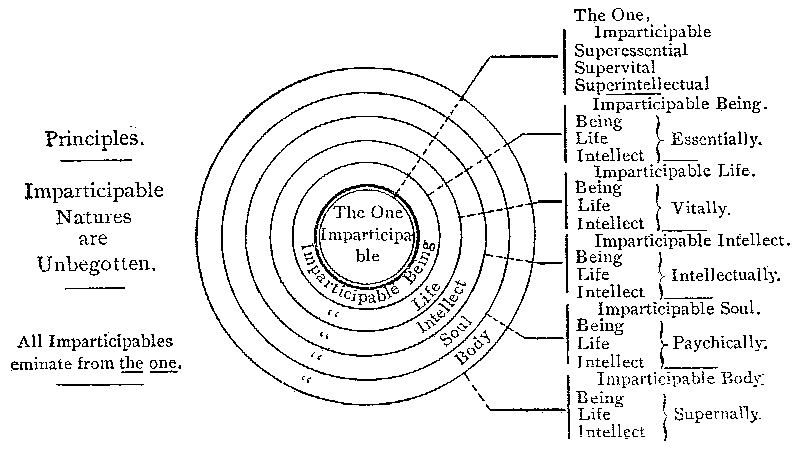
The One
In Platonic thought, the First Principle is called the One; it is also known as the Good. The One is not one being among many; the One, rather is Being Itself, or that by virtue of which everything anything has existence. In one sense, the One does not even exist-- not because it is nothing, but because it precedes existence and allows for the possibility of existence. In another sense, the One is everything that exists.
Intellect
The Second Principle is Intellect, or, in Greek, "Nous." It is sometimes named "Divine Mind" in English translations of Platonic writing, or "Angelic Mind" in the work of Christian Platonists like Ficino. It is better not to think of it as mind in the ordinary sense. Intellect consists, not of ordinary thoughts, but of Ideas. Note the capital I-- the word in Greek means something like "showings." In the 19th century, it was translated into English as "Form," and that is the word under which most people know it. Intellect consists of the Ideas or Forms, the fundamental patterns which create, shape, and sustain existence at lower levels of reality. It is important to note that Intellect isn't static; the Ideas aren't like blueprints sitting on a table somewhere. They are alive, constantly shaping our experience of reality.
The easiest way to understand the Ideas is to consider mathematical formulae, and, of these, the most traditional is the Pythagorean Theorem:
a²+b²=c²
The Pythagorean Theorem describes the geometry of a perfect right triangle. The trouble is, no perfect right triangle exists in the material world-- every physical triangle is off by at least some tiny fraction of a percent. The perfect right triangle of the Pythagorean Theorem, then, does not have material existence-- but it has a higher existence, which shapes and determines conditions in the material world. And notice: We can understand the perfect right triangle with our minds, even though we can never encounter it with our senses.
Now imagine the Pythagorean Theorem is alive. That's an Idea.
Intellect is not one idea among many, just as the One isn't one being among many; it is Idea Itself, as the One is Being Itself.
Soul
The Third Principle is Soul. In the same way that Intellect isn't what we commonly think of as the thinking mind, the word "soul" also means something a little different from its common English usage. Specifically, it isn't something that you "believe in," and it isn't some kind of weird, invisible bag of gas (perhaps weighing 27 grams?) which floats away from the body at the time of death in order to go live up in space or something. It's easier to understand what it is if you consider that the Greek word for soul is psyche; the definition is roughly the same as psyche. Soul includes all of our thoughts and emotions, our energy, desires, and sense-impressions.
Soul Itself-- you already saw this coming-- is not one individual Soul among many, but that by virtue of which everything which is ensouled has soul.
These three-- the One, Intellect, and Soul are called the Three Primary Hypostases. Hypostasis means a kind of Being or Substance, and so the Three Hypostases are also called the Three Primary Beings.
The Intelligible Triad
Everything which exists can be understood as possessing three basic properties: Existence, Life, and Thought (In Greek: On, Zoe, Nous.) Being is mere existence; Life is activity; Intellect is the capacity for awareness. It's very important to note that the Intelligible Triad is not the same as the Three Primary Hypostases-- rather, each hypostasis possesses Being and Life and Intellect. And so do you!
Also note that Intellect or Nous, in reference to the Intelligible Triad, is not the same as Intellect or Nous, the hypostasis-- though they mean something similar.
The Three Primary Hypostases, the worlds which they produce, and the lower world of Matter are all arranged hierarchically to one another. The One comes first, and with it, those Beings which are eternally united to the One-- yes, those would be the Gods. Intellect comes next, with its inhabitants, the Ideas. Soul is next, and with it the souls. Matter comes last, and material objects with it; matter is not a Fourth Hypostasis, as it has no causal power. But the terms of the Intelligible Triad are arranged horizontally to one another-- they occur on the same plane, at every level.
Pagan Platonism, Christian Platonism, Platonic Druidry
In the thought of late antiquity, the identities Primary Hypostases were assigned to the classical gods. There are various ways of doing this, depending on who you are reading, and sometimes individual thinkers contradict themselves-- Plotinus usually identifies Intellect as Saturn, but sometimes Intellect is Juno, who he also identifies with Aphrodite. Aphrodite, meanwhile, he elsewhere identifies with Soul! One older translator wrote that, in Plotinus's thought, the classical gods are basically vestigial. I think that's too much of a stretch-- Plotinus wrote at length of the importance of honoring the Gods, but he also made it clear that, in his view, they are subordinate to the One Itself, which he also refers to as God or the First God.
Proclus, on the other hand, was far more concerned with finding the old gods their proper places in the hierarchy of being-- so much so that he stretches the basic system I've described here nearly to its breaking point. Proclus divides Intellect into two levels, connected by various overlapping Triads and Heptads. His whole system is complex, baroque, fascinating and sometimes a bit ridiculous. It would require turning this blog post into a book to really get into the details of Proclus's thought here.
In the next post, I want to discuss another possible Platonic theology, based on traditional Christianity. After that, I want to look at a third possibility, based on the Druid Revival. Finally, I'll close this series with some thoughts on an ecumenical Platonism through which any spiritual tradition can be understood.


no subject
Date: 2022-08-30 12:59 am (UTC)no subject
Date: 2022-08-31 12:30 pm (UTC)no subject
Date: 2022-08-30 04:27 pm (UTC)Will be interested to hear your thoughts on Nous and how it is understood and used in Christian (especially Orthodox Christian thought). Was reading the Philokalia, and their understanding of it seems to be very specific but not unlike certain ways Plotinus and other Platonists understood a particular faculty of the soul.
no subject
Date: 2022-08-31 12:29 pm (UTC)Yes, I think that's right. From what I can tell, they were moving in the direction of a kind of Platonic Sola Scriptura, and each later thinker had his own very specific interpretation of Plato. Plato himself was far more flexible. To give one example, he discusses reincarnation in many of his dialogs, and so it is definitely a part of his philosophy, but he gives different accounts of it in Meno, Phaedo, Phaedrus, Republic and Timaeus (at least).
Someone recently pointed out that after Apuleius, the later thinkers almost completely lost the Platonic sense of humor.
I haven't read more than fragments of the Philokalia, but from what I get from those Orthodox thinkers I have read, they use "nous" in almost the exact same sense that the Platonists do. There was a very good series of talks on Ancient Faith Radio here: https://www.ancientfaith.com/specials/orthodox_anthropology/the_transformation_of_the_inner_man which discuss Orthodox practices for the care of the soul, with the anatomy of the soul lifted straight from the Republic.
no subject
Date: 2022-08-31 02:55 pm (UTC)One could say that the shift from Middle to Neo Platonism also marked the shift of Platonism from being a philosophy to a religion, or more specifically, a religious reimagination of Hellenism. Or in Spenglerian terms, Platonism migrated from the Apollonian to the Magian culture/worldview. Magian religions are well-known for being rather humorless and moralistic.
I myself prefer my Platonism to be non-dogmatic and open to humorous takes.
no subject
Date: 2022-08-31 05:20 pm (UTC)Yes, this is it exactly. I'd rather live in a world in which the ancient religion had survived, but it would have looked a lot like Christianity and Islam if it did, with the Oracles, Hermetica and Plato's dialogs as Sacred Scripture. Very likely we'd be well into a Platonic Protestantism by now (Porphyry and Plotinus are foreshadowings of it), with sacrifices and rites in honor of the daimons and heroes treated just like as saints and relics are in the Augsburg Confession or the Anglican 39 Articles.
no subject
Date: 2022-08-31 05:48 pm (UTC)no subject
Date: 2022-08-31 10:02 pm (UTC)But as for this:
Imagine the following, in the fire-and-brimstone voice of a Southern preacher:
"The bodily Kind, in that it partakes of Matter is an evil thing. What form is in bodies is an untrue-form: they are without life: by their own natural disorderly movement they make away with each other; they are hindrances to the soul in its proper Act; in their ceaseless flux they are always slipping away from Being.
"Soul, on the contrary, since not every Soul is evil, is not an evil Kind.
"What, then, is the evil Soul?
"It is, we read, the Soul that has entered into the service of that in which soul-evil is implanted by nature, in whose service the unreasoning phase of the Soul accepts evil- unmeasure, excess and shortcoming, which bring forth licentiousness, cowardice and all other flaws of the Soul, all the states, foreign to the true nature, which set up false judgements, so that the Soul comes to name things good or evil not by their true value but by the mere test of like and dislike."
no subject
Date: 2022-09-01 02:03 pm (UTC)But as for this:
Imagine the following, in the fire-and-brimstone voice of a Southern preacher:
"The bodily Kind, in that it partakes of Matter is an evil thing. What form is in bodies is an untrue-form: they are without life: by their own natural disorderly movement they make away with each other; they are hindrances to the soul in its proper Act; in their ceaseless flux they are always slipping away from Being.
"Soul, on the contrary, since not every Soul is evil, is not an evil Kind.
"What, then, is the evil Soul?
"It is, we read, the Soul that has entered into the service of that in which soul-evil is implanted by nature, in whose service the unreasoning phase of the Soul accepts evil- unmeasure, excess and shortcoming, which bring forth licentiousness, cowardice and all other flaws of the Soul, all the states, foreign to the true nature, which set up false judgements, so that the Soul comes to name things good or evil not by their true value but by the mere test of like and dislike."
no subject
Date: 2022-09-01 02:57 pm (UTC)no subject
Date: 2022-08-31 05:54 pm (UTC)no subject
Date: 2022-08-30 05:17 pm (UTC)no subject
Date: 2022-08-31 12:31 pm (UTC)no subject
Date: 2022-08-30 10:20 pm (UTC)no subject
Date: 2022-08-31 12:23 pm (UTC)no subject
Date: 2022-08-31 09:32 pm (UTC)no subject
Date: 2022-08-31 09:58 pm (UTC)Nous is not at all the same as intellect as the word intellect is currently used in English.
Intellect as it was used in older writing is the same as Nous. "Intellect" is the English translation of the Latin "Intellectus." "Intellectus" is the word that was used to translate "Nous" into Latin. "Ratio," or "reason" was the word used to translate "Dianoia." Dianoia or ratio are lower functions of the soul than nous proper.
Today, the English word "Intellect" means what "ratio" once meant, and there is no English word for "nous." This causes an enormous amount of trouble. It makes many of our own earlier works of philosophy and theology incomprehensible, it makes certain thoughts nearly unthinkable, and, at the worst, it cuts us off from nous itself, by rendering the concept so foreign.
no subject
Date: 2022-08-31 10:26 pm (UTC)Nous is the part of us with which we can know God.
But that is where so much of Western Christianity has gone totally off the rails: this weird idea that we can somehow know God through reason, or that reason is our highest human capacity.
no subject
Date: 2022-09-01 03:06 pm (UTC)Yeah, basically the whole notion of "humanism" rests on an entirely-erroneous premise. No wonder the West is in its death throes as we speak.
no subject
Date: 2022-09-01 06:44 pm (UTC)no subject
Date: 2022-09-01 03:08 pm (UTC)The way classical texts are translated into Modern English is a hot mess. It seems like we really need neologisms or simply leaving those "alien" words transliterated and nothing more.
no subject
Date: 2022-09-01 06:56 pm (UTC)http://orthodoxinfo.com/phronema/patristic-theology-romanides-chapter-1-what-is-the-human-nous.aspx
the connection with reason is tricky-- he says nous *functions* in the brain as reason, and in the heart as nous, and that nous functioning in the heart is how we connect to God.
Which is a dreadful oversimplification, but if you want the PhD version you can read the article ;)
no subject
Date: 2022-09-01 08:53 pm (UTC)The (IMHO easy-to-undersand) definition of the Nous given in the Philokalia glossary:
What is fascinating to me is that this rather technical term originated ostensibly outside the tradition but fits squarely within the Christian perspective—an indeed later understandings of the soul and its functions are dependent on it, thought seemingly unaware of its roots.
no subject
Date: 2022-09-01 09:30 pm (UTC)no subject
Date: 2022-09-01 10:42 pm (UTC)no subject
Date: 2022-09-02 02:10 pm (UTC)no subject
Date: 2022-09-02 02:45 pm (UTC)https://catalog.obitel-minsk.com/blog/2021/08/why-are-ancient-greek-philosophers-depicted-in-orthodox-churches
And not just any Orthodox churches-- that article cites Meteora (very famous!), Great Lavra (Mt. Athos), and Vatopedi(Mt. Athos).
They're not depicted as saints (no halos), but are still honored as precursors to Christianity.
no subject
Date: 2022-09-06 01:23 am (UTC)Yes indeed. There have always been two different schools of thought within Christianity regarding pre- and non-Christian philosophical and religious traditions. I have read that there was a tradition within Orthodoxy that when Christ broke the door of Hades, Plato was the first among the dead to bow down to him; I've also heard it said that "God sent Plato to the Greeks as surely as he sent Isaiah to the Hebrews." Whatever its historical or mythical truth, this sentiment expresses the truth about the origins of Christian theology much more accurately than the other school of thought, the one that says "What has Athens to do with Jerusalem?"